

16 min 39 sec
Available in: English
Quit Like a Millionaire: No Gimmicks, Luck, or Trust Fund Required
Shows how to make money decisions by arithmetic instead of feeling: clear high-interest debt, judge whether a house really pays, invest in low-cost index funds and work out the portfolio that lets you retire early.
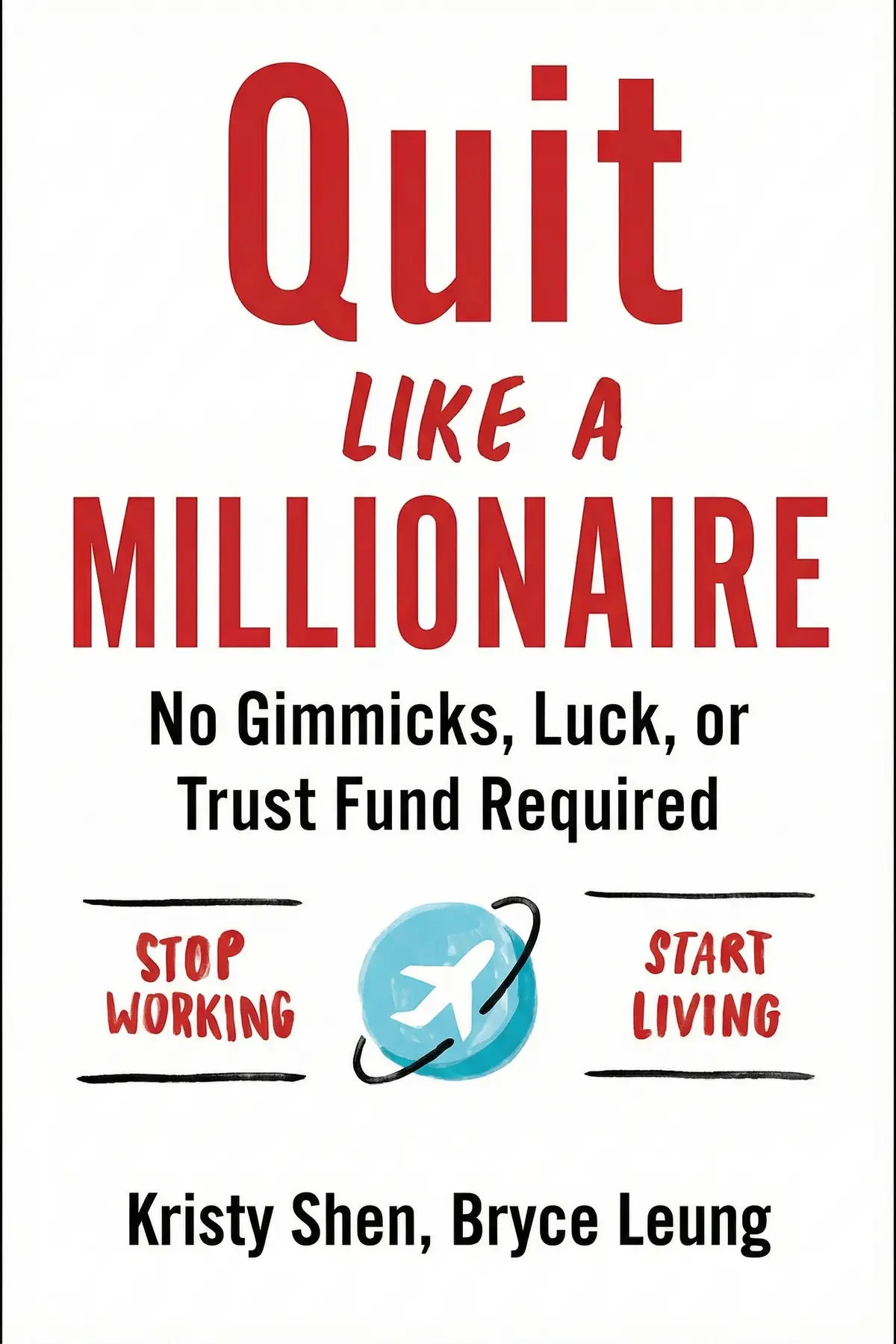
Table of Content
1. Introduction
1 min 07 sec
Most people make money decisions by feel: the degree they love, the house everyone buys, the purchase that promises a better mood. In Quit Like a Millionaire, Kristy Shen and Bryce Leung argue that this habit keeps people working into their sixties, and that the fix is arithmetic done before the heart gets a vote. Shen grew up poor in China, in a family that once lived on 44 cents a day, and she retired at 31 with a seven-figure portfolio.
The authors call money the most useful tool we have for a better life. Freedom from work, they argue, depends on your savings rate, and almost anyone can change that. One rule runs through everything: follow the math. It shows why expensive debt must go first, how a house can lose money, why index funds are the safer bet and how a smaller target brings retirement years closer. The rules of thumb behind it, from dividing by 72 to multiplying by 25, fit on the back of a receipt.
2. Let the numbers fund the dream you love
1 min 51 sec
A young student had to choose between the subject she loved and the one the spreadsheet favored. Her choice looks like giving up on a dream, until you see how her story actually turned out.
3. Divide by 72 to see how fast debt grows
1 min 36 sec
One country’s citizens save 38 percent of their income on average, compared with 3.9 percent in the United States, and the reason lies in its history. A rule from a fifteenth-century mathematician shows that the instinct behind it is simply good math.
4. Kill the hungriest debt before investing
1 min 33 sec
Paying off the smallest balance first feels like progress. The authors argue it is the wrong target, and that credit card companies are counting on you to fall for one tempting offer.
5. Spend on experiences that keep paying back
1 min 35 sec
A designer handbag and a hard drug light up the same part of the brain, and both stop working the same way. The authors still insist money can buy happiness, if you know where to spend it.
6. Test whether a home really pays before buying
2 min 10 sec
An imagined family buys a house, sells it nine years later at a handsome price, and walks away with almost nothing. The authors add up every bill, then offer a quick test anyone can run.
7. Own the whole market through cheap index funds
1 min 34 sec
Wall Street spends fortunes trying to pick winning companies. The authors favor an approach that never picks at all, costs a fraction as much and makes bank managers visibly uncomfortable.
8. Your savings rate sets your retirement date
1 min 53 sec
Someone earning a million dollars a year may never be able to stop working, while a couple on a median income could quit at 54. The difference comes down to one ratio most people never calculate.
9. Shrink the number you need to stop working
2 min 02 sec
A million dollars can make early retirement feel impossible. A 1998 study turned that figure into a simple multiplication, and two lesser-known routes can cut the target to a third of the size.
10. Conclusion
1 min 18 sec
What Shen and Leung offer is a way of seeing: every money decision has a number behind it, and that number usually looks after your future better than your feelings do. Passion picked a writing degree worth $2,752 a year. Pride of ownership nearly erased the Smiths’ gain. Shopping chased a high the brain had already learned to expect. In each case the arithmetic was there to be done.
The habits are small enough to begin tonight. Divide 72 by each debt’s rate and attack the one that doubles fastest. Before buying a home, multiply the mortgage payment by 1.5 and set it beside your rent. Multiply your yearly spending by 25, then watch each cut shrink the total.
For waste you cannot see, the authors suggest a closet test, citing a Guardian report that Americans discard 11 million tons of clothes a year. Push every garment to the left, hang an empty marked hanger in the middle, and return each piece to the right once it has been worn and washed. Months later, whatever still hangs on the left is money that bought nothing. In this book, freedom begins with seeing that pile clearly.
About this book
What is this book about?
Most people handle money by instinct and habit. They study what they love, buy a house because everyone does, and spend on things that promise a better mood. Kristy Shen and Bryce Leung argue that this is why so many people work into their sixties. Shen grew up in poverty in China and still retired at 31, and the book explains the method that got her there. The method is to follow the math. The authors start with Shen's choice of a university major, then turn to debt and the Rule of 72, the brain science of shopping, the hidden costs of owning a home, the Rule of 150 for deciding whether to rent or buy, and the case for cheap index funds over stock picking. The book's main promise is that early retirement depends on how much you save, not on how much you earn. Readers learn how the savings rate sets the retirement date and how to find their own target portfolio by multiplying yearly spending by 25. Two smaller routes are covered too: partial financial independence and living abroad where money goes further.
Book Information
Who it's for
Young professionals in debt
Young professionals carrying card debt who want a clear order for paying it off.
Renters pressured to buy
Renters under pressure to buy who want a quick test of whether a home really pays.
Ordinary earners
Workers on ordinary incomes who want to know exactly how much they need to stop working early.
About the Author
Kristy Shen
Kristy Shen was born in China and grew up in poverty; at one point her family lived on 44 cents a day. She became a millionaire by 31 and left her job to travel the world. Bryce Leung, her co-author, also left a software engineering career, and the couple retired early with a seven-figure portfolio. Together they help people with their finances, and Shen co-created the website millennial-revolution.com. Their story has appeared in the New York Times, CBC and CNBC.
Ratings & Reviews
Ratings at a glance
What people think
Listeners find the guidance in this book to be both stimulating and actionable, providing in-depth breakdowns of investment strategies. The material is thorough and accessible, making for a rewarding experience that listeners can finish over a single weekend. Additionally, the text includes a motivating personal narrative that engages the audience; listeners appreciate the book's affordability, with one mentioning it assists young people in learning about wisely saving money.
Top reviews
Bua
Wow. This isn't your typical dry finance manual; it’s a punchy, math-heavy manifesto that actually makes sense for our generation. Kristy Shen’s journey from growing up in extreme poverty in Maoist China to retiring in her early thirties is both harrowing and deeply motivating. I loved how she broke down the 'Yield Shield' and the specific tax-avoidance strategies without making my eyes glaze over. To be fair, her tone can be a bit polarizing—she’s unapologetically blunt about choosing a high-paying career over 'passion'—but the logic is sound. It’s refreshing to see a woman’s perspective in the male-dominated FIRE community. I finished this in two sittings and immediately started re-evaluating my 401k allocations. If you’re tired of the vague advice found on most finance blogs, this provides a concrete roadmap that feels achievable even if you don't start with a silver spoon.
Show moreNew
Finally got around to reading this, and I’m honestly kicking myself for not finding it sooner. Most investment books are written by people who started with a high net worth, but Kristy’s 'scarcity mindset' resonated with me on a personal level. She doesn't just tell you to invest; she explains the 'why' behind every move using clear, logical frameworks. I particularly appreciated the detailed research into the US tax code despite her being Canadian. The concept of the 'Pot of Gold' and how to bridge the gap until retirement age is something I haven't seen explained this clearly elsewhere. It's a comprehensive guide that covers everything from choosing a degree to geographic arbitrage. The humor is sharp and keeps the momentum going through the dryer technical bits. This is easily the most practical finance book I’ve read in the last five years.
Show moreSue
Ever wonder why we're taught that homeownership is the only way to build wealth? This book completely deconstructs that myth and replaces it with a fascinating, math-driven strategy for total freedom. I loved the 'Pot of Gold' metaphor and the very specific advice on how to draw down your portfolio without going broke. Shen and Leung have a great way of taking intimidating financial concepts and making them actually fun to learn about. The writing is witty and fast-paced, which is a rare feat for a book about index funds. Even though I’m not planning to retire at 31, the concepts of geographic arbitrage and the 'Cash Cushion' gave me a much clearer sense of security. It’s a worthwhile investment of your time that provides way more value than its cover price. Highly recommend for any young person starting their career.
Show moreSaranya
Look, if you want a blueprint that actually accounts for the math instead of just 'vibes,' this is it. Kristy Shen doesn't sugarcoat anything. She shows exactly how she and Bryce went from $0 to $1M by being ruthless with their expenses and smart with their investments. The breakdown of how to use various retirement accounts to your advantage is the best I've seen in print. I loved the focus on the 'Sequence of Returns' risk; it's a topic most beginners ignore but it's crucial for early retirement. The book is well-organized, moving from her childhood in China to her career in Canada and then to their global travels. It’s an inspiring story backed by cold, hard numbers. Whether you want to retire tomorrow or in twenty years, the lessons on building a 'Yield Shield' are essential.
Show moreLeila
Picked this up after seeing it on a few FIRE blogs, and I have to say, the 'rent vs. buy' math was a total eye-opener. As a millennial living in an overpriced city, the pressure to buy a house is constant, but Shen uses hard data to show why renting might actually be the faster path to wealth. My only minor gripe is that she occasionally glosses over the nuances of the American healthcare system, which is much more of a nightmare than the book implies for those without Canadian safety nets. Still, the technical breakdown of index funds and tax-loss harvesting is top-tier. The writing is snappy and humorous, making complex topics like the 4% rule feel like a casual conversation. It’s a great weekend read that actually leaves you with actionable steps instead of just 'feel-good' fluff about saving pennies on lattes.
Show moreBun
As someone who grew up in a middle-class bubble, Kristy’s backstory was a real wake-up call regarding the privilege we often take for granted. Her survival-based approach to money is fascinating, though her 'work a job you hate for the money' stance is a tough pill to swallow for some. The math she presents is incredibly compelling, especially the breakdown of how fees can eat your retirement alive. I do wish there was more focus on the risks of a litigious society—she seems to ignore the need for umbrella insurance or asset protection entirely. That said, her explanation of the 'Yield Shield' during market downturns is worth the price of the book alone. It’s a smart, calculated look at how to win at capitalism without being a 'psycho' about it. A very solid four stars for the clarity and the unique cultural perspective she brings.
Show moreWachira
In my experience, most money books ignore the psychological barriers of being risk-averse, but this one leans right into them. Kristy’s 'engineer' approach to risk management is refreshing because it doesn't just say 'dont be afraid,' it gives you the math to prove you'll be okay. The section on the 'Yield Shield' was particularly insightful for someone like me who gets nervous during market dips. I did find the dismissal of Dave Ramsey’s existence a bit odd, as his methods are the starting point for so many people, but her strategy is definitely more advanced. The book is comprehensive, covering both US and Canadian contexts, which is rare. It’s not perfect—some of the lifestyle choices sound a bit miserable—but the financial mechanics are undeniably effective. If you want a blueprint for independence, this is it.
Show moreWaree
After hearing Kristy on a podcast, I had to see if the book lived up to the hype. Frankly, it’s one of the most entertaining finance books I’ve ever picked up. The authors have a sharp, irreverent voice that keeps you engaged even when they are diving deep into tax-loss harvesting or the intricacies of the 401k. I appreciated the case studies, though I would have liked to see more diversity in the examples—it felt a bit heavy on tech workers and engineers. Still, the core message about prioritizing 'freedom' over 'stuff' is one that more people need to hear. It’s a great weekend read that simplifies the complex world of investing without being condescending. Just be prepared for some brutal honesty about your spending habits and your career choices.
Show morePairot
To be fair, the first few chapters where she discusses her childhood were a bit of a rollercoaster for me. While her story is impressive, the way she dismisses the 'follow your passion' mantra feels a bit cynical, even if it is pragmatic for reaching early retirement. The book is heavily focused on the stock market as the only viable path, which ignores the benefits of real estate or side hustles that many other authors swear by. I also found the lack of discussion on asset protection and liability a major oversight for someone building a million-dollar portfolio. However, the breakdown of how to legally minimize taxes in both Canada and the US is brilliant. If you can get past the somewhat abrasive 'engineer-brain' tone, there are some genuine gems of wisdom here regarding investment strategy and the psychology of scarcity.
Show moreCha
Not what I expected, specifically regarding the housing debate which felt a bit narrow in scope. Comparing a cheap rental to an expensive mansion with a massive mortgage isn't exactly a fair fight, and she skips over the hidden costs of renting like moving fees or security deposits. The tone is also quite aggressive at times; she clearly has no patience for conventional financial wisdom or people who don't prioritize math over emotion. On the plus side, her study of the 4% rule and sequence of returns risk is excellent. She makes the stock market feel less like a casino and more like a tool. It's a useful read if you want to optimize your taxes, but take the lifestyle advice with a grain of salt. It feels like a book written for a very specific type of person—someone who is willing to be hyper-frugal now to be free later.
Show moreQuestions about this book
What is the main idea of Quit Like a Millionaire?
Kristy Shen and Bryce Leung argue that financial freedom comes from following the math instead of feelings or social habits. That means choosing paths by their real payoff, clearing high-interest debt before investing, spending on experiences, testing whether a house really pays, investing in low-cost index funds and raising your savings rate. Early retirement, they argue, depends on how much you save far more than on how much you earn.
What is the Rule of 150 for buying a house?
It is the authors’ test for comparing owning with renting. In the first nine years of a standard 30-year mortgage, about half of each payment goes to interest, and other ownership costs such as maintenance and insurance roughly equal that interest. To get a realistic figure, take what you pay each month on the mortgage and increase it by half again. A $1,500 payment really costs $2,250. If that true cost is higher than your rent, renting makes more sense.
How much do I need to retire early, according to the book?
Based on a 1998 study in the investment journal AAII, a portfolio sustains itself when yearly living costs are no more than 4 percent of its value. So multiply your annual expenses by 25. Needing $40,000 a year means a $1,000,000 target. Part-time work can cut that sharply, to $300,000 in the authors’ example, and so can living in a lower-cost country.
How should I pay off debt using this book's method?
First cut spending hard, through a side job, renting a spare room or skipping meals out. Then list your debts from the highest interest rate to the lowest, pay the minimum on all of them, and send every spare dollar to the most expensive one. Use zero-interest balance transfers only if you are sure you can clear the full balance before the offer ends.
Readers also enjoyed




AUDIO SUMMARY AVAILABLE
Listen to Quit Like a Millionaire in 15 minutes
Get the key ideas from Quit Like a Millionaire by Kristy Shen, plus 5,000+ more nonfiction titles.
- 5,000+ titles
- Listen as much as you want
- 7-day free trial
- Cancel anytime









