

14 min 44 sec
Available in: English
Privacy Is Power: Why and How You Should Take Back Control of Your Data
Shows how governments and companies harvest your personal data, why that data gives them power over your money, your choices and your vote, and which laws and everyday habits can take that power back.
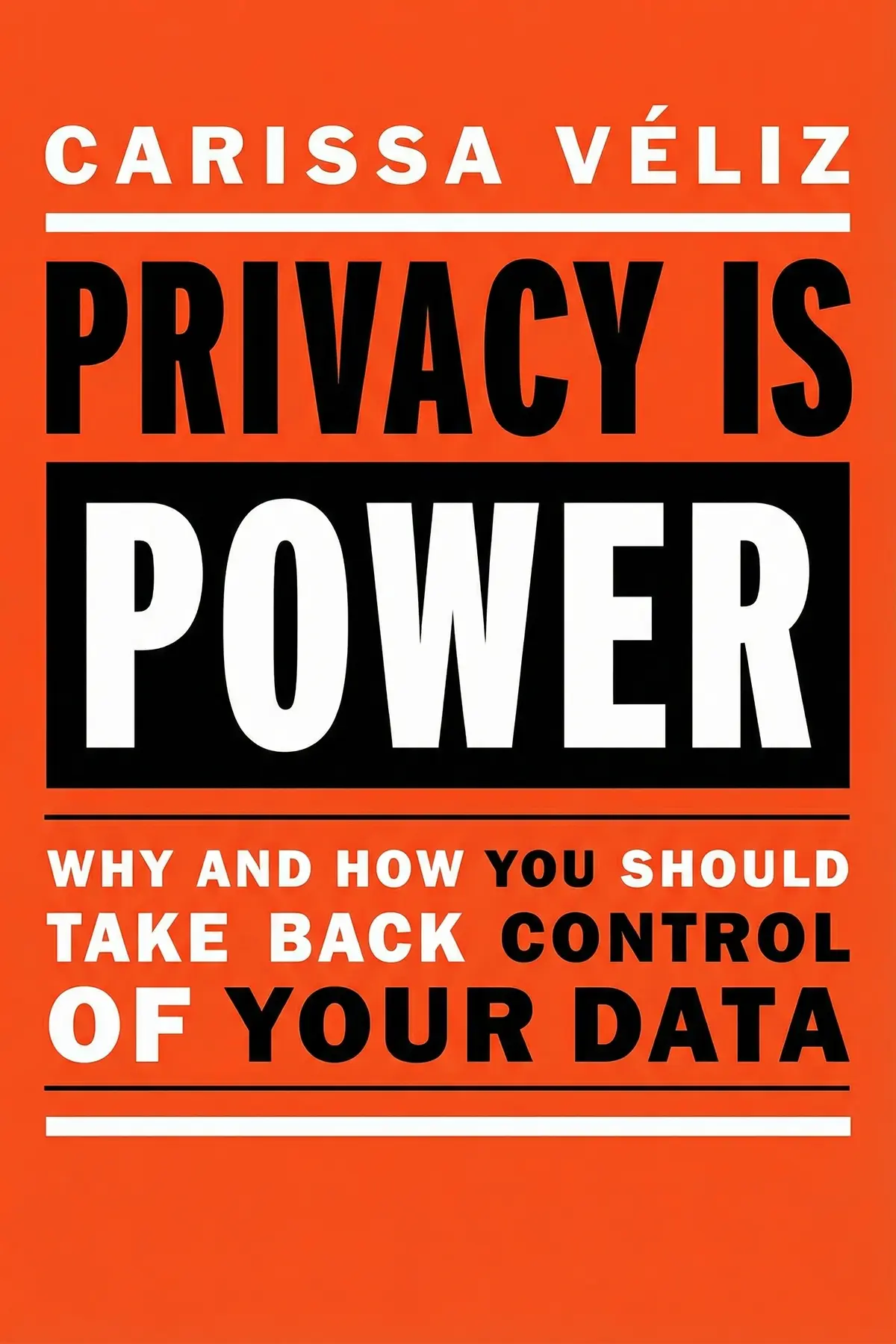
Table of Content
1. Introduction
58 sec
Most people sense they are tracked online, but few know how deep it goes, or that they can push back. In Privacy Is Power, Oxford philosopher Carissa Véliz argues that personal data is a form of power: whoever holds yours can use it to sell to you, sort you and steer your vote. Her case is that this arrangement is young, fragile and reversible. Surveillance capitalism only took off around the year 2000, it depends on our cooperation, and both law and daily habits can take that power back.
That thread runs from a smart TV that contacted hundreds of internet addresses in a quarter of an hour, through census records in occupied Europe, to a screen in a Microsoft control room that tracks public mood. By the end, you will know who is watching, why it matters even with nothing to hide, and which rights and habits return some control to you.
2. See every device that reports on your day
1 min 39 sec
A smart TV that contacts more than 700 internet addresses within 15 minutes of being turned on is only the start. Follow one ordinary day and the number of silent observers becomes hard to ignore, along with what each one learns.
3. Discover the search engine that made your data valuable
1 min 47 sec
Not long ago your car had no interest in you. One company’s discovery about search queries changed that, and its earnings over the next four years explain why nearly every gadget now wants to watch you.
4. Know what your data lets strangers do to you
1 min 38 sec
A friend who knows your tastes recommends a good book. A stranger with the same knowledge can do something very different, from deciding how long you wait on hold to choosing which voters see which falsehoods.
5. Treat personal data like a toxic substance
1 min 58 sec
Having nothing to hide is no protection. A dating site leak and two countries’ census records from the Second World War show how stored data turns dangerous once it reaches the wrong hands.
6. Answer the claim that surveillance equals progress
1 min 55 sec
Offline we would call it stalking, yet online we accept it as normal. Véliz explains who taught us that double standard, and a failed pair of camera glasses shows the story can be rewritten.
7. Demand the two bans that break the data trade
1 min 52 sec
The biggest tech firms pour money into lobbying Washington, and Véliz thinks she knows why. Two bans and a handful of rights could, in her view, bring their whole structure down.
8. Use small privacy habits to pressure big companies
1 min 43 sec
Microsoft keeps a screen in one control room that has nothing to do with servers. What it measures reveals why ordinary habits, from posting less to tidying your phone, carry more weight than they seem.
9. Conclusion
1 min 14 sec
Véliz ends at a fork. One road leads to a society where every word and movement is recorded, analyzed and sold to whoever pays, and privacy stops being possible. The other leads to devices that do not watch you, private information that only you can reach and companies that serve citizens instead of exploiting them. Her verdict is blunt: mass surveillance cannot coexist with freedom, equality and democracy, so surveillance capitalism has to go.
What lifts the book above a warning is its reminder of how recent and breakable the system is. Data became a business around 2000. Google Glass vanished because people disliked it. Microsoft watches public mood on a screen because it needs us.
So treat each piece of data as something that could leak, and picture it in the worst hands before you share it. Replace one Google or Facebook service with a privacy-friendly one, and spend an evening deleting old apps and tightening settings. When technology comes up in an election, ask about targeted ads and data brokers.
Power that rests on our cooperation can be withdrawn, one setting at a time.
About this book
What is this book about?
Your phone, your car, your television and even a smart kettle report on you to companies you have never heard of. Most people shrug. They assume they have nothing to hide and that tracking is simply the price of modern technology. Carissa Véliz, an Oxford philosopher who studies the ethics of AI, argues that both assumptions are wrong. Her central claim is that personal data is power. Whoever holds yours can aim ads at your weak spots, rank you with secret scores, try to steer your vote, as Cambridge Analytica did in 2016, or expose you when the data leaks. She traces this surveillance economy to Google's discovery around 2000 that search data could sell advertising. She also compares personal data to asbestos: cheap, useful and toxic. The book argues that the system is young and fragile. Véliz makes the case for banning targeted ads and the trade in personal data, and for clear rights over your own information. She adds small personal habits, from posting less to choosing privacy-friendly apps, that deny surveillance the cooperation it depends on.
Book Information
Who it's for
Wondering what devices reveal
Professionals surrounded by smart devices who want to know what those devices reveal, and to whom.
Wondering why privacy matters
Readers who feel they have nothing to hide and wonder why privacy should matter to them.
Citizens wanting clear demands
Citizens who want clear arguments and concrete demands for the next debate on tech regulation.
About the Author
Carissa Véliz
Carissa Véliz is a Mexican, Spanish and British philosopher. She is an associate professor at Oxford's Institute for Ethics in AI and a Fellow at Hertford College. Her research spans privacy, technology, political philosophy and public policy. She edited the Oxford Handbook of Digital Ethics, received the 2021 Herbert A. Simon Award for outstanding research in computing and philosophy, and advises companies and policymakers on privacy and AI ethics. Privacy Is Power was named an Economist book of the year. She has also written Prophecy.
Ratings & Reviews
Ratings at a glance

What people think
Listeners find the work insightful, with one listener characterizing it as a compelling read regarding the future. The tempo receives favorable reviews, while one listener points out that it is thoroughly documented and supported by anecdotal stories.
Top reviews
Anawin
Véliz’s core argument that privacy is not just a personal choice but a collective responsibility is absolutely vital in our current digital age. While some critics say it lacks academic weight, I found the anecdotal stories—like the tragic Ashley Madison leak—to be far more impactful than dry theory. The book moves at a brisk pace, laying out the terrifying ways our smart TVs and speakers are essentially wiretapping our living rooms. Frankly, the advice on how to reclaim our digital autonomy is worth the cover price alone. If you’ve seen 'The Social Dilemma' and wanted more concrete steps, this is your next stop. It’s a powerful punch to the gut that demands we stop being the product and start being citizens again.
Show morePete
Wow, this really makes you want to throw your smartphone into the nearest river and move to a remote cabin. Véliz creates a compelling, if terrifying, narrative about how we are being stripped of our autonomy by companies we thought were helping us. I loved the clear, actionable tips like using camera stickers and avoiding those 'free' DNA tests that end up in law enforcement databases. The book is remarkably well-researched, connecting the dots between modern trackers and the historical danger of national registries. It’s a fast-paced manifesto that reminds us that data is toxic if mishandled. Not gonna lie, I spent the whole evening after finishing this deleting old accounts and changing my passwords to something actually secure. This should be required reading for anyone with an internet connection.
Show moreTong
Ever wonder why a 'free' app asks for your location, contacts, and microphone access? This book answers that question in a way that is both enlightening and deeply disturbing. Carissa Véliz has written a powerful defense of a right we are losing far too quickly without realizing the consequences. I especially appreciated the nuanced discussion on how privacy protects our ability to be autonomous individuals capable of functioning in a democracy. The way she describes 'cookies' as spyware and 'engagement' as addiction really reframes the entire internet economy for the reader. It’s a quick read but stays with you for a long time, prompting real changes in how you interact with technology. This is probably the most important book I’ve read this year regarding our future.
Show moreWatcharin
The truth is, most of us have become far too comfortable with the silent trade-off we make every time we click 'Accept' on a privacy policy. Véliz does a brilliant job exposing the blatant hypocrisy of Silicon Valley elites who preach freedom while designing systems for mass surveillance. I was especially struck by the chapter detailing how 'data exhaust' is harvested to influence our voting behavior through microtargeting. Even if you aren't ready to go full Luddite and buy a 'dumb' phone, the insights into how our data affects our friends and family are eye-opening. My only gripe is that the tone can get a bit preachy at times, assuming the worst-case scenario for every technological advancement. Still, it’s an enlightening read that will make you rethink that Alexa in your kitchen.
Show moreThitima
As someone who works in digital marketing, I found Véliz's breakdown of 'surveillance capitalism' to be incredibly accurate, if a bit uncomfortable to read. She perfectly captures how our most sensitive details are commodified and sold to the highest bidder without our informed consent. I found the section on the Chinese social credit system particularly haunting, serving as a grim warning of where our own 'liberal democracies' could be headed. The writing is accessible and avoids getting bogged down in jargon, making it a great recommendation for friends who aren't tech-savvy. I do wish she had engaged more with the free software movement as a viable alternative to the big tech monopoly. Overall, it’s a solid 4-star read that highlights the urgent need for government regulation and personal vigilance.
Show moreUbolwan
Picked this up after reading Zuboff’s massive tome, and I appreciated how much more concise and direct Véliz is in her approach. She moves quickly through the ethical minefield of facial scans and behavioral tracking, making the case that our data is a collective resource. Truth is, I hadn't really considered how my own data could be used to profile my siblings or children until I read this. The anecdotes are well-placed and keep the pacing tight, though a few feel a bit dated, like the mention of the 1999 murder case. Despite some minor overlaps with other books in the genre, the philosophical perspective on 'the value of forgetting' was a fresh and welcome addition. It’s a great introduction to why we should care about digital footprints.
Show moreLuke
Looking for a way to understand the data economy without needing a PhD? This is the book for you. Véliz does an excellent job of simplifying complex issues like DNA libraries and smart appliance vulnerabilities into something readable and engaging. While I found her disdain for Silicon Valley a bit one-sided, it’s hard to argue with the facts she presents about mass surveillance. The argument that 'privacy is power' is well-supported throughout the text, showing how information imbalances lead to direct abuses. I would have liked to see a bit more discussion on how we can balance privacy with the undeniable convenience of modern tech. Regardless, the practical steps at the end are fantastic and easy to implement. A very strong recommendation for the curious reader.
Show moreWachira
While I appreciate the effort to bring privacy ethics to a mainstream audience, I found some of the political conclusions in this book a bit simplistic. The duality between 'good' Western democracies and 'bad' authoritarian regimes ignores the fact that the NSA and CIA have the same backdoors as foreign actors. However, Véliz is spot on when it comes to the invasive nature of smart devices and the lack of transparency in the data broker industry. The chapter on how schools monitor children is particularly alarming and serves as a necessary wake-up call for parents. It’s a well-written, fast-paced book that provides a much-needed critique of the current status quo. To be fair, it’s more of a manifesto than a deep academic study, but its impact is undeniable. Definitely worth your time.
Show moreSuphan
After hearing so much buzz about this book, I was ultimately let down by the lack of rigorous philosophical engagement. Dr. Véliz has the credentials, yet she leans heavily on 'Guardian-style' journalism rather than the deep ethical literature one might expect from an Oxford scholar. The horror stories of stalkers and false DNA matches are certainly chilling, but they often feel like they are scaring the reader into compliance rather than inviting a nuanced debate. To be fair, it’s a decent primer for someone who knows nothing about surveillance capitalism or data brokers. However, it glosses over the genuine benefits of data sharing and presents a somewhat binary choice between total privacy and an authoritarian nightmare. It’s an easy read, but perhaps a bit too surface-level for those already familiar with the topic.
Show moreAisha
Frankly, I expected more than a collection of scary stories designed to make me paranoid about my coffee maker. The author starts with some interesting premises about the power dynamics of data, but the logic often falls apart under scrutiny. For example, suggesting that we should avoid all data collection because it 'might' lead to a totalitarian regime feels like an extreme leap. It’s essentially the same as saying we shouldn't have roads because they could be used for invasions. The book lacks a balanced view and completely ignores how data sharing has revolutionized healthcare and public safety. While the individual tips are okay, the writing feels repetitive and the tone is unnecessarily alarmist. If you want a serious study on privacy ethics, look elsewhere; this is mostly techno-phobic rhetoric for the masses.
Show moreQuestions about this book
What is the main idea of Privacy Is Power by Carissa Véliz?
Véliz argues that personal data gives whoever holds it power over you: to target ads at your weak spots, rank you with hidden scores, sway your vote or expose you in a leak. She traces this surveillance economy to Google’s discovery around 2000 that search data could sell advertising. Because the system is young and depends on public cooperation, she believes regulation and personal habits can still take that power back.
Why should I care about privacy if I have nothing to hide?
Véliz says privacy protects you from other people’s wrongdoing, not just your own secrets. Bank details can empty your account and a scanned passport can enable identity theft. Her starkest example is the Second World War: Dutch census records listed religion and 73 percent of Jews in the Netherlands were murdered, while in France, where privacy laws kept religion out of the records, the figure was 25 percent.
What laws does Carissa Véliz want to regulate the data economy?
She calls for banning targeted advertising, which she says normalized surveillance and spread fake news while possibly bringing advertisers only a marginal gain over ordinary ads. She also wants a ban on trading personal data, citing Amy Boyer, murdered by a stalker who bought her address from a data broker. On top of that, she wants clear consent before collection and rights to see, contest and delete your data.
How can I protect my privacy according to Privacy Is Power?
Véliz suggests asking before each post whether it needs to be online and how it could be used against you. Switch to privacy-friendly messaging, email, browsers and search engines. Clean up regularly by deleting unused apps and old files and setting accounts to their most private options. For a guided walkthrough of securing your devices and accounts, she points to the detox course at datadetoxkit.org.
Readers also enjoyed

Adults in The Room: My Battle With Europe’s Deep Establishment
Yanis Varoufakis



Age of Anger: A History of the Present
Pankaj Mishra


A Different Kind of Power: A Memoir
Jacinda Ardern

Age of Propaganda: The Everyday Use and Abuse of Persuasion
Anthony Pratkanis

AUDIO SUMMARY AVAILABLE
Listen to Privacy Is Power in 15 minutes
Get the key ideas from Privacy Is Power by Carissa Véliz, plus 5,000+ more nonfiction titles.
- 5,000+ titles
- Listen as much as you want
- 7-day free trial
- Cancel anytime









