

15 min 05 sec
Available in: English
Predictive Analytics: The Power to Predict Who Will Click, Buy, Lie, Or Die
By Eric Siegel
Shows how organizations turn everyday data into scores that predict what each person will do, why those predictions sometimes fool their makers, and where prediction starts to harm privacy and fairness.
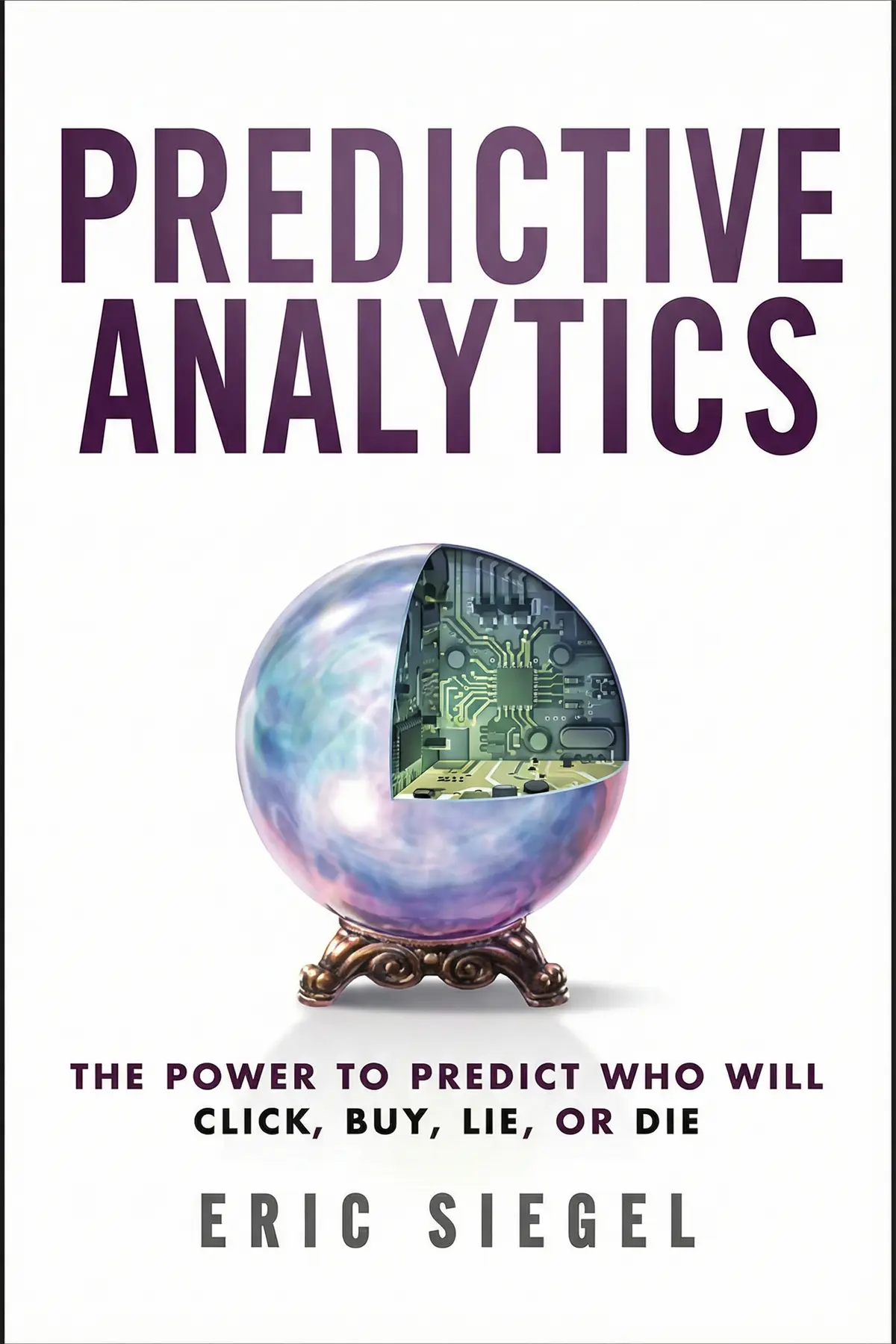
Table of Content
1. Introduction
1 min 04 sec
Most of us leave a trail of data every day, through every like, purchase and clicked ad, without knowing how much it reveals about what we will do next. In Predictive Analytics, Eric Siegel, who taught machine learning at Columbia University, shows how organizations turn that trail into a score for each person: how likely you are to click, buy or lie. The output is a probability, and those probabilities already decide which ads you see, which loans a bank worries about and which streets police patrol.
Siegel’s case is that prediction gets its power from discipline. That means balanced data, models that learn from their errors, many models combined, and tests that measure whether a message changes anyone’s mind. The same power raises hard questions about privacy and fairness. Whether you run campaigns, manage risk or just want to understand the systems watching you, what follows is a working map of where machine prediction succeeds, where it fools itself and where it crosses a line.
2. Bet on individual people, not broad audiences
1 min 53 sec
Most marketing asks which ad will please the most people. Prediction asks a sharper question about one person at a time, and a simple check on old stock market data shows whether its answers deserve trust.
3. Spot a false pattern before it fools you
1 min 52 sec
A study once suggested that a car’s paint color predicts whether it will break down, and the numbers backed it up. The flaw behind that finding hides in many dashboards that look perfectly convincing.
4. Catch small losses before they grow large
1 min 45 sec
A major bank discovered that something its customers did politely and on purpose was costing it a fortune over time. Seeing it took a model that added up those small losses in long-term projections of earnings.
5. Combine many models to beat any single one
1 min 53 sec
In 2008 a company opened a crowdsourcing contest to make its recommendations 10 percent more accurate. The notable part was not one lone genius. It was two large teams joining forces near the end, along with their models, which both hit the target.
6. Learn how machines grasp what people really mean
1 min 54 sec
The same three words can be praise or mockery, and most of the world’s data is written in words like these. A quiz show contest in 2011 showed how far machines had come in reading them.
7. Stop sending offers that drive customers away
1 min 46 sec
A phone company tried to keep customers from leaving and ended up pushing some of them out the door. The fix borrows a method from medical trials and changes who deserves a call at all.
8. Know when prediction crosses the line
1 min 48 sec
The same tools that help police guard a neighborhood can also mark a man as dangerous because of where he lives. Siegel separates the uses that protect people from the ones that profile them.
9. Conclusion
1 min 10 sec
Siegel’s larger point is that prediction already surrounds you, choosing which ads appear, which mortgages a bank watches and which streets a patrol car drives. Knowing how it works is now part of knowing how modern technology works. What makes it work is discipline: balanced data, models allowed to learn from mistakes, many flawed models combined, and control groups that reveal what a message really changes.
That same discipline is the best defense against misuse. A parole model that judges a man by his zip code is, the book argues, prejudiced, because it scores the crime rate of his neighborhood instead of his own record.
In practice, ask how any forecast would have performed on past data before you trust it. Treat a surprising correlation as a sample problem until more data says otherwise. And before contacting customers, hold some back, so you can see whether your message persuades anyone or simply unsettles people who were happy to stay.
Prediction, in Siegel’s telling, deals in probability, never prophecy, and the advantage goes to the people who remember the difference.
About this book
What is this book about?
Every like, purchase and clicked ad leaves a trace, and companies and governments now use those traces to estimate what each of us will do next. Eric Siegel, a former Columbia University professor of machine learning, explains how this works and why it matters to anyone who markets, manages risk or simply lives online. His focus is predictive analytics: models that give each individual a score for how likely they are to click, buy or reoffend. Siegel walks through what makes those scores reliable and what makes them wrong. He covers balanced data, the orange car that seemed less likely to break down, and the trap of models that learn too much. He also explains the ensemble effect behind the Netflix prize and IBM's Watson, and the uplift model that shows which customers a message actually persuades. He does not stop at technique. The book weighs Target's pregnancy predictions, crime forecasting in Santa Cruz and parole scores that judge people by their zip code. Readers get a clear picture of the systems shaping their daily lives and practical tests for telling a sound prediction from a misleading or unfair one.
Book Information
Who it's for
Founders and marketers
Marketers and founders who want to know which customers a campaign actually moves.
Managers and analysts
Analysts and managers who must judge whether a forecast or dashboard deserves trust.
Professionals uneasy about scoring
Curious professionals uneasy about how their own data is used to score them.
About the Author
Eric Siegel
Eric Siegel holds a Ph.D. and taught graduate courses in machine learning and artificial intelligence at Columbia University, where he won the Distinguished Faculty award for teaching. He later became a business school professor. He founded the Machine Learning Week conference series, is executive editor of The Machine Learning Times and is cofounder and CEO of Gooder AI. Courses at hundreds of universities have used Predictive Analytics, and he also wrote The AI Playbook.
Ratings & Reviews
Ratings at a glance

What people think
Listeners consider this title an excellent introduction for non-experts, praising the clear and accessible writing style. Its high level of readability is well-regarded; one listener notes its suitability for professional or private application, while another points to the effective real-world illustrations, especially those featuring Watson and banking institutions. Although many listeners feel the material is easy to grasp, some remark that the content is a bit too elementary for what they require.
Top reviews
Fah
Ever wonder how companies seem to know exactly what you’re going to buy before you even do? Siegel does a phenomenal job of demystifying the world of big data without drowning the reader in complex equations or jargon. The examples involving IBM’s Watson and how banks use these algorithms to assess risk were genuinely fascinating to me. To be fair, this is a layman’s overview, but it’s written with such clarity that it makes for an ideal introduction for business leaders. I appreciated the quirky quotes and the way he frames the ethical implications of data collection throughout the chapters. It’s rare to find a book on such a technical subject that manages to be this readable and engaging for a general audience. Highly recommended for anyone curious about the tech driving our modern economy and personal interactions.
Show morePisit
Picked this up because I needed a plain-English explanation of big data for a presentation, and it delivered exactly what I needed. The way Siegel breaks down the logic of IBM’s Watson winning Jeopardy! was both entertaining and educational. Personally, I loved the inclusion of quirky quotes and the diverse case studies that show how PA affects everything from insurance to voter turnout. It’s not meant to be a technical manual, so criticizing it for a lack of equations seems a bit unfair to the author’s intent. For a novice, this book provides the perfect amount of context to understand how automated decision systems are shaping our lives. It’s a thought-provoking read that stays light enough for a plane ride or a weekend on the couch. Definitely a must-read for the data-curious among us who want a birds-eye view.
Show moreNook
Wow, I didn't expect a book about math and computer models to be such a page-turner! Siegel’s enthusiasm for the subject is infectious, and he has a knack for telling stories that make complex ideas feel incredibly simple. The breakdown of how banks use data to predict credit risk was eye-opening for someone like me who isn't a numbers person. I've read other books on big data that were dry and academic, but this one feels alive with practical, modern examples. It’s the perfect gift for a business student or anyone trying to understand the technological forces at play in the 21st century. Not once did I feel lost in the jargon, which is a testament to the author’s skill as a communicator. This is easily one of the best overviews of the field currently available on the market today.
Show moreKamol
Finally got around to reading this for my business book club and I was pleasantly surprised by the accessibility of the text. Siegel manages to walk a very fine line between being a high-level business overview and providing enough conceptual detail to keep things interesting. I particularly liked the discussion on uplift modeling, even if the explanation was a bit brief for my personal taste. The case studies involving healthcare and law enforcement provide a much-needed human context to the underlying math. Not gonna lie, some chapters feel a bit repetitive, especially when he keeps coming back to the power of advertising as the primary use case. Still, it provides a solid vocabulary for anyone who needs to talk to data scientists without feeling like an idiot. It’s a great bridge between two very different worlds of thought.
Show moreSiraporn
The chapter on uplift modeling alone made this worth the purchase for my marketing team. Siegel explains how to target the 'persuadables' rather than wasting resources on those who would buy anyway, which is a total game-changer for ROI. The writing style is very conversational, which makes it an easy sell for executives who might be intimidated by traditional techie textbooks. I did find the author's tone a bit self-congratulatory at times, as if he personally invented these concepts, but the practical value is undeniable. He covers the basics of lift and ensembles in a way that is intuitive and easy to grasp for the average professional. It’s not a 'how-to' guide by any means, but it’s an excellent 'what-is' guide that sparks creative thinking about data. A solid four stars for clarity and real-world relevance.
Show moreSaowalak
After hearing about this book for years, I finally see why it's considered a staple for entry-level analysts. It provides a comprehensive map of the predictive analytics territory without getting bogged down in the swamp of actual programming. While I agree with some critics that it can be a bit shallow, the breadth of applications covered is impressive. From predicting criminal recidivism to optimizing advertising spend, the scope of the book is truly expansive. I found the five core principles in the appendix to be a helpful distillation of the entire text’s philosophy. It’s a great resource for anyone needing to grasp the strategic potential of data-driven decision support systems. Just don't go in expecting a manual on how to write Python code for your own models. It's a conceptual guide, and a good one at that.
Show moreThitiwan
As someone who works with data occasionally, I found this to be a bit of a mixed bag. On one hand, the real-world examples of PA in action are quite illustrative and help bring the concepts to life for a non-technical audience. However, the book often veers into what feels like a 200-page propaganda piece for the industry rather than a balanced analysis. The truth is that Siegel spends way too much time on high-level anecdotes and not enough time on the actual logic behind building decision trees. You get a sense of what can be done, but you’re left in the dark regarding the technical 'how.' It’s a decent survey of the field, but if you’re looking for a deep dive, you’ll likely find it too shallow for your needs. It’s okay for a quick holiday read, but nothing more.
Show moreKanokporn
Frankly, Siegel has a tendency to treat predictive analytics as a magic black box rather than a rigorous scientific discipline. He pushes the idea that we don't need to know 'why' a correlation exists as long as the prediction works, which feels a bit anti-scientific to me. While this 'whatever works' approach might fly in a marketing department, it lacks the depth required for fields like healthcare or law. The book provides a decent survey of the current landscape, but it glosses over the dangers of human trust in technical systems. I enjoyed the sections on machine risk, yet I wish he had explored the ethical pitfalls with more vigor. It’s a useful introductory text, but readers should take the hype with a grain of salt. It’s more about decision-making math than it is about actual science.
Show moreFatima
Look, I wanted to like this, but it felt more like a long-winded sales pitch for the author's consulting business than a helpful guide. While the opening chapters had some interesting teases, the content quickly devolved into fluff and 'let me tell you about my grandchildren' style tangents. There is so much noise here and very little actual signal for someone trying to learn the mechanics of predictive analytics. It’s frustrating because the few pages that actually deal with five core principles are hidden at the very end of the text. Why not just lead with the meat instead of burying it under a mountain of anecdotal filler? If you already know that massive data sets involve probability, you’ve already mastered 90% of what this book has to offer. It's just too basic for its own good, even for a beginner.
Show moreMuk
Total waste of time if you have even a basic understanding of statistics. The writing is frankly some of the most frustrating I have encountered in a professional text, feeling more like a middle schooler’s rambling essay than a serious discourse. Siegel floats all over the place with long-winded sentences that never seem to land on a concrete point. Instead of a rational dissection of predictive methods, we get a 50,000-foot view that offers zero technical value. If you want signal, look elsewhere, because this book is almost entirely noise and fluff. It’s hard to believe this is considered a definitive guide when it lacks any real depth on how to actually build a model. Save your money and just read a Wikipedia page on decision trees instead. You will learn more in five minutes of browsing than you will in ten hours of reading this.
Show moreQuestions about this book
What is the main idea of Predictive Analytics by Eric Siegel?
Siegel argues that organizations can turn the data people leave behind into a score for each individual, estimating how likely that person is to click, buy or behave in a certain way. These scores are probabilities, not certainties. They become reliable through machine learning, backtesting on past data, balanced data sets and combined models, and the same power raises real concerns about privacy and prejudice.
What is the uplift model in predictive analytics?
The uplift model measures persuasion. It compares two data sets, usually including a control group that receives no contact, much like a placebo group in a medical trial. This shows who a message actually moves, and who to skip: sure things who need no push and do-not-disturbs who will never be persuaded. Siegel reports gains in marketing effectiveness of up to 36 percent at companies such as US Bank, Fidelity and Telenor.
What is the ensemble effect?
The ensemble effect is the improvement that comes from combining several predictive models instead of relying on one. Siegel traces its rise to the 2008 Netflix contest, where merged teams and models reached a 10 percent accuracy gain. Research he cites puts the lift at 5 to 30 percent, and IBM used the same approach to build Watson, which beat two former Jeopardy! champions in 2011.
Why can predictive analytics be unfair?
Some models judge a person by what others around them did. Siegel describes parole predictions in which two people convicted of the same crime get different risk scores because one comes from a zip code with more crime. Since such neighborhoods often have disenfranchised minority populations, he sees this as a form of racial profiling. Privacy is another worry, as Target’s pregnancy predictions showed.
How can I apply Predictive Analytics at work?
Ask how any forecast would have performed on past data before trusting it, as backtesting does. Treat surprising correlations, like orange cars breaking down less, as a possible sample problem until more balanced data confirms them. Seek several independent views rather than one model or analyst. And when contacting customers, keep a control group so you can measure whether your message persuades anyone.
Readers also enjoyed









AUDIO SUMMARY AVAILABLE
Listen to Predictive Analytics in 15 minutes
Get the key ideas from Predictive Analytics by Eric Siegel, plus 5,000+ more nonfiction titles.
- 5,000+ titles
- Listen as much as you want
- 7-day free trial
- Cancel anytime









