

13 min 40 sec
Available in: English
Perfectly Confident: How to Calibrate Your Decisions Wisely
By Don A. Moore
Shows how to match your confidence to what you actually know, using range forecasts, second guesses, clear standards and honest probabilities, so your decisions improve and people trust what you say.
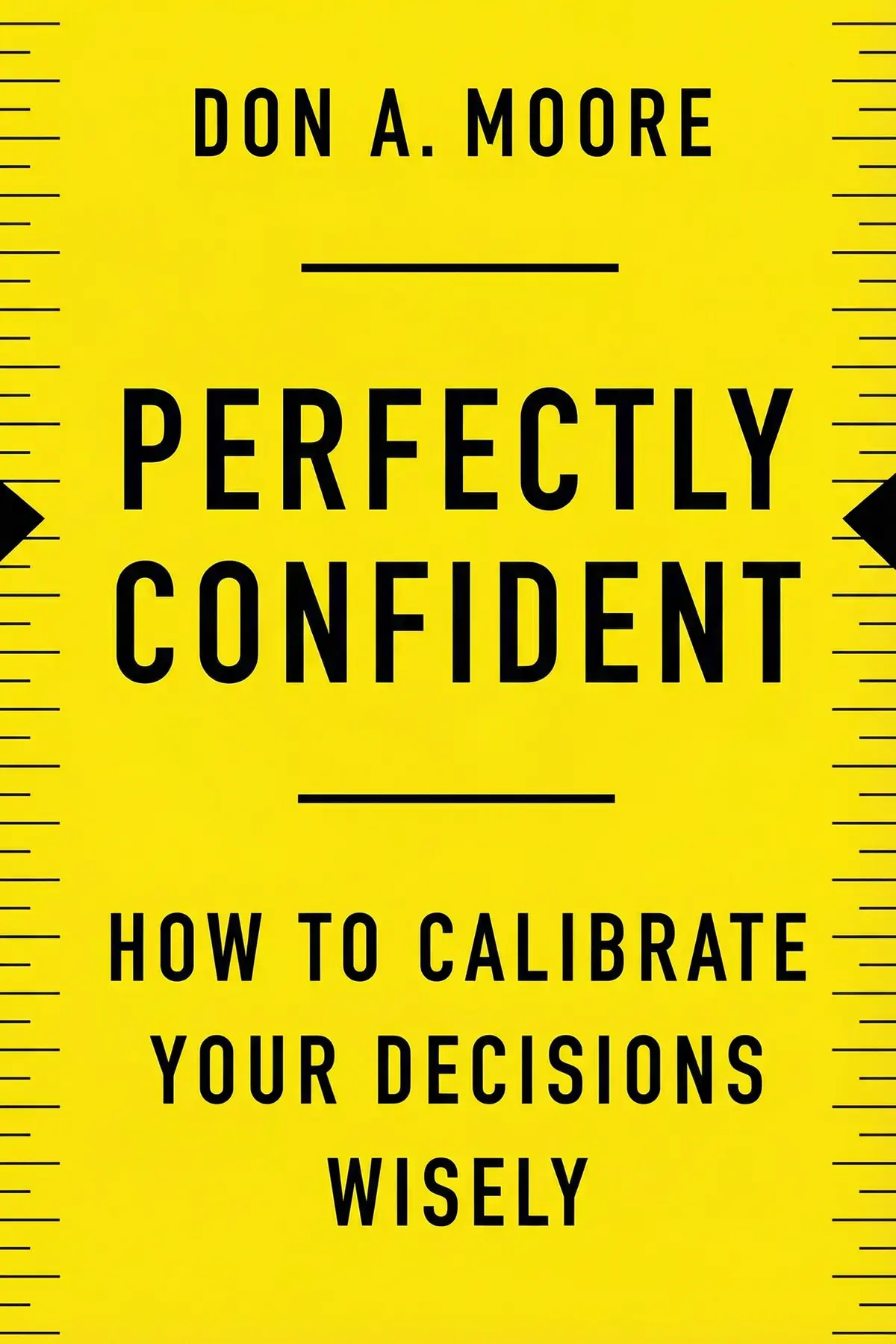
Table of Content
1. Introduction
1 min 01 sec
Confidence that runs ahead of what you know is a bet you have not priced, and the 2008 financial crisis showed how costly such bets become when everyone is sure they know what subprime mortgages are worth. In Perfectly Confident, Berkeley professor Don A. Moore argues that the goal is the right amount of confidence: belief that matches the evidence, no higher and no lower.
That single idea, calibration, runs through everything that follows. It explains why some language learners grow discouraged when they cannot see their classmates struggling, why a wedding planner should think in ranges, and why a sports analyst who says 65 percent is trusted more than one who sounds certain.
The tools are small and practical. A range instead of a single number. A second guess set against your first. A clear standard in place of a vague one. Use them, and your decisions get sharper while your word starts to carry more weight with the people who depend on it.
2. Use confidence to start the work, never skip it
1 min 58 sec
A famous line credited to Henry Ford suggests that belief is all you need to succeed. One psychologist’s research points to a less comfortable truth about people who picture their future victories most vividly.
3. Stop measuring your practice against others' polished results
1 min 54 sec
Even a Nobel Prize winner once claimed he had been fooling everyone about his talent. The cause of that feeling is surprisingly ordinary, and it has to do with what you can and cannot see.
4. Judge your skills against standards you can measure
1 min 51 sec
Ask a room full of people whether they drive well and nearly every hand goes up. A small change in the question produces a far more honest answer, and it can calm a frustrated team too.
5. Forecast in ranges and plan for every outcome
2 min 00 sec
Planners love a single, tidy number for guests, days or costs. A simple study about buying a DVD shows how much one word in your question can change the choice you end up making.
6. Let disagreement correct the errors you cannot see
1 min 58 sec
No one in a group can guess the number of jelly beans in a jar. Somehow the group as a whole comes close, and the same trick works even when you are completely alone.
7. Earn trust by admitting what you don't know
1 min 47 sec
Bold certainty wins people over, at least at first. A study of sports analysts found a kind of speaker who was trusted even more, and they did something most experts are afraid to do.
8. Conclusion
1 min 11 sec
Moore’s book pulls apart two things that usually travel together: feeling sure and being right. The aim is to tie them back together, so that how certain you sound tracks how much you actually know. Overconfidence helped sink the mortgage market in 2008. Underconfidence makes a language learner quit while unseen classmates struggle just as hard. The cure for both is the same habit of looking for what you cannot yet see.
The most useful place to begin is the forecast Moore himself recommends. Before your next big project or long-term goal, write down how likely you are to finish within several different time frames, and keep the page. When the work is done, compare it with what happened. Over a few rounds you will learn whether you tend to run high or low, and why.
Along the way, frame your choices as which rather than whether, and when someone disagrees with you, treat the gap between your views as information worth having.
Perfect confidence, as Moore uses the phrase, is confidence that has been checked. It belongs to the person who knows where their knowledge ends, and says so.
About this book
What is this book about?
Most advice about confidence says the same thing: have more of it. Don A. Moore, who studies confidence at the University of California, Berkeley, argues that this is only half right. Too little belief makes people pass up chances, but too much leads to snap decisions that collapse under real-world pressure, from a student who skips studying to a global market that misjudged subprime mortgages in 2008. Moore's answer is calibration: confidence that rises and falls with the evidence. He shows why people underrate themselves at hard tasks, why vague standards produce flattering self-images, and how forecasting in ranges instead of single numbers leads to better plans. He explains why the average of many guesses often beats one expert, and how even a second guess against your own first one can sharpen judgment. Readers get practical habits for work and life: write probability forecasts and check them afterward, ask which option to choose instead of whether to act, seek out varied opinions, and tell people how sure you really are. The payoff is better decisions and a reputation that holds up when someone looks closely.
Book Information
Who it's for
Professionals who forecast
Professionals who make forecasts, estimates or promises and want them to hold up under scrutiny.
Leads wanting clearer standards
Team leads who need clearer standards and a culture where bad news reaches them early.
Students and new professionals
Students and early-career people who feel like impostors next to classmates and colleagues.
About the Author
Don A. Moore
Don A. Moore teaches leadership, negotiation and decision making at the Haas School of Business at the University of California, Berkeley, and holds a PhD in Organization Behavior from Northwestern University. His research focuses on confidence: when people overrate themselves, when they rank themselves above others and when they feel too sure they know the truth. He has coauthored a textbook on managerial decision-making and written columns for the Wall Street Journal, Fortune and the Harvard Business Review.
Ratings & Reviews
Ratings at a glance
What people think
Listeners find the book to be highly readable and value the superb examples gathered from a variety of disciplines. The quality of information is well-regarded, with one listener mentioning that it features insightful anecdotes from the realms of business and politics.
Top reviews
Katya
Finally, a book that addresses imposter syndrome without the usual 'fake it till you make it' fluff. As someone who has always struggled with second-guessing every choice, Moore’s breakdown of underconfidence was incredibly eye-opening. The book uses research to show that being too cautious is just as damaging as being too bold. I loved the business cases he used to illustrate how leaders can create better team dynamics by being open to dissenting views. It’s a beautifully written guide that feels both authoritative and accessible. The way he explains probabilities in everyday decisions has changed how I approach my morning meetings. It is a must-read for any aspiring leader or manager.
Show moreWorawit
Wow, the research in this is just stellar. It is so rare to find a 'business' book that is actually backed by hard data instead of just some CEO’s intuition. Moore explains that the consequences of a bad choice should dictate your level of caution—using the analogy of flying an airplane versus making a new friend. This simple framework for 'erring on the side of caution' when stakes are high is something I’ll be using daily. Not gonna lie, I was skeptical at first, but the depth of the anecdotes really sold me. It’s one of those books that you’ll want to keep on your desk to reference whenever you’re facing a big fork in the road.
Show moreHiroshi
Don Moore delivers a refreshing, evidence-based take on a topic usually drowned in toxic positivity. Instead of the typical 'just believe in yourself' rhetoric, he dives into the messy reality of how our brains miscalculate risk. The examples from political history and business boardrooms provide a grounded context that makes the data feel much more applicable. Truth is, I appreciated the nuanced distinction between overconfidence and the paralyzing effects of underconfidence. It isn’t just a pep talk; it’s a toolkit for rational calibration. While some sections felt a bit academic, the payoff for those interested in decision science is massive. Highly recommended if you liked Superforecasting or other research-heavy non-fiction.
Show moreMason
After hearing about the 'calibration' concept on a podcast, I picked this up expecting a dry textbook but was pleasantly surprised. The author is clearly an expert, and his ability to weave together psychological studies with real-world political drama is impressive. He doesn't just tell you to be confident; he shows you how to be correctly confident. The strategies for avoiding confirmation bias, like the pre-mortem review, are worth the price of admission alone. My only gripe is that it feels a bit long-winded in the middle chapters where the anecdotes start to overlap. Still, for anyone serious about improving their decision-making process, this is a very solid and helpful addition to your shelf.
Show moreLek
Picked this up because I wanted to understand why I always underestimate how long a project will take. Moore’s explanation of the 'planning fallacy' and how our own egos get in the way of realistic timelines was spot on. The book provides a great middle ground between the paralyzing fear of failure and the reckless abandon of 'just believing.' I especially liked the part about acknowledging the rarity of self-fulfilling prophecies. It’s a grounded, rational look at a topic that is usually treated with way too much emotion. The prose is clear, the examples are diverse, and the takeaways are actionable. A very strong four-star read that I would recommend to colleagues.
Show moreMethinee
Look, we all know that guy who is always wrong but never in doubt—this book is essentially a manual on how to not be that person. Moore gives us a masterclass in intellectual humility. By focusing on 'calibration' rather than just 'confidence,' he changes the entire conversation about success. I found the chapter on collective decision-making particularly useful for my own work environment. It highlights the importance of seeking out dissenting opinions to fill in our own blind spots. While it could have been tighter in some areas, the quality of the information is top-tier. It's a pragmatic, evidence-based approach to living a more rational and effective life.
Show moreErn
Ever wonder why some people succeed despite being totally wrong? Moore tackles the mechanics of overconfidence with a level of rigor you don't often see in the self-help aisle. He argues that real confidence must be built on a foundation of competence, which sounds like a cliché, yet he explains it through fascinating experiments. I particularly enjoyed the section on how to use 'outside perspectives' to avoid the trap of overvaluing local information. To be fair, the pacing is inconsistent. I felt the author spent too much time on personal stories that didn't add much to the core data. It's a solid 3-star read that offers decent value but requires a lot of patience to finish.
Show moreNitaya
To be fair, the insights regarding 'betting against yourself' to test your own logic are brilliant. Moore suggests that if you aren't willing to put money on your prediction, you probably don't believe it as much as you think you do. This kind of practical advice is what keeps the book afloat. However, the book repeats a lot of truisms that felt like common sense to me. 'Skills build confidence, but not the other way around' is a recurring theme that didn't need ten chapters of explanation. In my experience, the first half is much stronger than the second. It’s a decent guide for the uninitiated, but seasoned readers of behavioral economics might find it redundant.
Show moreEleanor
This could have been a brilliant 30-page essay, but instead, it’s a repetitive 200-page slog. While the core message about calibrating your internal 'confidence meter' is vital, Moore tends to circle the same points until they lose their impact. Honestly, the writing feels a bit dry compared to the heavy hitters in this genre. I found myself skimming through the endless anecdotes about half-way through the book. If you've already read Thinking, Fast and Slow, you might find a lot of this territory already well-trodden. There are some gems here regarding the 'pre-mortem' strategy, but they are buried under layers of filler that simply didn't need to be there for the average reader.
Show moreWeera
I really wanted to love this because the premise is so important for modern life. Unfortunately, the execution falls flat for me. The writing is sluggish and lacks the punch found in similar books like Superforecasting or even Atomic Habits. Moore spends an exhaustive amount of time rehashing the idea that overconfidence is dangerous, which most people picking up this book probably already know. The 'tools' provided are okay, but they felt a bit buried in academic jargon and long-winded stories about the author's colleagues. It’s not that the information is bad—it’s just poorly packaged. If you’re a fan of dense, research-heavy texts, you might enjoy it, but I struggled to stay engaged.
Show moreQuestions about this book
What is the main idea of Perfectly Confident by Don A. Moore?
Moore argues that the best confidence is calibrated, meaning it matches what you actually know. Too little makes you miss opportunities, but too much leads to snap decisions and painful failures, such as the misjudged subprime mortgages behind the 2008 financial crisis. He offers tools to find the right level: forecasting in ranges, comparing options, inviting varied opinions, using clear standards and stating honest probabilities.
How does Perfectly Confident explain impostor feelings?
Moore says underconfidence grows when you see your own limits clearly but cannot see anyone else’s. A language learner assumes classmates are gifted, missing the hours they spend studying at home. Even John Steinbeck, a Nobel Prize winner, said he felt he had been fooling everyone. The remedy is to stop comparing your hidden effort with other people’s visible results.
What is a probability forecast and how do I make one?
Instead of predicting one outcome, you assign chances to several. For a project you think will take 10 days, estimate how likely it is to finish in under 6 days, 6 to 8, 8 to 10, 10 to 12 and longer. Averaging these gives a sounder estimate. Save the forecast, and when the work is done compare it with reality to learn whether you tend to overestimate or underestimate.
Why does Moore say to ask which instead of whether?
Asking whether to do something hides the alternatives. In one study, 75 percent of people asked whether they wanted to buy a DVD said yes, but only 55 percent bought it when reminded that the money could go to something else. Framing a decision as a choice between options keeps the other possibilities in view and leads to better choices.
How can leaders use the ideas in Perfectly Confident?
Moore advises leaders to set clear, measurable standards, as a teacher does by showing students examples of strong papers, which reduces conflict over expectations. Leaders should also seek out unwelcome information, since people tend to scrutinize bad news harder than good news, and build teams that can disagree, as Abraham Lincoln did with his cabinet.
Readers also enjoyed

Acting with Power: Why We Are More Powerful Than We Believe
Deborah Gruenfeld


Age of Propaganda: The Everyday Use and Abuse of Persuasion
Anthony Pratkanis




59 Seconds: Change Your Life in Under a Minute
Richard Wiseman


AUDIO SUMMARY AVAILABLE
Listen to Perfectly Confident in 15 minutes
Get the key ideas from Perfectly Confident by Don A. Moore, plus 5,000+ more nonfiction titles.
- 5,000+ titles
- Listen as much as you want
- 7-day free trial
- Cancel anytime









