

14 min 43 sec
Available in: English
Pay the People!: Why Fair Pay Is Good Business and Great for America
Two members of a group of wealthy Americans argue that higher pay strengthens companies and the economy. Their evidence includes border-town wage studies, Walmart's turnaround and widespread wage theft, all pointing to workers as customers.
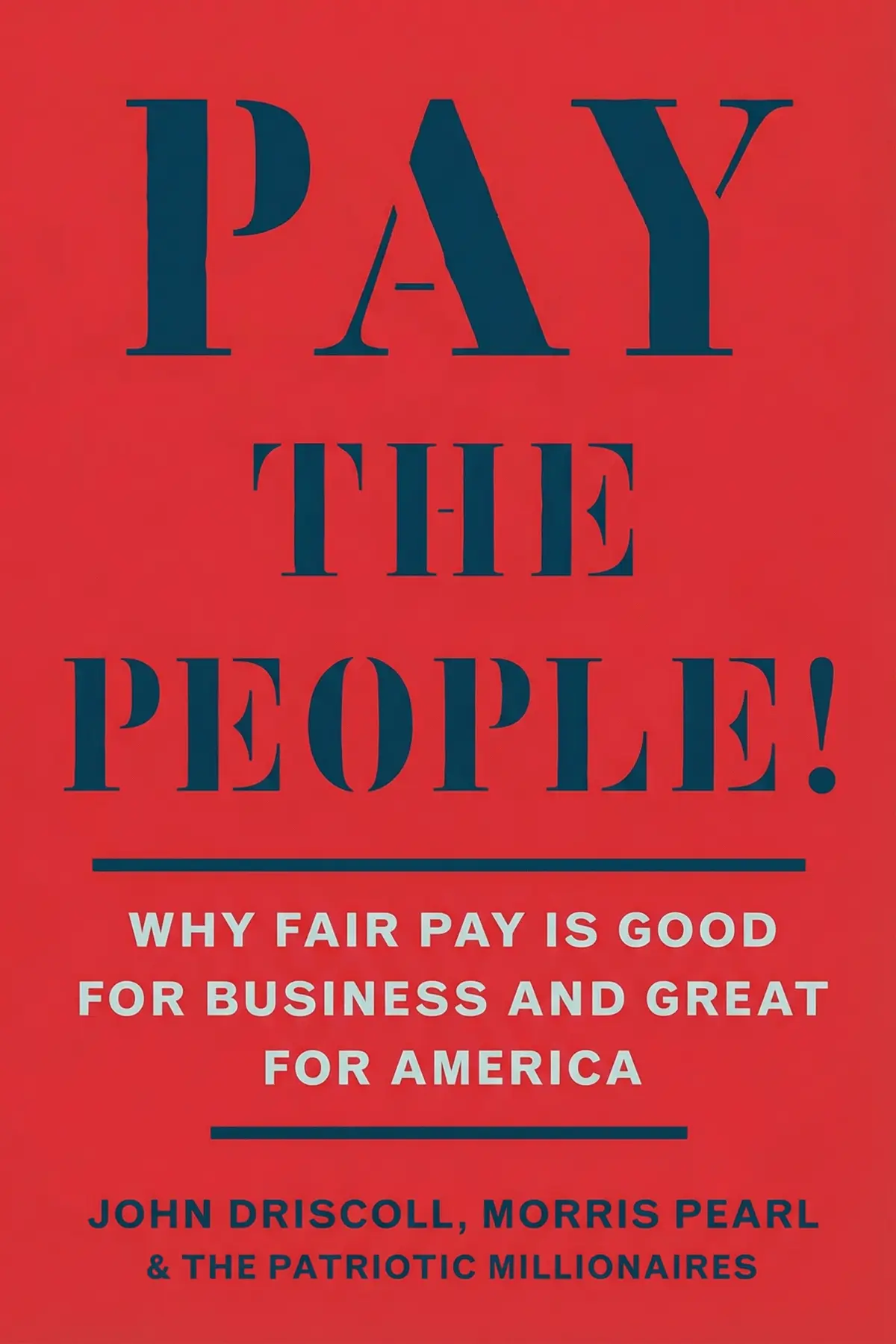
Table of Content
1. Introduction
57 sec
If you run a team or a business, cheap labor can look like the safest way to protect a margin. In Pay the People!, John Driscoll and Morris Pearl of the Patriotic Millionaires argue the opposite, and they begin with Walmart. In 2015 its low-wage model was costing it in staff turnover and unhappy shoppers, so the company raised pay, trained its people and watched profits climb.
The authors are wealthy business people themselves, which makes their warning harder to wave away. Their case is that an economy grows from the middle out, because workers are also the customers, and that fifty years of pushing money upward have left it unsteady. The proof runs from a tower of wooden blocks to two diners on opposite banks of a river and a theft hidden in ordinary paychecks. Managers get a business case for paying well, and anyone who argues about wages gets the figures to back it.
2. See why an economy stacked at the top wobbles
1 min 54 sec
A children’s block game offers a surprisingly exact picture of fifty years of American economic policy. And some of the loudest people warning about it are the ones who have gained the most.
3. Spot the business case executives only admit privately
1 min 39 sec
A restaurant executive let something slip on a call with investors, and a leaked poll told a similar story. What many business leaders believe about wages differs sharply from what they say in public.
4. Know what a frozen minimum wage really costs
1 min 47 sec
A number that has not moved in years sounds harmless. Measured in hamburgers, and against what workers now produce, it tells a story that reaches far beyond the lowest-paid jobs.
5. Answer the usual objections to higher pay with evidence
2 min 10 sec
Raise wages and jobs vanish, robots take over, and only teenagers are affected anyway. A river between two states turned these predictions into something that could be tested.
6. Find the money missing from ordinary paychecks
1 min 36 sec
Stores spend heavily guarding against shoplifters. A far larger loss happens every payday, mostly unseen and rarely punished, and one industry stands out above the rest.
7. See how higher pay beat low pay at Walmart
1 min 53 sec
Two of America’s biggest retailers made opposite bets on their workers. One of them came to expect it might run out of people willing to work there.
8. Set wages by data instead of political fights
1 min 39 sec
Wage debates in Washington can stall for over a decade. Some states and one country have found a way to keep pay current without anyone having to win the argument.
9. Conclusion
1 min 08 sec
Pay the People! is an unusual kind of warning: rich people saying the system that made them rich is pulling blocks from its own base. Their tower is not a moral fable. It is a business forecast. When pay falls behind output, when the wage floor loses value year after year and when billions vanish from paychecks unseen, the people who stop spending are the ones every company needs as customers. The border diners, Walmart’s turnaround and the leaked Chamber poll all point the same way, in the authors’ telling: decent pay builds demand and keeps jobs.
What can a listener do with that? If you set pay, weigh the cost of turnover against the cost of a raise, as Walmart did, and make sure every hour, tip and overtime shift is honestly paid. If you argue about wages, bring the evidence: the matched towns on either side of the Delaware River, an hour of minimum wage that buys under two Big Macs, the states whose pay rises with prices. And when someone insists wages must stay low to protect business, remember the Denny’s executive who admitted that higher pay in California was good for his restaurants.
About this book
What is this book about?
Low wages look like a safe way to protect profits. John Driscoll and Morris Pearl, both members of the Patriotic Millionaires, a group of wealthy Americans, argue that this belief is weakening the very economy that made them rich. Over fifty years, they say, tax changes, lobbying and held-down pay have moved trillions of dollars from most earners to the top 1 percent, leaving the base of the economy unsteady. Their case is built for business readers as much as for activists. A restaurant chain found its higher-wage California locations doing better. A study of towns on the New York and Pennsylvania border found that higher pay did not cost jobs. Walmart raised wages and saw turnover fall, while Amazon's churn cost billions. Along the way the authors expose wage theft, a loss from paychecks far larger than shoplifting. Readers get a clear argument that the economy grows from the middle out, the numbers to defend it, and a practical model for setting wages by living costs and inflation instead of political deadlock.
Book Information
Who it's for
Bosses weighing higher pay
Founders and managers weighing whether higher pay will cost them or save them money.
Fighting staff turnover
HR and team leads fighting turnover who need numbers to make the case for raises.
Wanting evidence on wages
Voters and students who want evidence for debates about the minimum wage and inequality.
About the Author
John Driscoll
Morris Pearl chairs the Patriotic Millionaires, a group of wealthy Americans formed in 2010 that campaigns on taxes, wages and political equality. He was a managing director at BlackRock, where he worked on the Maiden Lane transactions, and earlier helped invent securitization technology on Wall Street. Co-author John Driscoll, a former healthcare executive, holds a bachelor's degree and an MBA from Harvard and a Master of Philosophy from Cambridge, and served as a captain in the US Army Reserve.
Ratings & Reviews
Ratings at a glance

What people think
Listeners find the work thoroughly documented and extensive in its examination of economic principles, ensuring it remains accessible without being overly complex or too simplistic. Furthermore, the text offers actionable insights on how equitable wages for employees advantage everyone, as one listener points out its optimistic outlook for a more stable economic future. Beyond this, the caliber of the prose is commended, and listeners value the case made against stagnant pay and corporate excess.
Top reviews
Arm
This book is a loud wake-up call for anyone who thinks the current economic status quo is sustainable. Driscoll and Pearl make a compelling case that paying a living wage isn't just a moral imperative, but a practical necessity for a thriving consumer economy. I loved how they dismantled the myth that higher wages kill jobs, showing instead how they fuel growth and employee retention. It's refreshing to see millionaires calling for higher taxes on themselves and better pay for their staff. This isn't just theory; it’s a blueprint for a more equitable future that benefits everyone from the bottom up. The writing is sharp and the message is vital.
Show moreAudrey
Picked this up on a recommendation from a colleague in HR, and it totally changed my perspective on compensation strategies. The Patriotic Millionaires argue that when we pay people enough to actually live, they spend that money back into the local economy, creating a virtuous cycle. It was fascinating to see the historical data on how previous wage increases didn't lead to the mass unemployment that critics always predict. The writing is accessible and avoids overly dense jargon, making it a great read for business leaders and curious citizens alike. This book proves that a fair wage is the ultimate strategic tool for success.
Show moreKob
Wow, this was a powerful and surprisingly emotional look at the reality of being a low-wage worker in America today. We often talk about economics in the abstract, but the authors bring it down to the human level by discussing things like the struggle of tipped employees. I was unaware of how some companies use 'manager' titles just to avoid paying overtime, which feels incredibly predatory when laid out like this. The argument for raising the floor to lift everyone up, including those already making above minimum wage, is logically sound. It’s a hopeful book that offers real solutions for a more balanced and fair economy.
Show moreVarinee
Personally, I found the analysis of the productivity-pay gap to be the most compelling part of this entire book. The authors show that while workers are doing more than ever, their compensation has remained virtually flat for decades, which is a recipe for social instability. Look, the book isn't perfect; some of the charts are a bit small and hard to read without a magnifying glass. Still, the core message that a healthy middle class requires a solid foundation of fair pay is something that both parties should listen to. It’s a call to action for institutions to stop prioritizing short-term gains over long-term viability.
Show moreRodrigo
The chapter on tipped wages alone is worth the price of the book, as it exposes a system that essentially legalizes poverty wages. As someone who has worked in the service industry, I found the authors’ defense of one fair wage to be incredibly validating and well-researched. They don't just complain about the problem; they provide practical ideas for how we can transition to a better model without crashing the economy. It’s a quick read, but the information stays with you long after you put it down. I’ll definitely be passing my copy along to friends who still think minimum wage increases are bad for the business world.
Show moreNathan
Ever wonder why the federal minimum wage has been stuck at $7.25 since the year 2009? Pay the People! dives deep into this stagnation, illustrating how the disconnect between productivity and pay has reached a breaking point for the American worker. The authors use a lot of stats to back up their claims, which can get a bit dry at times, but the core message remains powerful and clear. I found the sections on how low wages actually cost the taxpayers more in the long run quite eye-opening. While some graphs were a little cluttered and needed better explanation, the overall argument for economic justice is undeniable.
Show moreSau
Not what I expected when I first picked this up, but I appreciate the passion behind the project. While the authors are clearly experts, the text felt a bit repetitive in the middle chapters as they hammered home the same points about corporate greed. To be fair, the examples regarding 'fake manager' titles and tipped workers being exploited were shocking and well-documented. However, I felt the political attacks on specific senators were a bit distracting from the actual economic data being presented. It serves as a decent reference book, but the editing could have been tighter to keep the momentum going.
Show moreLaddawan
Finally got around to reading this, and frankly, it should be required reading for anyone in a leadership position. The book shines a light on some truly horrifying practices, like the 'school lunch debt' shaming and the loophole where tipped workers earn less than the minimum wage. Driscoll’s writing style is punchy and direct, even if a few of the proofreading errors—like the flipped years for inflation—snuck through into the final copy. I appreciated the specific examples of companies that already pay living wages and are thriving because of it. It’s an enlightening look at why our current system is failing so many people.
Show moreHassan
After hearing Morris Pearl speak on a podcast, I knew I had to check out Pay the People! for myself. The truth is, we are living through an era of unprecedented corporate wealth while the people actually doing the work are struggling to buy groceries. This book cuts through the noise and explains why it's in everyone's best interest to raise the federal minimum wage immediately. It’s written with a sense of urgency and clarity that you don't often find in books about economics. If you want to understand the fight for a living wage in America, this is a great place to start your research.
Show morePear
I really wanted to like this more, but I found it a bit too confusing with the way the statistics were listed throughout. While I agree with the premise that people deserve a living wage, the book felt more like a collection of political grievances than a cohesive economic study. Many of the graphs were presented with very little explanation, leaving me to guess at what the data was actually trying to show. The repetition of certain talking points made it feel twice as long as it needed to be. It’s an important topic, but the delivery and the lack of professional editing just didn't work for me as a reader.
Show moreQuestions about this book
What is the main idea of Pay the People!?
John Driscoll and Morris Pearl argue that fair wages are good business and good for the economy. With consumer spending making up about 70 percent of US economic activity, they hold that growth rises upward, starting at the bottom and the center. Fifty years of tax changes, lobbying and held-down wages have moved roughly $50 trillion to the top 1 percent since 1981, which they compare to pulling blocks from the base of a Jenga tower.
Does raising the minimum wage cost jobs, according to the book?
The authors say no. After New York raised its minimum wage in 2014 while Pennsylvania held back, a Federal Reserve study comparing paired border towns found earnings for leisure and hospitality workers in New York climbed 50 percent over nine years, versus 10 percent across the border. Employment growth in New York matched or beat Pennsylvania’s. Studies they cite also find only a small automation effect from higher wages.
What is wage theft in Pay the People!?
Wage theft is employers taking pay their workers have earned, about $50 billion a year by the authors’ figures, against roughly $14 billion lost to shoplifting. Methods include calling employees independent contractors, keeping servers’ tips and skipping overtime pay. It affects more than 4.5 million workers a year, and with about 1,000 federal investigators for 150 million workers, under 4 percent of stolen wages are recovered.
How does the book propose setting the minimum wage?
The authors want data to replace politics. Thirteen states already raise their minimum wage with inflation automatically. Australia goes further, with an independent panel that reviews living costs every year and sets the wage. In the United States, they suggest using MIT’s Living Wage Calculator, which covers every county, so pay reflects what it actually costs to live in each place.
Who should read Pay the People!?
It suits business owners and managers who suspect low pay is costing them through turnover, as well as anyone who debates wages and inequality and wants evidence. The Walmart and Amazon comparison speaks to leaders of large workforces, while the border-town study and the minimum wage figures give voters and students concrete numbers to bring to an argument.
Readers also enjoyed


A Splendid Exchange: How Trade Shaped the World
William J. Bernstein

Afropean: Notes From Black Europe
Johny Pitts




All About Love: New Visions
bell hooks


Adults in The Room: My Battle With Europe’s Deep Establishment
Yanis Varoufakis
AUDIO SUMMARY AVAILABLE
Listen to Pay the People! in 15 minutes
Get the key ideas from Pay the People! by John Driscoll, plus 5,000+ more nonfiction titles.
- 5,000+ titles
- Listen as much as you want
- 7-day free trial
- Cancel anytime









