
14 min 14 sec
Available in: English
Out of Character: Surprising Truths about the Liar, Cheat, Sinner (and Saint) Lurking in All of Us
Shows why decent people sometimes lie, cheat, lust or turn cruel. It explains how emotions, social cues and a sense of who counts as one of us decide which side of your character wins in the moment.
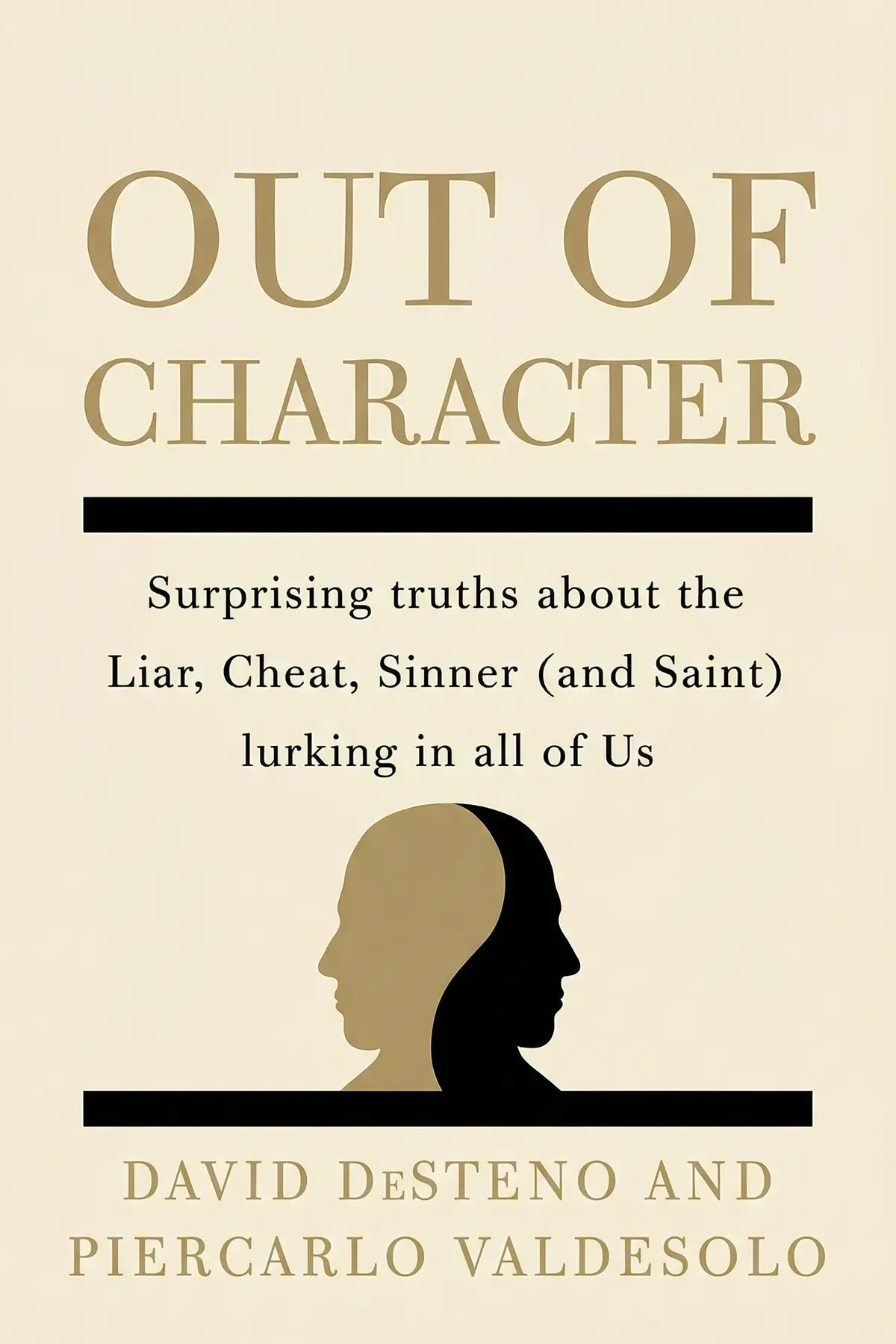
Table of Content
1. Introduction
1 min 03 sec
Most of us sort people into fixed types, the cheat, the drinker, the reliable friend, and assume we already know which type we are. In Out of Character, psychologists David DeSteno and Piercarlo Valdesolo argue that this sorting is a mistake, because the same person can turn honest or dishonest, kind or cruel, depending on the moment. Their evidence comes from experiments in which small changes, a comedy show, the smell of fresh cookies, a stranger’s help, shifted how ordinary people judged, trusted and acted.
The throughline is simple. Character is a running contest between impulses inside each of us, and the situation decides who wins. That is also useful. Once you can spot the conditions that tip the contest, such as anger, jealousy, gratitude or a sense of who counts as one of us, you can predict your worse moments and set up your better ones.
2. Treat your character as a contest you can steer
1 min 29 sec
An old word for character described a mark that could never change. The authors think that image misleads us, and a fable about two insects explains far better why good people sometimes behave badly.
3. Catch the double standard you apply to yourself
1 min 29 sec
People who break a rule rarely feel like hypocrites. One simple experiment with a fun task and a dull one shows how differently we grade the same choice depending on who made it.
4. Expect desire to test even a devoted partner
1 min 27 sec
Finding the right person does not switch off attraction to others. An experiment with unwashed T-shirts suggests the pull runs deeper than choice, and jealousy brings its own surprising urge to punish.
5. Use earned pride to push harder and rise
1 min 26 sec
Pride is listed among the deadly sins, yet it can drive effort and raise your standing in a group. Even its ugly cousin, hubris, once helped a crowd of jobless traders hold their heads up.
6. Widen your circle of us to stay compassionate
1 min 32 sec
In the middle of a civil war, two armies stopped fighting to cheer for the same team. That strange pause reveals how thin the line between kindness and cruelty really is.
7. Spot how kindness and cheating spread in groups
1 min 33 sec
A rescued computer file made participants more willing to give away tokens that held a dollar value. Yet the same social pull works in reverse, and a single confident cheater can change the honesty of a whole room.
8. Notice your mood to judge risk more wisely
1 min 28 sec
Some people seem born gamblers and others born savers. The authors argue the difference shifts with headlines, smells and anger, and that the same person can swing from cautious to reckless in an afternoon.
9. Watch for hidden bias when anger rises
1 min 36 sec
Most people are sure they judge others fairly. A classroom lesson about eye color and a test with two buttons on a screen suggest that bias waits for the right moment to show itself.
10. Conclusion
1 min 11 sec
The coin from the opening of the book is worth turning over. A Greek coin’s mark could never change, and we like to believe the same of people: the cheat stays a cheat, the saint stays a saint. DeSteno and Valdesolo’s experiments tell a different story. A comedy sketch changed moral verdicts. A rescued computer file made people more willing to give away valuable tokens, the smell of baking raised the risks they would accept, and anger brought hidden biases to the surface. Nobody in these studies was simply good or bad. Each was a set of competing impulses, and the setting picked the winner.
That is a hard thing to accept about yourself, and a useful one. If context tips the contest, you can watch the context. Treat strong anger, jealousy or excitement as a signal to delay judging people and making big bets. Grade your own choices as if a rival had made them. Thank people in ways they can see, and fill your days with people unlike you.
Your character was never stamped on you. It gets decided again in every situation you walk into.
About this book
What is this book about?
We like to sort people into types: the cheat, the gambler, the loyal partner, the good person we believe ourselves to be. Psychologists David DeSteno and Piercarlo Valdesolo argue that this sorting gets human nature wrong. Character is not a fixed mark. It is a constant contest between impulses that want a reward now and impulses that plan for later, and the situation of the moment often picks the winner. The authors build their case from experiments. A comedy show changed people's answers to a moral dilemma. A rescued computer file made strangers more generous with money. The smell of fresh cookies raised the risks people would take, and anger made it easier to plant prejudice in adults. Along the way they look at hypocrisy, lust and jealousy, pride and hubris, compassion and cruelty, gratitude, cheating, risk and stereotypes. What readers get is a more honest picture of themselves and others, and a practical habit that follows from it. If context tips the contest, you can learn to read the context, slow down when emotions run high, and arrange your surroundings so your better impulses get a fair chance.
Book Information
Who it's for
Judging others for work
Professionals who judge others for a living, in hiring, reviews or negotiations, and want to catch their own blind spots.
Leaders curious about influence
Team leads who want to understand how gratitude, praise and one bad example spread through a group.
Puzzled by moral lapses
Curious readers puzzled by why good people, including themselves, sometimes act badly.
About the Author
David DeSteno
David DeSteno is a professor of psychology at Northeastern University, where he leads a research group on social emotions. He earned his Ph.D. at Yale, is a fellow of the Association for Psychological Science and the American Psychological Association, and served as editor-in-chief of the journal Emotion. Piercarlo Valdesolo is a psychologist at Claremont McKenna College, where he directed the Moral Emotions and Trust Lab and chaired the psychology department. Both study how emotions shape moral judgment and behavior.
Ratings & Reviews
Ratings at a glance
What people think
Listeners find the material highly accessible and easy to grasp, with one review highlighting that it offers compelling evidence and serves as a superb primer on human instinct. They describe the experience as a fascinating exploration, and one listener notes that it effectively clarifies human behavior.
Top reviews
Pia
After hearing so much about how 'good' people break bad, I finally picked this up to understand the mechanics of it. DeSteno and Valdesolo provide a compelling introduction to the hidden instincts that drive our moral choices. Instead of the typical angel-on-the-shoulder trope, they use the Ant and the Grasshopper metaphor to explain our internal tug-of-war between long-term gains and immediate gratification. Frankly, the research studies described—like the one where students watched SNL versus a boring documentary—were absolutely fascinating and felt very original. It’s a journey through the human psyche that makes you realize how thin the line between saint and sinner really is. While some might find the tabloid examples a bit dated, the underlying science is solid and easy to digest. This book changed how I view 'character' entirely, seeing it now as a fluid state rather than a permanent label.
Show moreSofia
Wow. This was such an eye-opening look at the 'sinner and saint' lurking in all of us. As someone who tends to judge people harshly for their mistakes, this book offered a necessary dose of perspective. The authors demonstrate that our character isn't a fixed attribute like eye color; it’s a shifting balance between competing psychological mechanisms. I loved the section on how we rationalize our bad behavior—it’s scarily easy to convince ourselves that our vices are actually virtues in disguise. The experiments are creative and show just how much our subconscious influences our 'choices.' It’s a very interesting journey that makes you more compassionate toward others and more mindful of your own potential for hypocrisy. In my experience, it’s one of the best books I’ve read on human nature lately. It provides valuable evidence that we are all capable of almost anything given the right circumstances.
Show moreRafael
The chapter on race and how we perceive 'others' was particularly moving and backed by some very strong research. I’ve been reading a lot of social science lately, and this stands out as a very interesting journey into the hidden forces that shape our decisions. The authors do a great job of explaining complex psychological concepts without making them feel overwhelming. Truth is, we all like to think we’re the hero of our own story, but this book shows how easily we can become the villain. The Ant and Grasshopper metaphor is a helpful framework for understanding that our 'bad' impulses are often just short-term survival strategies that have gone off the rails. It’s a valuable piece of evidence for anyone trying to understand the complexity of human instinct. Highly recommended for fans of Predictably Irrational.
Show moreGai
Ever wonder why we make decisions that we later regret? Out of Character explores the surprising truths behind our moral compass, arguing that our environment plays a much larger role than we’d like to admit. Personally, I found the chapter on how scents or minor emotions can prime us to be more or less honest to be the highlight of the book. The writing style is accessible and lacks the dry, academic tone you might expect from two professors. However, to be fair, the structure does get a little repetitive after a while. Every chapter starts with a high-profile scandal involving a politician or celebrity before diving into the data. It’s a very interesting journey into human behavior, but I wish they had used some less-famous examples to keep the narrative fresh. Still, it's a great read for anyone into social psychology.
Show moreNim
Finally got around to reading this and I’m glad I did. The central argument—that we have two dueling systems (the impulsive grasshopper and the future-oriented ant)—makes a lot of sense in the context of evolutionary psychology. DeSteno and Valdesolo write with a witty tone that keeps the pages turning. I particularly enjoyed the descriptions of the experiment designs; it’s amazing how researchers find ways to simulate real-world moral dilemmas in a controlled environment. Not gonna lie, some of the results are a bit unsettling because they suggest we have less control over our actions than we think. My only gripe is that the book leans heavily on studies involving college students, which isn't always the most representative sample. Regardless, it’s an excellent introduction to why we sometimes act against our own best interests. Definitely worth a spot on your shelf.
Show moreOat
Look, this isn't a perfect book, but it's a very interesting one. DeSteno and Valdesolo explore how our environment—even something as simple as a smell or a quick video—can shift our moral compass. I found the analysis of why we rationalize our failures as 'out of character' to be spot on. We want to believe we have a solid core, but the data suggests we’re much more flexible. The book is well-written and serves as an excellent introduction for those new to the field. I did find the structure a bit predictable, as each chapter followed the same rhythm, but the quality of the insights made up for it. It’s a fascinating look at the sinner and saint in all of us. If you can get past the somewhat repetitive tabloid examples, there is a lot of gold here.
Show moreNina
Not what I expected, but still worth a look if you’re a fan of Malcolm Gladwell’s Blink. The authors do a decent job showing how our minds value flexibility over rigid character traits. Using the Ant and the Grasshopper metaphor is a clever way to reframe the internal battle we all face. That said, I found myself getting bored with the repetitive chapter outlines. It’s always tabloid story, lab experiment, take-home point, repeat. Also, some of the information feels like it’s been covered better in other pop-psychology books. Look, the research on how we judge 'outsiders' differently is important, but it didn't feel like it was breaking much new ground. It’s a solid introduction to human instinct, but if you’ve already read a lot in this genre, you might find it a bit elementary. A middle-of-the-road experience for me.
Show moreSebastian
Picked this up because I wanted to understand why public figures keep self-destructing. The authors provide some great evidence regarding how external pressures trip our moral scales. It’s fascinating to see how priming can make a student act selfishly or generously in a lab. However, I have to agree with other reviewers that the book is a bit of a disappointment when it comes to the bigger picture. Got to say, the authors ignore things like personality disorders or genetic predispositions that make some people consistently bad. Calling a serial killer's actions 'out of character' because they once worked a suicide hotline is a stretch. It’s an easy read and comprehensible for a layperson, but it lacks the nuance needed to truly explain the extremes of human behavior. Good for a casual reader, but maybe not for a deep dive.
Show morePot
This book left me feeling incredibly frustrated despite its interesting premise. While the authors give plenty of reasons why people change their behavior based on minor environmental shifts, they fail to answer the core question: why do people who have been consistent for decades suddenly snap? I’ve paid my taxes for thirty years without fail, and the book doesn't explain why someone like me would suddenly stop. The authors seem to dismiss the idea that most of us actually behave quite predictably over time. Truth is, they focus so much on how easy it is to manipulate people in a lab setting that they ignore real-world consistency. They also take a bizarre stance on hypocrites like Tiger Woods, trying to explain away long-term deception as just being 'out of character' rather than a revelation of true personality. It’s an incomplete picture that needs more work.
Show moreJoshua
As someone who has always believed that character is built through habit and remains stable, I found this book to be a hard pill to swallow. The authors argue that character is basically a myth and that we are all just at the mercy of our surroundings. Frankly, it felt like a way to excuse bad behavior rather than explain it. They spend so much time on Tiger Woods and Eliot Spitzer, but they don't tackle the fact that many people remain faithful and honest despite facing the same temptations. The writing is easy to read, but the logic felt flawed. To be fair, the experiments on priming were cool to read about, but they don't justify the sweeping conclusions about the fluidity of morality. It felt more like a collection of interesting lab notes than a cohesive theory on human nature. Disappointing.
Show moreQuestions about this book
What is the main idea of Out of Character?
David DeSteno and Piercarlo Valdesolo argue that character is not fixed. Each person holds competing impulses, like the ant that plans for winter and the grasshopper that enjoys today, and the situation decides which one wins. Their experiments show emotions, perceived similarity and other people’s behavior shifting honesty, generosity, risk-taking and prejudice. No one is simply a saint or a sinner.
What experiments are described in Out of Character?
The authors describe a task-sharing study in which people judged their own unfair choice more kindly than someone else’s, and a bridge dilemma whose answers changed after viewers watched Saturday Night Live. Others include women rating unwashed T-shirts, a token game where grateful players gave more, cookies that raised risk-taking, a classroom eye-color lesson and a shoot or don’t-shoot test that exposed racial bias.
How can I apply the ideas in Out of Character?
Start by watching the context, because the authors warn that intuition cannot always be trusted. When you feel angry, jealous or excited, delay judging people and making big decisions. Grade your own choices as if a rival made them. Thank people visibly, since gratitude makes them more generous and trusting. Spend time with many different kinds of people so your sense of us grows.
Does Out of Character say pride is bad?
No. The authors argue that pride often drives effort and helps people overcome obstacles, especially when others praise their work. An expanded posture is linked with pride and status, and praised people speak up more in groups. The danger is hubris, pride claimed without being earned, though even that helped jobless stockbrokers after the 2007 crisis keep their status and self-worth.
Who should read Out of Character?
It suits readers who want to understand why decent people sometimes lie, cheat, lust or turn cruel, including themselves. Managers and team leads will find useful material on gratitude, praise and how cheating spreads in a group. Anyone who makes judgments about people, in hiring, reviews or daily life, will benefit from its findings on how anger brings hidden bias to the surface.
Readers also enjoyed


Acting with Power: Why We Are More Powerful Than We Believe
Deborah Gruenfeld


Age of Propaganda: The Everyday Use and Abuse of Persuasion
Anthony Pratkanis




59 Seconds: Change Your Life in Under a Minute
Richard Wiseman


AUDIO SUMMARY AVAILABLE
Listen to Out of Character in 15 minutes
Get the key ideas from Out of Character by David DeSteno, plus 5,000+ more nonfiction titles.
- 5,000+ titles
- Listen as much as you want
- 7-day free trial
- Cancel anytime









