
A History of Iran: Empire of the Mind
Michael Axworthy
 English
 ไทย
Shows how the West invented an exotic, irrational Orient in order to study and rule the East, and how those stereotypes still shape travel ads, news coverage, university research and foreign policy.
1 min 08 sec
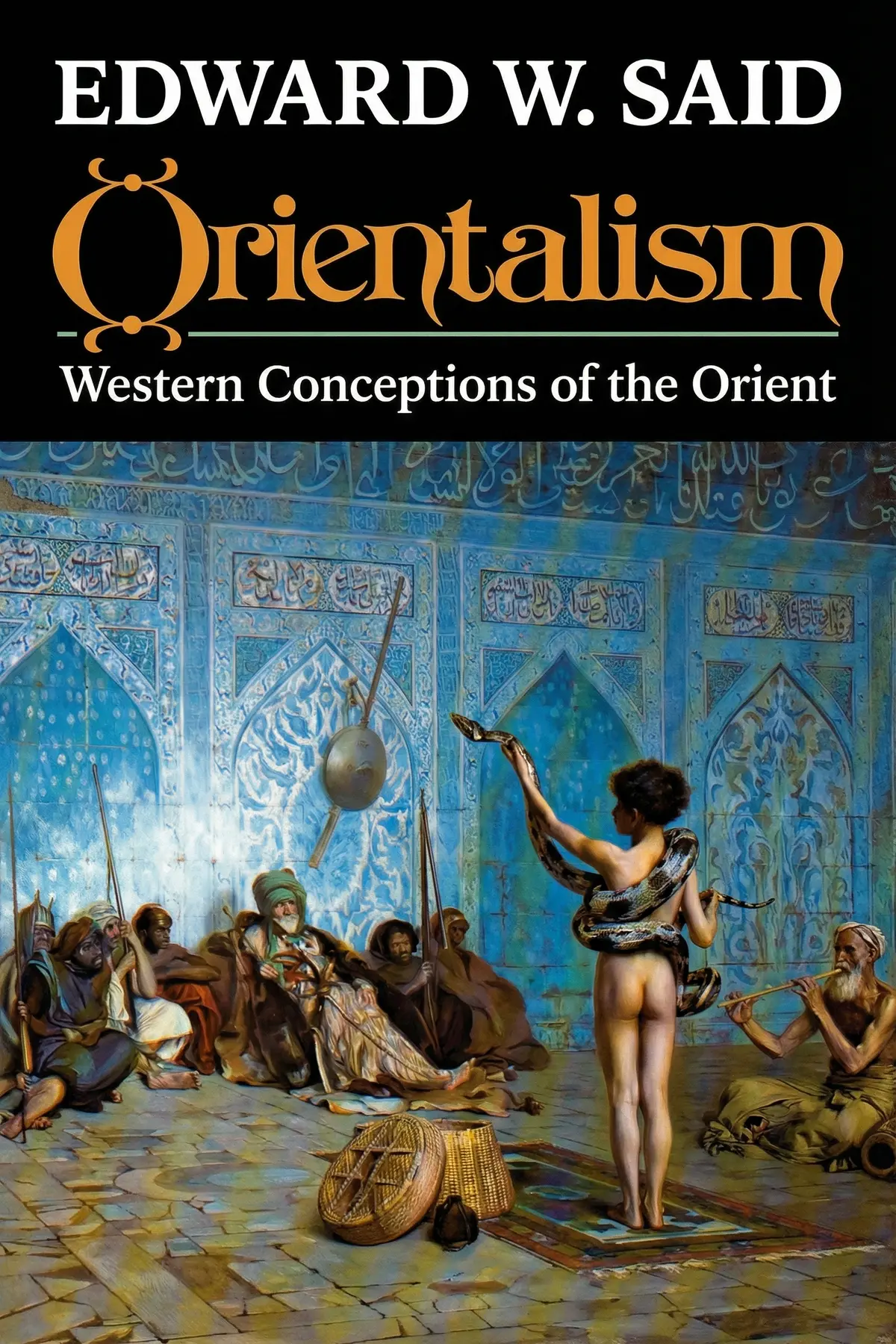
Most of us picture the Middle East and Asia through images we never chose: crowded markets, veiled dancers, palaces frozen in time. In Orientalism, the Columbia University scholar Edward W. Said traces those pictures to a precise beginning, Napoleon’s invasion of Egypt in 1798, when an army arrived with scholars who would write the country up in a 23-volume encyclopedia. Said argues that the Orient those scholars described was never a real place. It was a Western creation, one strange region stretching from Egypt to the Far East, defined as everything the West believed it was not.
That invented East did real work. It helped empires rule, it sorted and ranked whole peoples, and it lives on in cartoons, university courses and foreign policy. Follow Said’s argument and a holiday ad or a news headline stops looking neutral. It becomes something you can take apart, word by word and image by image.
2 min 16 sec
A glossy holiday ad and a 23-volume French encyclopedia have more in common than they appear. Both draw on a single idea of the East, and its most telling feature is what it says about the West.
1 min 55 sec
A general claimed to be a better Muslim than the people he had just invaded. The story shows how scholarship, from Koran readings to deciphered hieroglyphs, can turn into an instrument of rule.
2 min 12 sec
Two French linguists set out to read minds through grammar, and a devoted Englishman even dressed like a local. All three ended up making the people they studied harder to see.
2 min 06 sec
A poet arrived in the East he had written about and barely recognized it. Revolutions followed, and the experts had to choose how much of their picture they were willing to give up.
2 min 00 sec
Liberty, equality and fraternity were exported to prove Europe’s superiority. Then they came back as charges against it, while two costly wars changed the math of empire for good.
2 min 14 sec
A cartoon from the 1973 oil crisis, a set of university courses and one famous book about clashing cultures share a family tree. Learning to see it changes how the evening news sounds.
1 min 13 sec
Said’s book adds up to a claim about how seeing and ruling feed each other. The West did not discover the Orient. It imagined one, gave the imagined place encyclopedias, grammars and experts, and then used that authority to govern real people who had never been asked. The picture bent when travelers like Nerval saw the real East and when colonies spoke the language of nationhood, yet it never broke. It simply moved, from Napoleon’s scholars to the sheikh cartoons of 1973 and the policy papers of today.
The practical value lies in noticing. Pay attention to the adjectives and images a news report attaches to each side of a conflict, because the vocabulary often makes the argument before the facts arrive. Treat any portrait of a whole region as timeless, uniform or naturally irrational as evidence about whoever painted it. And when someone dismisses the person who breaks a stereotype as a mere exception, ask whether the stereotype is what needs examining.
The East in the travel ad was always a mirror. Said’s achievement is to show whose face it reflects.
Exotic travel ads, cartoon sheikhs and confident talk of a clash of civilizations can seem like separate things. Edward W. Said traces them to one source: Orientalism, the Western body of knowledge that invented a single, strange, sensual and irrational region called the Orient, stretching from Egypt to the Far East. Said dates the modern field to Napoleon's 1798 invasion of Egypt, when scholars arrived with the army, and follows it through French and British colonial rule. He shows how its experts served empire, how linguists like Silvestre de Sacy and Ernest Renan ranked peoples by language and race, and how anticolonial movements and two World Wars weakened Europe's grip without ending the habit of mind. Today, he argues, it lives on in the United States, in popular images, university disciplines and policy research. Readers get a clear account of how knowledge and power feed each other, and a practical way to read news coverage and advertising about the East with fresh attention to the words and pictures chosen.
Readers who follow news from the Middle East and want to judge the words and images used to describe it.
Students of history, literature or politics meeting Said's critique of Western knowledge for the first time.
Professionals in media, marketing or policy who shape how other cultures are portrayed.
Edward W. Said was born in Jerusalem in 1935 and moved with his family to Egypt and then the United States after the 1948 Palestine war. He graduated from Princeton in 1957, earned a Harvard doctorate for his studies of English literature in 1964 and taught at Columbia University from 1963 to 2003, lecturing at more than 200 other universities. A public intellectual who argued for a Palestinian state, he sat on the Palestinian National Council until 1993. In 1999 he co-founded the West-Eastern Divan Orchestra with Daniel Barenboim.
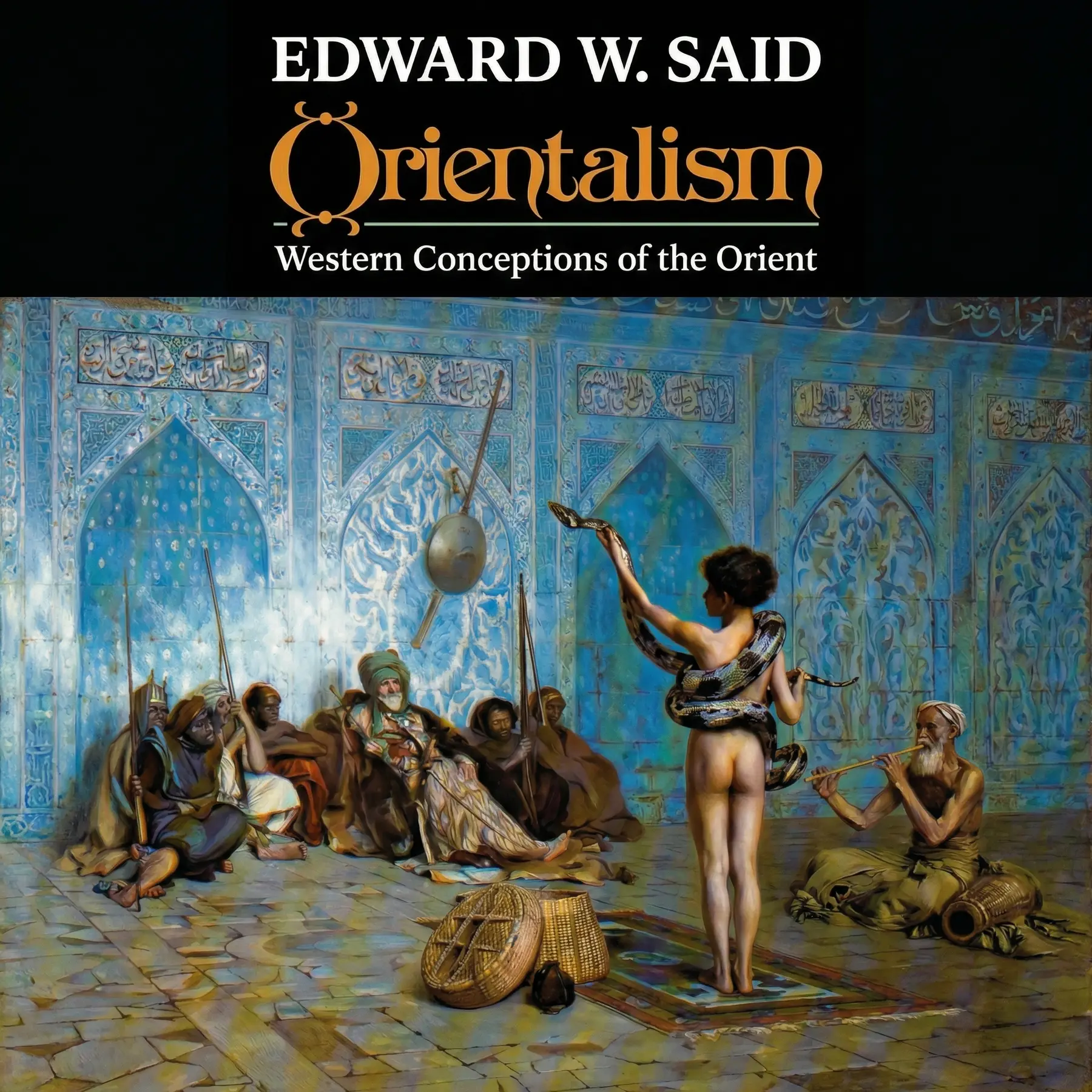
Listeners view the work as a significant classic, with one listener noting its essential role in post-colonial studies. It receives praise for its academic depth and great value for the price. However, listeners are divided on readability, as some find it deeply rewarding while others call it painful to finish. Opinions on the language and quality of information vary; while some enjoy the text, others find it overly technical, often remarking that the content feels dense.
Rarely does a book feel this prophetic decades after its initial publication. Said’s 'Orientalism' isn't just a history lesson; it's a mirror reflecting our own subconscious biases back at us. To be fair, the academic language can be a bit of a barrier, but the payoff is immense. He perfectly articulates how the West has acted as spectator, judge, and jury over Eastern cultures, creating a version of the 'Orient' that exists only in our heads to justify political domination. I was particularly struck by the analysis of how these representations stripped people of their humanity by turning them into static tropes. It’s dense, yes, but every page contains a nugget of insight that makes the effort worth it. Every student of history or politics needs this on their shelf. It is worth every penny.
Show moreAs someone who studied International Relations, I can say this text is unavoidable for a reason. Said manages to pull back the curtain on the relationship between knowledge and power. He isn't just talking about old books; he's talking about how we've been conditioned to see certain parts of the world as 'passive' or 'backwards' so that we can feel comfortable 'civilizing' them. Personally, I found his analysis of how universities wield power through knowledge construction particularly biting. The scholarly content is top-tier and offers incredible value, even if it requires a high level of concentration. It’s not just a book; it’s a total paradigm shift. If you want to understand the roots of modern Islamophobia and interventionism, you have to start here.
Show moreThis book is a masterclass in intellectual history. Said’s ability to weave together literature, politics, and sociology is nothing short of stunning. He warns us against 'aggregated facts' and the dangerous labels we use to simplify millions of people into a single, monolithic entity. Frankly, it is one of the few books that actually changed the way I process information. While some people complain about the academic tone, I found it necessary for the depth of the argument he’s making. You cannot dismantle centuries of colonial discourse with a light, breezy narrative. It requires the heavy lifting of serious scholarship. For those willing to put in the work, this is one of the most rewarding books you will ever read. It is an absolute landmark of 20th-century thought.
Show morePicked this up after seeing it referenced in a documentary on the Iraq War, and it completely reframed my understanding of foreign policy. Said’s central point—that the West is always the actor while the Orient is the passive reactor—is a lightbulb moment. Once you see it, you cannot unsee it. It shows up in everything from news reports to blockbuster films. The truth is, it’s a demanding read, and I had to take frequent breaks to digest the information. It is highly technical and expects the reader to have a decent grasp of European history. But the effort pays off in spades. This is more than just a book; it’s a toolkit for deconstructing the propaganda we are fed every day. It is a major investment in your own critical thinking.
Show moreFinally got around to this monolith of post-colonial theory after years of hearing it cited in every humanities class. Look, it’s a classic for a reason—Said’s deconstruction of how European powers constructed a 'Middle East' of their own imagination is still incredibly relevant today. But let’s be real: it is a slog. The prose is dense, academic, and highly technical, which makes it feel like a chore at times. I found myself having to re-read entire paragraphs just to grasp the nuance of his critique on 19th-century French literature. Still, the way he exposes the power dynamics behind scholarly representation is eye-opening. It changed how I look at news coverage and travel writing. Is it an easy beach read? Absolutely not. Is it essential for understanding the modern world? Without a doubt.
Show moreThis was a heavy, often uncomfortable journey through the blind spots of my own education. I grew up with the very stereotypes Said deconstructs—the 'exotic' East and the 'irrational' Arab—without ever questioning where those images originated. The truth is, the book is a difficult read not just because of the scholarly prose, but because it challenges the reader to unlearn so much. I appreciated the deep dives into Flaubert and Nerval, even if the literary analysis felt a bit long-winded at times. My only real complaint is that it can be repetitive; Said hammers his point home again and again, which is effective but exhausting. However, seeing the 'fog-like gaze' of the West described so clearly made it impossible to look at films or documentaries the same way again.
Show moreEver wonder why the Middle East is always portrayed as a land of sand, camels, and mystery in our movies? Said answers that question by tracing the history of 'Orientalism' back to British and French colonial scholars. The book is definitely technical and dense, but the core argument is simple: we don't see the East as it is, but as we want it to be. I’ll admit, some of the chapters on 19th-century philology went way over my head. It’s a tough nut to crack. But the sections on how 'essentializing' another culture leads to dehumanization are brilliant. It's a shame this isn't taught more widely. It would solve a lot of the 'us vs them' mentality that dominates our politics today. A solid four stars for the insight, minus one for the occasionally impenetrable writing style.
Show moreIs Said’s thesis groundbreaking? Certainly, but it’s also deeply flawed in its execution. As a piece of polemic, it is brilliant, but as historical scholarship, it often feels like it is cherry-picking examples to fit a pre-determined narrative. I struggled with how he tends to lump all Western scholarship together as a tool of oppression. While he is right that many 19th-century writers fetishized the 'Orient,' dismissing centuries of genuine linguistic and cultural study as purely nefarious feels like an overreach. Critics like Bernard Lewis have pointed out these inconsistencies, and after finishing the book, I tend to agree with them. The writing style is also unnecessarily opaque. It is a foundational text for a reason, but one that should be read with a very critical eye rather than taken as gospel truth.
Show moreThe influence of this book is undeniable, but the reading experience is another story. On one hand, Said’s critique of the 'Orientalist' lens is a vital tool for anyone interested in history. On the other hand, the prose is so thick with jargon that it becomes a barrier to the very message he is trying to spread. At times, he feels like an enraged polemicist, though his actual tone throughout is quite dry and cautious. It is an odd contradiction. I also felt that he occasionally ignored the nuances of the scholars he was attacking, painting them with as broad a brush as he claims they used for the Orient. It is an essential read for the background, but I would recommend reading it alongside some of its critics to get a fuller picture of the debate.
Show moreNot gonna lie, I found this almost unreadable. I understand that it's a 'classic' and a 'must-read' for post-colonial studies, but the language is so incredibly dry that I had to force myself to finish it. It felt less like a book and more like a never-ending series of academic footnotes. While the central idea—that the West creates a fantasy version of the East to justify imperialism—is powerful, Said spends 400 pages saying the same thing over and over. He gets bogged down in the careers of 18th-century scholars I have never heard of, making the scope feel far narrower than the title suggests. If you aren't a graduate student or a professional academic, you might be better off reading a summary. It is important, sure, but painful.
Show moreSaid argues that the Orient was a Western creation, not a real place. From Napoleon’s 1798 invasion of Egypt onward, European scholars built an image of the East as exotic, uniform, sensual and irrational, which implied that the West was the rational opposite. That body of knowledge, Orientalism, helped colonial powers rule, and its stereotypes survive today in popular images, university research and foreign policy.
Napoleon brought more than 150 scholars and scientists with his army, and their research produced the 23-volume Description of Egypt. Said treats this as the birth of modern Orientalism. The scholars advised colonial powers and helped protect French trade, and Napoleon enlisted imams to interpret the Koran in ways that favored the occupation, even presenting his soldiers as the true Muslims.
Yes, in a new form centered on the United States. Said points to cartoons of a hook-nosed Arab sheikh during the 1973 oil crisis, to university disciplines that treat Muslims and Arabs as opposed to the West, and to think tanks and books such as Samuel P. Huntington’s Clash of Civilizations, which he says feed into foreign policy planning.
Said’s argument supports a habit of close noticing. Next time you see a television report about the Israeli-Palestinian conflict or the wider Middle East, pay attention to the adjectives and images attached to each side. When you see a travel ad for a destination such as Dubai, ask whether it presents a timeless, exotic place waiting for a Western visitor. Also watch for counterexamples being dismissed as mere exceptions.
It suits readers who want to understand how the West has portrayed the Middle East and Asia, and why those portrayals matter politically. Students of history, literature and politics will find a foundational critique, while people working in media, marketing or policy will see how images and categories can justify power. Anyone who follows world news gains a sharper way to read it.
Michael Axworthy
Johny Pitts
Tom Standage


Ishmael Beah

bell hooks




William J. Bernstein
AUDIO SUMMARY AVAILABLE
Get the key ideas from Orientalism by Edward W. Said, plus 5,000+ more nonfiction titles.









