
14 min 09 sec
Available in: English
On the Edge: The Art of Risking Everything
By Nate Silver
Shows how poker players and forecasters think about risk. Price bets by expected value, read probabilities honestly, and build habits such as strategic empathy, process focus and decisive commitment so your choices hold up over time.
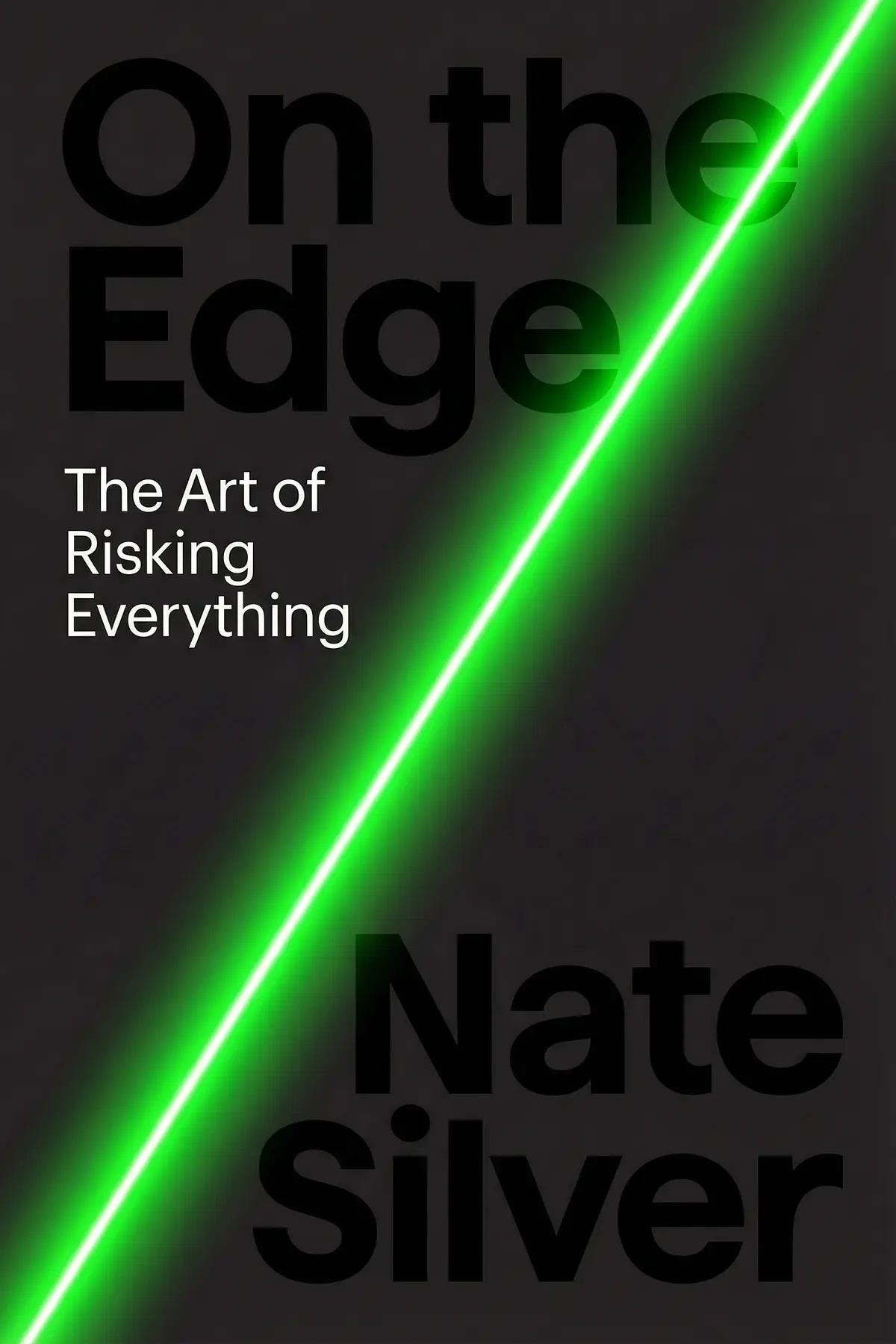
Table of Content
1. Introduction
55 sec
Most people judge a risky choice by whether it is likely to work. In On the Edge, Nate Silver, a professional poker player turned political forecaster, argues that the better test is what a bet is worth over many tries, so the wisest bet is sometimes one you will probably lose. Silver argues that pricing uncertainty splits people into two camps, and the camp that thinks in probabilities keeps coming out ahead.
His case is that risk rewards those who measure it honestly and then act on it with discipline. The evidence runs from a raffle ticket with one-in-2,000 odds to a 2016 election forecast that critics called wrong. It also takes in a €900,000 hole at the poker table and a scientist whose stubborn bet led to COVID-19 vaccines. What remains is a small set of habits for deciding well when the outcome is out of your hands.
2. Price every bet by its long-run average
1 min 33 sec
A raffle ticket with a one-in-2,000 chance of winning looks like money thrown away. Silver shows why it can be a bargain, and why it can still be exactly the wrong thing to buy.
3. Read a forecast the way a poker player does
1 min 24 sec
Silver’s model gave the eventual winner of the 2016 US election a better chance than most other models did, and he was still called an idiot. The reaction says more about his critics than about his math.
4. Know which tribe you think like
1 min 39 sec
Silver has spent his working life moving between two groups of very clever people who see uncertainty in opposite ways. Each has a blind spot, and the most useful thinking borrows from both.
5. See the game through your rival's eyes
1 min 31 sec
One entrepreneur and investor routinely asks how a rival could beat his own businesses. A former national security advisor says policy in Iraq went wrong for a similar reason. Their habit has nothing to do with being kind.
6. Stay with a good process through a bad run
1 min 31 sec
A poker professional found himself €900,000 down in a single match. What he did next, and what he refused to do, separates people who recover from losses from those who make them worse.
7. Commit fully or walk away
1 min 30 sec
When a choice is hard, the middle path feels like the safe one. Silver looks at how countries handled COVID-19 and argues that the compromise often carried the costs of both extremes.
8. Bet against the crowd only with a reason
1 min 37 sec
For years, most researchers believed a certain molecule was too fragile to ever become a medicine. One scientist suspected the experts were wrong for reasons unrelated to science, and she turned out to be right.
9. Keep your focus for the moments that count
1 min 23 sec
Astronauts during launch face a flood of alarms, and top poker players spend long stretches scrolling on their phones. Both are practicing the same skill, and successful entrepreneurs and executives pace their attention in a similar way.
10. Conclusion
1 min 06 sec
On the Edge adds up to an argument that handling risk is a skill and not a mood. The forecaster mocked for a 29 percent call and the poker player sitting €900,000 down were doing the same thing: holding to an honest estimate of the odds while others reacted to a single result. Silver’s River thinkers do this by instinct. His best risk-takers add something the Village is good at, a feel for what other people want and fear.
The habits are modest enough to try this week. Before saying no to a long shot, estimate what it is worth over many tries, and then ask whether you could survive losing it. When a plan goes badly, judge the process behind it before you judge the result. If you catch yourself choosing a half-measure, decide whether to raise or fold. And when you want to bet against the crowd, name the reason it might be wrong.
None of this guarantees a win on any single hand, and Silver never claims it does. What it gives you is a way of choosing that holds up across many hands, which is the only place where skill can ever show.
About this book
What is this book about?
Pandemics, market crashes and close elections all force the same hard question: how should anyone think about risk they cannot avoid? Nate Silver, who made his living as a professional poker player before becoming a well-known political forecaster, argues that most people answer it badly. They treat likely things as certain and unlikely things as impossible, and they judge a decision by its result instead of its odds. Silver's alternative starts with expected value, the average outcome of a bet across many tries, which explains why a raffle ticket you will almost surely lose can still be a good buy. He then describes two communities: the River, home to analysts, forecasters and gamblers who reason in probabilities, and the Village, made up of many people in government, media and academia who often do not. From hedge fund managers, generals, astronauts and poker champions, Silver draws habits that successful risk-takers share. They read the other side, trust a sound process through bad runs, commit fully or walk away, doubt the crowd only for good reasons and save their focus for the moments that decide the outcome.
Book Information
Who it's for
Facing uncertain bets
Professionals and founders who face uncertain bets and want a clearer way to weigh them.
Struggling with probabilities
People who struggle to read forecasts, odds and polls without rounding them to yes or no.
Panicking or hedging
Anyone who tends to panic after a bad result or settle for half-measures.
About the Author
Nate Silver
Nate Silver, born in 1978, is an American statistician, political analyst, author, sports gambler and poker player. He first made his name with PECOTA, a system for forecasting Major League Baseball players' performance. His 2008 election model called the winner in 49 of 50 states, and Time named him one of the world's 100 most influential people in 2009. He founded FiveThirtyEight and later served as its editor-in-chief. His book The Signal and the Noise won the 2013 Phi Beta Kappa Award in Science. He now publishes the newsletter Silver Bulletin and advises Polymarket.
Ratings & Reviews
Ratings at a glance
What people think
Listeners find the work highly absorbing, with every chapter offering substantial enjoyment and intriguing material. It earns praise for its insightful look at risk and decision-making and its robust discussion of game theory, while also being well-documented and educational. Listeners appreciate the wide variety of interviewees and find the book entertaining, with one listener noting it tackles a vital issue of our time. However, the writing quality receives mixed reviews; some find the style breezy while others suggest it is not well written.
Top reviews
Pong
What if you could view every major global challenge through the lens of a high-stakes poker game? Silver does exactly that, mapping out a fascinating ecosystem he calls 'The River,' populated by quantitative thinkers who thrive on uncertainty. I was captivated by the deep-dive interviews with everyone from professional sports bettors to AI researchers like Eliezer Yudkowsky. The way he breaks down the psychology of decision-making is both practical and deeply researched, making complex game theory concepts accessible to a general audience. While some might find the narrative a bit breezy, I appreciated the conversational tone and the insider access he provides to Silicon Valley’s biggest players. It’s a thought-provoking look at the essential issues of our time, particularly the existential risks surrounding AGI. Whether you're a gambler or a venture capitalist, there is a wealth of information here about how to handle the odds in a chaotic world. This is easily one of the most engaging books on strategy I've read in years.
Show moreLadawan
Truth is, Nate Silver writes exactly like he thinks—fast, slightly scattered, and obsessed with finding an edge where others see only noise. I found this to be an absolutely brilliant exploration of the 'gambler's mindset' applied to everything from sports to the future of humanity. The way he weaves together poker strategy with the risks of AGI is surprisingly seamless and kept me hooked through every chapter. I loved the diversity of people he interviewed; it’s not just the usual CEOs, but also professional bettors and niche experts who actually understand the odds. His concept of 'positive expected value' is a great mental tool for anyone looking to make better decisions in their personal or professional life. Some critics might find his tone a bit arrogant, but I think he’s just being honest about the level of skill required to win in these fields. This is an essential read for anyone who wants to understand the hidden mechanics of our modern, high-risk world.
Show moreRania
After hearing so much buzz about Nate Silver’s return to long-form writing, I was eager to see if he could recapture the magic of his previous work. This book is a substantial and engaging deep dive into the minds of people who play for keeps, whether at the poker table or in the boardroom. I especially appreciated the nuanced look at the SBF saga, which avoids the typical black-and-white moralizing in favor of a look at how 'expected value' calculations can go horribly wrong. The writing is energetic and the interviews are top-notch, though the middle 'Habits' section felt a little like a blog post that got expanded into a chapter. To be fair, Silver is at his best when he’s explaining the math behind the madness, rather than trying to define vague social groups. It is an informative and occasionally challenging read that forced me to reconsider my own aversion to risk. It’s not perfect, but it’s a vital contribution to the conversation about innovation and its consequences.
Show morePia
The chapter on professional slot machine players was a total eye-opener for someone like me who always assumed the house wins no matter what. Silver excels at finding these hidden pockets of rationality in places where most people see only luck or chaos. His exploration of venture capital as a 'Keynesian beauty contest' was equally illuminating, providing a sharp critique of the herd mentality that drives Silicon Valley investments. While the book is long, the short chapters and varied subject matter keep the momentum going through some of the denser statistical sections. I did feel that he was a bit soft on some of his more controversial subjects, but he does offer a cogent critique of how gamification can lead to addiction. In my experience, this is the kind of book you read slowly to digest the different mental models he presents. It’s a powerful discussion of game theory that manages to be both entertaining and deeply educational for anyone interested in decision-making.
Show moreEli
As someone who spent way too much time watching the FTX collapse in real-time, I found Silver’s insider-perspective on SBF to be the highlight here. He captures the weird, utilitarian logic of the Effective Altruism crowd perfectly, showing both the potential and the peril of that mindset. The book is definitely scattershot, but it works because Silver is such a curious and capable guide through these high-stakes subcultures. I enjoyed the stories about his own poker career, even if they bordered on a humblebrag every now and then. One minor complaint is that he sometimes neglects the role of luck or external funding in the success stories of people like Musk or Bezos. Still, the core message about the value of risk-taking in a stagnant society is incredibly relevant today. It's a breezy, well-written journey that feels very 'current' and avoids being too dry or academic. Definitely worth a read for anyone who enjoys books like 'Range' or 'Rationality'.
Show moreFrida
To be fair, the book's subtitle 'The Art of Risking Everything' is a bit of a misnomer since most of these people are actually obsessed with bankroll management. Silver shows that true risk-takers aren't just blind gamblers; they are calculated analysts who understand when the price is right to move. I picked this up wanting to learn more about prediction markets, and I was not disappointed by the depth of coverage provided there. The writing style is casual and easy to digest, which helps when he starts diving into more complex probability theories or AI alignment issues. I did find the SBF sections a bit repetitive after a while, especially since that story has been covered so extensively elsewhere. However, the overall package is a fascinating look at the subcultures that are currently shaping our technology and economy. It’s a great pick for generalists who want a speedy refresher on the major trends of the last decade. Silver remains one of the most interesting voices in data journalism for a reason.
Show moreCee
The dichotomy between the 'River' and the 'Village' provides a fascinating, if sometimes overly simplistic, framework for understanding modern power structures. On one hand, I love Silver's epistemically humble approach to statistics and his clear-eyed view of how professionals manage risk in high-pressure environments. On the other hand, the book often feels like it's trying to do too many things at once, jumping from poker rooms to AI doom scenarios without a strong connective thread. Personally, I found the chapters on gambling much more grounded and insightful than the later sections on Effective Altruism and Sam Bankman-Fried. Silver clearly identifies with the risk-takers, but he occasionally misses the mark by ignoring the safety nets that many of these 'disruptors' rely on. It’s a decent collection of essays, yet it lacks the cohesive punch needed to be a true classic. You'll definitely learn something new, but you might find yourself skimming through the more self-indulgent personal anecdotes.
Show moreManop
Wow, this was a massive undertaking that feels part memoir and part sociological study of the world's most aggressive gamblers and tech elites. There is no denying that Silver is an incredible interviewer who can get people to open up about their processes in ways other journalists can't. However, the tone often shifts between objective analysis and a weird 'me-against-the-world' vibe that gets tiring after three hundred pages. He spends a lot of time shadowboxing against a 'Village' establishment that he never quite defines clearly, making some of his arguments feel like they belong on a Twitter thread. The sections on sports betting and opening odds were the highlight for me, offering a genuine 'edge' in understanding how those markets function. Look, it’s a good book if you’re already interested in these subcultures, but it probably won't convert anyone who isn't already a fan of his style. It’s informative, but the lack of a central thesis makes it feel like a series of interesting detours.
Show moreRapee
Finally got around to finishing this, and I’m walking away with very complicated feelings about Silver's worldview. The information is presented well and the research is undeniably thorough, yet I can't help but feel that he’s preaching to the choir. If you already like the Silicon Valley ethos and enjoy gambling metaphors, you’re going to love this book. For the rest of us, his defense of 'The River' can feel a bit elitist and disconnected from the realities of most people's financial lives. He analyzes the psychology of risk-takers brilliantly, but he often ignores the systemic advantages that allow them to fail without consequences. To be fair, the section on AI risk was genuinely terrifying and much better articulated than most mainstream media coverage on the topic. It’s a mixed bag of brilliant insights and frustrating blind spots. I don’t regret the time spent reading it, but I’m not sure it changed my perspective as much as 'The Signal and The Noise' did.
Show moreElias
I picked this up because I’m a fan of Silver’s data-driven approach, but the execution here is surprisingly messy and unfocused. While I enjoyed his earlier work, this feels like a loosely connected series of name-dropping anecdotes masquerading as a grand theory of risk. The narration on the audiobook is particularly distracting, with strange pauses and bizarre impressions that really pull you out of the experience. Frankly, he spends way too much time defending his elite 'River' friends like SBF and Thiel without offering enough critical pushback. It’s a shame because there are flashes of brilliance when he sticks to the math of poker, but those moments are buried under layers of humble-bragging. If you’re looking for a tight analysis of game theory, you might be disappointed by how much of this feels like a Twitter feud in book form. It’s an okay read for a plane ride, but it lacks the intellectual rigor I expected.
Show moreQuestions about this book
What is On the Edge by Nate Silver about?
It is about how to think about risk. Silver, a former professional poker player and political forecaster, explains expected value and why many people misread probabilities. He contrasts the River, a community of analysts, forecasters and gamblers who reason in odds, with the Village of government, media and academia. He then describes habits that successful risk-takers share, such as strategic empathy, process focus and a raise-or-fold mentality.
What is expected value in On the Edge?
Expected value is the average outcome of an uncertain event if it were repeated many times. Silver’s example is a $100 raffle ticket with a one-in-2,000 chance at a $1,000,000 prize. Each ticket is worth about $400 on average, even though it will almost surely lose. He adds that you should only take such bets if you can afford the loss.
Why does Nate Silver say his 2016 forecast was not wrong?
His model gave Donald Trump a 29 percent chance of winning, which is close to the odds of rolling a 1 or a 2 on a die. An outcome like that is far from impossible. His forecast also rated Trump higher than most other models, some as low as 1 percent, and the betting markets at 17 percent, so people who bet using his numbers made money.
What does raise or fold mean in On the Edge?
Borrowed from poker, it means either committing fully to a course of action or dropping it completely, instead of settling on a half-measure. Silver argues that during COVID-19, New Zealand’s aggressive containment and Sweden’s minimal intervention both turned out better than compromise approaches, which often brought long disruption without controlling the virus.
How can I apply the ideas from On the Edge at work?
Judge long shots by their value over many tries and by whether you could survive the loss. When results turn bad, review your process before changing course, as poker player Phil Galfond did. Argue a competitor’s case the way Mark Cuban does, avoid half-steps, name a clear reason before you bet against the consensus, and save your focus for the moments that decide the outcome.
Featured in
Readers also enjoyed



Adults in The Room: My Battle With Europe’s Deep Establishment
Yanis Varoufakis


1929: Inside the Greatest Crash in Wall Street History--and How It
Andrew Ross Sorkin

23 Things They Don’t Tell You About Capitalism
Ha-Joon Chang
A Little History of Economics
Niall Kishtainy


A Splendid Exchange: How Trade Shaped the World
William J. Bernstein
AUDIO SUMMARY AVAILABLE
Listen to On the Edge in 15 minutes
Get the key ideas from On the Edge by Nate Silver, plus 5,000+ more nonfiction titles.
- 5,000+ titles
- Listen as much as you want
- 7-day free trial
- Cancel anytime









