

13 min 54 sec
Available in: English
Obedience to Authority: An Experimental View
Shows why most ordinary people will harm a stranger when a credible authority tells them to continue, what lets them shed responsibility, and which conditions help some of them refuse.
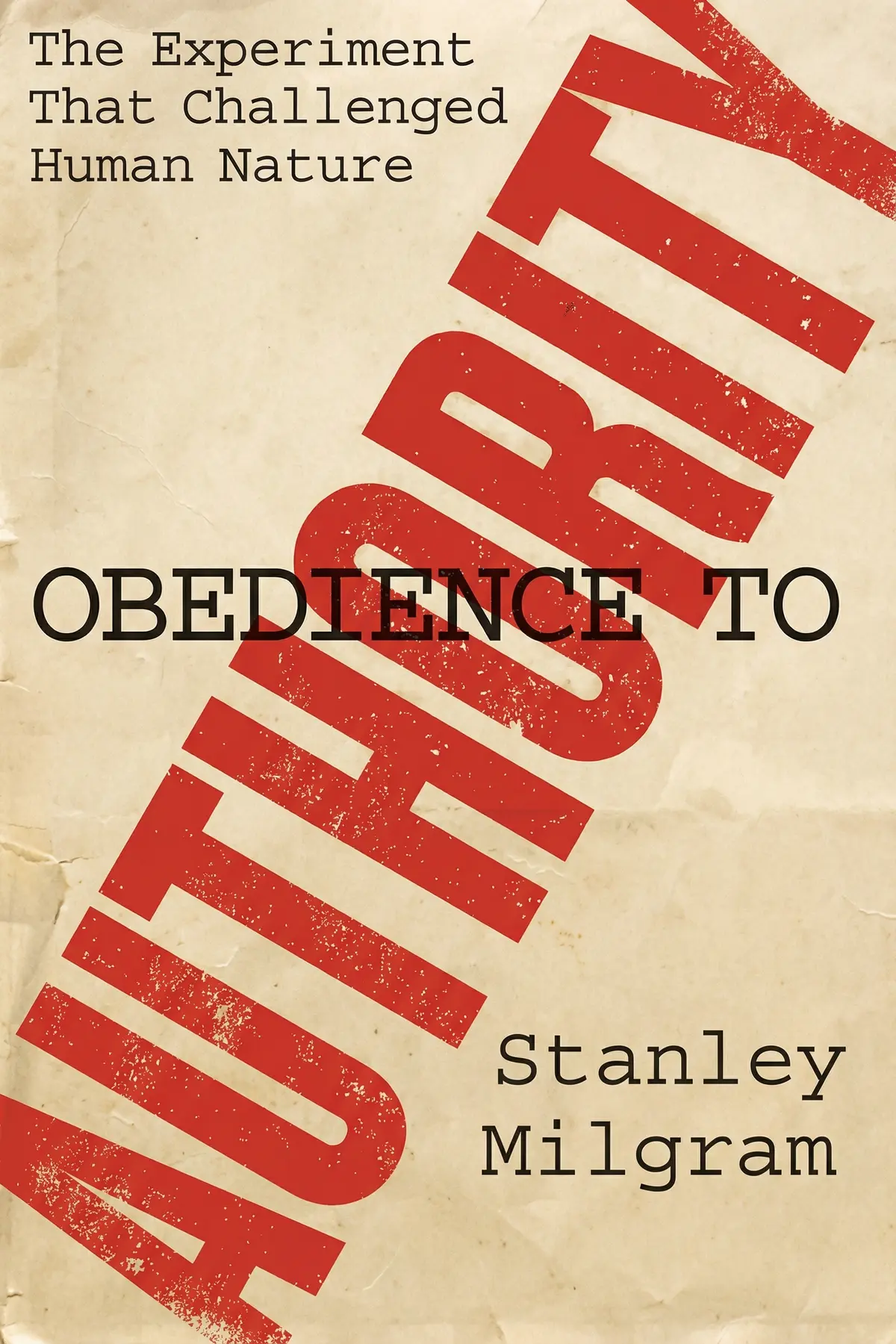
Table of Content
1. Introduction
59 sec
Most of us trust our conscience to stop us from hurting a stranger just because someone told us to. In Obedience to Authority, social psychologist Stanley Milgram tested that trust at Yale, and it did not hold up: in his first study, 26 of 40 ordinary volunteers kept pressing a switch they believed sent 450 volts into a screaming man. They took no pleasure in it. They had simply been told to continue by someone who looked like he was in charge.
Milgram’s argument is that obedience turns decent people into tools of harm because they pass the moral weight of their acts to the authority above them. Status makes that handover easy and distance makes it easier. Closeness to the victim makes it hard. Follow his experiments and you will learn to spot the moment your own judgment is being outsourced. You will also see what the few who refused had that the others lacked.
2. Learn how decent people end up following cruel orders
1 min 38 sec
Nearly everyone who reads about history’s massacres feels certain they would have refused to take part. Milgram suspected that certainty was the most dangerous assumption of all, and he set out to measure it.
3. Understand the setup that fooled thousands of volunteers
1 min 38 sec
Recreating the pressure that leads people to hurt others sounds impossible to do safely. Milgram found a design simple enough to involve thousands of participants, with the actors’ performances making it all feel disturbingly real.
4. Spot the signals that make an order feel legitimate
1 min 51 sec
The same instruction, word for word, produced obedience from one person and outrage from another. The difference had nothing to do with what was being asked, and everything to do with who seemed to be asking.
5. Notice the moment you hand away your conscience
1 min 47 sec
Milgram’s volunteers kept asking the same anxious question before they pressed the next switch. Once they got the answer they wanted, something inside them changed, and the act no longer felt like their own.
6. Small private rebellions leave the harm in place
1 min 42 sec
Many of the obedient volunteers were secretly cheating the experiment whenever they thought nobody was watching. Their small acts of defiance reveal a lot about human decency, and about why decency alone so rarely stops harm.
7. Closeness to the victim makes refusal far more likely
1 min 38 sec
One small change to the setup flipped the results almost completely. It did not involve a stronger argument or a kinder experimenter, only how much of the learner’s suffering the volunteer was forced to face.
8. Turn inner conflict into the courage to say no
1 min 31 sec
The few volunteers who walked away did so as strain mounted, until their own moral code outweighed the wish not to offend the experimenter. Milgram saw in that struggle the same material heroes are made from.
9. Conclusion
1 min 10 sec
Milgram’s experiments take apart a comforting story, the one that says atrocities need monsters. The people in his Yale lab were ordinary volunteers who hated every switch they pressed. What kept them going was a composed man in a white coat, a respected building and the relief of hearing that someone else would answer for the outcome. When the order came from someone with no status, they called it sadistic. When they had to press the victim’s hand down themselves, most of them stopped.
That leaves some working tests. When an instruction troubles you, imagine it coming from a peer with no title and see whether it still sounds reasonable. Listen for the phrases that pass your responsibility upward, and ask which part of the result is still yours. Close the distance to the people who will bear the cost. And when you notice yourself softening an order in secret, consider whether the honest move is to refuse it out loud.
Disobedience, Milgram found, costs stress and self-doubt, which is why so few manage it. Yet the volunteers who broke free were the same kind of people as those who kept going. The only difference was that they stopped letting the coat decide.
About this book
What is this book about?
Most people are sure their conscience would stop them from hurting someone just because they were told to. Stanley Milgram, troubled by the crimes of the Nazi regime, decided to test that confidence in a laboratory at Yale. Volunteers believed they were giving electric shocks to a learner who screamed and begged to be released, while a calm experimenter in a lab coat told them to go on. The results unsettled even the experts. In the first study, 26 of 40 people went all the way to the maximum of 450 volts. Milgram then varied the setup. He removed the authority figure, sent orders by phone and forced teachers to touch the victim. These versions show what drives obedience and what weakens it. His central idea is the agentic state, the frame of mind in which people treat their own actions as someone else's responsibility. Readers get a clear account of the experiment and its main variations, and a set of practical tests for noticing when their own judgment is being handed to someone in charge. Milgram also explains why the rare people who refuse deserve to be called heroes.
Book Information
Who it's for
Following orders they doubt
Professionals and managers who sometimes carry out instructions they privately doubt.
Hoping teams speak up
Team leads who want people to feel able to question orders that cause harm.
Trying to understand atrocities
Readers of history and psychology trying to understand how ordinary people take part in atrocities.
About the Author
Stanley Milgram
Stanley Milgram (1933 to 1984) was a social psychologist born in Manhattan. After a political science degree at Queens College, he earned his PhD at Harvard and went on to teach at Yale, Harvard and the City University of New York Graduate Center. He ran his obedience experiment at Yale in 1961, first reported it in a 1963 journal article and explored it in full in this 1974 book. He also introduced the idea of familiar strangers, and a 2002 survey ranked him 46th among the most-cited psychologists of the 20th century.
Ratings & Reviews
Ratings at a glance
What people think
Listeners view this work as essential reading, especially for those studying psychology, and describe it as one of the most profound investigations into human behavior ever written. Furthermore, the book is praised for its clear writing style, affordable price, and revelatory perspectives, while one listener highlighted how accurately the author details the experiments.
Top reviews
Worawit
This book is essentially a foundational pillar for anyone even remotely interested in social psychology. Milgram provides a remarkably clear account of his 18 different experimental variations, and the results are as illuminating as they are deeply disturbing. I was particularly struck by the discrepancy between how people predicted they would behave and how they actually acted when the pressure was on. It’s a penetrating examination of the human condition that forces you to question your own moral compass. While the subject matter is heavy, the prose is surprisingly accessible for a scientific text. This should be mandatory reading for students to understand how authority can override individual conscience so easily.
Show moreAlejandra
Ever wonder how ordinary people can commit horrific acts under the guise of 'just following orders'? This book provides the most chilling answers I have ever encountered in a psychology text. Milgram’s work at Yale in the early 1960s remains one of the most significant studies ever conducted on human behavior. He meticulously documents how subjects were willing to deliver what they believed were lethal electric shocks to a screaming victim just because a man in a lab coat told them to continue. The writing is sharp and clinical, yet it carries an emotional weight that stayed with me long after I put it down. It is an eye-opening look at the fragility of our personal ethics.
Show moreSomkid
Not what I expected in terms of readability, as Milgram writes with a clarity and directness that is rare for academic researchers. He doesn't just present dry numbers; he includes transcripts of the subjects' conversations that make the tension in the room feel tangible. You can almost feel the anxiety of the participants as they struggle between their empathy for the 'learner' and their ingrained habit of obedience. The book does an excellent job of addressing early criticisms while laying out a theory that explains why good people knuckle under. It’s a penetrating study of power dynamics that feels as fresh today as it did decades ago. Truly an essential read for understanding our darker impulses.
Show moreTan
The chapter on group defiance provides a much-needed glimmer of hope in an otherwise depressing investigation of the human psyche. Milgram shows that when the 'authority' is challenged by a group, the individual’s tendency to obey drops off a cliff. This part of the research is often overlooked in favor of the more shocking results, but it’s arguably the most important lesson. Personally, I think this book is a must-read for anyone who wants to understand how tragedies like My Lai or Abu Ghraeb can happen in modern times. The analysis is thorough, the cost is reasonable, and the insights into human behavior are absolutely unparalleled. It completely changed how I view social hierarchies.
Show moreIsaiah
Finally got around to reading this classic and it’s every bit as unsettling as the summaries suggest. The truth is, we all like to believe we’d be the ones to walk out of that room, but the data suggests otherwise. I found the sections on group defiance particularly interesting, showing that we are much more likely to resist if we see others doing the same. To be fair, some of the methodology is dated, and modern critics have raised valid points about the ethics involved. However, the core message about the 'agentic state' is still incredibly relevant in today's world. It’s a well-written, reasonably priced edition that belongs on every thinker's bookshelf.
Show morePloy
As someone who is currently studying behavioral science, I found the transcriptions of the participants to be the most haunting part of this entire book. Milgram’s investigation into why we defer to authority figures is perhaps the most famous experiment in history, and reading the primary source is far better than any textbook summary. The way he breaks down the 18 variations of the experiment shows just how much physical proximity to the victim changes our willingness to inflict pain. My only minor complaint is that the latter half of the book gets a bit repetitive with the theoretical analysis. Regardless, it remains a penetrating examination of how social structures influence our private morality.
Show moreSing
Look, this isn't exactly a light beach read, but it’s a necessary deep dive into the 'agentic state' that governs so much of our social hierarchy. Milgram explains his procedures with such accuracy and detail that you can see exactly where the pressure points were for the participants. I found the section on female participants particularly interesting since their results were almost identical to the men’s, debunking some old-school myths. The book is an accurate explanation of a very complex series of tests. My only gripe is that the tone can get a bit clinical when discussing what was essentially psychological torture for the subjects. Still, it is one of the most penetrating books on behavior ever written.
Show moreSofia
Milgram’s prose is surprisingly accessible, making this one of the most penetrating looks at the darkness hidden within the average person. He takes us through the 1960s Yale labs and shows us that the line between a 'good person' and a participant in cruelty is thinner than we want to admit. The connection he draws between his results and real-world atrocities like the My Lai massacre is both chilling and convincing. I appreciate that he included the negative reactions and criticisms his work received, as it gives the reader a more complete picture. This is a well-written account that provides a lot of food for thought. It's a reasonably priced investment for a massive amount of psychological insight.
Show moreDing
Frankly, while the insights are groundbreaking, the ethical concerns surrounding the original 1960s protocol cast a long shadow over the entire work for me. Milgram’s results are depressing and suggest that we are hardwired for barbarism under the right conditions. While the book is well-written, I found myself questioning the validity of some conclusions given the psychological stress placed on the participants. It is definitely an eye-opening read, but it needs to be taken with a grain of salt alongside more modern critiques. The introduction by Zimbardo is a nice touch, though it reminded me how controversial this branch of social psychology has become. It’s important historically, but a tough pill to swallow.
Show morePick
After hearing so much about these 'frauds' in modern psychology podcasts, I approached this with a healthy dose of skepticism. The experiments are famous, sure, but there is a lot of debate now about whether the subjects actually believed they were shocking someone. To be fair, Milgram does address some of these concerns in the later chapters, and his writing style is very professional. However, the book feels a bit like a defense of his own legacy rather than a purely objective report. It's a fascinating historical document that every psych student should read, but it’s not the definitive word on human nature it’s often made out to be. A mixed bag for sure.
Show moreQuestions about this book
What is the main idea of Obedience to Authority?
Stanley Milgram argues that most ordinary people will harm another person when someone they see as a legitimate authority tells them to. In his first study at Yale, 26 of 40 volunteers gave what they believed was a 450 volt shock to a screaming learner. They were not sadists. They obeyed because they had been trained to respect authority and because they passed responsibility for the act to the experimenter.
What is the agentic state in Milgram's experiment?
The agentic state is Milgram’s term for the frame of mind in which people stop treating their actions as their own and see themselves as instruments of an authority. His subjects kept asking the experimenter to take responsibility for any harm. Once he agreed, their guilt eased and they continued. Milgram saw the same state in Auschwitz guards who never killed anyone directly but made the killing possible.
What made people disobey in the Milgram experiment?
Two factors stand out. When a fellow volunteer with no authority gave the order to raise the voltage, subjects refused and called him cruel. When teachers had to press the learner’s hand onto a shock plate themselves, 70 percent openly disobeyed, because they could no longer deny their part in his pain. Rising stress and inner conflict also pushed a few people to break free.
How can I apply the lessons of Obedience to Authority at work?
When an instruction troubles you, ask whether you would follow it if a peer without a title gave it. Notice phrases like it is not my decision, which signal that you are handing responsibility upward. Get closer to the people your choice will affect. And if you find yourself secretly softening an order you think is wrong, consider refusing it openly, because hidden resistance rarely stops the harm.
Did Milgram's subjects enjoy giving the shocks?
No. Milgram found almost no one enjoyed causing pain. Subjects were stressed and nervous and hoped the experimenter would let them stop. When he left the room and gave orders by phone, many kept the shocks low while claiming they had raised them, or hinted the right answers to the learner. Yet almost none openly refused, because walking out meant a scene, lost payment and a confrontation.
Readers also enjoyed

Acting with Power: Why We Are More Powerful Than We Believe
Deborah Gruenfeld


Age of Propaganda: The Everyday Use and Abuse of Persuasion
Anthony Pratkanis




59 Seconds: Change Your Life in Under a Minute
Richard Wiseman


AUDIO SUMMARY AVAILABLE
Listen to Obedience to Authority in 15 minutes
Get the key ideas from Obedience to Authority by Stanley Milgram, plus 5,000+ more nonfiction titles.
- 5,000+ titles
- Listen as much as you want
- 7-day free trial
- Cancel anytime









