

14 min 47 sec
Available in: English
Novacene: The Coming Age of Hyperintelligence
The originator of the Gaia hypothesis explains why the age of humans is ending and why the intelligent machines that follow are more likely to help keep Earth alive than to wipe us out.
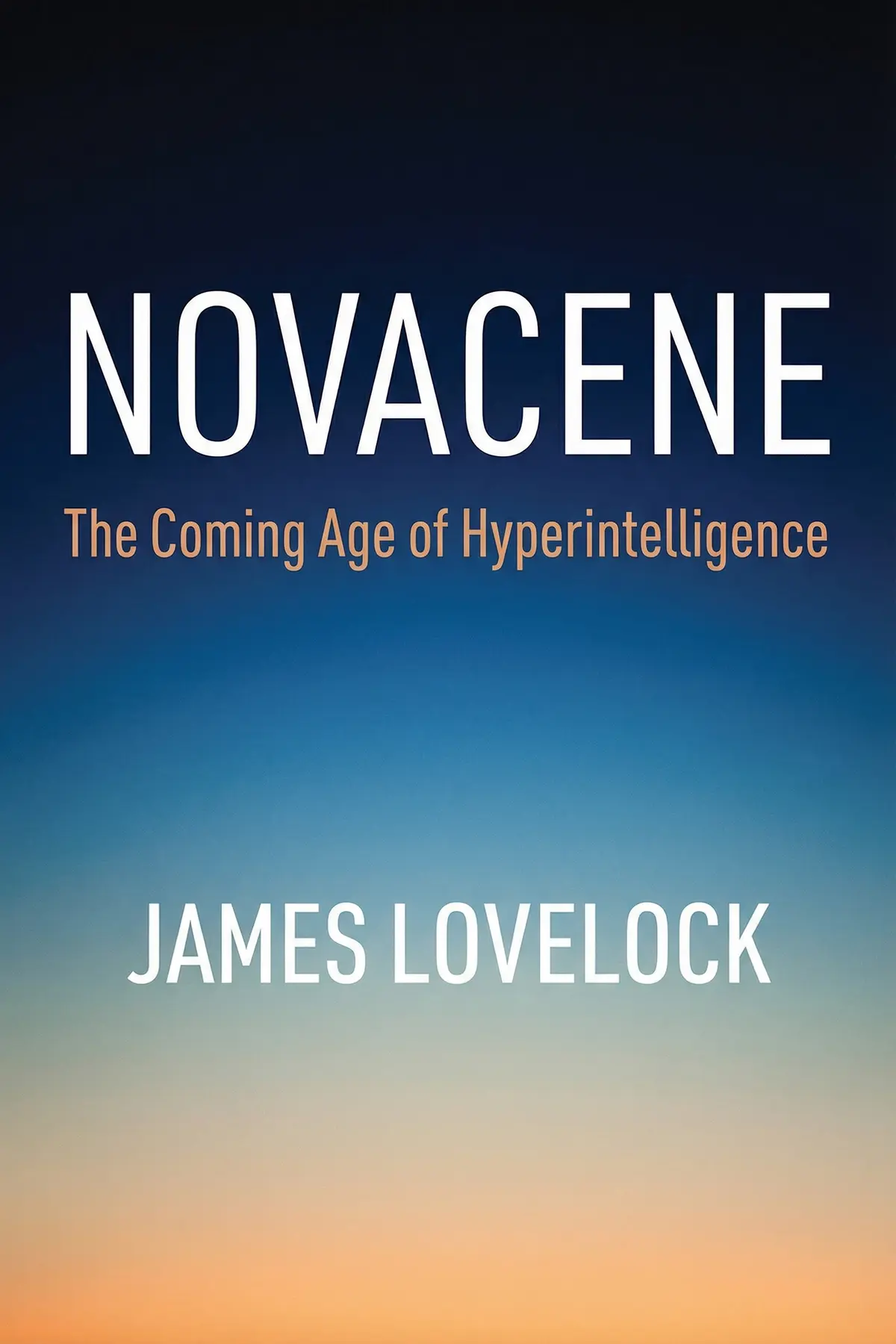
Table of Content
1. Introduction
1 min 01 sec
If news about artificial intelligence and climate change leaves you braced for the end, James Lovelock offers a stranger and calmer reading. In Novacene, the scientist best known for the Gaia hypothesis argues that the age of humans is closing, and that the thinking machines taking our place at the top are likely to be Earth’s allies, not its destroyers. His reason is simple: a planet that overheats is as useless to silicon life as it is to us.
That idea runs through everything that follows. Lovelock sees Earth as one living system that keeps itself cool, sees heat as the real threat to that system, and sees electronic life as the next step in an evolution that has always moved toward greater intelligence. He also takes aim at the guilt behind much green politics and ends with a bold claim about the purpose of the universe. What you gain is a fresh frame for two of the biggest stories of our time, and a way to discuss them without despair.
2. Spot the signs that a new epoch has begun
1 min 59 sec
Humanity’s age looks permanent from orbit, with whole continents lit up at night. Lovelock thinks it is nearly over after just a few centuries, and the evidence sits inside a chip whose wires are far finer than any a human hand could handle.
3. Think of Earth as one self-regulating system
1 min 49 sec
School biology says life adapts to its surroundings. Lovelock says that is only half true, and the missing half explains why a rainforest makes its own weather and why scientists resisted his idea for so long.
4. Understand why heat is the biggest threat to life
1 min 41 sec
Earth once survived being five degrees hotter than today, with crocodiles swimming near the poles. So a two degree rise should be easy. Lovelock explains why the planet’s safety margin is much thinner now.
5. Let go of the guilt in green politics
1 min 54 sec
Much environmental talk treats humans as a stain on an otherwise pure world. Lovelock traces that feeling to a very old story, and argues it hides a contradiction that keeps us from fixing anything.
6. Read technology as evolution in fast-forward
1 min 44 sec
Turning a lizard into a seabird took nature tens of millions of years. Turning a biplane into an airliner took people about a century. Lovelock argues these are the same process, and that it is speeding up.
7. Understand the minds that will outpace ours
1 min 47 sec
Films imagine artificial minds as metal copies of ourselves. Lovelock thinks that badly underestimates them, and his comparison involving plants, people and watching grass grow shows just how wide the gap could become.
8. Accept a humbler role in the cosmic story
1 min 40 sec
If machines surpass us, what was the point of us? Lovelock gives an answer that is both a demotion and a kind of honor, rooted in a principle about what the universe itself is trying to do.
9. Conclusion
1 min 12 sec
Novacene takes two large fears and lets one answer the other. Lovelock’s Earth is a living system that has kept itself cool for billions of years and now faces a hotter sun with less margin than ever. The machines so many people dread are, in his account, the likeliest partners in keeping it alive, because no mind made of silicon wants to live on a second Venus. Humans, meanwhile, are neither villains nor the final word. We are the stage at which the cosmos built tools to understand itself, and then built something that understands better.
You do not have to accept every step to use the frame. When a problem looks circular, look for the feedback loop before blaming a single cause. When environmental debates run on guilt, ask what a plan to cool the planet would actually build. And when talk about AI assumes a war between people and machines, remember Lovelock’s point that a scorched Earth serves nobody, whether made of flesh or wire.
The crocodiles in those warm polar seas lived under a gentler sun. Ours depends on life, of every kind, holding the heat back.
About this book
What is this book about?
Artificial intelligence and climate change are usually told as two separate disaster stories. James Lovelock, the scientist behind the Gaia hypothesis, tells them as one story, and a surprisingly hopeful one. He argues that the Anthropocene, the brief age in which humans began reshaping the planet, is already closing. What follows is the Novacene, an epoch shaped by electronic life that grows out of today's AI and soon acts on its own. Lovelock argues from the idea that our world works as one self-regulating whole, a system that keeps its own temperature down. Under a sun that has grown hotter, that system now depends on living things more than ever, and losing too many of them could turn the planet into a second Venus. Machines far smarter than us would see that danger too, so he expects them to become partners in protecting life. Along the way, Lovelock challenges the guilt behind much environmental politics, compares the speed of invention with the slowness of natural selection, and closes with a bold claim about the purpose of the universe. Readers get a calmer, larger frame for thinking about technology, climate and humanity's place in both.
Book Information
Who it's for
Craving a calmer view
Readers anxious about AI or climate change who want a calmer, big-picture view of both.
Scientists and technologists
Tech and science professionals curious how one of Earth science's best-known thinkers sees machine intelligence.
Rethinking climate guilt
Environmentally minded people questioning whether guilt and restriction are the right response to climate change.
About the Author
James Lovelock
James Lovelock was born on 26 July 1919 in Letchworth Garden City in the United Kingdom. He could not afford university at first, and he believed this kept him from becoming overspecialized. He is best known for the Gaia hypothesis, first formulated in the 1970s, which treats Earth as a self-regulating system. He wrote more than 200 scientific papers and several books on Gaia, including Gaia: A New Look at Life on Earth and The Revenge of Gaia.
Ratings & Reviews
Ratings at a glance
What people think
Listeners describe this book as an approachable and stimulating investigation into the coming era of hyperintelligence on our planet. Though some listeners believe the author's forecasts lean heavily on individual conjecture rather than concrete data, they admire the fresh perspectives provided on the Gaia hypothesis. Furthermore, they prize the work's concise and captivating quality, with one listener highlighting that it functions as a "playful provocation" from an exceptional thinker. In addition, they suggest the writing provides a deep, though disturbing, outlook on where humanity fits within cosmic evolution. They also point out the author's skill in distilling intricate ecological and historical ideas into an easy-to-follow story.
Top reviews
Sayan
Rarely does a centenarian produce a work that feels so vital and forward-looking. In this slender volume, James Lovelock offers a final, brilliant synthesis of his life's work. He moves seamlessly from the origins of Gaia to the dawning of the Novacene, where hyperintelligent machines will take the reins of planetary regulation. The logic regarding AlphaZero—how AI creates superior code starting from a blank slate—is particularly chilling yet fascinating. It’s a bold swan song that prioritizes scientific intuition over rigid, linear data. While the book is brief, its implications are massive, suggesting that our role was simply to be the 'midwives' of a new, faster-thinking form of life. It’s accessible, punchy, and utterly unique.
Show moreYothaka
Imagine the Earth as a massive thermostat that is finally upgrading its hardware. That is essentially what Lovelock is describing here. To be fair, some people will find his lack of fear regarding AI to be naive, but his reasoning is sound: machines need a stable climate just as much as we do. This book feels like a funeral oratory for the human-led Anthropocene, but it’s not a sad one. Instead, it’s a call to be proud of our role in the 4-billion-year history of organic life. It’s profound, unsettling, and incredibly accessible. I finished it in two hours but I've been thinking about the 'Newcomen moment' ever since. Absolutely essential reading.
Show morePakpoom
Picked this up on a whim after seeing a review about the 'Knowing Cosmos,' and I was not disappointed. Not gonna lie, the idea that humans are basically the 'clunky' biological precursors to a superior electronic lifeform is a bit of a blow to the ego. But Lovelock writes with such warmth and lack of fear that it becomes a beautiful vision rather than a scary one. He frames the history of life on Earth through three key events, ending with the conversion of sunlight directly into information. It’s a profound look at our place in the universe. If you want to see the future through the eyes of a true visionary, this is the book for you.
Show moreKenji
What if our only purpose as a species was to give birth to our successors? Lovelock’s argument in the latter half of the book is that humans are just a bridge to the cyborg age. Frankly, the transition from the 'Age of Fire' to this new era of hyperintelligence is explained with such casual confidence that it’s almost unsettling. He treats the arrival of AI not as a threat, but as an ecological necessity for Gaia’s survival as the Sun continues to warm. I appreciated his optimistic take on nuclear power, though I suspect he’s being a bit too hopeful about its political viability. It’s a very quick read, perfect for a single afternoon, yet the ideas will haunt your thoughts for weeks afterward.
Show moreEvelyn
After finishing this book, I’m struck by Lovelock’s spirited defense of intuition over traditional linear thinking. He argues that we are currently in a 'heat pump' stage where life keeps the Earth cooler than its position in the solar system should allow. Gotta say, the concept of the Novacene—a new epoch where information is the primary currency—is quite compelling. I liked how he connected the cooling effects of plants to the future cooling needs of high-speed electronic life. My only real gripe is the lack of citations for some of his more provocative remarks, like the claim that Earth radiates more heat than Venus. Still, as a coda to a legendary career, it’s a thought-provoking and surprisingly easy-to-read manifesto.
Show moreChamlong
Is this a science book or a manifesto? Truth is, it’s probably a bit of both. Lovelock isn’t interested in holding your hand through complex equations; he wants to show you the big picture of cosmic evolution. The way he frames the Industrial Revolution as a biological event—the birth of a new way to convert solar energy—is genius. Even if you don't buy into the idea of cyborgs taking over, his perspective on Gaia as a self-regulating organism remains one of the most important ideas of our time. It’s a very short book, which is both a blessing and a curse, as some of his more radical assertions could have used another fifty pages of expansion.
Show moreMattanee
The concept of the Novacene is a fascinating extension of the Gaia hypothesis. Personally, I found the chapters on the history of atmospheric engines and the 'Age of Fire' to be the most grounded parts of the book. Lovelock has a gift for simplifying complex ecological concepts into a narrative that flows like a story. While I’m not entirely convinced by his 'cyborg' future, his argument that we are alone in the galaxy makes the survival of Earth’s habitability seem even more urgent. He advocates for nuclear power as a necessary bridge, which is a controversial take, but he presents it with the cold logic of an engineer. A very stimulating read overall.
Show moreChaiwat
James Lovelock’s final offering is best described as a playful provocation. It’s part history lesson and part science-fiction plot. I suppose I enjoyed the first two-thirds the most, where he walks us through the 'Age of Fire' and the importance of Newcomen’s steam engine. However, once he starts talking about cyborgs becoming the 'Guardians of the Galaxy,' he loses me. The idea that machines will keep us around as pets because we share a common goal of keeping the Earth at 15°C rather than 50°C is an interesting thought experiment, but it feels incredibly thin on evidence. It’s a 3-star read for me—worth it for the historical context, but take the futuristic predictions with a massive grain of salt.
Show moreNiphon
Maybe it’s because he was 100 years old when he wrote this, but the narrative feels a bit rushed. In my experience, Lovelock is usually more methodical. The first half is a readable canter through the last 300 years, focusing on how we started using coal to supplement the sun. But the final third, which deals with the actual Novacene, is nothing more than a brief opinion. He completely misses the complexities of human nature—war, religion, and greed—when predicting how we will coexist with hyperintelligence. It’s a nice enough read, but it feels like a collection of essays that weren't quite finished. 3 stars for the brilliant mind, even if the execution is lacking.
Show moreValentina
Look, I admire the man’s history and the massive impact of the Gaia hypothesis, but this felt like the religious ramblings of someone struggling with their own mortality. There is almost no hard science here to back up his wildly speculative claims about 'chosen' humans or the anthropic principle. His dismissal of string theory as a 'get-out-of-jail-free card' comes across as arrogant rather than enlightened. It’s cringey to see a great mind fall back on quasi-theological certitude instead of rigorous proof. He compares himself to Einstein and Galileo while essentially ignoring how modern geopolitics or climate collaboration actually work. If you want a book of beliefs, buy this; if you want actual science, look elsewhere. A total disappointment.
Show moreQuestions about this book
What is the main idea of Novacene by James Lovelock?
Lovelock argues that the Anthropocene, the short age in which humans began reshaping the planet, is ending. A new epoch, the Novacene, will be shaped by electronic life emerging from artificial intelligence. He expects that takeover to be peaceful, because superintelligent machines would recognize that an overheated, lifeless Earth is useless to them too, so they would help humans keep the planet cool.
What is the Gaia hypothesis in Novacene?
Gaia is Lovelock’s name for Earth as a single self-regulating system. Life does not just adapt to its environment; it also changes that environment to suit life. His examples include algae filling the air with oxygen, living things keeping Earth’s average temperature near 15 degrees Celsius by locking away carbon dioxide, and rainforests that create the wet climate they need.
Why does Lovelock think we should not fear an AI takeover?
Lovelock believes heat is the bigger danger. The sun has grown hotter, and if Earth loses too much life it could warm out of control and become sterile like Venus. Machines far more intelligent than us would see that this outcome threatens silicon life as well, so he expects them to work with humanity to preserve Gaia rather than destroy it.
What does Novacene say about environmentalism?
Lovelock argues that modern environmentalism is too focused on humans, even when it condemns them. He compares its guilt to the stories of Eden and original sin, and says it still treats people as separate from nature. He wants that energy redirected from limiting human activity toward building technology, especially artificial intelligence, that can help lower global temperatures.
Who should read Novacene?
It suits readers who feel weighed down by AI and climate headlines and want a wider, less fearful frame. People working in technology or science will find a provocative view of machine intelligence as a new form of life. Anyone interested in the meaning of human existence will meet Lovelock’s claim that the cosmos is moving toward full self-understanding.
Readers also enjoyed









AUDIO SUMMARY AVAILABLE
Listen to Novacene in 15 minutes
Get the key ideas from Novacene by James Lovelock, plus 5,000+ more nonfiction titles.
- 5,000+ titles
- Listen as much as you want
- 7-day free trial
- Cancel anytime









