

13 min 30 sec
Available in: English
Not Today: The 9 Habits of Extreme Productivity
Shows how to get far more done by sorting your hours into four kinds of time, defending them with nine learnable habits, and recovering fast when life knocks your routine apart.
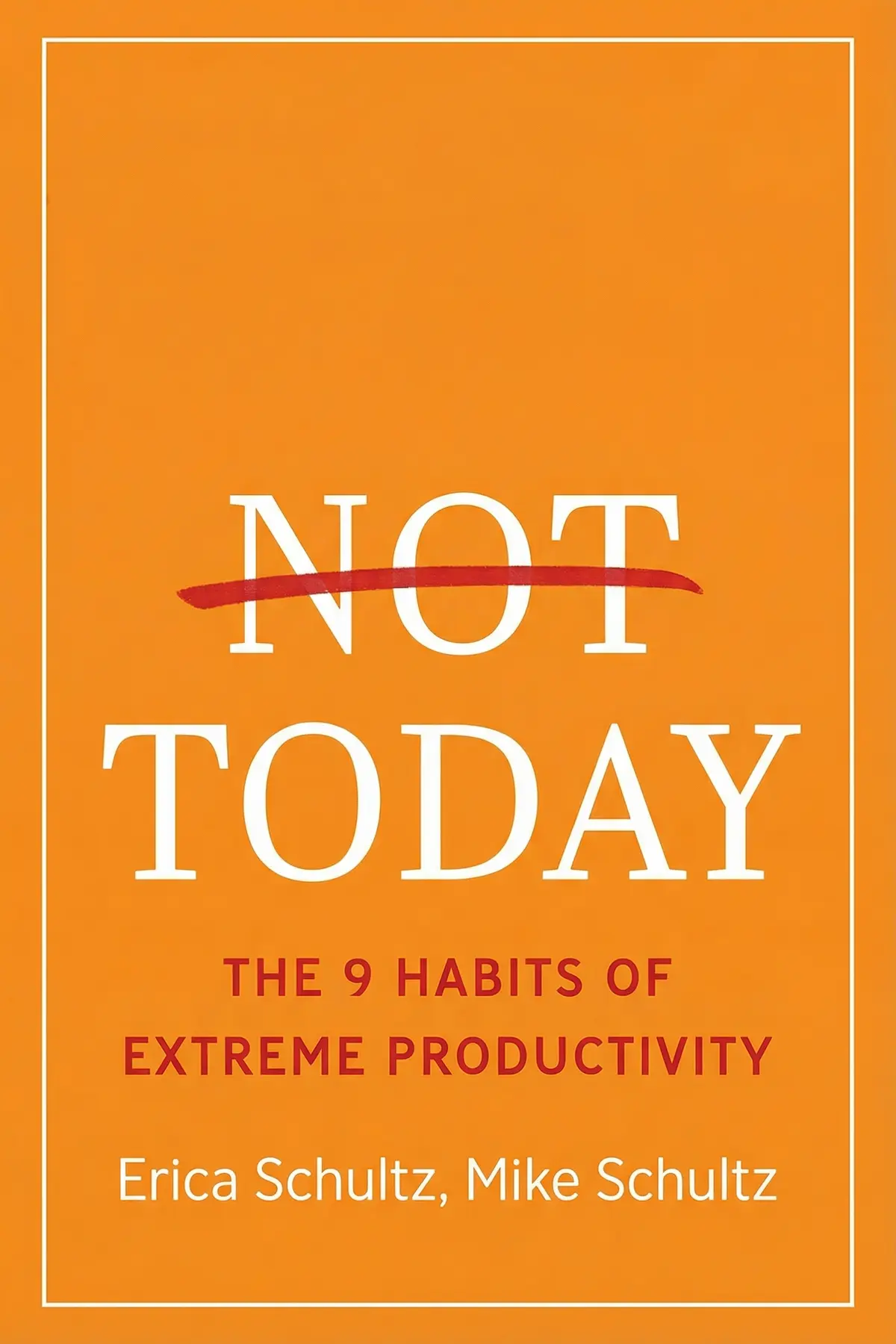
Table of Content
1. Introduction
1 min 08 sec
Most workdays leak away in small pieces: a notification, a favor, an hour that turns out to hold ten minutes of real work. In Not Today, sales researchers Mike and Erica Schultz argue that the people who get far more done follow habits anyone can learn. The couple tested that claim in the hardest conditions imaginable.
While their son Ari fought a serious heart defect, spending more than a year of his short life in hospital, they ran their company from waiting rooms. In those years they opened nine international offices and wrote four books. A survey of thousands of professionals then showed them a group they call the Extremely Productive, and nine habits that set them apart.
The argument is simple. Productivity comes from deciding what each hour is for, defending that choice, and recovering fast when life breaks the plan. What follows is a way to sort your calendar, a test for every request, and a routine for getting back on course after a hard week.
2. Sort every hour into four kinds of time
1 min 47 sec
Two hours can look identical on a calendar and be worth completely different things. A family living in a hospital found a simple way to see the difference, and it changed how they spent every day.
3. Find a reason strong enough to finish hard projects
1 min 51 sec
Two months before a charity event, a family got news that made cancelling seem like the only sensible choice. The person who changed their minds was their young son, and his reaction reveals what really drives big projects.
4. Spend your freshest hours on the task that matters
1 min 57 sec
A sick boy’s mornings kept disappearing into a screen, and nobody had the heart to stop it. The small change his parents finally made lifted his whole day, and it maps neatly onto the way most adults start work.
5. Protect your schedule with a firm no
1 min 56 sec
A father trying to work beside his son’s hospital bed felt annoyed by the interruption, until he realized what the morning was teaching him. That lesson leads to a simple test for every request you receive.
6. Work in timed sprints and keep your energy high
1 min 50 sec
An hour at the desk once yielded barely a sixth of an hour of real work for one of the authors. The fix he found is mechanical, almost boring, and it depends on a tool most people carry but should not use.
7. Recover quickly when your good habits collapse
1 min 48 sec
After the worst loss a parent can face, two people with every productive habit in place found themselves sleepless and running on empty. What brought them back was smaller and more practical than most people would expect.
8. Conclusion
1 min 13 sec
The Schultzes built their method in a hospital waiting room, which makes it hard to argue that ordinary distractions are too big to beat. Their nine habits rest on a plain idea: an hour does not become productive by accident. Someone has to decide what it is for, keep requests, emails and phones from taking it, and fill it with focused work while there is still energy to give.
The place to begin is small. Write down one goal that matters to you, two years out, and work backward to what this month and this week require. Tomorrow, label your hours with the four letters of TIME and notice how much of the day was empty. Run one timed sprint on your Greatest Impact Activity before the morning is gone. And when your routine collapses, as it will, refuse one bad habit and take one tiny step rather than waiting to feel ready.
When the next request arrives that does not fit your priorities, you already have the words. Not today, said often enough, gives your hours back to the work and the people you treasure.
About this book
What is this book about?
Most people lose their working day in small pieces: a buzzing phone, a favor they could not refuse, an hour that holds ten minutes of real work. Mike and Erica Schultz faced far worse. For years they ran a growing company while their son Ari, born with a serious heart defect, spent more than a year of his short life in hospital. Drawing on that experience and on survey responses from thousands of professionals, they singled out a set of people they name the Extremely Productive, along with the nine habits that distinguish them. The method starts with TIME, a way of sorting every hour into treasured, investment, mandatory or empty time. It then shows how to find a purpose that carries hard projects, protect the morning for your most valuable task, refuse requests that do not fit, work in timed sprints and keep your energy up. The final habit is about recovery: what to do when grief, stress or bad routines pull you off course. Readers get a practical system for building better days, told through a family story that makes every rule feel earned.
Book Information
Who it's for
Professionals with stalled priorities
Professionals whose days fill up with email, meetings and favors while their most important work never moves.
Leading amid home stress
Founders and managers running a business through a stressful period at home.
Hoping to rebuild routines
Anyone whose good routines collapsed after a hard stretch and who wants a practical way back.
About the Author
Erica Schultz
Mike Schultz has served as President of RAIN Group and directs its Center for Sales Research, which has studied buying and selling since 2005. He wrote the Wall Street Journal bestseller Rainmaking Conversations, along with Insight Selling and Virtual Selling, and has taught marketing and sales at Brandeis University and Babson College. Erica Schultz leads go-to-market strategy, branding and lead generation at RAIN Group, turning the center's findings into reports for sales professionals, including The Extreme Productivity Benchmark. Worcester Business Journal named her to its 40-under-40 list in 2019.
Ratings & Reviews
Ratings at a glance
What people think
Listeners find this book inspiring and potentially life-altering, with one review noting the deep level of detail provided for every habit. Furthermore, they appreciate the way it helps boost personal productivity and consider it a rewarding experience with a captivating narrative. They also value the message of overcoming adversity, as one review highlights the book’s focus on authentic real-world events.
Top reviews
Bam
This book destroyed me and then rebuilt me from the ground up. It isn't just about getting more done at a desk; it's about the grit required to keep moving when your heart is breaking. The story of Ari is absolutely gut-wrenching and stays with you long after the final page is turned. To be fair, I initially struggled with the shift from personal tragedy to corporate productivity hacks. However, the concept of 'righting the ship' eventually resonated with my own professional struggles. It provides the spark needed to overhaul your daily routine through pure resilience. This is a profound look at finding strength in adversity while staying functional.
Show moreRodrigo
Finally, a time management book that actually acknowledges the messiness of real human life and deep personal struggle. Most productivity gurus act like we live in a vacuum, but Erica and Mike show strength from adversity. The chapter on 'Righting the Ship' gave me practical steps to recover when my routine inevitably falls apart. I loved the concept of 'free won't' and how it helps you break destructive, unproductive patterns of behavior. The book is rooted in the harrowing reality of medical crises, making the advice feel earned and authentic. This provides the spark needed to overhaul your daily routine and focus on what truly matters to you.
Show moreElan
The concept of 'Treasured Time' alone is worth the price of admission for this incredible, heartfelt book. It shifted my perspective from just surviving the workday to actually cherishing the moments that have the most meaning. While the story of their son Ari is incredibly sad, it serves as a powerful catalyst for their methods. I have already started breaking my big-picture goals down into the manageable daily chunks they recommend in chapter one. This is a complex and complete guide for anyone who wants to value their time more effectively every day. It is easily one of the most motivating books I have picked up in the last several years.
Show moreMind
After hearing about the 'Productivity Code' on a podcast, I finally decided to give these nine habits a try. The most impactful part for me was the chapter about Mike playing hockey signals with his son, Ari. It illustrated the 'Treasured Time' concept perfectly and made me rethink my own schedule immediately. Instead of just working harder, the authors teach you how to fuel your energy triad of mind, body, and spirit. I have started using the '3, 2, 1, go!' trick to get out of bed, and it actually works. This book revolutionized how I perceive my limited hours on this earth and I highly recommend it.
Show moreTawee
How do you stay productive when your world is falling apart and everything feels completely out of control? The Schultz family answers this through their 'TIME' acronym, which categorizes hours into Treasured, Investment, Mandatory, and Empty. I found the focus on eliminating 'Empty Time' to be particularly helpful for my own scrolling habits. Not gonna lie, reading about Ari’s heart condition was difficult, but it grounded the advice in a harsh reality. The authors go into significant detail regarding the implementation of their habits, which makes it feel like a guide. It is a solid resource for anyone looking to increase their output while maintaining their humanity.
Show moreJirapat
Ever wonder how high-level executives manage to keep their companies afloat during a massive personal crisis? This book provides a compelling answer by detailing the systems Mike and Erica used while Ari was in the hospital. I particularly appreciated the 'GIA' framework, which helps you identify the one activity that produces the biggest return. The breakdown of 'sprints' and 'relays' is practical and something I could implement in my office right away. My only minor criticism is that the 'Productivity Code' tools are somewhat difficult to access online without giving up data. Despite that, the core message about managing energy rather than just time is a very powerful one.
Show morePhichai
Not Today is a strange hybrid of a heart-wrenching memoir and a standard corporate productivity manual. Personally, I was expecting a deep-dive into efficiency, but the narrative often veers back into their personal tragedy. The resilience the Schultz family showed is undeniably inspiring, but the productivity tips themselves felt somewhat derivative. If you are looking for a story about finding strength in adversity, you will certainly find value here. However, for those seeking groundbreaking new systems, the advice might feel like a rehash of other famous authors. It is a decent read, but the balance between self-help and memoir felt a little bit uneven for me.
Show morePong
Look, I have nothing but sympathy for what the Schultz family went through with their young son, Ari. Their story is undeniably moving and the level of resilience they displayed is truly off the charts. That said, as a productivity guide, I found the actual advice to be a bit of a rehash. If you have read any Brene Brown or David Rock, you have already encountered these concepts before. I wanted a book that focused more on extreme efficiency and less on the emotional memoir side. It is a good read, but perhaps not the best for those seeking technical time-management strategies.
Show moreSam
Maybe I’m being cynical, but the productivity advice here felt like a recycled version of every other business book. I checked out a book on efficiency only to end up reading repeatedly about a family losing their son. While the authors’ personal story is tragic, it felt like it was being used to bolster very basic tips. I found the frequent mentions of their sales success to be a little bit off-putting and corporate. The writing style is clear, but I was seeking something much more focused on neuroscience and technical workflows. Frankly, there are more accessible ways to learn about time management without the heavy emotional weight of this memoir.
Show moreMaksim
The authors are clearly sales experts, and that commercial vibe permeates every single chapter of this book. Truth is, I was incredibly disappointed to find that the online tools mentioned were gated behind a data wall. I do not appreciate being treated like a sales lead when I have already paid for the product. Furthermore, most of the actual productivity advice is just a repackaged version of things you find in basic seminars. They cite better authors constantly, so my advice is to just go read those original sources instead of this. It felt like they were selling their personal tragedy to bolster a very weak self-help manual.
Show moreQuestions about this book
What is the main idea of Not Today by Erica and Mike Schultz?
The authors argue that extreme productivity is learned, not inborn. From a survey of thousands of professionals, they identified a group called the Extremely Productive and nine habits that set them apart. The habits cover three areas: finding the drive to pursue goals, managing your time through their TIME framework, and working in focused, energetic sessions. A final habit helps you recover when life knocks you off course.
What does TIME stand for in Not Today?
TIME sorts every hour into four kinds. Treasured time is personally precious, like hours with family or a favorite class. Investment time returns more than you put in and should take most of your working day. Mandatory time covers chores and duties, which you should shrink, outsource or convert, for example by playing a useful podcast on your commute. Empty time, such as idle scrolling, should be cut entirely.
What is a Greatest Impact Activity?
In Not Today, your Greatest Impact Activity is the task that gives the biggest long-term return on focused, careful effort. It can change from day to day. The authors recommend filling your calendar with investment activities, then doing your Greatest Impact Activity early in the day while your mind is fresh. On sluggish mornings, they suggest sitting up and counting down from three to get moving.
How do you get into the zone according to Not Today?
The authors recommend sprints: blocks of 20 to 90 minutes reserved for focused work. A relay is made up of a series of four sprints, one after another, separated by brief breaks. Time them with a stopwatch that is not on your phone, so you are not tempted to check messages. Staying in the zone also needs energy, which they split into mind, body and spirit: positive self-talk and fewer small decisions, good food, sleep and exercise, and meaningful work.
Who should read Not Today?
It suits busy professionals and business owners who feel their days are consumed by interruptions, requests and email. It also speaks to anyone trying to stay productive through a personal crisis, since the authors built their method while their son was seriously ill. Its final habit, righting the ship, offers concrete tools for anyone whose routines have collapsed, from refusing bad habits to making small, costly commitments to yourself.
Readers also enjoyed



AUDIO SUMMARY AVAILABLE
Listen to Not Today in 15 minutes
Get the key ideas from Not Today by Erica Schultz, plus 5,000+ more nonfiction titles.
- 5,000+ titles
- Listen as much as you want
- 7-day free trial
- Cancel anytime









