Doppelganger: A Trip into the Mirror World
Naomi Klein
 English
 ไทย
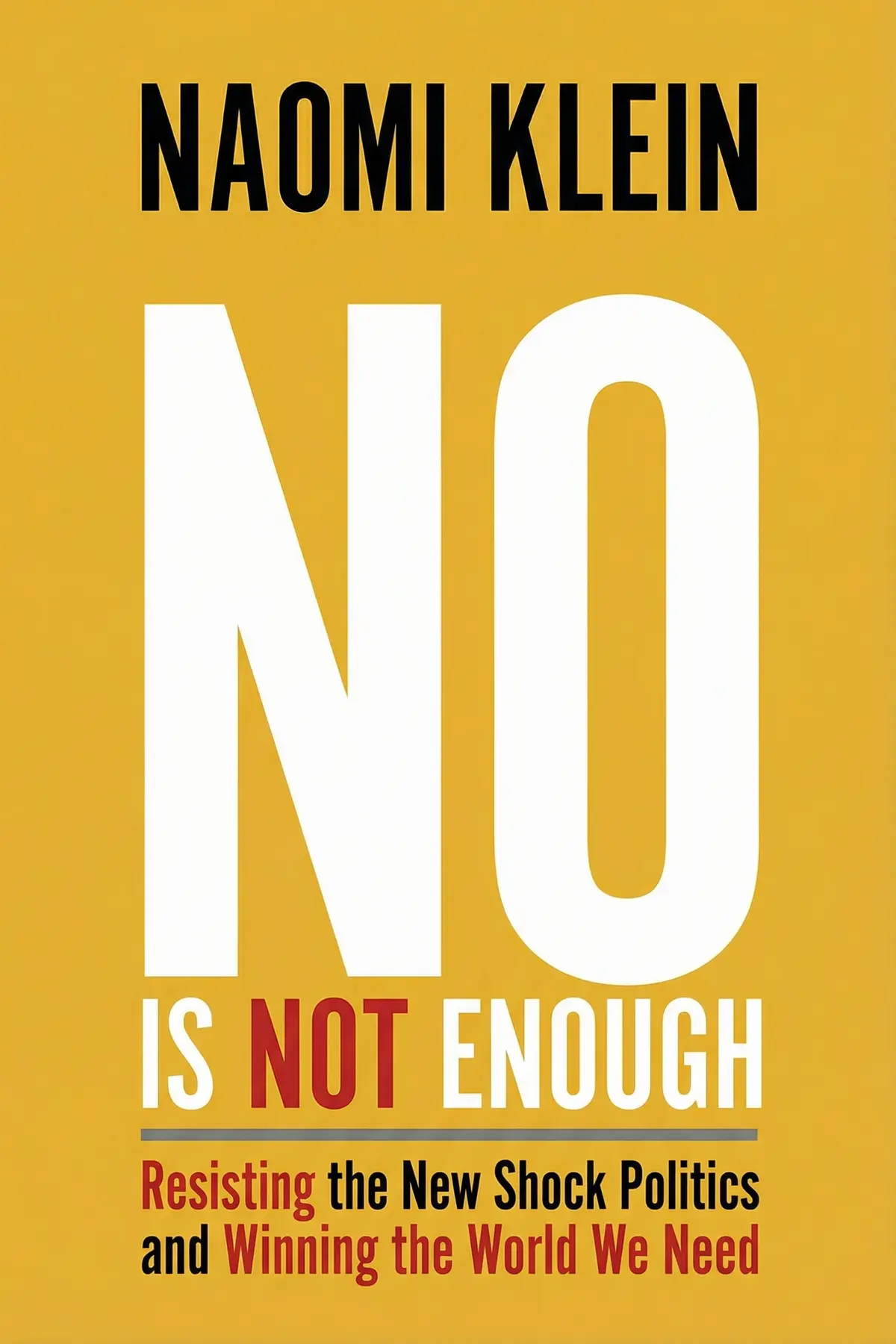
Naomi Klein shows how to read Donald Trump as a brand that exploits moments of shock, and argues that resistance succeeds only when it offers a concrete, unifying plan for a better society.
58 sec
If the political news leaves you stunned and always one step behind, Naomi Klein offers a way to get your footing back. In No Is Not Enough, the journalist and author of The Shock Doctrine argues that Donald Trump is easy to read once you see him as a brand that happens to hold the presidency, and brands follow predictable rules. Her second key is that Trump and his team thrive on disorientation, using crises to rush through policies the public would reject in calmer times.
Seeing both lets citizens spot the moves early. Yet refusing them is only half the work: resistance wins when it offers a concrete vision people can sign. Along the way come Nike sneakers, a walled compound in Baghdad, a hotel bought for a sliver of its value, crowds filling airports and a Canadian manifesto that turned anger into a plan.
1 min 54 sec
A pair of sneakers once sold for $250 mainly because of a slogan and a basketball star. The business logic behind that price turns out to describe a president’s choices more clearly than any party platform.
1 min 59 sec
A reality show about firing people and a staged wrestling match look like odd guides to governing. Klein treats them as a forecast, and points to the one kind of joke that reliably made the brand’s owner furious.
1 min 46 sec
Billionaires who fund causes in Africa and fight global warming earn public trust as fixers. Klein questions where that trust comes from, and why a party’s safest choice in 2016 proved to be its riskiest.
1 min 59 sec
In Baghdad, a walled zone with gyms and fast food became the place where a country’s economy was rewritten. The same method, Klein argues, shaped a hotel deal in 1970s New York.
2 min 08 sec
A school system remade within a year of a hurricane, and a $180 million farewell gift from an oil company. Klein connects these to explain why some people in power prefer disorder to calm.
1 min 44 sec
Crowds in Spain in 2004 and at American airports showed that a crisis does not always leave the public helpless. One thing makes a shock tactic backfire, yet protest on its own still falls short.
1 min 52 sec
Union heads, Indigenous leaders, feminists and environmentalists in Canada sat at one table to draft a single document. Tens of thousands signed what they wrote, and its proposals go further than most protest slogans.
1 min 08 sec
The title carries the argument. Saying no to a leader you oppose is necessary, and Klein never doubts it. But a no without a yes leaves people where Occupy ended up: loud for a season, then scattered, while those who profit from chaos wait for the next crisis.
What the book gives a resister is sight. Seen as a brand, Trump’s choices stop looking random and start looking like a product line, from The Apprentice to a doubled club fee. Seen through the shock doctrine, his rush of early decrees belongs with the Commodore Hotel deal and Baghdad’s Green Zone: speed used against a stunned public.
When the next crisis brings a burst of sudden decisions, slow down and ask who gains from each, and remember the last time a crisis was used this way, as Spaniards remembered Franco. Then find, or help write, a plan that ties your cause to others, the way the Leap Manifesto joined labor, climate, Indigenous and feminist groups in one document.
Shock works on people who are confused and alone. It struggles against people who remember, and who already know what they want instead.
When Donald Trump won the 2016 election, many people who had worked for years on climate action, gender equality and civil rights felt stunned and unsure how to respond. Naomi Klein wrote No Is Not Enough for them. Her argument is that Trump becomes easy to understand once you treat him as a brand, bound by the same rules that turned Nike and Starbucks into superbrands. The second step is to recognize the shock doctrine, the tactic of pushing unpopular policies through while the public is disoriented by crisis. Klein traces that tactic from Baghdad's Green Zone and post-Katrina New Orleans to Trump's own New York real estate deals and his administration's early flood of decrees. She examines his climate rollbacks, his cabinet's ties to oil and banking, and the risk that a war or a financial crisis could serve as the next shock. The core message sits in the title. Protest alone, Klein argues, falls short, as the Occupy Movement showed. She offers the Leap Manifesto, drafted with Canadian labor, Indigenous, feminist and environmental leaders, as a model of a positive plan that unites separate causes.
Activists and volunteers who feel overwhelmed by fast-moving political crises and want to see the pattern behind them.
Organizers of climate, labor, feminist or Indigenous causes looking for a model of joint action.
Readers curious how branding and disaster economics shape modern politics.
Naomi Klein, born in Montreal in 1970, first became known internationally with No Logo and followed it in 2007 with The Shock Doctrine, a history of neoliberal economics. No Is Not Enough became a New York Times bestseller and a National Book Award nominee. She has written columns for The Guardian, reported for Harper's and Rolling Stone, and made the documentary The Take with her husband Avi Lewis. In 2016 she received the Sydney Peace Prize for her climate justice activism, and since 2021 she has been a professor of climate justice at the University of British Columbia, where she co-directs the Centre for Climate Justice.
Listeners consider this title to be crucial reading, specifically for the Trump era, commending its thoroughly researched and sharp analysis. Additionally, the prose is straightforward and succinct, with one listener mentioning that it is as engaging as a novel. The material is also seen as evocative and emboldening, with one review emphasizing its functional tips for neutralizing Trump. Listeners value the political themes, with one review highlighting how the book explains neoliberalism and presents alternatives to disaster capitalism.
Naomi Klein has a remarkable gift for articulating the vague sense of dread many feel in this current political climate. This book isn't just a critique of a single administration; it’s a surgical examination of how we became a society that worships 'superbrands' over citizens. Klein connects her previous work on the shock doctrine to our present reality with such clarity that it often reads as quickly as a thriller. Frankly, the way she explains the merger of corporate branding with the highest levels of government is both terrifying and brilliant. It provides a necessary toolkit for keeping our heads when everything feels like a manufactured crisis. If you want to understand how the public sphere was auctioned off, start here. This is essential reading for anyone who refuses to accept the current status quo as normal.
Show moreAs someone who has followed Klein’s work since 'The Shock Doctrine,' I found this to be her most urgent and practical piece yet. She doesn't just diagnose the terminal illness of our political system; she offers a roadmap for recovery through collective action. The sections detailing the resistance at Standing Rock were moving and served as a powerful illustration of what a unified 'yes' looks like in practice. We are living through a period where the very idea of democracy is being undermined by corporate interests. This book helps you flip the script and stop reacting to every tweet so you can focus on systemic change. It’s empowering and deeply insightful. You will walk away from this feeling like there is actually a path forward through the chaos.
Show morePicked this up during a long flight and ended up finishing the whole thing before I landed because the writing is just that compelling. Klein breaks down how both major American parties have essentially abandoned the democratic project in favor of the free market. She explains 'shock politics' in a way that makes sense of the overwhelming barrage of daily headlines. Truth is, we've been conditioned to accept the commodification of our entire lives, and this book acts as a much-needed wake-up call. It’s incredibly empowering to realize that the current chaos is a tactical tool, not just accidental incompetence. This isn't just another political book; it’s a guide for survival. It makes complex neoliberal theories feel accessible to anyone. Definitely a must-read for the age of Trump.
Show moreAfter hearing Naomi Klein speak at a recent rally, I finally grabbed this book to see if her 'Yes' was as strong as her 'No.' It absolutely is. She argues convincingly that the modern Left has lost its sense of utopia and desperately needs to reclaim a vision for what we actually want to build. The way she links environmental protection to systemic economic justice and indigenous rights is masterfully done. It’s a bold course for winning a fair and caring world, rather than just surviving a corporate takeover. Every chapter feels like a tool for shock-resistance in an era of constant distraction. Personally, I found the discussion of the Leap Manifesto to be the most hopeful thing I’ve read in years. It’s clear, concise, and incredibly vital.
Show moreCan we actually move past just saying 'no' to every single outrage coming out of Washington? This is the central question Klein tackles, and her answer is a resounding call for a proactive 'yes.' She takes her thesis on disaster capitalism and applies it to the modern era with precision, focusing on how crises are used to roll back rights. I found the inclusion of the Leap Manifesto particularly inspiring, as it offers a tangible vision for the future rather than just a list of complaints. To be fair, a few chapters felt slightly rushed, likely because the book was written so quickly to address the immediate political moment. However, that sense of urgency is exactly what makes the prose so punchy and readable. It’s a great primer on how to build a better narrative.
Show moreThe branding analysis in the first half of this book is worth the price of admission alone. Seeing the current administration not as a Martian invasion but as the logical conclusion of decades of corporate deregulation is a total lightbulb moment. Klein’s expertise from 'No Logo' shines through as she explains how a family can operate as a series of spin-off brands. I do wish she had spent more time criticizing the specific failures of the previous decade to provide a more balanced view of the vacuum that was left behind. Still, it’s a thought-provoking read that moves at a breakneck pace. Not gonna lie, the sections on environmental destruction are pretty scary. It’s a sobering look at our reality that somehow manages to stay optimistic.
Show moreNot what I expected, but exactly what I needed to read to make sense of the constant noise of the news cycle. Klein explains that the current political moment is a symptom of a much deeper disease involving the deconstruction of the regulatory state. The writing is so sharp and engaging that it really does read like a novel at times, making very complex economic shifts easy to grasp. I appreciated the practical advice on how to neutralize the shock tactics used by those in power to keep us disoriented. While the subject matter can be depressing, the focus on 'caring majorities' is genuinely heartening. It’s a necessary guide for navigating our current surreal reality. A bit more data would have been nice, but the message is clear.
Show moreI’ve been a fan of Klein's reporting for years, and this book feels like the culmination of her warnings about how 'shocks' are used to bypass democracy. She does an excellent job reframing the narrative around wealth creators and the corporate capture of the public sphere. The core message is that we don't have time to despair because the stakes are simply too high for the planet. Gotta say, her critique of how both sides of the aisle have failed the public is spot on and very hard to ignore. It’s a quick, punchy read that provides a much-needed toolkit for anyone feeling overwhelmed by the current state of the world. A few more specific examples of successful international resistance would have made it a five-star for me.
Show moreFinally got around to this one, and while I agree with the core politics, the execution left me wanting a bit more substance. The book is definitely clear and accessible, which is great for a general audience, but it lacks the heavy-hitting investigative research I usually expect from Klein. In my experience, the calls for grassroots community building were a bit repetitive and lacked concrete steps for local implementation. However, the insights into how natural disasters are manipulated to hand public wealth to the mega-rich are still incredibly important and relevant. It’s a decent introduction to her theories if you’re new to her work, but it feels a bit like a 'greatest hits' collection. It’s worth a read, but maybe check it out from the library first.
Show moreWow, I really wanted to like this more, but it felt like a series of recycled blog posts rather than a cohesive, deeply researched book. Klein is obviously a talented writer, but this lacks the rigorous data and deep case studies that made her earlier work so revolutionary. Many of the arguments about Trump as a brand are interesting but feel a bit thin after the first fifty pages. Look, the advice to 'confront our inner Trumps' is just too vague and amorphous to be useful for actual political organizing or policy change. It’s a fast read, but it feels like it was put together in a weekend to capitalize on the 2017 news cycle. If you've read her other books, you won't find much new here. It was a bit of a letdown.
Show moreKlein argues that Donald Trump becomes predictable once you see him as a brand that must stay true to itself, and that his administration relies on the shock doctrine, pushing unpopular policies through while the public is disoriented by crisis. Resisting those tactics matters, but she insists protest alone falls short. Opponents need a concrete, shared vision of a better society, which she models with Canada’s Leap Manifesto.
The shock doctrine is Klein’s name for using a crisis to rush through policies people would normally reject. The term echoes shell shock, the dazed state that follows war, terror attacks or disasters. Her examples include Paul Bremer privatizing Iraq’s state assets from Baghdad’s Green Zone, Trump buying the Commodore Hotel cheaply during New York’s 1976 brush with bankruptcy, and Mike Pence’s flat-tax idea for the region hit by Hurricane Katrina.
The Leap Manifesto is a document Klein helped draft in 2015 with Canadian labor, Indigenous, feminist and environmental leaders, later signed by tens of thousands of Canadians. It treats these causes as connected and calls for collectively owned energy providers that fund services like daycare and public transit, a move to renewables that keeps workers employed, and higher taxes on corporations and the wealthy, a carbon tax and a smaller military budget.
The book suggests a few habits. When a crisis brings a rush of sudden decisions, ask who benefits from each and whether it would survive calm debate. Remember earlier crises that were exploited, since that memory helped Spaniards reject Aznar’s push for war in 2004. And when you protest, link your cause to others and back a concrete alternative, because Occupy showed how anger fades without one.
It suits activists, organizers and engaged citizens who felt stunned by the 2016 election and want to understand the pattern behind fast-moving political events. People working on climate, labor, gender equality or Indigenous rights will find an argument for joining forces. Readers curious how corporate branding and disaster economics shape politics will find concrete cases, from Nike’s superbrand status to post-Katrina New Orleans.



Barack Obama

Masaji Ishikawa

John Rawls



Miles Taylor


AUDIO SUMMARY AVAILABLE
Get the key ideas from No Is Not Enough by Naomi Klein, plus 5,000+ more nonfiction titles.