59 Seconds: Change Your Life in Under a Minute
Richard Wiseman
 English
Explains what happens during a night's sleep, what short nights cost in safety and mood, and which simple changes help you sleep better, from darker evenings to white noise.
51 sec
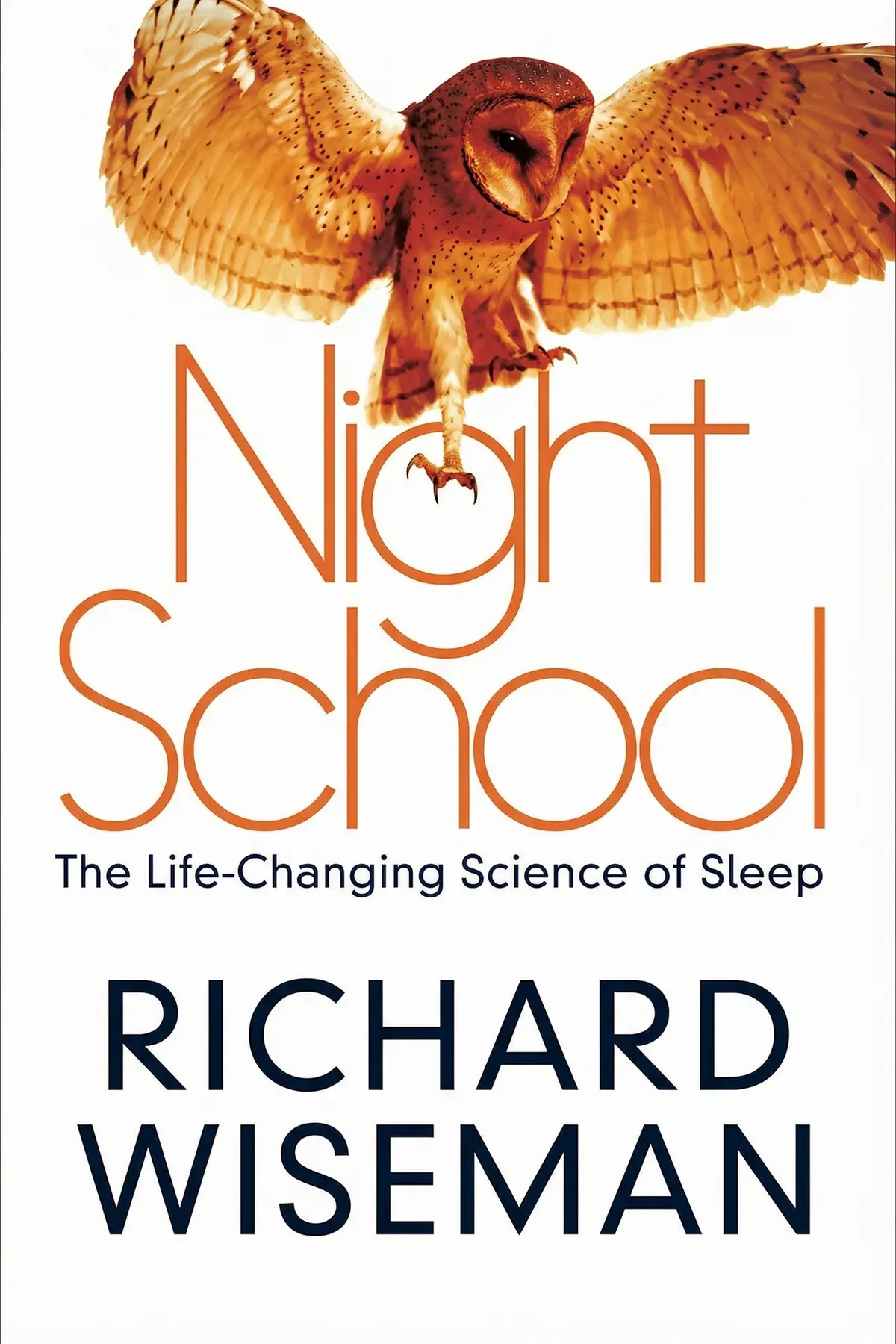
If sleep is whatever time is left over after work and life, you are shortchanging the hours that shape everything else. In one study spanning more than 200 countries, only 15 percent of people slept eight hours or more, and half did not think they needed to. In Night School, psychologist and former magician Richard Wiseman argues that getting better at sleep deserves a place beside eating well and exercising.
His case is that the night does real work on your safety, your habits and your emotions, so guarding it improves the day. The evidence runs from an oil tanker wrecked off Alaska to a summer camp where boys were coached out of nail-biting in their sleep. Along the way you learn what happens in each stage of the night, why feeling alert can mislead you, and which two bedroom changes the research supports.
1 min 49 sec
A famous painter fell asleep on purpose, holding a spoon, to catch something most of us lose every night. His trick reveals how much is happening in a process we usually treat as switching off.
1 min 40 sec
The man who lit up the world thought sleep was a waste of time, and he built his most famous invention partly to avoid it. His success changed every bedroom since, including yours.
1 min 42 sec
A ship’s officer off Alaska failed to notice the autopilot was on, and the spill that followed wrecked huge stretches of marine habitat. A lab experiment later showed why people in his state rarely know how impaired they are.
2 min 05 sec
A 70-year-old woman said she needed just one hour of sleep a night, and a scientist brought her to his lab to watch her sleep. What they found points to a possible genetic link, and a teenager was rescued from a crane high above London.
1 min 44 sec
Charles Dickens turned his bed to face north and still wandered the streets at night. Victorian cures got stranger from there, yet a couple of plain fixes have outlasted them all.
1 min 33 sec
At a summer camp in 1942, a psychologist crept into a cabin night after night with a phonograph. When the machine broke, he kept going in person, and the boys’ fingers told the story.
1 min 35 sec
Volunteers watched a gruesome film before bed, and some were stopped from dreaming about it. The next day, the difference between the two groups was hard to miss, and it reframes the worst nights of a bad year.
1 min 05 sec
Night School turns sleep from empty time into something closer to a night shift. Across about five 90-minute cycles, the brain slows, dreams and climbs back up, and while it does, it keeps your reflexes sharp, takes in what it hears and softens the day’s worst moments. Edison’s bulb and everything that followed have cut that shift to around seven hours, and the Exxon Valdez shows how costly a short one can be, even when the person on duty feels fine.
The advice the book supports is modest and easy to begin. Treat the hour before bed as a dark hour, with lamps low and screens away, so melatonin can rise. Keep the bedroom quiet, and where traffic or neighbors get in, cover them with the sound of waves or rain. Be skeptical of anyone who claims to thrive on four hours unless they carry that rare gene. And when a painful stretch of life brings rough dreams, take them as the mind sorting things out.
Sleeping well belongs on the same list as eating well and moving more. It is the habit the others depend on.
People set goals to eat better, exercise more or become calmer. Almost nobody sets a goal to sleep better, even though sleep shapes how well every other goal goes. Psychologist Richard Wiseman argues that sleep deserves that kind of attention, because it is a complex process that does real work while we are unconscious. Wiseman takes the reader through the five stages of a night, from the drowsy state Salvador Dalí used for ideas down to deep sleep and dreaming. He shows how Thomas Edison's light bulb began a long slide in sleep time, and how even modest losses slow reactions, as one sleep study and the Exxon Valdez disaster both show. He looks at rare people who need only an hour a night, at sleepwalkers who climb cranes and cook meals, and at experiments where sleepers were coached out of habits and dreams helped people recover from distress. Readers come away understanding what their brain does at night, why feeling alert is a poor guide to being alert, and which practical steps the research supports: less bright light before bed and a quieter bedroom.
Professionals who cut sleep to fit in more work and assume they feel fine.
People who lie awake at night and want simple fixes that research supports.
Curious readers who wonder what dreams, sleepwalking and the stages of sleep actually do.
Richard Wiseman began his career as a professional magician, then studied psychology at University College London and earned a doctorate at the University of Edinburgh. He is professor of the public understanding of psychology at the University of Hertfordshire, researching luck, self-help, persuasion and illusion. His best-selling books, including 59 Seconds and Quirkology, have been translated into more than 30 languages. He has spoken at the Royal Society and Google and created the YouTube channels Quirkology and In59Seconds.
Richard Wiseman
Richard Wiseman
Listeners consider the book to be highly readable and clear, with one individual mentioning how effectively it turns scientific research into actionable advice. They value the informative details regarding sleep science, as one listener points out how well it addresses both slumber and dreaming. Listeners also find the book’s comedic touch entertaining.
Can a book actually change how you view your pillow? Night School is an incredibly engaging deep dive into the third of our lives we usually ignore. Wiseman has this gift for taking dense, clinical studies and turning them into something you’d actually want to talk about at a dinner party. The sections on how even an hour of lost sleep can wreck your cognitive function were particularly eye-opening for me. Frankly, the writing is so fluid that I polished it off in just two sittings. While some might find the humor a bit light, I thought it kept the pace moving through the more technical bits. It’s a perfect mix of hard science and actionable advice that feels realistic for a busy person to implement.
Show moreFinally got around to reading this after it sat on my nightstand for months, and I’m kicking myself for waiting so long. Night School is easily one of the most accessible science books I’ve ever picked up. Wiseman manages to explain why we dream and how our internal clocks function without ever making the reader feel stupid. The practical tips, like using specific soundscapes or adjusting bedroom lighting, are simple yet backed by legitimate research. Not gonna lie, I was skeptical about the sections on lucid dreaming, but the way he breaks down the mechanics of the unconscious mind is actually quite grounded. If you want to understand the 'why' behind your sleep habits, this is the definitive book to buy.
Show moreWiseman has a knack for making complex psychology feel like a casual chat at the pub with a very smart friend. Night School isn't just a list of rules for sleeping; it’s an exploration of the human experience through the lens of our unconscious hours. I was fascinated by the data regarding how sleep deprivation mimics the effects of alcohol on the brain. The writing is punchy, the research is solid, and the tone is perfectly balanced between being informative and entertaining. I’ve recommended this to several friends already because it’s just so readable. Even the parts about the history of sleep labs, which could have been boring, were told with a great sense of narrative.
Show moreThis book is a fantastic bridge between academic jargon and everyday curiosity. If you are looking for a dry medical textbook, keep moving, because Wiseman leans heavily into a conversational tone that makes the history of sleep research feel alive. I particularly appreciated the focus on the psychology of dreaming, which is a topic often ignored in more 'practical' sleep guides. To be fair, a few of the anecdotes felt a little padded, and I can see why some readers might want more bulleted lists of instructions. However, the insights into how our brains process emotions during REM cycles were worth the price of admission alone. It’s a solid, well-written exploration of what happens when the lights go out.
Show moreAfter hearing Richard Wiseman on a podcast, I decided to dive into this one despite already having read 59 Seconds last year. I’ve got to say, this feels like a more focused effort, even if it covers some common-sense ground that most adults probably already know. The way he explains the 150-year evolution of sleep science is fascinating and easy to digest. Look, it’s not going to cure chronic insomnia overnight, but the tips on using white noise and environmental adjustments are grounded in real data rather than just 'wellness' trends. It’s a breezy read that manages to be educational without being condescending, which is a rare feat in the popular science genre these days.
Show moreThe chapter on the 'power of the nap' was a complete eye-opener that changed my afternoon routine entirely. Richard Wiseman has a knack for translating complex psychological phenomena into everyday language that anyone can understand. I loved the balance between the biological side of sleep and the more mysterious world of dreams. Truth is, I’ve read a lot of these types of books, and this one stands out because it doesn't take itself too seriously. The humor is subtle but effective, making the data points stick better in your memory. While a few of the suggestions felt like stuff I’d already seen on the internet, the scientific context provided here makes them much more convincing.
Show moreEver wonder what actually happens to your brain when you drift off? This book answers that question with a lot of wit and a surprising amount of heart. Wiseman covers everything from the impact of blue light to the strange history of Victorian sleep patterns. I found the actionable advice on white noise and temperature control to be particularly helpful for my own routine. The prose is snappy, and the short chapters make it a perfect book to read right before bed without getting too overwhelmed. It might not be a groundbreaking scientific paper, but as a piece of popular science, it hits all the right notes for a general audience.
Show moreWow, this was a bit of a mixed bag for me personally. On one hand, Wiseman is a charming writer who clearly knows his subject inside and out, but on the other, the book feels a bit disjointed in the middle. The descriptions of specific clinical studies tended to waffle on, detailing the lives of the researchers more than the actual results of the work. I was hoping for a more direct 'how-to' guide for better rest, but what I got was more of a historical overview with some tips sprinkled in. In my experience, the first few chapters are the strongest, while the latter half loses steam. It’s a decent enough read if you’re a complete novice, but seasoned non-fiction readers might find it a bit basic.
Show moreAs someone who struggles with chronic fatigue, I was looking for a miracle manual but found a historical overview instead. The book is definitely well-written and the author's voice is pleasant, but the content felt a bit thin in certain areas. It loses its way in the middle sections where the descriptions of clinical trials become a bit repetitive and dry. I did enjoy the parts about how sleep affects our emotional resilience, as that felt very relevant to my daily life. However, I think I had unrealistic expectations for how much 'new' information would be here. It’s a good introductory text for someone who has never read about sleep science, but it’s probably not for the 'uninitiated' experts.
Show moreNot what I expected given the rave reviews I had seen on social media. I bought this specifically to help with my sleep issues, but it felt much more like a history lesson than a practical manual. The author spends far too much time on long-winded anecdotes about researchers from decades ago instead of getting to the point. Frankly, if you’ve spent more than ten minutes googling 'how to sleep better,' you have already encountered about 70% of the advice in this book. The presentation style felt borderline-silly at times, almost like it was written for a much younger audience. It’s a readable book, sure, but it didn't offer the depth or the solutions I was looking for.
Show moreNight School explains the science of sleep and argues that sleeping well deserves the same attention as diet or exercise. Wiseman covers the five stages of a night, how the light bulb and later technology cut sleep time, what lost sleep does to reaction speed, why a few people need very little sleep, and how sleep supports learning and emotional recovery.
Wiseman cites a 2000 study, described in Paul Martin’s book Counting Sheep, in which more than 200 countries took part. Only 15 percent of participants slept eight hours or more, and only half thought they needed that much. Figures from the US National Sleep Foundation show the typical night falling from eight to nine hours in 1960 to seven hours by 2000.
In Gregory Belenky’s 2003 study described in the book, people who slept seven hours a night felt awake and alert, yet their reflexes were far slower than those of people who slept nine. Wiseman uses this to show that feeling fine is a poor test of how well you are functioning, which matters before driving or demanding work.
Wiseman highlights two. First, avoid bright light from lamps, phones and computers before bed, since about an hour of it can stop melatonin, the hormone that makes you drowsy, from rising. Second, keep the bedroom quiet, and when noise cannot be blocked, mask it with white noise such as ocean waves or rainforest sounds, available online or from dedicated machines.
The book argues they often do. In Richard Greenberg’s 1972 study, people stopped from dreaming were more disturbed by a gruesome film the next day. Rosalind Cartwright found that divorced women who had intense bad dreams for weeks or months overcame their depression sooner. Wiseman cautions that nightmares are not a reliable cure and can also disturb rest.
AUDIO SUMMARY AVAILABLE
Get the key ideas from Night School by Richard Wiseman, plus 5,000+ more nonfiction titles.