

15 min 35 sec
Available in: English
New Dark Age: Technology and the End of the Future
By James Bridle
Bridle shows why ever more data and computing power leave us understanding less. The book traces the military roots, hidden biases, climate costs and profit motives of technology, and argues we should question every system we use.
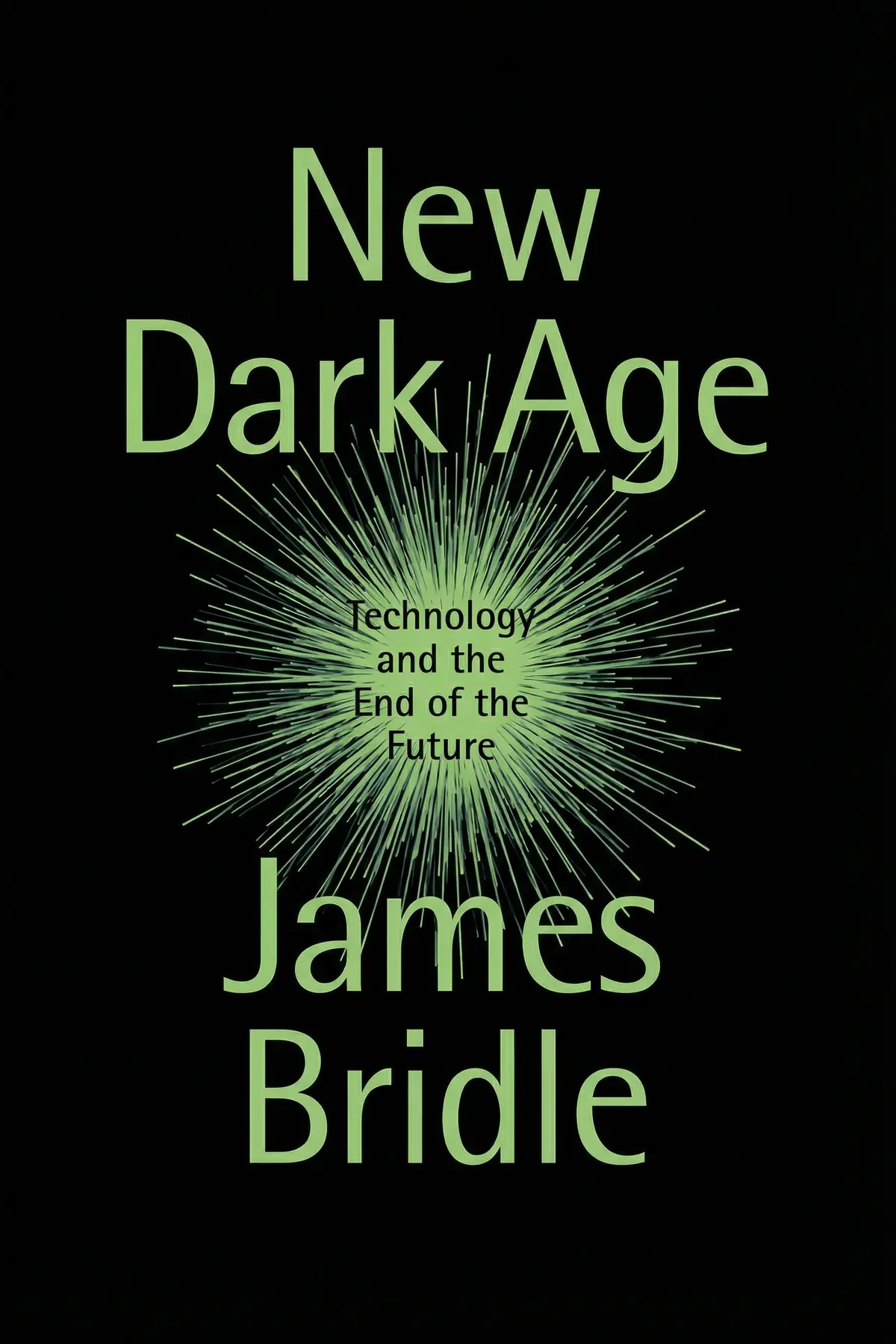
Table of Content
1. Introduction
56 sec
If your feeds leave you knowing more and understanding less, James Bridle says the problem is not you. In New Dark Age, the writer, artist and technologist argues that we now gather more data about the world than ever, yet grasp less and less of it. Networks once hailed as a new enlightenment have spread division, abuse, misinformation and conspiracy theory.
Bridle’s case is that more computation does not bring more understanding by itself. Machines carry hidden origins, old biases and the interests of their owners, so the way forward is to ask where a technology came from, how it works and who it serves. The evidence runs from a First World War weather dream to a market crash nobody can explain and cartoon videos no person made. What you gain is a short set of questions sharp enough to test any tool, feed or dashboard you rely on.
2. See the hidden purpose behind your machines
1 min 29 sec
In 1948, IBM placed a computer in a New York shop window where the public could see it. What they were told it was doing and what it was really doing were two very different things.
3. The cloud runs on heat, power and weather
1 min 37 sec
We talk about data as if it floats somewhere weightless. Bridle follows it into cables, servers and drought-struck farmland, and finds a link between the climate and the quality of our own thinking.
4. See how more data can mean fewer discoveries
1 min 38 sec
Computers keep doubling in power, and labs now test thousands of compounds a day. Yet one key measure of medical progress has been heading the wrong way for decades.
5. Spot the past's prejudice inside new algorithms
1 min 44 sec
An army system scored perfectly in training and then failed completely in the field. The reason sounds almost comic, but the same flaw sits inside software that judges people today.
6. Ask who gains when computers set the pace
1 min 39 sec
In a plain warehouse outside London, trades move at the speed of light. Six billion dollars once vanished and returned within minutes, and even the experts still cannot say exactly why.
7. Notice what governments keep out of view
1 min 46 sec
Survivors of colonial abuse went to court and uncovered a hidden archive of over a million files. What those files contained says a lot about how much of our past is still being edited.
8. Understand the pull of simple stories over complex truths
1 min 50 sec
People who believe they are being secretly watched are not entirely wrong. Bridle explains why their version of the story still misses, and why politicians find that gap so useful.
9. What algorithms make when profit is the only goal
1 min 43 sec
Some of the most watched channels for toddlers are made largely by bots. Follow the recommendations long enough and the cheerful songs give way to something no parent would choose.
10. Conclusion
1 min 13 sec
Bridle’s sharpest example comes from a claim made at Google’s 2013 Zeitgeist conference. Chief executive Eric Schmidt said that camera phones in 1994 would have prevented the Rwandan genocide, when an estimated one million people were murdered over 100 days. Later investigations showed that NGOs, foreign embassies and the UN were watching closely, and the US government tracked events through high-resolution satellite images. The world knew. It did not act.
That is the dark age Bridle describes: a surplus of information that leaves people informed and stuck. Even Clive Humby, the British mathematician behind the 2006 slogan “data is the new oil,” added that data, like oil, has little use until it is broken down and analyzed.
So the work starts with questions. When a new system enters your life, ask where it came from, what it was built to do and who owns what it gathers. Look for the past its data carries and for whoever profits from its speed. Bridle offers no escape from complexity, only a way to face it with open eyes. The lights are on. Now someone has to look.
About this book
What is this book about?
The internet was supposed to bring a new enlightenment. Instead, James Bridle argues, it has helped spread division, abuse, misinformation and conspiracy theory. We collect more measurements of the world than ever, yet seem to grasp less and less of it. Bridle calls this condition a new dark age. The book builds its case from concrete episodes. Modern computing grew out of military efforts to predict the weather and simulate bombs. Data centers burn a real share of the world's electricity. Drug research gets less productive as the screening machines get faster. A system trained to spot tanks learned to spot sunny days instead. Bridle follows the same thread through high-frequency trading, Amazon warehouses, government secrecy, mass surveillance, conspiracy theories and machine-made children's videos on YouTube. His conclusion is that the belief that more computation is always better has failed us. To live sensibly with complex technology, we have to look at where our data comes from, what it is used for and who owns it. Readers get a set of questions they can put to any tool, feed or algorithm that shapes their work and their thinking.
Book Information
Who it's for
Unsure more data helps
Professionals who work with data and dashboards and suspect more numbers are not making them wiser.
Managers weighing algorithms
Managers deciding whether to adopt algorithms that rank, screen or monitor people.
Uneasy about life online
Parents and curious readers uneasy about surveillance, conspiracy theories and what their children watch online.
About the Author
James Bridle
James Bridle, born in 1980, is a writer, artist, journalist and technologist who coined the term the New Aesthetic. Their projects have examined Western security systems, including drones and the deportation of asylum seekers. Bridle's writing has appeared in WIRED, The Atlantic, the Financial Times and the Guardian, and New Dark Age is their second book.
Ratings & Reviews
Ratings at a glance
What people think
Listeners find the book consistently thought-provoking. However, the prose style receives varied responses, as one listener describes it as engagingly-written while another considers it difficult to read. The level of analysis also generates mixed feedback, with some listeners praising its fantastic analysis while others observe little to no analysis.
Top reviews
Astrid
Picked this up on a whim and was immediately floored by the riveting introduction. Bridle manages to articulate that gnawing feeling that our tools are no longer within our control or even our comprehension. The analysis of how 'computation thinking' flattens complex reality into simple, often dangerous binaries is some of the best social criticism I’ve read in years. I particularly appreciated the deep dive into how military intelligence and state power use digital shadows to hide their operations while exposing ours. It is a haunting, dense, and deeply necessary map of the territory we are currently lost in. Look, it’s a pessimistic book, but it’s an honest one that refuses to offer easy, techno-optimist solutions to systemic failures.
Show moreFang
Wow, this is a truly massive achievement in technological criticism. This is the first book I’ve encountered that successfully connects the dots between the digital world, state surveillance, and the physical reality of climate change. Bridle avoids the 'internet will fix everything' trap and instead provides a visceral look at how our infrastructure is literally gnawing at the planet. The way he describes data centers being threatened by rising sea levels serves as a perfect metaphor for our crumbling certainty. I found the writing to be incredibly engaging, almost like a high-stakes detective novel for the information age. Personally, I think the 'Optometrist Algorithm' section alone is worth the price of admission. It’s a dark read, but it’s illuminating.
Show moreAim
As someone who works in software, this book was an absolute gut punch to my professional world-view. Bridle moves beyond the 'distraction' narrative to explore the profound and higher-order problems of how we structure our collective reality. His analysis of how the 'cloud' hides the brutal conditions of warehouse workers and the environmental cost of our habits is chilling. While the lack of actionable solutions might frustrate some readers, the depth of the critique is where the true value lies. It’s rare to find a tech book that actually feels like a work of literature rather than a simple business manifesto. In my experience, this is essential reading for understanding why everything feels so chaotic right now.
Show moreOwen
Direct and uncompromising, 'New Dark Age' is a masterclass in modern systemic thinking. Bridle uses the metaphor of the cloud to describe a world where we are drowning in data but starving for actual wisdom. I was particularly struck by the sections on military drones and the way digital tools allow states to cloak their own operations. It’s a heavy, demanding read that refuses to hold your hand or offer a comforting list of tips to unplug at the end. Instead, it demands that we sit with the uncertainty and the 'cloudiness' of our current era. Gotta say, the link between carbon levels and human cognition was a terrifying highlight I won’t soon forget.
Show moreLayla
Bridle takes the ubiquitous 'cloud' metaphor and flips it on its head, arguing that our abundance of data is actually blinding us. To be fair, some sections feel like a dense, exhaustive catalog of tech-induced woes, but the connection between meteorology and early computing is absolutely brilliant. I found the prose to be quite challenging. It requires a very slow pace to digest the heavier philosophical arguments which Bridle weaves throughout the narrative. This isn't just another Silicon Valley critique. Frankly, this is exactly the kind of uncomfortable analysis we need as algorithms start making more of our decisions for us in this strange, new era.
Show moreParichat
The chapter on the history of computation and its roots in weather prediction changed how I view my smartphone forever. Bridle moves past the usual techlash tropes to show how our world is entering a flailing, confused epoch driven by forces we can't quite grasp. Some might find the writing style a bit opaque or overly academic, but the metaphors—like comparing data to atomic power—are incredibly sharp. My only real gripe is that he occasionally leaves neoliberalism off the hook, focusing perhaps too much on the software rather than the economic engines driving it. Still, it’s a fantastic analysis that demands your full attention. Not gonna lie, I had to reread several pages just to catch the nuances of his cloud hermeneutics.
Show moreSelin
After hearing so much about this, I finally dove in and found it to be a remarkably dense but rewarding critique of modern life. Bridle doesn't just blame Silicon Valley; he looks at how state power and finance capital have woven themselves into the fabric of our networks. The discussion on 'Eroom's Law' and the replication crisis in science was a total curveball that I didn't see coming, but it fit perfectly. Some parts are definitely a slog, and the author's dismissal of certain scientific fields felt a bit rushed and unearned. However, the overarching theme of 'cloudiness'—the idea that more information leads to less understanding—is a powerful lens for viewing today’s headlines. It's a solid four stars.
Show moreHana
Ever wonder if the internet is actually making us less capable of understanding the world? That’s the core question here, but the execution felt a bit uneven to me. The introduction promised a groundbreaking philosophical shift, yet much of the subsequent chapters felt like a repackaged blog series on surveillance and worker abuse. Personally, I think Bridle is a gifted thinker, but the book lacks a singular, cohesive theory to tie all these disparate threads together. I was hoping for something as transformative as Neil Postman, but instead, I got a fairly standard list of grievances against big tech. It’s certainly thought-provoking in spurts, though it occasionally gets lost in its own gloom.
Show morePridi
Finally got around to finishing this, though I’ll admit I nearly gave up halfway through. The book is undeniably smart, but the writing style is so dense and academic that it often feels like a chore to get through. Bridle has a lot of interesting things to say about how technology obscures power, yet he frequently fails to acknowledge any of the actual benefits these tools provide. It's hard to take a critique seriously when it treats a GPS helping a taxi driver as a net negative for society. Truth is, there are some brilliant philosophical nuggets buried in here if you have the patience to dig for them. I just wish the author had spent more time on a coherent theory.
Show moreDimitri
Not what I expected given the high praise I saw on social media. While the book starts with an incredible hook, it quickly devolves into a laundry list of tech-related problems without providing much new information. I already know that algorithms are biased and that Bitcoin mining is bad for the environment, so I was looking for a deeper synthesis. Instead, the narrative feels incredibly disjointed and bleak. The prose is often quite difficult to navigate, which makes the lack of a clear, central thesis even more frustrating to deal with for a reader. If you've read Zuboff or Lanier, you probably won't find much here that hasn't been covered more effectively elsewhere.
Show moreQuestions about this book
What is the main idea of New Dark Age by James Bridle?
Bridle argues that we gather more data about the world than ever, yet understand less of it. Computers grew out of military projects, often hide their real purposes, copy the biases in past data and concentrate power in a few hands. The belief that more computation is always better has failed, so we must question where technologies come from, how they work and who they serve.
Why does James Bridle say more data does not lead to better science?
Bridle points to drug research, where machines screen thousands of compounds a day, yet the number of new drugs approved per billion US dollars of research has halved every nine years since the 1960s. Commentators call this Eroom’s law. He also cites the replication crisis: when the University of Virginia repeated five landmark cancer studies in 2011, only two results held up.
How does New Dark Age explain bias in machine learning?
Machines learn from data, and all our data comes from the past, which is full of violence, injustice and racism. Bridle argues that systems trained on it repeat those patterns and carry them forward. He uses a story about an army system that learned to spot sunny days instead of tanks, and Shanghai researchers who claimed their face-reading software was free of bias.
How can I apply the ideas in New Dark Age?
Treat every tool you rely on as something with a history and an owner. Ask what it was first built to do, what past its data reflects, and who gains from its speed or its conclusions. Remember that visible problems are not solved problems, as the Rwanda example shows. And be wary of explanations that feel satisfying because they name one simple villain.
Who should read New Dark Age?
It suits knowledge workers and managers who use data and algorithms daily and want to judge them more critically. It also speaks to readers worried about climate change, mass surveillance, conspiracy theories and children’s online viewing, since Bridle connects all of these to the same problem: technology that produces more information while leaving us less able to understand it.
Readers also enjoyed









AUDIO SUMMARY AVAILABLE
Listen to New Dark Age in 15 minutes
Get the key ideas from New Dark Age by James Bridle, plus 5,000+ more nonfiction titles.
- 5,000+ titles
- Listen as much as you want
- 7-day free trial
- Cancel anytime









