

15 min 08 sec
Available in: English
Never Get a “Real” Job: How to Dump Your Boss, Build a Business and Not Go Broke
By Scott Gerber
Shows first-time founders how to start a business without betting everything on it: plan for the worst case, test the idea in small steps, choose partners with care and market for action.
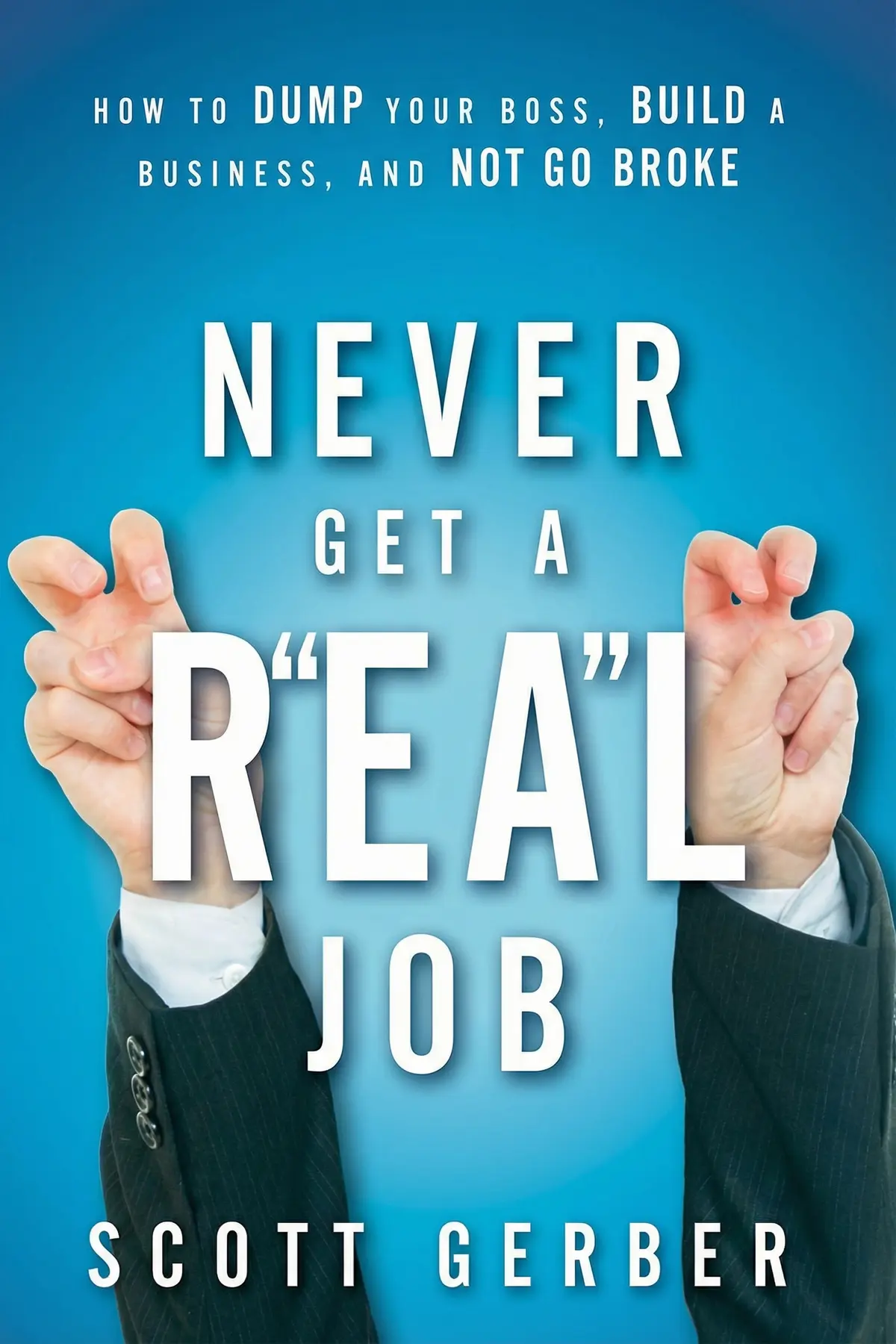
Table of Content
1. Introduction
1 min 01 sec
If a corporate paycheck will never touch your student debt, or no paycheck is on offer at all, working for yourself can look like the only way out. In Never Get a Real Job, entrepreneur Scott Gerber argues that it can be, provided you start from a sober fact. According to the U.S. Small Business Association, one small business in three is gone within two years, and fewer than half reach year four.
Gerber’s answer is not a brilliant idea or a big budget. It is a habit of testing cheaply, preparing for the worst and putting time and money only where the evidence says they pay. That habit runs through everything he recommends, from a business plan that fits in one paragraph to a free treat handed out at a dog park. What follows is a working kit for a first business: how to decide, how to plan, whom to partner with, how to shape your week and how to find customers who actually buy.
2. Plan for the worst outcome before you decide
1 min 47 sec
Most founders picture the day everything goes right. Gerber wants you to picture the opposite, and he turns that gloomy exercise into four quick checks that make a young company much harder to knock over.
3. Test whether your hobby can pay the bills
1 min 43 sec
Passion gets most new businesses started, and it is also where many of them go wrong. A box of Legos and a garden of driftwood sculptures show what love for your work cannot do on its own.
4. Replace the long business plan with one paragraph
1 min 57 sec
Founders are told to begin with a thick, detailed plan. Gerber spent two months doing something smaller and messier instead, and came out with a marketing formula he still relies on.
5. Choose a business partner you won't regret
1 min 51 sec
Some partnerships make a company. Others end like a bad marriage, sometimes in court. Five questions, asked before anyone shakes hands, help you tell which kind you are about to sign.
6. A weekly schedule built on your best hours
1 min 53 sec
Founders lose the clean line between work and home. Gerber’s answer starts with a demanding month of daily work and a simple log, and it ends with a timetable your friends may not love.
7. Look professional on a starter budget
1 min 49 sec
Big companies pay designers and consultants to impress. A new founder can get a similar effect for very little, using a simple website and an ordinary meal in the middle of the day.
8. Use targeted marketing to make customers act now
1 min 58 sec
Posting on social media feels like marketing, yet it often brings in nobody. A dog-walking service and a single free treat show the difference between being noticed and getting a customer.
9. Conclusion
1 min 09 sec
What Gerber offers adds up to one way of thinking. Every part of a new business is a guess, and each guess should prove itself cheaply before it grows. The worst-case check, the hobby tests, the paragraph that turns into checklists, the trial run with a partner, the month of logged wins and the free dog treat all do the same job: they find out whether something works before it can sink you.
He is honest that the life is hard. It brings independence and the pride of handling whatever comes, but it demands long hours and steady hustle. That is why he adds a warning about health. Full commitment does not mean working around the clock. Schedule time to unwind and make exercise a habit, even if it is only push-ups or stretches in your bedroom, because the business does better when you feel well.
So take one decision in front of you and run it through its worst case. Then write your three sentences and test the first one this week. A job hands you someone else’s plan. Gerber asks you to write your own, one tested guess at a time.
About this book
What is this book about?
Many young people did everything they were told, studied hard and finished college, and still face a thin job market and paychecks that barely touch their debt. Scott Gerber argues that working for yourself is a real alternative, as long as you go in with open eyes. A third of small businesses close within two years, so the founder who lasts is the one who prepares for trouble. Gerber skips traditional coaching advice and offers tools built for people with little money and lots of uncertainty. He shows how to weigh any decision against its worst outcome, test whether a hobby can become a business, and replace a long business plan with one paragraph of hypotheses that turn into dated checklists. He also covers how to vet a business partner, how to build a schedule around your most productive hours, how to look professional with a cheap website and a few well-chosen lunches, and how to write marketing that makes customers act. Readers get a lean, practical way to launch and run a first business, and a habit of testing every guess before it costs too much.
Book Information
Who it's for
Recent graduates weighing self-employment
Recent graduates facing a weak job market and heavy debt who are thinking of working for themselves.
Employees planning to quit
Employees planning to quit and turn a skill or hobby into a business on a small budget.
First-time founders
First-time founders who want simple tools for planning, partnering, scheduling and marketing.
About the Author
Scott Gerber
Scott Gerber is a cofounder of the Community Company, which builds professional membership communities for global brands. He also founded YEC, an invitation-only group for young entrepreneurs, and Forbes Councils, a set of invitation-only groups for executives. His ventures include invitation-only groups for young entrepreneurs and for executives. Besides Never Get a Real Job, he wrote Superconnector, published in 2018, about building business relationships that matter.
Ratings & Reviews
Ratings at a glance

What people think
Listeners find the work educational and accessible, featuring useful suggestions and well-structured directories of online tools. Furthermore, they value its genuine feel and compelling narrative, making it a vital tool for budding entrepreneurs. The content is also inspiring, with one listener mentioning that it prompts them to take initiative. However, the author's demeanor draws varying feedback from listeners.
Top reviews
Ford
Scott Gerber writes like a true New Yorker who has seen it all and survived the trenches while maintaining a sense of grit often missing from modern entrepreneurship guides. This is a fantastic, no-BS guide that shatters the delusions many people have when they quit their day jobs. I loved the "do it now" mentality he pushes throughout every chapter. It’s a provocative read that forces you to stop over-planning and start taking actual, measurable action. The advice on picking dependable partners and keeping overhead low is timeless, even if some critics call it basic. Sometimes the most basic things are exactly what we ignore when we're blinded by a "big idea." If you want a book that tells you the hard truth about cash flow and grit, this is the one.
Show moreThongchai
This book is a total kick in the pants for anyone sitting on a great idea. I’ve read plenty of business books that spend 300 pages on "mindset," but Gerber actually gives you a to-do list. He doesn't want you to over-plan or over-finance your dream into a nightmare. Instead, he tells you to get off your rear and just start building something. The organized lists and clear sections make it an easy reference guide to keep on your desk. I appreciated the honest look at the sacrifices required to make it work. It’s an aggressive, in-your-face read that won’t be for everyone, but it’s exactly what I needed to stop procrastinating. If you're tired of the "walk in the park" narrative of entrepreneurship, buy this book immediately.
Show moreWipawan
Finally got around to reading something that doesn't sugarcoat the startup life. Most books make entrepreneurship look like a beach vacation, but this one focuses on the trade-offs and the genuine hardships of the first two years. I really appreciated the realistic take on surviving the early stages. The writing style is engaging and punchy, making it a very quick read for anyone with a busy schedule. Some people might find the attitude a bit much, but I think the "kick in the pants" approach is necessary for certain personalities. The organized lists of websites and tools are a huge plus for those of us starting with zero connections. My only complaint is that the goals seem a bit small-scale, but staying profitable is better than going broke while dreaming too big.
Show morePang
As someone who just finished a business seminar, this was exactly the reality check I needed. I was able to compare the high-level theories I just learned with Gerber’s grounded, practical advice on how to actually survive the first year. The book doesn't waste time on fluff or corporate jargon; it just gets straight to the point of what you need to do to turn a profit. I found the sections on web resources to be particularly helpful for a beginner like me. It made the prospect of going off on my own feel much more manageable and less like a blind leap into the dark. While the tone is a bit abrasive at times, the information is solid enough to help you avoid common pitfalls.
Show moreSirinat
Look, the formatting alone makes this worth the purchase price for a new entrepreneur. It's so rare to find a book that lists out practical web resources in such an organized way. The author’s hardened perspective might come off as pessimistic to some, but I found it refreshing and deeply authentic. He isn't trying to be your friend; he's trying to make sure you don't go bankrupt. The advice about keeping your business between "greatness and shittiness" while staying profitable is a bit unusual, but it makes a lot of sense for a first-timer. It's a quick, engaging read that avoids the stale language of traditional business texts. I’ll definitely be keeping this on my shelf as I navigate my own startup journey.
Show moreKoi
The first few chapters definitely hook you with that gritty, anti-corporate attitude. Gerber captures the misery of the "real job" perfectly, and his New York vibe is refreshing compared to the usual Silicon Valley fluff. However, once you get past the initial ranting, the actual meat of the book is pretty thin. It’s less of a story and more of a manual filled with basic instructions. I found myself wishing for more personal anecdotes to liven up the lists of web tools and resource links. It’s accurate, bordering on pessimistic, which is a nice change of pace, but it lacks the inspiration needed to actually get moving. It's a decent middle-of-the-road guide for college students, but seasoned professionals might find it a bit too elementary for their needs.
Show moreJoy
Truth is, I have mixed feelings about the 'no-BS' approach taken here. On one hand, the skepticism regarding the "startup dream" is absolutely fantastic because it keeps your feet on the ground. On the other hand, the advice often feels a bit too pessimistic, almost like it’s discouraging you from aiming for greatness. The author seems to advocate for a middle-ground business—something that makes money but isn't exactly world-changing. I lived this life for a few years and can confirm about 97% of the hardships he describes are spot on. It’s a useful resource for the technical side of things, like finding web tools, but it’s definitely not a book for "big thinkers." It's practical, if a bit dry once you get past the initial snark.
Show moreRatthapong
Why does every chapter feel like I’m getting yelled at by a disgruntled boss? I picked this up hoping for inspiration, but I mostly felt reprimanded for being "stupid" enough to consider traditional employment. The tone is incredibly condescending, assuming the reader has zero clue how the real world works. While the lists of online resources are organized well enough, the delivery is so aggressive it becomes a turnoff. Frankly, most of the "gems" are things any serial entrepreneur already knows by heart. It’s a lot of "common sense" masquerading as revolutionary truth. I appreciate the attempt at being realistic, but you can be honest without treating your audience like they're incompetent children. It’s hard to stay motivated when the person teaching you seems to hate your current situation more than you do.
Show moreJob
Is it just me, or is the advice in here incredibly basic for anyone who has ever opened a browser? I really wanted to like this because the title is so relatable, but the content felt like a compilation of WikiHow articles. Telling someone to pick a "trustworthy" partner isn't a business secret; it's just a part of living a normal life. The book is easy to read and the layout is clean, but the substance is lacking for anyone over the age of twenty-two. The author’s aggressive tone feels like he's trying to compensate for the fact that the information isn't actually that revolutionary. Not gonna lie, I was expecting a bit more sophisticated strategy rather than just being told to make lists. It might be okay for a high schooler, but for anyone else, it's pretty stale.
Show morePraepimon
Avoid this if you possess even a shred of common sense. I was lured in by the edgy title, expecting some underground tactics for the modern age, but I was sorely disappointed. Instead of high-level strategy, the author spends pages explaining how to make a basic pros and cons list. It feels like it was written for people who haven't yet mastered basic life skills, let alone business ones. The constant swearing felt forced, as if trying too hard to seem "street" or authentic when the content was actually just stale. To be fair, the snarky comments about soul-crushing cubicles were funny for about five minutes. After that, it’s just a collection of pedestrian advice you could find on any mediocre blog. Save your money and just use Google instead of buying this.
Show moreQuestions about this book
What is the main idea of Never Get a Real Job?
Scott Gerber argues that young people can build their own business instead of chasing a corporate job, but only with realistic expectations. Since a third of small businesses close within two years, he teaches founders to plan for the worst, start with the resources they have, treat their plan as hypotheses to test, and spend money and effort only where results show they pay off.
What is the One-Paragraph Start-Up Plan?
It is Gerber’s replacement for a long business plan. You answer three questions in one or two sentences each: what you sell, who your main customers are and how you will earn money right away. Each answer becomes five dated, costed action steps called a Guess and Checklist. After each step you review the result and revise the hypothesis, so the plan keeps changing as the business does.
How do you decide whether to take on a business partner?
Gerber suggests five questions. Do you really need a partner, or could you hire the skill? Would a licensing deal or joint venture work better than a partnership? Can you defend your choice of person without doubt? Does a trial period with short-term goals show you work well together? And is everything, from equity to stock rules, agreed in writing?
How does the book recommend marketing a new business?
Gerber says posting on social media is not enough. Build a brand language of three or four bold words, write an active brand message of about eight words, and pick channels that fit it. His dog-walking example trades a free treat for owners’ contact details, because marketing should make customers act, and action is what produces revenue.
How can I apply Never Get a Real Job this week?
Pick one costly decision and run Gerber’s four worst-case steps on paper. Write your three-sentence start-up plan and turn one sentence into five dated actions. Invite one well-connected person to lunch with a clear question in mind. And protect your health with downtime and simple exercise such as push-ups or stretches, so you can keep working over the long run.
Readers also enjoyed

Alibaba: The House That Jack Ma Built
Duncan Clark



7 Powers: The Foundations of Business Strategy
Hamilton Helmer


Bad Blood: Secrets and Lies in a Silicon Valley Startup
John Carreyrou
AUDIO SUMMARY AVAILABLE
Listen to Never Get a “Real” Job in 15 minutes
Get the key ideas from Never Get a “Real” Job by Scott Gerber, plus 5,000+ more nonfiction titles.
- 5,000+ titles
- Listen as much as you want
- 7-day free trial
- Cancel anytime









