
Can’t Hurt Me: Master Your Mind and Defy the Odds
David Goggins
 English
 ไทย
Shows how to stop letting old pain and other people's labels set your limits. It does this by facing hard memories, pausing one second before quitting and holding yourself to standards higher than anyone requires.
53 sec
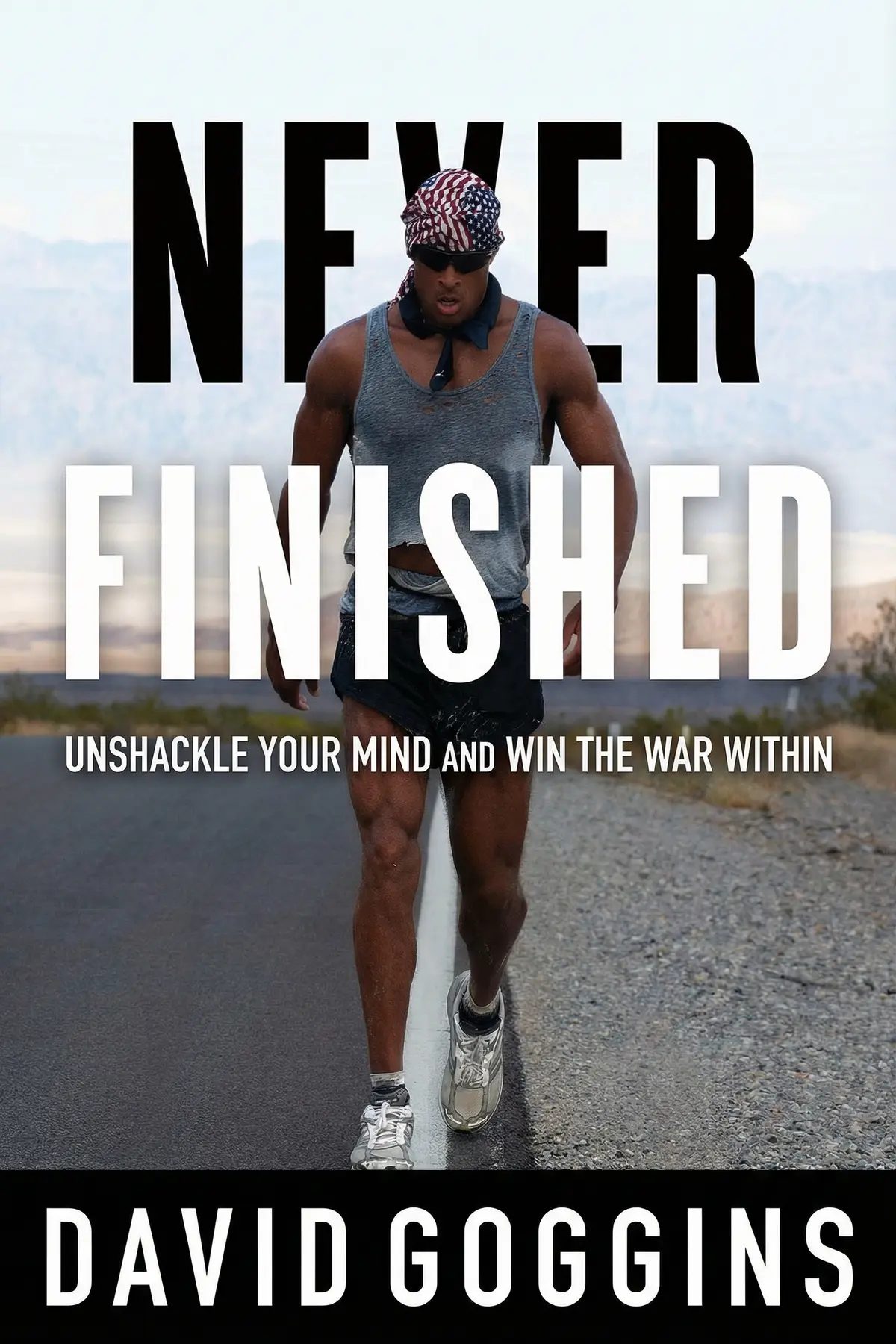
If an old failure or a hard memory still decides how far you let yourself go, David Goggins has a blunt reply: that pain can become fuel, but only once you stop hiding from it. In Never Finished, the retired Navy SEAL and ultramarathon runner argues that whatever peak you think you have reached is closer to a starting line.
His case is simple to state and hard to live. The limits that hold most people back are mental, and they give way to steady, deliberate choices made in small moments, day after day. The tools he offers are plain ones. A voice recording you replay until a memory loses its grip. A single second of pause before you quit. A list of tasks finished properly even when nobody checks.
Used together, they give you a way to stop measuring yourself by your worst day, or by the categories other people put you in.
1 min 29 sec
Most people carry one memory they would rather not look at, and the usual way of handling it keeps them stuck. Goggins suggests an uncomfortable daily exercise that uses nothing more than the phone in your pocket.
1 min 20 sec
Years after an injury or a bad relationship ends, some people still live inside it. Goggins says the way out does not require feeling fine, only a kind of evidence you can produce every single day.
1 min 27 sec
Lose one deal, get one rejection letter, and a voice says you were never good enough. Goggins argues that the fight is decided in an instant, and that most people lose it without noticing.
1 min 18 sec
A hiker rounds the last bend expecting the summit and finds another hill. Goggins explains why constantly hunting for the end of a hard stretch makes it longer, and what to do with your attention instead.
1 min 28 sec
Soldiers drilling before sunrise make discipline look like something only an army can teach. Goggins disagrees, and he links it to a benefit most people would never expect: less envy of everyone else.
1 min 21 sec
Your boss asks for one week of work and you deliver one week. That sounds like doing your job well. Goggins argues it is exactly what keeps you from finding out what you are capable of.
1 min 32 sec
Nobel winners and Moon mission leaders can make excellence feel reserved for the gifted. Goggins traces that feeling to labels handed out from birth, and to a fear that keeps people on the lowest rung.
1 min 02 sec
The title is the argument. Goggins wants no finish line in anyone’s head: not the peak you think you reached in your twenties, not the end of a hard stretch, not the rung where comfort sets in. What stands between people and who they could be, he argues, is a set of barriers built partly by themselves and partly by everyone who sorted them into categories. Both kinds come down the same way, through repeated choices to go past the limit and keep the past from writing the future.
He closes with advice about company. Choose carefully who you keep close. The right people see your full potential before anyone else does and walk with you toward it. The wrong ones hold you down.
So look at the people around you this month and decide which side of that line each one stands on. Record the memory you keep avoiding and play it back until it stops frightening you. And the next time quitting feels like the only option, give it one second.
That second is where the war within is won or lost.
Plenty of people reach their mid-twenties or thirties believing they have figured life out, while an old failure or a hard memory still decides how far they let themselves go. David Goggins argues that this supposed peak is closer to a starting line, and that the walls in front of us are built mostly in our own heads. His method is plain and demanding. Face the memory you have been denying, even by recording yourself telling it and replaying it daily. Make steady progress instead of waiting to feel fine. When doubt strikes, take one second to decide whether to quit or to fight. Stop scanning for the finish line and give full effort to the task in front of you. From there Goggins turns to discipline, to standards set above what a job requires and to the categories people are sorted into from birth. Readers get a set of simple, repeatable habits for outgrowing their past and for treating the bottom rung as a place to train.
Young professionals who feel they peaked early and suspect they are capable of more.
People still held back by an old failure, injury or painful relationship.
Career switchers and late starters told they are too young, too old or the wrong kind of person.
David Goggins is an American author, speaker and athlete. He is a retired United States Navy SEAL who served in the Iraq and Afghanistan wars, and he also served in the US Air Force. He competes as an ultramarathon runner, ultra-distance cyclist and triathlete, and he once held a world record for pull-ups. In 2019 the International Sports Hall of Fame made him a member for his sporting achievements and military service. His memoir Can't Hurt Me was a New York Times best seller.
David Goggins
Listeners find this work both captivating and easy to connect with, highlighting the powerful narrative style and inspiring subject matter. It successfully analyzes how the brain functions and assists audiences in building mental toughness, alongside offering actionable advice for personal growth. Listeners value the author's grit and fortitude, with one listener noting how the text helps shed layers of weakness.
David Goggins is back with a vengeance in 'Never Finished', and it’s every bit as intense as you’d expect. While some people claim he’s just rehashing his old trauma, I saw it as a necessary evolution of his philosophy on mental toughness. He provides a roadmap for dissecting the human mind and stripping away the layers of weakness we all carry around like security blankets. The chapters on his recent physical hurdles, including those brutal surgeries, really drive home the point that the mind can overrule the body’s loudest screams. Frankly, it’s not a comfortable read, but growth isn’t supposed to be comfortable. He challenges you to stop making excuses and start taking accountability for your own potential. If you’re looking for a soft self-help book with 'live, laugh, love' vibes, keep walking. This is for the people who want to become a savage and stay that way through consistent, grueling effort.
Show moreThe audiobook is an absolute beast and probably the best way to consume this content. I loved the structure, specifically the podcast-style conversations between Goggins and Adam Skolnick that break up the chapters. Hearing Goggins elaborate on his thought process adds a layer of authenticity that you just don't get from the printed page alone. The interview with his mother was particularly moving and shed light on the generational trauma he’s been fighting to overcome for decades. Many critics say he's just self-abusing, but I see a man who found a way to turn his pain into a source of infinite fuel. It’s compelling storytelling that forces you to look in the mirror and ask what you’re truly capable of if you stopped listening to your own bullshit. It’s high-octane, vulgar, and incredibly motivating. If you need to build a stronger mindset, this is the blueprint you've been searching for.
Show moreEver wonder what happens when you stop negotiating with your own brain? 'Never Finished' provides the answer in the most graphic, grit-filled way possible. Goggins isn’t just telling stories; he’s teaching a masterclass on how to cultivate a mindset that refuses to accept mediocrity. His description of running on broken bones and pushing through surgeries that would sideline most people for years is bordering on lunacy, but that’s the point. He’s showing us the outer limits of the human condition. I found the section on the 'Evolutionary Thirst' to be particularly inspiring because it reminds us that the work is never actually done. You don't just reach a summit and stay there; you have to keep climbing. The book is raw, unfiltered, and deeply personal. It’s a rare look into the mind of someone who has truly mastered his own internal dialogue. Absolutely essential reading for anyone serious about peak performance.
Show moreThis isn't just a book; it's a mental blueprint for anyone stuck in a rut. Goggins has this uncanny ability to speak truth to your deepest insecurities and force you to address them head-on. I was particularly struck by his idea that mental toughness and resilience fade if they aren’t used consistently. It’s like a muscle that atrophies the moment you get comfortable. The book is packed with practical tips for self-improvement that go beyond just 'working out hard.' It’s about how you frame obstacles and whether you choose to make them big or small in your own mind. I’ve read a lot of self-help, but nothing else feels this visceral or honest. He doesn’t sugarcoat the process, and he doesn't pretend it's easy. If you want to stop taking comfort in pity and start building something real, read this. It’s an empowering, high-speed journey into what makes a human being truly unstoppable.
Show moreTo be fair, Goggins isn't asking you to be him; he’s just showing you what’s possible. I’ve seen reviews calling his methods 'self-abuse,' but I think they’re missing the point. He’s a man who refused to be defined by his past and used physical challenges to rewrite his own DNA. The section where he talks about being haunted by his future goals rather than his past failures resonated deeply with me. It’s a powerful shift in perspective that turns anxiety into fuel. I also loved the focus on doing demeaning jobs to learn humility; it’s a lost art in today’s world. The book is like a volcano of motivation—it’s hot, it’s dangerous, and it’ll burn you if you aren't careful, but it’s undeniably powerful. Goggins is a savage, and his story is a testament to the incredible strength of the human spirit.
Show moreAfter tearing through 'Can't Hurt Me' a few years ago, I had high expectations for this follow-up. Truth is, it’s a bit more disjointed than his debut, jumping between military stories and ultra-endurance feats without a traditional narrative arc. However, the wisdom buried in the 'blue-dark horizon' section alone makes the purchase worthwhile. Goggins continues to prove that resilience isn’t a one-time achievement but a daily practice that requires you to confront your inner demons constantly. I appreciated the practical tips for self-improvement, even if I’ll never find myself signing up for a 444-mile cycling race after major surgery. He definitely leans into the 'savage' persona here, and while the writing style is blunt and occasionally repetitive, the message remains clear. You are either getting better or you are getting worse. It’s a solid 4-star read that serves as a necessary kick in the pants for anyone feeling stagnant in their current life path.
Show moreFinally got around to finishing this today and I have mixed feelings, though mostly positive. The chapter about his mother was the highlight for me, as it humanized him in a way the rest of the book doesn't. Goggins is obviously a unique character—a machine who treats his body like a rental car—and that can be polarizing. Personally, I found the 444-mile cycling race story to be the most intense part of the book, especially considering his health issues at the time. My only real gripe is that the writing is a bit choppy and could have used a tighter edit to avoid the repetitiveness. Still, the core message about impact and effort is something everyone needs to hear. It’s about more than just physical fitness; it’s about a total psychological overhaul. Not quite as life-changing as his first book, but definitely worth a read if you’re looking to sharpen your mental edge.
Show moreAs someone who struggles with consistency, I found this to be a very helpful, if somewhat terrifying, read. Goggins is definitely an outlier, and while I’ll never be a Navy SEAL or an elite ultrarunner, I could still extract plenty of value from his mindset. The truth is, most of us quit when things get hard, but he advocates for quitting when things are easy—that way you know you’re not just running away from pain. That specific piece of advice has already changed how I approach my morning runs. The book is a bit aggressive, and the language is exactly what you’d expect from a Goggins podcast, so be prepared for that. It’s not a literary masterpiece, but it is an effective tool for anyone looking to shed layers of weakness. I’d recommend it to anyone who needs a harsh wake-up call to get their life back on track.
Show moreNot what I expected after his first memoir, but in a good way. 'Never Finished' feels more like a manual for maintaining the ground you’ve already won. It’s one thing to get in shape or change your life once; it’s another thing to stay in that headspace for decades. Goggins is very open about his setbacks and the surgeries that almost ended his career, which makes his eventual return to competition even more impressive. The book is a bit scattered in terms of timeline, but the raw energy keeps you turning the pages. I especially liked the emphasis on 'impact and effort' over simple pass/fail metrics. It’s a great reminder that the journey is the point, not the destination. If you're looking for a compelling story about grit and the refusal to quit, this is it. It’s a solid 4 stars and a great companion to 'Can’t Hurt Me'.
Show moreLook, I have massive respect for the man's discipline, but this felt like a retread of his previous work. I’m giving it three stars because there are definitely some powerful nuggets of wisdom, but the overall tone felt increasingly masochistic and hard to relate to. He records negative comments and listens to them while he walks around his house? That feels less like mental toughness and more like unaddressed trauma. In his first book, the struggle felt purposeful, but here it often feels like he’s seeking out pain just for the sake of it, even when his body is clearly failing him. To be fair, his resilience is unmatched, but I found the 'savage' rhetoric a bit exhausting after a while. It’s a lot of the same energy we've seen before without much new depth. If you loved 'Can't Hurt Me', you'll probably enjoy this, but don't expect it to break much new ground.
Show moreGoggins argues that the limits holding most people back are mental and that whatever peak you think you have reached is really a starting point. He says those limits fall to small, repeated choices: facing painful memories instead of denying them, making steady daily progress, pausing before quitting, focusing on the task rather than the finish, and holding yourself to standards higher than anyone requires.
It is Goggins’ name for the brief pause he recommends when doubt strikes, such as after losing a deal or being rejected by a school. Instead of reacting, you set your emotions aside for a second and ask whether you truly need to quit or whether stress and insecurity are talking. If it is the second, you use that instant to decide to keep fighting.
He warns that denying a bad experience keeps you in pain longer. Journaling is a starting point. His stronger method is to record yourself on your phone telling the story out loud in full detail whenever a hurtful comment or traumatic memory comes up, then listen to it every day. Over time, he says, you realize you can face it, and the pain becomes motivation.
Treat required standards as a floor, not a target. Goggins’ example is a boss who asks for one week of social media content: deliver a month or more, for your own growth rather than praise. Write your own to-do list and finish each task properly, so your capacity grows. Spend time with people who regularly exceed expectations.
It suits people who feel stuck after a setback, who doubt they are capable of greatness, or who have been told they are the wrong age or gender for their ambitions. Goggins speaks to anyone at the bottom of a ladder who wants to treat that position as training, and to anyone tempted to quit at the first moment of doubt.


Barack Obama


Masaji Ishikawa

Ben Macintyre


James Shapiro


AUDIO SUMMARY AVAILABLE
Get the key ideas from Never Finished by David Goggins, plus 5,000+ more nonfiction titles.