

13 min 53 sec
Available in: English
Nail It then Scale It: The Entrepreneur’s Guide to Creating and Managing Breakthrough Innovation
Shows founders why money and a brilliant idea are not enough. Prove a customer's pain, learn how buyers decide and settle on a repeatable model before spending a cent on growth.
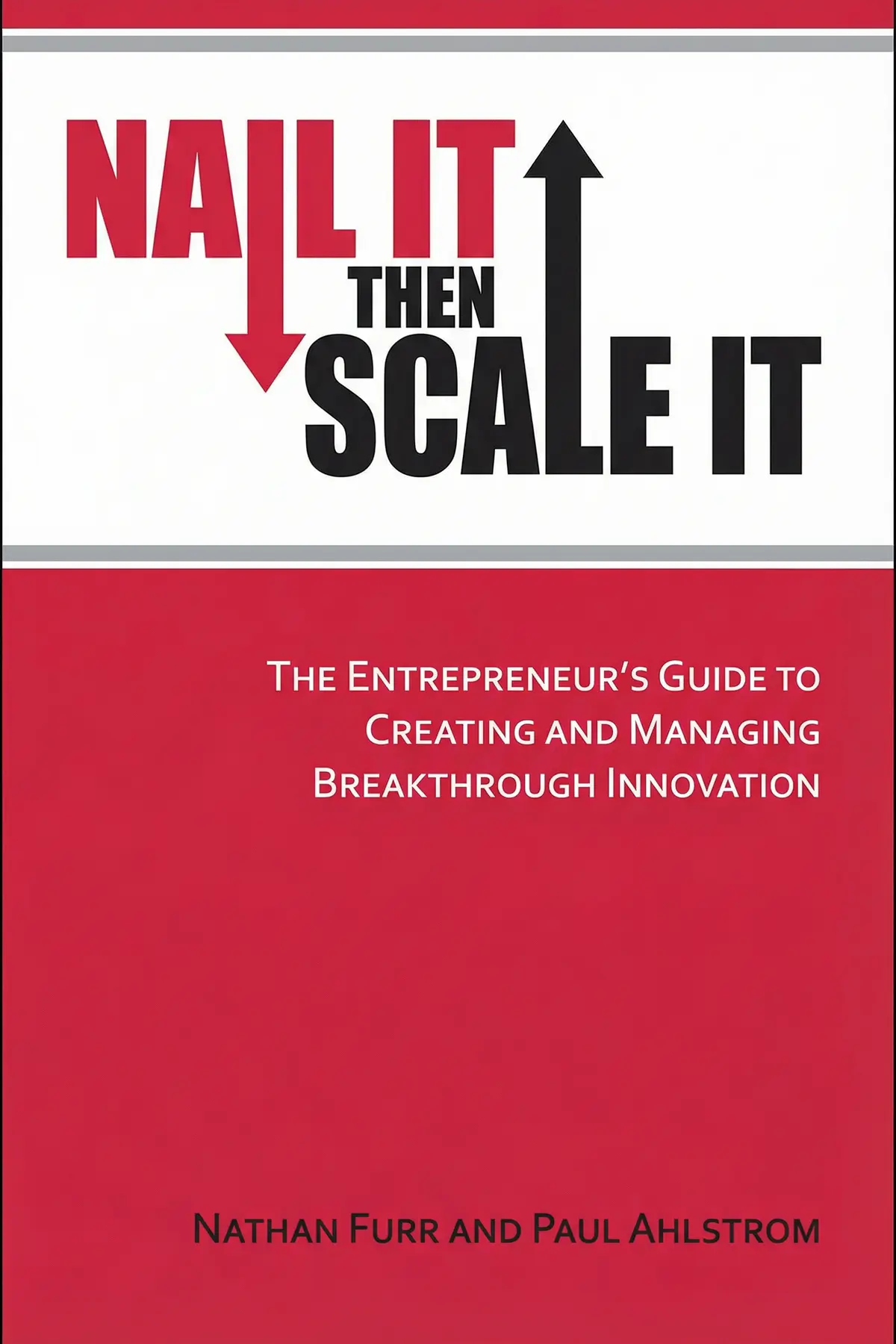
Table of Content
1. Introduction
1 min 11 sec
If you have an idea you love and a plan to launch fast and fix things later, Nathan Furr and Paul Ahlstrom have unwelcome news: that plan has killed many promising companies. In Nail It then Scale It, an innovation professor and a venture investor argue that neither money nor a brilliant idea builds a lasting business. A business lasts when it solves a painful customer problem, understood in detail and fixed in a way people will pay for, before any money goes into growth.
The order is everything. First you nail it: find the pain, learn how buyers make up their minds, and shape a business model you can repeat. Only then do you scale it, often with managers who are better at running a big company than you are.
Along the way come a video game that took 12 years and never shipped, accounting software trimmed from 125 setup screens to three, and the reason Yahoo passed on buying Google. What you get is a sequence for testing any venture idea, and a clear signal for when it is ready to grow.
2. Spend less until you know what customers need
1 min 52 sec
A small studio built a hit game on almost nothing, then used its fortune to make a sequel. What happened next shows how plenty of cash can stall a team that scarcity once kept sharp.
3. Turn everyday annoyances into products people pay for
2 min 01 sec
A torn tea bag and a clumsy software setup look like small irritations. To these authors they are the raw material of strong companies, as one recycling scheme in a Philadelphia suburb showed in dramatic numbers.
4. Improve what exists instead of inventing from scratch
2 min 01 sec
Finding out your idea already exists feels like the end. A jet ski maker that lost its lead over a missing seat, and a retailer who studied rival stores, suggest it may be the beginning.
5. Find out what really drives the buying decision
1 min 53 sec
A struggling hardware company was sure its buyers cared about price and specifications. A few phone calls revealed something else entirely, and the company turned that discovery into control of its market.
6. Build a business model you can repeat
1 min 53 sec
An online grocer spent a fortune on trucks and warehouses, and a web giant once turned down a chance to buy Google. Both stories show what separates a lucky start from a model that holds.
7. Scale only once paying customers prove the model
1 min 54 sec
Craigslist’s founder handed his company to an employee, and eBay waited patiently while rivals raced ahead. Both choices look like caution. The authors see them as the reason those companies grew so large.
8. Conclusion
1 min 08 sec
The title holds the whole argument, and the part most founders get wrong is the order. The failures Furr and Ahlstrom describe did not lack money or conviction. Duke Nukem Forever had both, and so did Webvan. The companies that lasted stayed close to the customer from the start, from Intuit trimming setup screens to Sam Walton measuring the distance between the front door and the checkout. In this view, the right to grow is earned with proof.
That suggests what to do next. Name the pain your product removes in one sentence a customer would recognize as their own. Find out where your buyers form their opinions by asking them directly, the way SuperMac did by phone. When you are unsure which version people prefer, the authors recommend an A/B test: give one group product A and another group product B, ask each how satisfied they are, and compare the answers. And hold back on scaling until the business pays its own way.
Until customers prove a great idea, it is still a guess. Nail it first, and the scaling has solid ground to stand on.
About this book
What is this book about?
Many new companies fail even with a strong idea behind them. The founders launch fast, plan to fix the product later and spend heavily on growth, and then the customers never arrive in the numbers they expected. Nathan Furr, an innovation scholar, and Paul Ahlstrom, a venture investor and former founder, argue that the problem is one of order. Their method has two stages. First you nail it. Find a pain customers actually feel, build on what already exists, learn where buyers get their information and shape a business model that works the same way again and again. Only then do you scale it, with a business that already pays for itself and, often, outside managers who know how to run something large. The case studies range widely: a video game that spent 12 years in development and was never released, Intuit cutting software setup from 125 screens to three, SuperMac's rescue by telephone, Webvan's billion-dollar collapse and the day Yahoo turned down Google. Readers get a sequence for testing any venture idea and a clear sign of when it is ready to grow.
Book Information
Who it's for
Tempted to launch fast
First-time founders tempted to launch fast and fix the product later.
Newly funded founders
Founders with fresh funding who want to spend it on learning, not on premature growth.
Testing a venture idea
Product managers and career switchers testing whether a new venture idea solves a real customer problem.
About the Author
Nathan Furr
Nathan Furr is an innovation and technology strategy expert who has taught at INSEAD and earned his doctorate at Stanford, studying how innovators take ideas to market. He is an Innosight Fellow and has worked with Google, Microsoft and Philips. Paul Ahlstrom co-founded Alta Ventures and Alta Growth Capital, has raised over $900M and has sat on investment committees for more than 100 deals. Before investing, he founded Knowlix, later bought by Peregrine Systems.
Ratings & Reviews
Ratings at a glance

What people think
Listeners consider this a mandatory business read, offering useful guidance and hands-on suggestions relevant to any industry. The writing is easy to follow and direct, providing in-depth breakdowns of the NISI method along with various illustrative cases. They value the high return on investment, highlighting its ability to conserve time and capital, while one listener reports that it turned their company into a successful enterprise.
Top reviews
Boss
This book is the missing manual for anyone tired of burning through cash on ideas that nobody actually wants. Frankly, the NISI process isn't just a set of suggestions; it's a rigorous framework that demands you validate your assumptions before you spend a dime on scaling. While some might find the tone a bit like an academic textbook, the real-world utility of the five stages—pain, solution, strategy, model, and scale—is undeniable for a modern entrepreneur. I found the section on nailing the customer pain to be particularly eye-opening because it forces you to stop being in love with your own solution. It’s about the market, not your ego. If you're serious about not becoming another startup statistic, this is worth every penny of the investment.
Show moreDivya
Finally got around to reading this and it completely transformed how I look at my current business model. In my experience, most business books are 200 pages of fluff surrounding a single good idea, but Furr and Ahlstrom provide a comprehensive roadmap that covers everything from market risk to the final scale-up. The authors are clearly experts who understand that luck is not a strategy. The language is a bit formal, which can make it a slow read during the later chapters on strategy, but the insights are gold. It’s a must-read for anyone who wants to build something that actually lasts. Stop guessing and start validating with this guide.
Show moreIsabelle
After hearing so much buzz about the NISI framework in VC circles, I decided to see if the hype was real. It is. This book is a fantastic read that blends customer development and lean principles into a clear, compelling narrative for any founder. The phrase 'start with the customer and work backwards' is echoed throughout, and the authors provide the tactical tools to actually make that happen. Got some really good bits out of the market strategy section that I hadn’t considered before. While it's a bit of an easier-read textbook, the practical tips on avoiding premature scaling are worth their weight in gold. Definitely a resource to keep close.
Show moreMia
I've been searching for a way to validate my new product idea without losing my mind, and this book provided the perfect framework. It really moves entrepreneurship into the world of facts and validity rather than just gut feelings and guessing. The examples included are great; they illustrate the principles well and help break the monotony of what can sometimes feel like a dry reading experience. I especially liked how it addresses the 'how' of testing a solution through the NISI process. Even if you aren't planning to start a massive corporation, the logic here can be applied to any project. It’s an essential resource that saved me months of potential frustration.
Show moreMoon
Picked this up after a mentor recommended it as a companion to Business Model Generation. Truth is, the formatting is a bit distracting at times, and some of the examples feel a little dated in the fast-moving tech world. However, the core philosophy of 'nailing it' before you ever think about 'scaling it' is timeless wisdom that too many founders ignore. It provides a very detailed explanation of how to actually test your theories rather than just guessing in a dark room. You’ll save months of wasted effort by following the checklists provided in these chapters. It’s a solid resource that I’ll likely keep on my desk for reference during my next venture's discovery phase.
Show moreAey
Not what I expected, but in a very good way. Look, I’ve read a dozen books on entrepreneurship this year, and this one stands out because it actually provides a repeatable process rather than just vague inspiration. The authors break down the NISI stages with such clarity that you can start applying the tips to your project immediately after finishing a chapter. I particularly appreciated the focus on customer pain points; it’s a simple concept that is shockingly hard to execute correctly without a structured approach. My only gripe is that the formatting makes it feel a bit like a self-published manual rather than a premium business book. Regardless, the value for money here is incredible.
Show moreTawee
Ever wonder why brilliant ideas often fail to gain any traction in the real world? This book answers that question by highlighting the difference between a great invention and a viable business. I gotta say, the focus on 'nailing' the business model before spending capital on growth is a lesson every founder needs to learn early on. The detailed explanations of tech and market risks were particularly helpful for my current SaaS project. It’s a straightforward guide that doesn’t sugarcoat the difficulty of the process. Even though some of the language is overly formal, the step-by-step nature of the NISI process makes it easy to follow. Truly a practical toolkit for the modern age.
Show morePang
Honestly, I wish I had read this three years ago before I wasted a fortune trying to scale my first failed startup. The authors provide a surefire method for testing ideas that removes the reliance on pure luck or brute-force hard work. By focusing on the five pillars—pain, solution, strategy, model, and scale—you gain a much clearer picture of where your gaps are. The book is very clearly written, although it does get a bit monotonous during the long explanations of market strategy. To be fair, the depth of knowledge here is superior to most 'lifestyle' business books you find on the bestseller lists today. It’s a mandatory addition to any entrepreneur's library.
Show moreBun
As someone who has been in the tech space for a decade, I found the core concepts here a bit redundant. Not gonna lie, if you’ve already read 'The Lean Startup' or 'The Four Steps to the Epiphany,' you might find yourself skimming through several repetitive sections. The writing style is very droll and feels like it was written for a classroom rather than a fast-paced office environment. To be fair, the examples are decent and they do a good job of illustrating why premature scaling is the primary killer of young companies. It’s an okay summary of popular ideas, but it lacks the 'how-to' depth I was hoping for in the creation phase. Good for beginners.
Show morePing
Why does a book with such valuable insights have to be so incredibly difficult to actually read? The formatting is genuinely distracting, with long-winded, repetitive explanations that could have been half as long without losing any of the core message. Personally, I found the authors' tone to be a bit condescending at points, as if they are the only ones who understand how markets work. They tell you to 'nail the solution' but the actual steps to create that solution feel a bit like 'draw the rest of the owl.' It’s not a complete waste of time because the five-step framework is logically sound, but I expected much better production quality for the price.
Show moreQuestions about this book
What is the main idea of Nail It then Scale It?
Nathan Furr and Paul Ahlstrom argue that customer needs should drive product development, not the reverse. Founders should first nail the business by finding a real customer pain, learning how buyers decide and settling on a repeatable model. Only after that should they scale it, ideally once the business pays for itself and with managers experienced in running large companies.
Why do startups with great ideas still fail, according to the book?
The authors blame a ready, fire, aim approach: founders sure of their idea build and launch quickly, spend heavily and assume they can adjust to customers later. The result is products nobody wants, such as a rental service for lawn mowers in Manhattan. Too much money can make it worse, as when a studio spent 12 years on a game sequel that was never released.
How does the book suggest finding out what customers want?
Start by watching and talking to customers. Sam Walton observed and interviewed shoppers in rival stores, and SuperMac phoned its buyers and learned they decided based on magazine reviews rather than price. The authors also recommend A/B testing: give one group product A and another product B, ask how satisfied each group is, then compare the answers.
When should a startup start to scale?
Only once it has a proven business model backed by paying customers and can at least support itself. The authors contrast dot-com companies that scaled on hype and burned through their resources with eBay, which grew in step with its users and became the world’s largest e-commerce platform. Scaling may also mean handing control to outside managers, as Craigslist’s founder did in 2000.
Who should read Nail It then Scale It?
It suits entrepreneurs at the idea or early stage, especially those tempted to launch fast or spend new funding on growth. It also helps product managers and anyone testing a venture idea. The book gives a clear sequence: find customer pain, build on existing products, understand how buyers decide, make the model repeatable, and only then scale.
Featured in
Readers also enjoyed


Alibaba: The House That Jack Ma Built
Duncan Clark



7 Powers: The Foundations of Business Strategy
Hamilton Helmer


Bad Blood: Secrets and Lies in a Silicon Valley Startup
John Carreyrou
AUDIO SUMMARY AVAILABLE
Listen to Nail It then Scale It in 15 minutes
Get the key ideas from Nail It then Scale It by Nathan Furr, plus 5,000+ more nonfiction titles.
- 5,000+ titles
- Listen as much as you want
- 7-day free trial
- Cancel anytime









