

14 min 01 sec
Available in: English
Missing Each Other: How to Cultivate Meaningful Connections
Shows why people can feel lonely while constantly in touch, and how to rebuild real connection by training attunement: calming your body, listening fully, reading others correctly and responding to them in the moment.
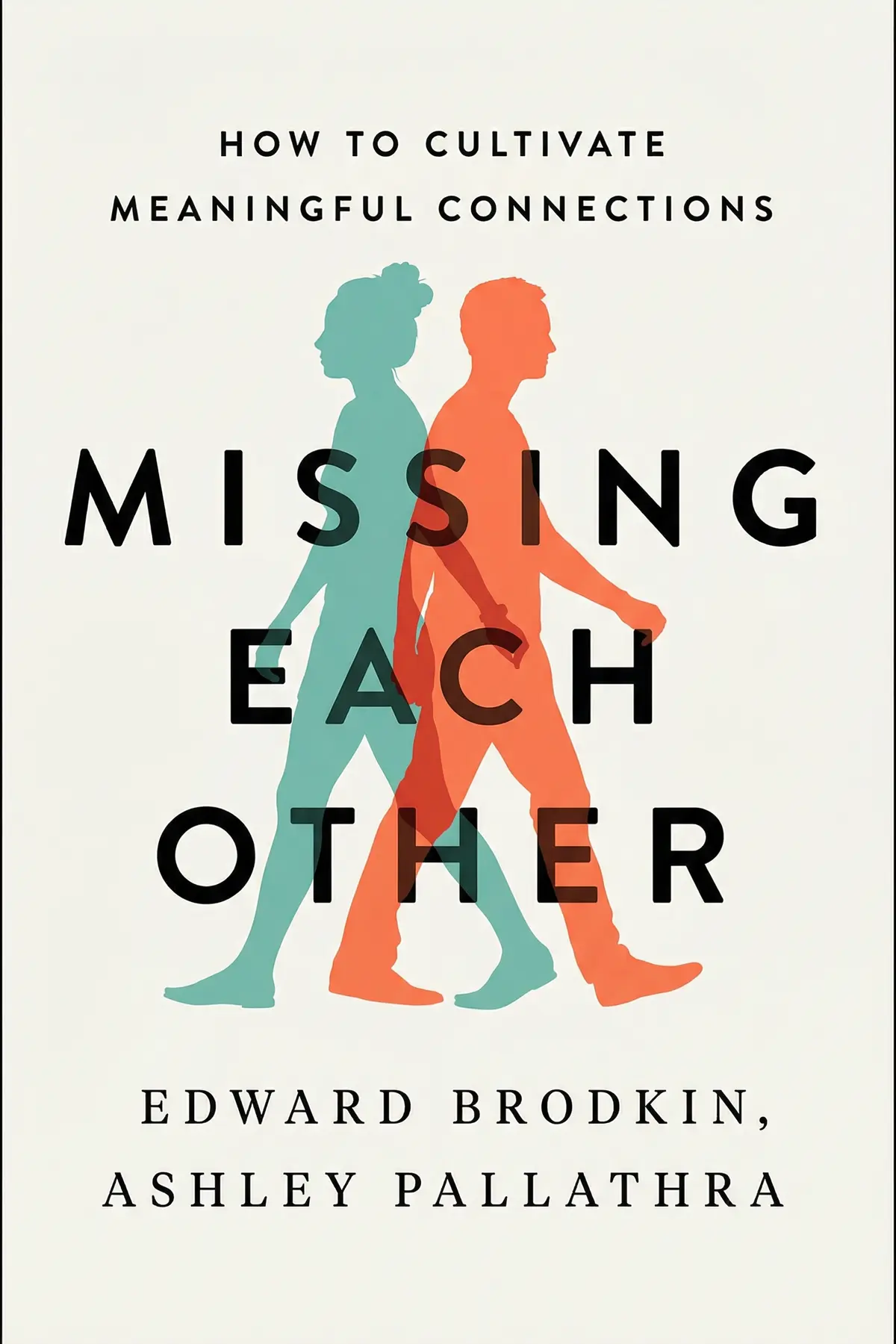
Table of Content
1. Introduction
1 min 00 sec
Plenty of people spend whole evenings messaging friends and scrolling past hundreds of acquaintances, then go to bed feeling alone. In Missing Each Other, psychiatrist Edward Brodkin and psychologist Ashley Pallathra trace that gap to the way we communicate: we trade many words but rarely tune in to each other. The missing skill has a name, attunement, the ability to sense your own feelings and someone else’s and bring the two together.
Their case is that anyone can learn it. Attunement rests on four pillars that can each be trained: relaxed awareness, listening, understanding and mutual responsiveness. Along the way come Oprah Winfrey’s real talent, a coffee date that went wrong for reasons neither friend could see, and the reason a talking speaker in your kitchen cannot be a friend. What the book offers is a way to make ordinary conversations feel like real contact again, starting with a few breaths before the next hard one.
2. Read what a friend needs before you respond
1 min 33 sec
A friend opens the door with a small frown instead of her usual hug. The right reaction could be tears or jokes, and the skill that tells you which one sits beneath every relationship you have.
3. Calm your body so your attention can open
1 min 36 sec
You want to follow a friend’s painful story, yet your mind keeps drifting to work and errands. A basketball legend and a few minutes of breathing point to the state you need first.
4. Listen with your eyes, your rhythm and your feelings
1 min 41 sec
Millions watched Oprah Winfrey for decades, and the authors think they know why. Her real strength had little to do with talking, and it breaks down into parts anyone can practice.
5. Look for the hidden reason behind rude behavior
1 min 38 sec
A friend arrives late, skips the apology and answers in single words. Naomi walks away sure she knows what happened. She is wrong, and the mistake she makes is one everyone makes.
6. Defuse anger by mirroring it a little softer
1 min 50 sec
Figure skaters, a stand-up comedian and a parent talking to a toddler all share one skill. It keeps conversations lively, and it also gives you a gentle way to bring an upset person down.
7. Know what a talking speaker can never give you
1 min 42 sec
Computers already beat people at chess, go and poker, and Amazon is teaching Alexa to hear your mood. The authors explain where the imitation ends, and what worries them about it.
8. Small daily check-ins that ease conflict everywhere
1 min 52 sec
A roommate who ignores the chores and a coworker too stressed to function seem like minor irritations. The authors start there, then make a much larger claim about what the same skills could do for whole societies.
9. Conclusion
1 min 09 sec
Loneliness, on this reading, grows from contact without attunement: many messages, many faces, and little sense that anyone has truly met us. Brodkin and Pallathra do not ask anyone to give up screens or crowded cities. They ask us to treat connection as a skill with parts we can train, from the calm in our own shoulders to the small drop in tone that settles an angry friend.
The habits the book supports are simple. Take a few slow breaths before a conversation you dread, or try tai chi as a way to join body and mind. Watch faces and voices along with words. When someone seems rude, wonder what might be happening for them and when you would act the same way. And when feelings run high, meet the other person’s mood, then offer it back a little calmer.
Think of Naomi walking away from that coffee date, certain her friend had changed. A little more understanding on both sides, the authors suggest, might have made Naomi more sympathetic and Oliver more open about his news.
About this book
What is this book about?
Many people are surrounded by others all day, on crowded streets and on video calls, and still feel alone. Psychiatrist Edward Brodkin and psychologist Ashley Pallathra argue that the trouble lies in how we communicate. Fast, media-heavy lives keep us busy while keeping us from actually connecting. Their answer is attunement: sensing and understanding your own emotions and someone else's, and bringing the two into line. They build it on four pillars. Relaxed awareness puts the body at ease and the mind alert. Listening adds focused attention, synchrony and emotional empathy. Understanding uses cognitive empathy to avoid misreading people. Mutual responsiveness turns all of it into a live back-and-forth. Along the way the authors draw on Michael Jordan in flow, Oprah Winfrey's gift for making guests feel heard, a coffee date spoiled by a misread mood and Amazon's attempts to make Alexa sound attuned. Readers get practical habits, from a few breaths before a hard conversation to a calmer way of answering anger, plus the authors' case that attunement could ease conflicts far beyond the home.
Book Information
Who it's for
Professionals who feel unheard
Professionals who talk with people all day yet feel unheard and disconnected.
Leaders of stressed teams
Managers and team leads facing stressed colleagues and tense conversations.
Wanting closer friendships
Anyone feeling lonely despite a busy social feed who wants closer friendships and calmer conflicts.
About the Author
Edward Brodkin
Edward S. Brodkin, M.D., teaches psychiatry as a tenured associate professor at Penn's Perelman School of Medicine, where he founded and leads a program for adults on the autism spectrum; his lab and clinic study social neuroscience. He trained at Harvard, Yale and Princeton, and credits clarinet, team sports and Chen style Tai Chi with teaching him about attunement. Ashley A. Pallathra, Ph.D., is a licensed clinical psychologist who treats children, teenagers and adults for anxiety, depression, trauma and related conditions, and has written for Psychology Today and Harvard Business Review.
Ratings & Reviews
Ratings at a glance

What people think
Listeners find this book enlightening, with one mentioning it is supported by modern scientific studies, and they value its novel outlook on human connections. This work offers meaningful activities for building skills in every area, and listeners feel it is simple to comprehend and absorb. They view it as an essential read, with one listener pointing out its benefit for those in leadership and subordinate roles alike.
Top reviews
Sirinat
Wow, this was exactly the antidote I needed for my post-pandemic social anxiety. Brodkin and Pallathra provide a sophisticated blueprint for rebuilding our capacity for fellowship in an era where we're all glued to our screens. I especially appreciated the section on 'artificial attunement' and how technology is fundamentally altering our brain chemistry and social interactions. It’s a must-read for anyone in a leadership position or anyone who just wants to feel more 'in sync' with their loved ones. While some might find the tone a bit clinical, I found the scientific backing to be reassuring rather than boring. It’s rare to find a self-help book that feels this well-researched and grounded in modern reality. Truly a refreshing read.
Show moreAir
The truth is, we are losing the art of being human in a digital world, and this book serves as a vital wake-up call. I was particularly fascinated by the terrifying look at brain-chip technology and artificial intelligence in the final chapters. It makes you realize how precious real, unmediated human connection actually is. The authors provide thoughtful exercises that genuinely help you slow down and tune back into the people around you. It’s an easy read that manages to be both relaxing and deeply informative at the same time. Not gonna lie, some of the AI stuff is frightening, but it’s a necessary look at where we’re headed. Highly recommended for the modern age.
Show moreKaen
Ever wonder why you can be in a room full of people and still feel completely alone? This book digs into the 'why' by exploring the mechanics of human connection, specifically through the four pillars of relaxed awareness and mutual responsiveness. I found the inclusion of Tai Chi and breathing exercises surprisingly grounding, though I'll admit I haven't mastered them all yet. It’s a refreshing perspective that moves away from superficial networking tips and focuses on the internal work needed to truly 'see' another person. The pacing is a bit slow in the middle, but the insights into our digital silos are timely and necessary. It’s a great resource for anyone looking to deepen their existing relationships through actual presence.
Show moreAubrey
As someone who works in high-stakes environments, I found the discussion on mutual responsiveness to be incredibly relevant to team dynamics. We often 'miss each other' because we aren't truly attuned to the non-verbal cues and energy of our colleagues. This book offers a scientific framework to fix that. I’ll be recommending this to my coaching clients who need to boost their EQ. My only gripe is that the writing is a bit passionless; it’s very informative, but it doesn't exactly set your soul on fire. Still, the exercises are practical and the research is top-notch. It's a solid 4-star read for anyone interested in the intersection of psychology and communication.
Show moreBig
Picked this up on a whim and was pleasantly surprised by the depth of the research involved. It’s not your typical 'rah-rah' self-help book; it’s a measured, scientific approach to how we relate to one another. I found the focus on the four levels of attunement to be an enlightening way to categorize my own social failings. While the prose can be a bit slow and academic, the actual skills being taught are essential for anyone living in our current disconnected society. If you can get past the somewhat robotic anecdotes, there is a wealth of knowledge here about becoming a more present and responsive human being. It’s a thoughtful, grounded read that actually gives you tools to work with.
Show moreWanida
After hearing so much about Brodkin’s work with autism, I picked this up hoping for a deep dive into neurodivergent social strategies. Unfortunately, that specific topic is barely touched upon after the introduction, which was a major letdown for me. Instead, we get a very broad manual on 'attunement' that feels a bit too academic and dry at times. It isn't a bad book by any means—the advice on active listening and staying present is actually quite sound—but it wasn't the specific resource I was looking for. If you want a general self-help book on mindfulness in relationships, this might work, but it lacks a certain spark to keep it from feeling repetitive. It’s interesting, but I’m likely passing my copy on.
Show moreSam
The chapter on listening was probably the most useful part of the entire book, though much of the rest felt like redundant padding. Frankly, the authors spend a lot of time explaining simple concepts in very complex ways, which can make for a sluggish reading experience. I liked the idea of 'relaxed awareness' as a foundation for communication, but the practical application felt a bit vague in places. It’s the kind of book that has about 50 pages of great information expanded into over 200 pages. I don’t regret reading it, but I’ll probably just keep the summary and pass the physical copy along. It’s useful if you’re new to mindfulness, but might feel like a retread for others.
Show moreMethinee
Look, this isn't going to be a life-changing read for everyone, but it’s a solid 3-star effort with some interesting takeaways. The authors define 'attunement' in a way that makes sense, breaking it down into manageable components like understanding and listening. However, the book suffers from a lack of personality. The anecdotes are so vague that they evaporate from your memory the second you turn the page. It’s like bottled oxygen—useful if you’re struggling to breathe in a siloed society, but the packaging is as bland as it gets. Good info, mediocre storytelling. I think it would work much better as a long-form magazine article than a full-length book.
Show moreTim
The core concepts of 'attunement' are undoubtedly valuable, but the execution left me cold. While the authors are clearly experts in their field, the writing style is stiff and oddly detached, making it difficult to stay engaged for long stretches. The anecdotes involving characters like 'Alice' and 'Jake' felt sanitized and robotic, as if real human messiness was filtered through a clinical lens. It’s hard to learn about deep connection from a book that feels so disconnected from its own narrative. To be fair, the research is solid, yet it reads more like an expanded journal article than a compelling guide for the layperson. I wanted to feel inspired, but I mostly felt like I was reading a manual for a piece of software.
Show morePenelope
Finally got around to finishing this, and I have to say I’m disappointed it didn't offer more practical advice on making *new* friends. I’m struggling with loneliness in a new city, but this book is geared much more toward improving existing, committed relationships. The tone is incredibly dry—imagine a business textbook trying to teach you how to hug—and the 'success stories' are so formulaic they feel like satire. There is some decent information here regarding emotional intelligence, but it’s buried under layers of clinical jargon and repetitive exercises. It simply wasn't the accessible guide I was hoping for. If you want to save time, just read a summary of the four components of attunement and skip the rest.
Show moreQuestions about this book
What is Missing Each Other by Brodkin and Pallathra about?
The book argues that many people feel lonely despite constant contact because they rarely achieve attunement, the ability to sense their own and others’ emotions and bring them into line. Psychiatrist Edward Brodkin and psychologist Ashley Pallathra show that attunement can be learned, and they break it into four trainable pillars. They also look at how machines imitate it and how it could help ease social conflict.
What are the four pillars of human connection?
The authors name relaxed awareness, listening, understanding and mutual responsiveness. Relaxed awareness means a calm body and an alert mind, trained through meditation. Listening combines focused attention, synchrony and emotional empathy. Understanding relies on cognitive empathy to avoid misreading why someone behaves as they do. Mutual responsiveness puts it all into action, as each person anticipates and builds on the other’s signals.
How can attunement help calm an upset person?
The authors suggest responding to someone who is upset in a similar way, but slightly calmer. Matching their emotional tone shows that you see and understand how they feel. Reflecting it back in a softer form invites them into your own more peaceful state. When the two of you are attuned, they say, the other person tends to accept that invitation.
Can AI assistants like Alexa achieve real attunement?
Not in the authors’ view. Amazon has built technology that analyzes the pitch and tenor of voices so future versions of Alexa might match a user’s mood, but Brodkin and Pallathra see this as simulation. Humans attune through shared feeling, while an AI gathers data. They also warn that artificial attunement could be used to manipulate people or draw them away from each other.
Featured in
Readers also enjoyed


A Liberated Mind: How to Pivot Toward What Matters
Steven C. Hayes


Acting with Power: Why We Are More Powerful Than We Believe
Deborah Gruenfeld


Age of Propaganda: The Everyday Use and Abuse of Persuasion
Anthony Pratkanis



AUDIO SUMMARY AVAILABLE
Listen to Missing Each Other in 15 minutes
Get the key ideas from Missing Each Other by Edward Brodkin, plus 5,000+ more nonfiction titles.
- 5,000+ titles
- Listen as much as you want
- 7-day free trial
- Cancel anytime









