

14 min 31 sec
Available in: English
Mindware: Tools for Smart Thinking
Shows why intelligent people still make foolish choices, naming the common reasoning traps behind them and giving simple tools for spotting false causes, resisting loss aversion and testing arguments and advice.
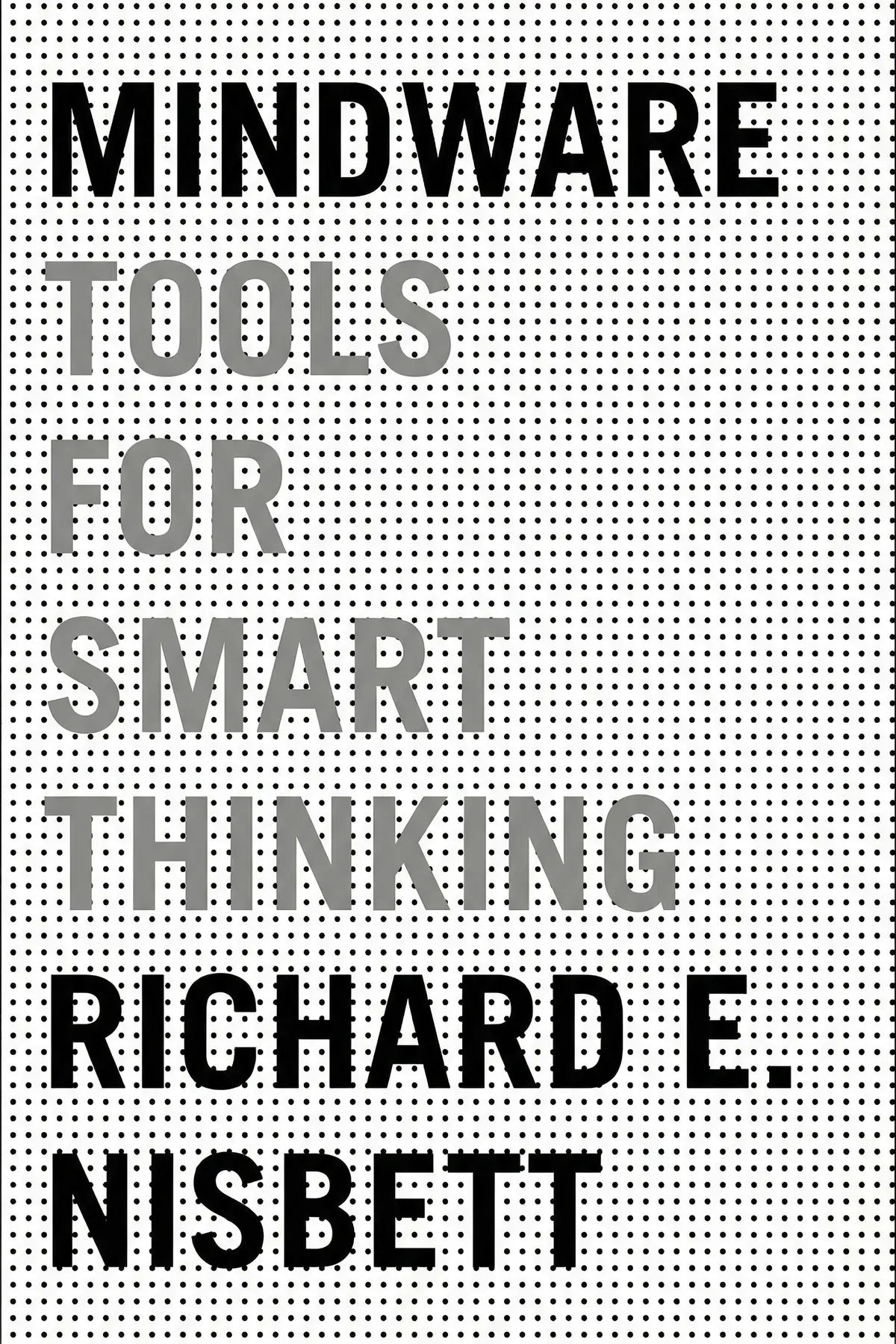
Table of Content
1. Introduction
1 min 04 sec
Smart people make foolish choices all the time. In Mindware, researcher Richard E. Nisbett argues that we all act foolishly at times, often because of very common reasoning mistakes that we can learn to notice and guard against. One of the most common is treating two things that happen together as if one caused the other, the kind of mistake that could make banning ice cream look like a cure for polio.
Nisbett’s case is that good thinking is a set of learnable tools. Most bad decisions grow from a few invisible habits of mind, and once you can name them, you can override them. The book moves from the traps themselves, mistaking correlation for cause, seeing what we expect, fearing loss and overvaluing what we own, to the defenses: checking advice against many studies, applying formal logic and choosing the simpler theory. What you take from it is a short list of questions to put to a headline, a tempting offer, a hiring decision or your own certainty.
2. Find the hidden cause behind a neat link
2 min 06 sec
Polio cases and ice cream sales climbed together every summer of the 1950s. Banning dessert would have saved no one, and the reason exposes a mistake that hides inside many confident headlines today.
3. See past details that trigger snap judgments
2 min 04 sec
Trained clinical psychologists were handed patient cards rigged to point one way. They saw the opposite, and even when told the truth, they trusted their experience. What their memories were doing applies to every expert.
4. Stop letting fear of loss block good bets
1 min 50 sec
A stranger offers a coin flip that pays more when you win than it costs when you lose. Most people refuse, and the price they demand before agreeing reveals how lopsided our feelings about risk really are.
5. Price what you own like a buyer would
1 min 54 sec
A nice mug bearing the university’s logo was priced at twice as much by the students who were given one to keep. The experiment explains why sellers and buyers so often stare at each other across an impossible gap.
6. Check expert advice against many studies
2 min 11 sec
An expert on television says babies should be shielded from germs as much as possible. It sounds responsible. A careful look at allergies in Germany, Russia, Finland and on farms suggests a very different answer.
7. Test any argument by checking its premises
2 min 05 sec
Aristotle grew tired of the weak arguments he heard in the Athenian assembly and built a way to test them. The same method sinks a familiar spam email and can take prejudice out of hiring.
8. Conclusion
1 min 17 sec
Mindware adds up to a modest and useful claim: intelligence does not protect anyone from foolish choices, but tools can. The errors Nisbett describes feel like common sense from the inside. The psychologists with their inkblot cards were sure of their experience. The students with their mugs were sure of their price. His tools work because they move judgment out of your head and onto something you can inspect: a list of premises, a set of studies, the price a stranger would pay.
One more tool completes the kit. When two theories both seem to fit what you see, Nisbett recommends Occam’s Razor, named after the Franciscan friar William of Ockham: pick the simpler one. Simple theories are easier to test and to model with numbers, and complicated ones rarely explain the evidence as well.
So the next time a headline links two trends, look for the summer behind the ice cream. Before you turn down an offer, ask whether fear of losing is doing all the talking. And before you hold out for a price because something is yours, value it as a buyer would.
Everyone falls into these traps. The people who think well are simply the ones who check.
About this book
What is this book about?
Everyone has watched a clever friend make a baffling decision, and most of us have done it ourselves. Researcher Richard E. Nisbett argues that the problem is rarely a lack of intelligence. It comes from a handful of common, invisible habits of mind that feel like sound judgment from the inside. In Mindware, Nisbett names these traps and shows them at work: summer ice cream sales that seemed to track polio, clinical psychologists misled by inkblot cards, people turning down a coin flip with good odds, and students who doubled the price of a mug as soon as it became theirs. Each story shows how expectations, fear of loss and the pull of ownership bend our reasoning. He then turns to defenses. Readers learn to test a confident claim against many studies at once, to judge an argument by its premises as Aristotle taught, to set criteria before looking at candidates, and to prefer the simpler of two theories. The result is a short kit of questions to put to a headline, an offer or their own certainty.
Book Information
Who it's for
Professionals making business decisions
Professionals who make hiring, investing or buying decisions and want fewer costly blind spots.
Students and news followers
Students and readers of news who want simple ways to test health advice and data-driven headlines.
Puzzled by avoidable mistakes
Anyone puzzled by why smart people, themselves included, keep making avoidable mistakes.
About the Author
Richard E. Nisbett
Richard E. Nisbett, born in 1941, earned his PhD at Columbia University under Stanley Schachter. He studies social cognition, culture, social class and aging. He has received the American Psychological Association's Award for Distinguished Scientific Contributions and is a member of both the National Academy of Sciences and the American Academy of Arts and Sciences. His other books include The Geography of Thought, Intelligence and How to Get It, and Thinking: A Memoir.
Ratings & Reviews
Ratings at a glance
What people think
Listeners find this title immensely helpful for logical reasoning, praising the unexpectedly vast collection of instruments for intelligent thought. Additionally, the quality of the writing is excellent and the lessons are relevant to daily existence, as one listener mentions its use of visual aids. Listeners also find the content clear and simple to digest. Even so, the specific direction of the book gets mixed feedback from listeners.
Top reviews
Tod
Ever wonder why you make terrible choices even when you think you're being rational? This book is a goldmine for anyone wanting to sharpen their logical thinking without getting bogged down in dense academic jargon. Nisbett provides an unexpectedly large number of mental models that are directly applicable to everyday life. I particularly appreciated the visual aids; they really helped clarify some of the trickier statistical concepts. While some critics say it’s too broad, I found the readability refreshing compared to other psychology tomes. It’s the kind of guide you keep on your desk to flip through when you need to recalibrate your brain. Truth is, most of us are walking around with outdated 'mindware' and this is the necessary upgrade. Highly recommended for fans of clear, actionable science.
Show moreSoontorn
The chapter on multiple regression analysis alone is worth the price! Nisbett has a knack for taking complex statistical concepts and making them feel relevant to a layman. I've read a lot of behavioristics books, but this one felt more 'hands-on' than most. He doesn't just talk about theories; he gives you actual frameworks to apply when you're looking at a news report or a sales pitch. The inclusion of visual aids was a smart move, as it breaks up the text and helps with retention. I found myself highlighting passages on almost every page, especially regarding the tragedy of the commons and opportunity costs. If you want to stop being a passive consumer of information, this is the book you need. It’s brilliant stuff.
Show moreThawee
After hearing so much about Richard Nisbett, I finally dived into his work on smart thinking. It's an excellent companion piece to the works of Kahneman and Taleb, though it approaches logic from a more accessible angle. I loved how he brought statistics and economics into the reality of our daily struggles. The 'eekonomics' section was particularly eye-opening, tearing apart how we misuse multiple regression analysis. My only gripe is that the writing style feels a bit clumsy in places, with some unnecessary jargon cluttering the prose. However, the insights into how our subconscious handles complex decisions are worth the price of admission alone. It’s a solid 4-star read that offers genuine tools for anyone willing to put in the effort to change their perspective.
Show moreLuke
As someone who teaches logic, I found Nisbett's approach to be incredibly practical and well-crafted. He identifies how our thinking is influenced by hidden factors before providing the actual tools to fix those biases. I was especially drawn to the chapters on cost-benefit analysis and how we often ignore the 'sunk cost' fallacy in our personal lives. The book isn't exactly a quick read, but it’s manageable if you take it in small chunks. It’s fascinating to see the evidence of how much we are fooled by advertising and framing. My only real complaint is the publisher's attempt to market this as a 'self-help' book when it’s clearly popular science. Still, it’s a very useful resource for sharpening your mental toolkit.
Show moreMalee
Finally got around to reading this, and I have to say the section on Western versus Eastern logic was a highlight. Nisbett explains how the Chinese approach contradiction differently than we do in the West, which really challenged my perspective on 'correct' reasoning. The book is dense with nuggets of debunking that make you question every 'recent study' you see in the news. While the author admits he often fails at 'smart thinking' himself, his honesty makes the advice feel more grounded and less like a sermon. Some parts do feel like a retread of basic psychology, but the way he synthesizes different fields is impressive. It’s a readable, informative journey through the flaws of the human mind. Definitely worth a spot on your shelf.
Show moreCholada
Picked this up on a whim and was pleasantly surprised by the depth of the content. It’s not just a collection of anecdotes; it’s a comprehensive look at how we can use logic and statistics to navigate a confusing world. I particularly enjoyed the sections on how we misperceive correlation as causality. Nisbett’s tone is academic yet accessible, though he does get a bit repetitive with his examples. To be fair, the repetition helps drill the concepts in, but it can make the middle sections feel like a bit of a slog. Regardless, the tools for smart thinking are all there if you’re willing to look for them. It’s a great addition to any library focused on psychology or economics. I’ll definitely be revisiting some of these chapters.
Show moreSamroeng
Personally, I think the criticism about this book being 'boring' is a bit harsh. While it’s not as fast-paced as a Gladwell book, it offers much more substance for those actually looking to learn. The exploration of the fundamental attribution error was particularly well-done, explaining why we judge others so differently than ourselves. I also appreciated the breakdown of the 'endowment effect' and how our possessions warp our sense of value. The writing isn't always graceful, but the clarity of the logic usually shines through. It’s a great manual for anyone who wants to understand the 'why' behind their own behavior. It’s definitely improved my ability to spot logical fallacies in daily conversations. A very solid and educational read for the curious mind.
Show morePing
Not what I expected given the 'tools' promised in the subtitle. I felt like I was reading a textbook that had been watered down for a general audience, losing its edge in the process. The author spends a lot of time explaining why we are wrong but doesn't spend nearly enough time on the practical how-to of thinking better. It’s uninspiring to read things that have been retold many times over in better-written books. Frankly, I found the structure messy and the conclusion—which basically tells us to just trust experts—to be quite a letdown. It seems to contradict the earlier chapters on scientific revolutions. I ended up skimming the last third just to get it over with. It's just 'meh' at best.
Show moreSam
Look, this isn't a perfect book, but the utility it provides for everyday decision-making is undeniable. I've been trying to apply the cost-benefit logic to my own stock portfolio and it’s already helping me avoid some classic emotional traps. Nisbett’s writing can be a little dry, and he definitely uses more jargon than necessary, but the core ideas are powerful. I liked the discussion on how the subconscious can actually be better at 'weighing up' complex choices like buying a house. It’s a relief to know that 'sleeping on it' is actually a scientifically backed strategy! It might not be the most exciting read of the year, but it’s certainly one of the most useful ones I’ve encountered lately. Solid 3 stars.
Show moreKatya
Disappointment is a complete understatement regarding this book. I picked this up because Malcolm Gladwell endorsed it, but the author somehow managed to make a fascinating topic like human behavior feel like a chore. The text is packed with redundant examples that stretch a simple point across ten pages, making for a very painful read. To be fair, the section on cost-benefit analysis was decent, but it wasn't enough to save the book from its own technical word choices. It felt like a collection of introductory lectures that never quite reached a meaningful conclusion. If you've already read Thinking, Fast and Slow, you can safely skip this one. You won't find anything new or particularly 'smart' in these chapters. It simply lacks the spark I expected.
Show moreQuestions about this book
What is the main idea of Mindware by Richard E. Nisbett?
Nisbett argues that intelligent people act foolishly because of common, invisible reasoning habits, not a lack of brains. He names traps such as mistaking correlation for causation, the representativeness heuristic, loss aversion and the endowment effect. He then offers tools to counter them: checking claims against many studies, judging arguments by their premises, setting criteria before evaluating people and choosing the simpler theory with Occam’s Razor.
What does Mindware say about correlation and causation?
Two things happening together does not mean one causes the other. Nisbett points to the 1950s, when polio and ice cream sales both rose each summer. The real link was swimming pools, where polio spread. He also suggests that richer countries may have higher average IQs because wealth brings better health care and schools, not the other way around.
What are loss aversion and the endowment effect in Mindware?
Loss aversion means losses hurt about twice as much as equal gains please. In one study, most people refused a coin flip offering $120 against $100 and wanted at least $200 to play. The endowment effect means we overvalue what we own: students given university mugs asked twice what other students would pay for the same mug.
How can I apply the ideas in Mindware?
When two trends move together, ask whether something else drives both. Before trusting advice, gather several studies from different groups and look for one explanation that fits them all, as Nisbett does with germs and allergies. Before rejecting a risky offer, check whether fear of loss is the only objection. When hiring, hide irrelevant traits and set your criteria first.
Who should read Mindware?
It suits anyone who makes decisions based on data, advice or experience: managers hiring staff, people weighing risky opportunities, parents sorting through expert claims, and students who want sharper reasoning. Nisbett’s examples, from spam emails to inkblot tests, show that even trained experts fall for these traps, so the tools are useful at any level.
Featured in
Readers also enjoyed

59 Seconds: Change Your Life in Under a Minute
Richard Wiseman




A Liberated Mind: How to Pivot Toward What Matters
Steven C. Hayes


Acting with Power: Why We Are More Powerful Than We Believe
Deborah Gruenfeld


Age of Propaganda: The Everyday Use and Abuse of Persuasion
Anthony Pratkanis
AUDIO SUMMARY AVAILABLE
Listen to Mindware in 15 minutes
Get the key ideas from Mindware by Richard E. Nisbett, plus 5,000+ more nonfiction titles.
- 5,000+ titles
- Listen as much as you want
- 7-day free trial
- Cancel anytime









