

A Life Decoded: My Genome: My Life
J. Craig Venter
 English
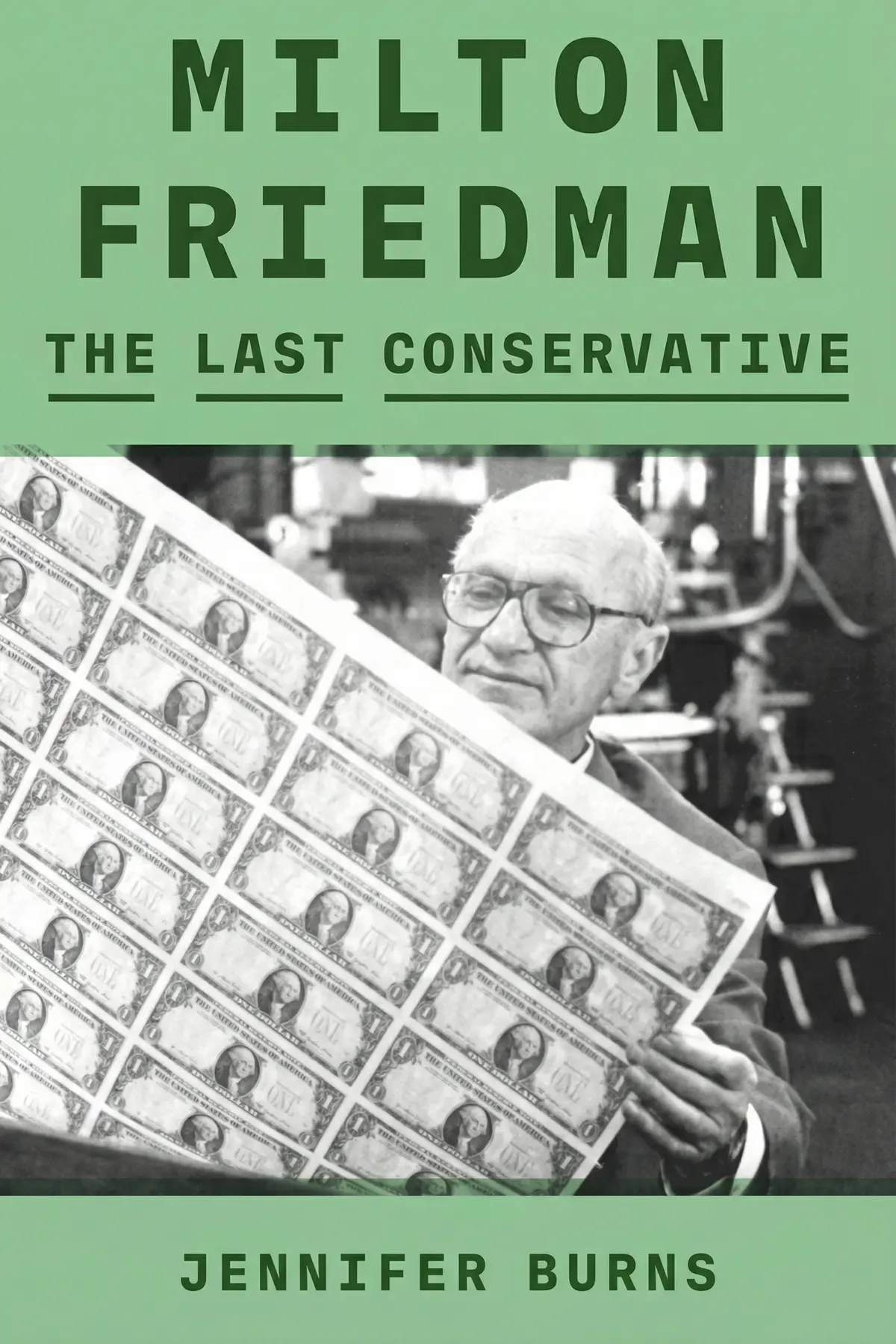
Jennifer Burns traces how a Depression-era outsider built the case that money and central bank mistakes, not unstable markets, explain inflation and the Depression's depth, and how those ideas came to shape policy for decades.
1 min 03 sec
If Milton Friedman is a name you hear in arguments about inflation, welfare or the Federal Reserve without quite knowing why, Jennifer Burns can fix that. In Milton Friedman: The Last Conservative, the Stanford historian follows the economist whose boldest claim, that the central bank’s own blunders made the Great Depression so severe, once sounded like heresy and later shaped how central banks fight inflation. His grip lasted long after his death. Running for president in 2020, Joe Biden still felt the need to insist, “Milton Friedman isn’t running the show anymore.”
Burns tells the story of a man who was an outsider for years. His ideas were formed in a crisis, sharpened by conflict and a loyal Chicago circle, and carried into power when inflation broke the consensus that had brushed him aside. Follow that arc and you can explain what monetarism claims, why the painful Volcker squeeze happened and why pandemic-era debates kept circling back to a bespectacled economist barely five feet tall.
1 min 52 sec
He was headed for a steady career calculating insurance risk. One college course, two professors and a collapsing economy pulled him somewhere else, along with the classmate he would marry.
2 min 22 sec
His first big piece of research made powerful people furious, and the fallout followed him from New York to Wisconsin. What kept him going says a lot about the economist he became.
2 min 08 sec
Back at his old university, Friedman found grief, rivals and a department drifting toward the planners. Within a decade the planners were gone. The way he turned it around was more social than academic.
1 min 50 sec
He did not want the old right’s answers, and he rejected the New Deal’s. The middle path Friedman carved out still shapes debates about welfare, schools and a guaranteed income.
1 min 49 sec
For a generation, economists blamed the Depression on capitalism’s built-in instability. Friedman and a coauthor went back through nearly a century of records and pointed at a different culprit, one that eventually agreed with them.
1 min 46 sec
Inflation was running wild and the standard remedies kept failing. The economist the establishment had dismissed suddenly had the ear of the Federal Reserve and the White House, and his ideas returned again after the pandemic.
1 min 04 sec
Burns’s Friedman spent most of his early life on the wrong side of the room. The doctors’ association, his supervisors at the bureau, the Wisconsin faculty and the Keynesian mainstream all pushed back, and he held on to the same few convictions about markets, money and freedom. The Depression gave him his subject, Chicago gave him allies, and inflation finally gave him an audience. The short, bespectacled economist ended up drawing admiration and fury in about equal amounts, praised as a champion of liberty and attacked as a high priest of greed.
His work leaves a few habits worth keeping. When prices rise, look first at what the central bank has been doing with money. When a new social program is proposed, ask whether a cash grant could do the job with fewer officials. And when an idea you dislike keeps returning, as Friedman’s did after the pandemic, treat it as a question that deserves a real answer.
Biden could announce that Friedman was no longer running the show. Fifteen years after his death, the show was still arguing with him.
Milton Friedman is still invoked in arguments about inflation, welfare and the Federal Reserve, often by people who could not say exactly what he argued. Jennifer Burns, a Stanford historian, tells the story behind the name: a gifted boy from Rahway, New Jersey, who found economics during the Great Depression and spent much of his early career in conflict with employers and the mainstream. Burns follows him from Chicago's price theory classrooms to a long fight over his dissertation, a resignation in Wisconsin, wartime statistical work and a return to Chicago shadowed by a friend's death. There Friedman and a tight circle of allies, including his wife Rose, built a counter-tradition to Keynesian planning. He reframed his values around freedom, proposed cash-based ideas such as school vouchers and a negative income tax, and argued with Anna Schwartz that Federal Reserve errors made the Depression so severe. Readers come to understand monetarism, why Paul Volcker turned to it, how Friedman came to advise Ronald Reagan, and why his questions returned during the pandemic and the inflation of 2021.
Professionals who follow inflation and interest rate news and want to know where the arguments come from.
Students of economics, history or politics looking for the human story behind monetarism.
Readers on the left or right who want to understand Friedman before praising or attacking him.
Jennifer Burns is an American historian, born in 1975, who teaches history at Stanford University and holds a research fellowship at the Hoover Institution. She studies twentieth-century American politics and culture, with a focus on markets, capitalism and economic ideas. Her earlier book, Goddess of the Market, examined Ayn Rand. Her articles have appeared in The New York Times and the Financial Times, and she has discussed her work on The Daily Show.
Listeners consider this biography an outstanding piece of economic history, with one review highlighting it as a comprehensive and nuanced exploration of Friedman’s life and philosophy. Furthermore, the narrative is compelling and well-constructed, with one listener remarking that it remains interesting without becoming tedious. Finally, listeners value how the work addresses Friedman’s significant impact on 20th-century economic thought.
Jennifer Burns has managed to condense a massive amount of archival research into a biography that feels both definitive and surprisingly fresh. It is easily the most comprehensive work on Friedman to date, far surpassing previous attempts to capture his complex legacy. I was particularly impressed by the chapter dealing with the Pinochet regime in Chile. Burns handles this controversial period with a level of scholarly detachment that is rare in discussions about neoliberalism. She avoids the typical villainization, choosing instead to contextualize his actions within his broader philosophical commitment to freedom. The book is thick, and the material is undeniably complex, but her 'plain English' explanations of macroeconomics are a godsend. It’s a brilliant look at how one man’s ideas came to dominate global policy. This is intellectual history at its absolute finest, and I can't recommend it enough for anyone serious about understanding the modern world.
Show moreFinally got around to finishing this behemoth, and it’s arguably the definitive work on the man. What I loved most was how Burns situated Friedman within his larger intellectual milieu. She gives due credit to his mentors like Arthur Burns and George Shultz, showing that his ideas didn't emerge in a vacuum. The exploration of how he toppled Keynesian dominance is gripping. To be fair, you have to be ready for some serious technical discussion. The book doesn't shy away from the math or the abstruse nature of monetary policy. Yet, the way she connects these theories to real-world outcomes—like the end of the draft—is masterful. It is a long, dense read, but it never feels like a waste of time. Burns has a gift for making even the driest economic models feel relevant to the current political landscape. This is a must-have for any history buff’s bookshelf.
Show moreThe way Burns traces Friedman’s shift from Rutgers to the Chicago School is incredibly detailed. She captures the urgency of the debates during the Gilded Age and the subsequent shock of the Depression perfectly. As someone who has read several biographies of 20th-century figures, I found this one to be uniquely thorough in its technical aspects. She doesn't just say he was influential; she proves it by walking you through the actual mechanics of his thought process. The book is a massive undertaking, yet the writing remains engaging throughout. I especially appreciated the nuanced take on his time in Chile. It's refreshing to see a historian move past the usual talking points to look at the actual evidence. This book shows Friedman as a man ahead of his time, whose ideas on globalization and freedom are still being debated today. A truly exceptional work of economic history.
Show moreWow, the sheer level of research Burns put into this is staggering. From his humble New Jersey roots to his status as a global icon, every stage of Friedman’s life is examined with surgical precision. I loved the deep dive into 'economics imperialism' and how he applied market lenses to every social issue imaginable. It’s a heavy book, both physically and intellectually, but the rewards are huge. You come away with a profound understanding of why our current economic system looks the way it does. The author’s ability to explain abstruse concepts in plain English is her greatest strength. Even the more technical chapters on monetarism were readable. It’s a meritorious book that manages to be both an academic triumph and a compelling portrait of a man who changed the world. If you want to understand the roots of contemporary capitalism, you have to read this. Highly recommended.
Show moreThis book is effectively a masterclass in the evolution of 20th-century economic thought. Jennifer Burns doesn't just chronicle Milton Friedman’s life; she reconstructs the entire intellectual atmosphere of the Chicago School. I appreciated how she gave weight to his collaboration with Anna Schwartz on the 'Monetary History of the United States,' which is often overlooked in more casual accounts. The prose is exceptionally clear for such a dense subject, yet the sheer volume of economic theory can feel like a heavy lift at times. Truth is, if you aren't interested in the nuances of monetarism or price theory, this might feel a bit like a textbook. However, for those who want a nuanced exploration of his influence on modern policy, from school vouchers to the all-volunteer military, this is an essential read. It isn't exactly a page-turner in the traditional sense, but it is deeply rewarding and remarkably objective.
Show moreTo be fair, you need to be prepared for a deep dive into monetary policy before cracking this open. This isn't a beach read. It is a dense, scholarly achievement that demands your full attention for all 400-plus pages. I found the sections on the Great Depression particularly illuminating, especially how Friedman used that crisis to catalyze his lifelong fascination with economic forces. Burns is a smart writer, and she does an excellent job of being fair to a subject who is often treated as a caricature. She addresses his blind spots—like his somewhat cold take on integration—without being preachy. My only real gripe is that it can feel like 'inside baseball' at times. If you don't have a basic grasp of macroeconomics, some of the arguments might fly over your head. Still, the epilogue alone, which connects his work to the 2008 financial crisis, makes the whole journey worth it.
Show moreWhat struck me most was how Burns balances the different facets of Friedman’s career as both a rigorous researcher and a public proselytizer. Most people know him from 'Free to Choose,' but this book shows the decades of hard data-crunching that came first. It’s a very good book about a very significant man. The prose is sophisticated and the research is clearly top-tier. I did find the pacing a bit sluggish in the middle sections, particularly when the focus shifted heavily toward the more esoteric aspects of price theory. Frankly, the narrative can get overwhelmed by the subject matter. However, the insights into his relationship with his wife, Rose, who was also a trained economist, added a much-needed human element to the story. It isn't a 'fun' read, but it is an enlightening one. It provides a necessary corrective to the oversimplified versions of Friedman we usually see in the media.
Show moreFrankly, it’s about time someone wrote an intellectual history this thorough. Burns manages to be fairly positive about Friedman while still acknowledging the inequality his policies helped drive. She depicts him as a man who genuinely cared about poverty, even if his solutions—like the negative income tax—were often misunderstood. The book is scholarly and thoughtful, providing a level of historical context that puts earlier biographies to shame. It’s interesting without being tedious, provided you have at least a passing interest in how money works. I was particularly fascinated by the discussion of his TV series and how he became a household name. My only criticism is that the focus is so narrow that it sometimes feels like he lived in a vacuum of ideas rather than the real world. Still, it’s an uncommonly revealing look at one of the most important thinkers of our era.
Show morePersonally, I found the lack of personal detail in this biography quite frustrating. While Jennifer Burns is clearly a talented historian, she focuses almost exclusively on Friedman's professional life and economic theories. Where are the stories about his children? What were his hobbies? We get almost nothing of the man behind the desk. Instead, the narrative is an endless stream of intellectual debates and policy shifts. Not gonna lie, I found myself skimming several sections that went into the weeds of sequential analysis and munitions testing. If you are looking for a standard biography with a balance of personal drama and career highlights, look elsewhere. This is an academic study of his brain, not a portrait of his life. It’s well-written for what it is, but for the average reader, it is unavoidably tedious. It serves a very specific, narrow audience of economics nerds.
Show moreNot what I expected when I bought a biography of such a famous figure. I was hoping for more of a 'life and times' approach, but this is strictly an intellectual biography. The truth is, I struggled to stay engaged with the long-winded explanations of fiscal policy and sequential analysis. It felt less like a story and more like a very long lecture. Burns is obviously brilliant, but she often assumes the reader has a PhD-level understanding of the field. While I appreciate the scholarly effort, it lacked the narrative drive that makes a biography truly 'scintillating.' There are long stretches where his personal life and family are completely absent from the pages. It serves its purpose as a deep dive into his ideas, but it’s a bit of a slog for anyone not already obsessed with the intricacies of the Chicago School. It's profitable, but not exactly likeable.
Show moreJennifer Burns’s biography follows Milton Friedman from a dry goods family in Rahway, New Jersey, through the Great Depression, years of professional conflict and his return to Chicago, to his peak influence in the late 1970s and early 1980s. She shows how his ideas on free markets, money and freedom were shaped by a loyal circle of allies and later adopted by policymakers, including Federal Reserve chairman Paul Volcker.
Friedman and Anna Schwartz held, in a 1963 work titled A Monetary History of the United States and covering 1867 to 1960, that poor Federal Reserve decisions were chiefly why the Depression grew so severe. That contradicted the Keynesian view that instability in private investment was to blame. Burns notes that the Fed itself later admitted Friedman’s conclusions were accurate.
Friedman held that inflation is always, everywhere, a monetary phenomenon, rooted in what happens to money. The claim was disputed for decades, but Burns finds it has lasted remarkably well and underpins the inflation targets modern central banks use. Volcker applied Friedman’s approach by targeting the money supply instead of interest rates, a painful tightening that broke stagflation.
Friedman proposed meeting social needs with cash grants rather than bureaucracies. His negative income tax would replace welfare programs and agencies with one simple payment guaranteeing basic sustenance. Burns describes it as an idea that anticipated today’s debates about a universal basic income. He promoted these views to a wide public through his 1980 television series and book Free to Choose.
It suits anyone who hears Friedman’s name in debates about inflation, the Federal Reserve, welfare or school vouchers and wants the full story. Students of economics and history get the intellectual battles between Chicago and Keynesian planners. Readers of any political view get a fair picture of why, as Burns argues, his questions remain essential to understanding the modern economy.
J. Craig Venter


Ishmael Beah
James Herriot


Barack Obama


Masaji Ishikawa

Andrew Ross Sorkin

Ben Macintyre
AUDIO SUMMARY AVAILABLE
Get the key ideas from Milton Friedman by Jennifer Burns, plus 5,000+ more nonfiction titles.









