

14 min 26 sec
Available in: English
Millionaire: The Philanderer, Gambler, and Duelist Who Invented Modern Finance
The story of John Law, a Scottish gambler who gave France its first paper money and share-fueled boom. His rise and collapse show how credit, bubbles and public trust really work.
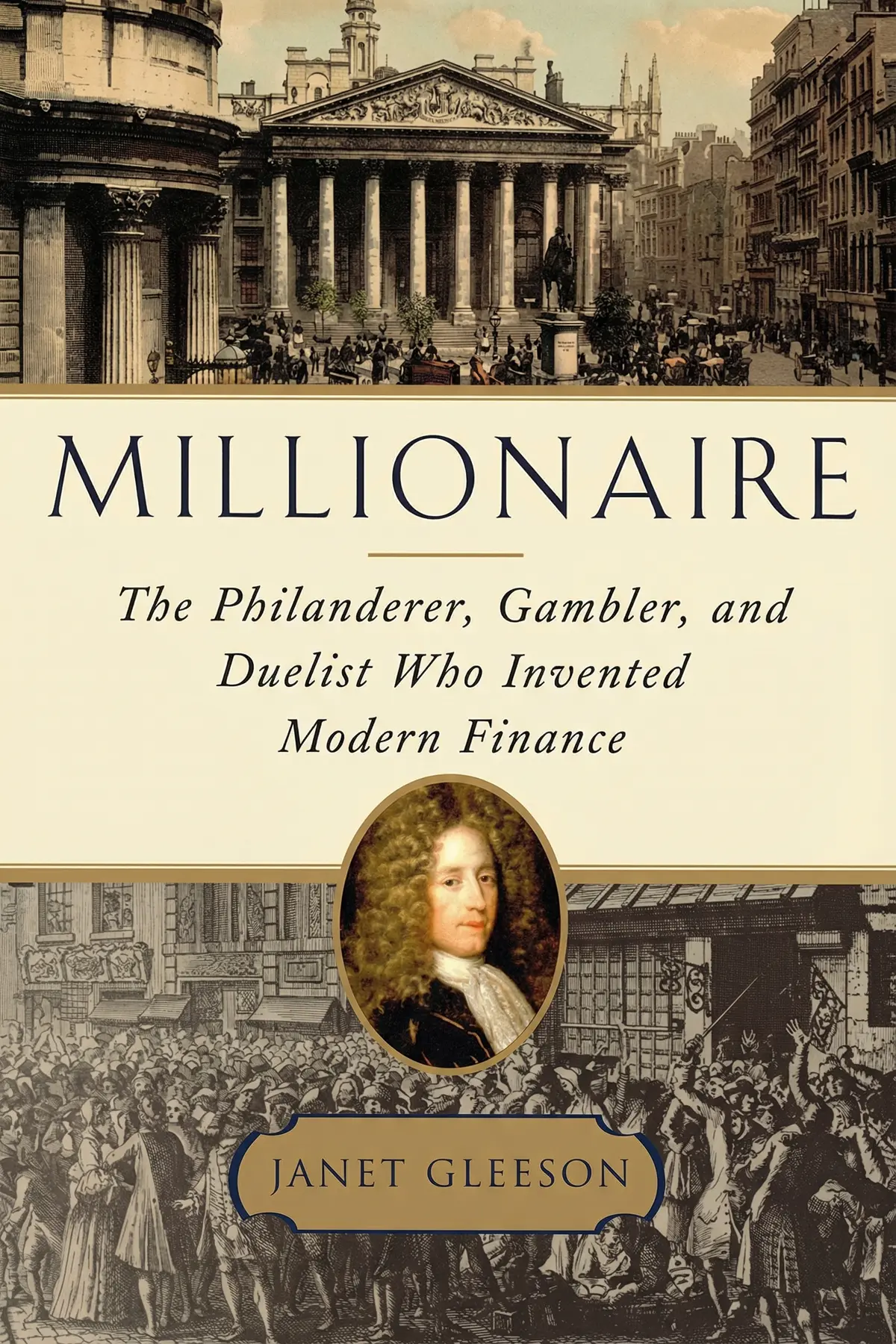
Table of Content
1. Introduction
55 sec
Most of us use money every day without asking what actually stands behind it. In Millionaire, author and former auction house specialist Janet Gleeson tells the story of the man who first ran a whole nation on that question: John Law, a Scottish gambler and duelist who gave early eighteenth-century France its paper money. His life gives a blunt answer. Paper money is a promise, worth exactly as much as people’s trust in it.
Law used that trust to lift a country buried in debt into a boom so wild that a new word, millionaire, was coined for the people it enriched. Then the trust ran out, and half a million people claimed losses. His rise and fall give you a working picture of how credit, shares and bubbles behave, plus warning signs that still apply whenever easy money starts to feel permanent.
2. See why every banknote is really a promise
1 min 34 sec
Long before John Law, bankers had found a way to let paper stand in for gold. It worked beautifully, with one weakness built in that no vault could ever fully protect against.
3. Read risk in odds, like a young gambler
1 min 41 sec
A rich young heir nearly landed in debtors’ prison before turning twenty-one. What he changed afterward made him a winner at cards and set him thinking about money in a completely new way.
4. Turn every rejection into a new direction
1 min 36 sec
A duel left one man dead and another waiting for the hangman. The survivor escaped, wrote a pamphlet nobody wanted and was refused by a queen, yet each setback pointed him closer to his chance.
5. Learn how paper money pulled France out of debt
1 min 58 sec
France owed a sum it could never repay in gold, and its own finance chief was making things worse. A suspect gambler with a private bank offered something no nation had tried before.
6. Spot a bubble by following the money loop
2 min 06 sec
Within two years a trading company bought the national mint, took over the state’s debt and saw its shares multiply twentyfold. Somewhere inside that dazzling growth was a pattern every investor should learn to recognize.
7. Bans and decrees cannot restore lost trust
1 min 53 sec
When doubt crept in, the most powerful financier in France reached for the law: no coins leaving the country, no diamonds worn in public. Each new rule was meant to calm people and did the opposite.
8. See Law's legacy in every modern market
1 min 40 sec
He died poor, kept apart from Katherine, the partner he had met in France, and France went without paper money for a century. Yet the tools he pioneered now run nearly every economy on Earth.
9. Conclusion
1 min 03 sec
Law’s life reads like a gambler’s lucky streak, but its real subject is belief. A Scot who understood odds saw that a modern economy runs less on gold than on confidence, and he built a nation’s finances on that insight. For a few years it worked: debt was absorbed, trade expanded, and lucky investors earned a new name, millionaire. The same insight explains the fall. Once people doubted the paper, no ban on coins or diamonds could make them believe again.
The story is useful because of the questions it trains you to ask. When something you own or work for is soaring, check whether the rise is paid for by real value or by more of the same promises. When an institution starts restricting how you hold or move your money, treat it as a signal of fear. And keep a balanced view of paper money and shares, the two tools Law left behind: they built modern prosperity, and they can still wreck it.
Every banknote in your wallet still carries his wager, that enough people will keep believing at the same time.
About this book
What is this book about?
Early in the eighteenth century, France owed more than it could ever repay in gold and silver. A Scottish gambler and convicted duelist offered a fix that no country had tried: run the economy on paper. Janet Gleeson tells how John Law went from London's card tables and a death sentence to running the finances of a deeply indebted France. Law's private bank issued notes that people trusted, and the economy grew. He then pushed the Mississippi Company toward a trade monopoly, bought the Royal Mint, offered to take over the national debt, and saw the company's shares rise twentyfold. The word millionaire was coined for the people it made rich. Then the promised riches of Louisiana never appeared, confidence cracked, and Law's desperate bans only sped up the collapse. The book is a story with a lesson that has not aged. It shows where paper money and share financing came from, why both depend on belief, and what the warning signs look like when a boom begins to feed on itself.
Book Information
Who it's for
Investors and savers
Investors and savers who want to recognize a bubble before it bursts.
Curious how finance began
Professionals curious where paper money and share financing actually came from.
History buffs
History lovers who enjoy a true story of duels, exile, fortune and ruin.
About the Author
Janet Gleeson
Janet Gleeson was born in Sri Lanka and studied art history and English. She worked at Sotheby's and later headed the Old Master Painting Department at Bonham's Auctioneers. She has written about art and antiques for House and Garden, worked as an editor at Reed Books, and published articles in Country Life and Apollo. Her books include The Arcanum, The Grenadillo Box, The Serpent in the Garden and Millionaire.
Ratings & Reviews
Ratings at a glance

What people think
Listeners find the writing both accessible and absorbing, with one review remarking that it reads much like a historical romance. They also prize the rich historical context, with one listener describing the work as "Financial history at its very best." Additionally, listeners value the book’s specific viewpoint, as one person points to its sharp economic and financial insights.
Top reviews
Araya
Finally got around to reading this after hearing it was the definitive account of the Mississippi Bubble, and it did not disappoint. This is financial history at its very best. Gleeson illustrates the sheer madness of the era, where French ladies supposedly begged to watch Law perform basic daily functions just to be in his presence. The book teaches more about the inherent value and danger of paper currency than most modern economics textbooks ever could. It’s a tragic, soaring arc of a man who understood probability better than his peers but couldn't outrun the mob once the gold ran out. If you want to understand why our current financial systems are so prone to instability, this is the perfect place to start. Truly a fantastic story that deserves a big-budget movie adaptation.
Show moreYaowaluk
Personally, I found this to be an incredibly insightful look at the origins of modern finance and the psychology of bubbles. The way Gleeson describes the transition from heavy metal coins to portable paper wealth is brilliant and easy for a layperson to grasp. Law wasn't just a gambler; he was an innovator who saw the future of credit before anyone else did. The book captures the atmosphere of 1720s France perfectly, from the desperate colonization of New Orleans to the stampede of investors in the Rue de Quincampoix. It’s a short read, but it packs a punch in terms of economic and financial insights. I highly recommend this to anyone interested in the history of money or the legendary figures who shaped our current global systems.
Show moreWorawit
Janet Gleeson managed to turn a dry subject like 18th-century macroeconomics into something resembling a fast-paced historical romance. Not gonna lie, I was worried this would be a dusty academic slog, but the narrative of John Law’s life is genuinely gripping. From his fatal duel in London to his escape from Newgate and his rise in the French court, the story moves with incredible momentum. The author does a superb job of explaining how the term 'millionaire' was actually coined during this specific speculative frenzy. I particularly appreciated the frequent references to Voltaire, which added a layer of intellectual authenticity to the drama. My only gripe is that the technical descriptions of the Banque Royale’s collapse were a bit sketchy and hard to follow without a prior history degree.
Show moreGiulia
As a history buff who usually avoids 'academic' biographies, I was pleasantly surprised by how briskly this moved through Law’s early life. The chapters detailing his obsession with the new science of probability were a highlight for me, showing how he used math to dominate the aristocratic salons of Europe. Look, the transition from a convicted murderer to the controller-general of French finance is the stuff of fiction, yet it’s all historical fact. Gleeson keeps the story constantly interesting without relying on too much flowery conjecture or imagined dialogue. You really get a sense of the sheer scale of the boom, where even the Regent’s mother was caught up in the mania. It’s a cautionary tale about inflation and the fragility of public trust that feels incredibly relevant to our modern world.
Show moreSureerat
What a wild ride through the decadent salons of Paris and the gritty cells of Newgate prison. I bought this on a whim and was really glad I did, mostly because the author knows how to frame a biography like a high-stakes thriller. John Law is a captivating figure—tall, charming, and dangerous—and his rise to become the richest person in Europe is handled with great narrative flair. The book avoids the 'dusty' feeling of many historical works by focusing on the human obsession with wealth and status. It was eye-opening to see how the Banque Royale's over-emission of currency led to such rampant inflation that people were trading religious chalices just to survive. While the middle section gets a bit bogged down in stock trading details, the overall impact is powerful.
Show moreMia
Is John Law a visionary genius or just a glorified con man? Gleeson attempts to bridge that gap, but frankly, the protagonist remains a bit of an enigma even after two hundred pages. The book provides a decent overview of how paper money revolutionized the French economy, yet I felt the author would seem to want to have it both ways regarding Law’s morality. One moment he is a brilliant mathematician using Pascal’s probability to beat the house, and the next he is a reckless adventurer ruining thousands. While the historical context of the Mississippi Bubble is fascinating, the prose occasionally drifts into the territory of a published PhD thesis. It is certainly informative, but I struggled to connect with the personalities of his common-law wife and children, who felt like mere footnotes in this financial saga.
Show moreAva
Truth is, I have mixed feelings about Gleeson’s portrayal of John Law’s economic 'miracle' in Paris. On one hand, the author makes a good case that he was acting disinterestedly and sincerely believed in his national bank scheme. On the other hand, the descriptions of the government’s attempts to control the ensuing disaster—like banning gold and silver coins—were almost too outrageous to believe. The book is definitely readable and engaging, but it seems to scratch only the surface of the complex political economy of the 18th century. I would have loved more analysis on why exactly his plan was on the cusp of working, as the author suggests. It’s a solid introduction to a fascinating man, but I left the final page wanting more depth than Gleeson provided.
Show moreOtt
Picked this up at a local library because the cover looked interesting, but I have to say it was a bit of a mixed bag. The story of Law’s escape from prison and his gambling exploits across the continent kept me turning the pages early on. However, once the focus shifted heavily to the administrative details of the Mississippi Company, the pace slowed down significantly. I felt like I was being hit with a barrage of facts that overwhelmed the actual story of the man. To be fair, the historical content is top-notch, but the writing style felt a little inconsistent—switching between a romanticized narrative and a dry report. It’s an interesting look at a speculative bubble, though I didn't find the author’s conclusions about Law’s character very definitive.
Show moreSoontorn
The premise of a gambler becoming the most powerful man in France was fascinating, but the execution left me cold. To be fair, the book is quite short, which might be why the descriptions of Law's handling of the French money supply felt too inadequate to be convincing. I never obtained a real sense of his motivations—was he a misguided philanthropist or just seeking personal glory? The author provides very little background on the secondary characters, making the whole affair feel like a sequence of events rather than a lived experience. By the time the Mississippi Company started failing, I was overwhelmed by details that seemed to cloud the main thread of the story. I found the ending particularly unsatisfying and abrupt, leaving me with more questions than answers about the actual mechanics of the crash.
Show moreJackson
I found myself more confused about the actual mechanics of 18th-century French finance after finishing this book than when I started. While Law is obviously a fascinating historical character, the author’s descriptions of his banking schemes were far too sketchy for my liking. I wanted to see the 'how' and 'why' of the economic collapse, but instead, I got a lot of anecdotes about ladies in waiting. The book feels a bit like it’s trying to be a historical romance and a serious biography at the same time, failing to fully satisfy either genre. Without a stronger background in French history, I found it difficult to follow the various political shifts. It was a quick read, but ultimately a disappointing one that lacked the rigorous analysis I was hoping for.
Show moreQuestions about this book
What is Millionaire by Janet Gleeson about?
It tells the life of John Law, a Scottish gambler and duelist who escaped a death sentence in London and later ran France’s finances. Law introduced the first national paper money system, built the Mississippi Company into a share-fueled boom and saw it collapse in 1720. Gleeson uses his story to show how paper money and credit depend on trust.
Who was John Law and why does he matter?
Law was a mathematically gifted Scot who lived off gambling, killed a man in a duel and fled to the continent. In France he founded the Banque Générale, then the Banque Royale, and took control of the Mississippi Company. His system collapsed, but paper money and raising investment through shares, both central to his plan, remain foundations of modern finance.
Where does the word millionaire come from?
According to Gleeson, the term was first used in France around 1719 to describe people who had grown rich from shares in John Law’s Mississippi Company. The boom was so intense that the company’s shares rose twentyfold and everyday prices soared, with a single chick costing as much as half a craftsman’s monthly wage.
Why did the Mississippi bubble collapse?
Investors expected gold, silver and fertile land in Louisiana, and none materialized. When share prices stalled, large shareholders sold, and people moved coins abroad. Law banned coin exports and even the wearing of diamonds, kept printing notes until circulation doubled, then cut paper money’s value in half. Confidence never returned, and half a million people claimed losses.
What lessons does Millionaire offer for today?
The book shows that paper money is only as strong as public trust in it. It suggests watching for booms where rising prices pay for further rises, as share sales funded purchases that justified more share sales. It also suggests treating sudden restrictions on how people hold their money as a sign of fear, since Law’s bans accelerated the panic.
Readers also enjoyed

A Promised Land
Barack Obama


A River in Darkness: One Man’s Escape from North Korea
Masaji Ishikawa

1929: Inside the Greatest Crash in Wall Street History--and How It
Andrew Ross Sorkin

A Spy Among Friends: Philby and the Great Betrayal
Ben Macintyre


23 Things They Don’t Tell You About Capitalism
Ha-Joon Chang

A Year in the Life of William Shakespeare: 1599
James Shapiro
AUDIO SUMMARY AVAILABLE
Listen to Millionaire in 15 minutes
Get the key ideas from Millionaire by Janet Gleeson, plus 5,000+ more nonfiction titles.
- 5,000+ titles
- Listen as much as you want
- 7-day free trial
- Cancel anytime









