

14 min 17 sec
Available in: English
Meditation: The First and Last Freedom
By Osho
A guide to meditation as plain awareness, with active methods that use breathing, shaking, dancing and humming to clear a restless mind before stillness, and simple ways to carry that watchfulness into everyday habits.
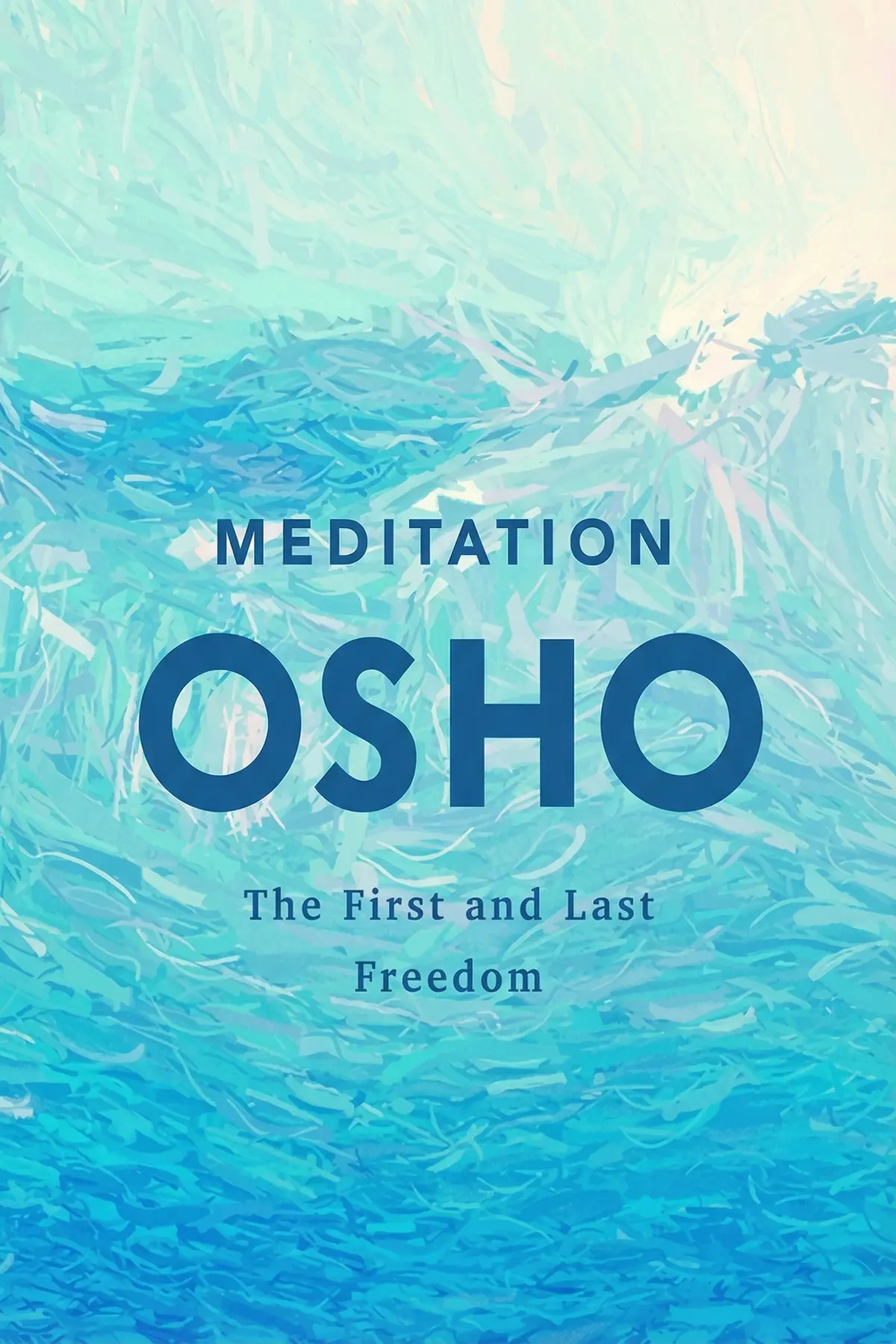
Table of Content
1. Introduction
58 sec
If your mind races the moment you try to sit still, most meditation advice feels like being told to calm a storm by wishing. In Meditation: The First and Last Freedom, the Indian teacher Osho offers another way in: let the storm out first. He holds that meditation is no technique at all. It is awareness, a way of watching your body, thoughts and feelings without being swept away, and even jogging or smoking a cigarette can become meditation once it is done fully awake.
A crowded mind cannot be shut off on command, so Osho’s methods often begin with hard breathing, shaking, dancing and shouting, and only then move into silence. Release first, then watch, until watching spreads into the whole day: that is the argument running through everything below. Along the way come an hour-long practice in five stages, a smoker who broke his habit in three months, and a month-long exercise in doing nothing but listening.
2. Become the watcher of your own mind
1 min 41 sec
A bad mood arrives and, before you notice, you have become the bad mood. Osho describes a way of standing slightly apart from what you feel, and it takes four stages to learn.
3. Give your practice one hour and its own corner
1 min 46 sec
Most people fit meditation between emails and wonder why it never goes deep. Osho asks for far more time, a dedicated space, and a small ritual at the threshold that changes how you arrive.
4. Shake out the noise before you sit still
1 min 42 sec
Telling a tense person to relax almost never works. The first of the Osho Active Meditations takes a stranger route, with an hour that moves from chaotic breathing and shouting to a sudden, total freeze.
5. Pick the moving meditation that suits you
1 min 47 sec
Not everyone expects meditation to involve shouting. Osho offers gentler routes through shaking, free dance and a deep hum, and each one hides the same pattern that makes his whole approach work.
6. Break an automatic habit by slowing it down
1 min 45 sec
One smoker broke his habit after three months by making every cigarette a slow, aware meditation. He did it by smoking with full attention, and the same principle reaches into how you eat, walk and breathe.
7. Find calm in open sky and deep darkness
1 min 43 sec
Staring into a cloudless sky or a starless night sounds like doing nothing. Osho turns both into practice, and adds a plain white wall that may be the hardest exercise of all.
8. Treat a restless mind as part of practice
1 min 46 sec
Sitting before a wall or dancing with closed eyes can sound too simple to help a busy professional. Osho expects that reaction, and he explains exactly who inside you is raising the objection.
9. Conclusion
1 min 09 sec
Osho’s book adds up to one demanding idea: freedom comes from watching, and watching comes far more easily once the body has had its say. That is why his meditations look so unlike the silent, solitary kind. The shouting, jumping and dancing clear the ground. The stillness that follows is what the clearing was for.
The practice can begin small and stay ordinary. Choose an hour and a corner, and take your shoes off at its edge. On a tense day, move hard before you sit, the way Dynamic Meditation does. Pick one automatic habit and slow it down until every step is visible, as the smoker did for three months. Then try the exercise Osho ends with: for one hour every day, for a whole month, do nothing but listen. According to the book, those who have tried it describe experiences that lingered throughout the remainder of their lives.
Your thoughts and moods will keep arriving. What changes is that you see them come, and you see them go.
About this book
What is this book about?
Many people give up on meditation because their mind will not stay quiet. Thoughts race, moods take over, and sitting still starts to feel like failing at a test. Osho starts from that problem and turns the usual advice around. Meditation, he argues, is not something you do. It is awareness: watching your body, thoughts and emotions without being carried off by them. Since a mind full of anger and desire cannot be turned off on command, many of his methods begin with noise and movement. In Dynamic Meditation you breathe chaotically, let out emotion, jump and shout, then freeze into fifteen minutes of silent watching. Other active meditations use shaking, free dance or deep humming to reach the same stillness. Osho then takes awareness out of the meditation room. He describes a man who broke a smoking habit in three months by slowing every step of it down, and offers simple practices with breath, sky, darkness and a blank wall. Readers get a set of concrete routines and a clear account of why the restless mind resists them.
Book Information
Who it's for
Restless in sitting meditation
People who have tried sitting meditation and quit because their mind would not settle.
Stressed professionals
Stressed professionals who want a physical way to release tension before seeking calm.
Curious about Osho's meditations
Anyone curious about Osho's dynamic and active meditations and how to practice them.
About the Author
Osho
Osho (1931 to 1990), born Chandra Mohan Jain in Kuchwada, India, studied philosophy at the University of Sagar and in 1966 left a lecturing post at the University of Jabalpur to speak across India. He rejected institutional religion, held that spiritual experience cannot fit one system of dogma, and taught meditation, including his own dynamic meditation. His ashram in Pune is now the Osho International Meditation Resort.
Ratings & Reviews
Ratings at a glance
What people think
Listeners find the meditation guidance provided in this book beneficial, with one individual highlighting it as a superb entry point to Osho’s philosophy. They value the all-encompassing perspective, while one person notes that it catalogues various methods and practices. Listeners also describe the content as straightforward and accessible.
Top reviews
Hassan
Osho’s approach is wild and deeply unconventional compared to the quiet, stoic mindfulness most of us are taught in the West. Frankly, the idea of 'going crazy' as a cathartic prelude to silence was exactly the breakthrough I needed to clear my mental clutter. This book acts as a comprehensive guide that bridges the gap between ancient traditions and the frantic pace of our modern lives. It doesn't just ask you to sit still; it invites you to dance, scream, and shake until the ego finally lets go. While the writing is a bit repetitive, the sheer variety of techniques—from chakra work to breath and sound—ensures there is something for everyone here. I feel much more equipped to handle daily stress now that I view meditation as an active process rather than a passive chore.
Show moreMia
Wow, this really flipped my perspective on what it means to be silent and how we relate to ourselves. After hearing so much about the controversy surrounding Osho’s life, I was hesitant to dive in, but the content itself is undeniably powerful and transformative. The core message is that all changes in the world start with us accepting and loving our own messy, complicated nature first. Once you accept yourself, complete peace follows, which is ultimately what every person on this planet is searching for. The chapters on sound and light are particularly beautiful and offer a more sensory way to enter a meditative state. I’ve read a lot of self-help, but this feels more like a lived experience than a dry lecture. It’s a book I’ll keep on my nightstand for years.
Show moreMoo
Finally got around to finishing this massive compilation of Osho's talks and I am genuinely impressed by the depth of wisdom. This isn't just a manual; it's a mirror for the soul that forces you to confront your own distractions and ego. I loved how the book acknowledges that we need to do things differently than in the past because our modern minds are so much more restless. The techniques are designed to exhaust that restlessness so that true meditation can happen naturally without effort. Personally, I found the 'Nadabrahma' humming meditation to be the most effective for my daily stress. It’s a long journey through the pages, but the insights on peace and happiness are worth every minute. This book is a companion for future years.
Show moreLeah
In my experience, no other book captures the essence of meditation as a radical act of self-love as well as this one. Dejando a un lado su secta (setting aside the controversy), the actual teachings on awareness and the flow of energy are masterfully presented. I especially liked the encouraging tone regarding the 'chaotic' phases of the practice, as it makes the process feel much more human and less like a rigid performance. The book is easy to understand, yet it contains layers of meaning that I know I will be uncovering for a long time. It bridges the physical and the spiritual in a way that feels very practical for someone living a normal life. This is easily the most enriching thing I have read all year. Please, just read it with an open heart!
Show moreOoi
Ever wonder why sitting still feels so impossible when your brain is racing at a million miles per hour? This book answers that by acknowledging that we live in unprecedented times where old-school methods might not always work. Truth is, I found the section on dynamic meditation to be a total game-changer for my morning routine. The instructions are straight forward and easy to understand, even if the concepts themselves are quite radical for a beginner to grasp. My only real gripe is that the book is quite lengthy and could have been edited down significantly without losing the core wisdom. If you read it in diagonal, you can find the gems quickly without getting bogged down in the more rambling anecdotes. It’s a solid introduction to his philosophy.
Show moreNutnicha
Picked this up after years of traditional mindfulness practice and found it to be a refreshing, if slightly chaotic, change of pace. The book acts as the eye of the storm, providing a stable center where you can focus your discipline while the world spins around you. I loved the diverse approaches to meditation, especially the focus on touch and light/dark techniques which I hadn't encountered elsewhere. To be fair, some of the energy flow theories felt a bit abstract, but the practical results of the exercises are hard to deny. It’s an objective look at the mechanics of the mind that doesn't shy away from the messy parts of human nature. This is a great resource for anyone looking to expand their spiritual toolkit beyond just following their breath.
Show moreTim
To be fair, this book is more of a reflection on existence than a simple 'how-to' guide for sitting on a cushion. It encourages you to look at yourself in a completely different way and understand the deep connection between the body and the mind. The instructions on various techniques like the chakra and breath meditations are helpful, providing a clear roadmap for those who need structure. I did find that the book could have been half its size, as Osho tends to repeat the same points in multiple ways across different chapters. However, the variety of approaches ensures that you won't get bored or feel stuck in a rut. It’s a very comprehensive manual that serves as a great companion for a long-term practice. Definitely worth a read for the open-minded.
Show moreElise
Gotta say, I was pleasantly surprised by how straightforward and helpful this book turned out to be for my daily routine. It lists a staggering amount of different approaches and techniques, making it an excellent introduction to Osho's broader teachings for any newcomer. The sections on touch and sound were especially interesting, as they offer a more grounded way to practice awareness during mundane tasks. While I enjoyed the content, I do agree with other reviewers who mentioned it feels a bit repetitive in the middle sections. Just read it in diagonal when he starts rambling and you’ll get the most out of it. It’s a 4-star experience that provides a lot of value for someone looking to deepen their spiritual discipline. It really helps you respect yourself more.
Show moreKatya
As someone who struggles with generalized anxiety, I found that many of these practices seemed to invoke more tension than they actually relieved. Not gonna lie, the intense focus on kundalini-style energy and the 'catharsis' stages felt overwhelming and left me feeling more wired than calm. The book does provide a massive list of different approaches, which is helpful, but there just seemed to be too much going on in each specific practice. It felt like I was trying to do too many things at once rather than simply being present in the moment. I appreciate the historical context and the tips on awareness, but for a novice, this might be a bit too intense. It's a 3-star read for me because I still learned a lot about the history of the practice.
Show moreSamira
The chapter on 'going crazy' before meditating felt incredibly dangerous to me and honestly made me fear for my own mental stability. I felt if I didn't meditate precisely as he instructed, I would go insane or do something I’d regret. While the book is easy to understand, the tone is often pushy and creates a sense of urgency that is the opposite of peaceful. Look, I understand the concept of catharsis, but the way it's presented here felt more like a recipe for a breakdown than a path to enlightenment. There are some okay tips on awareness scattered throughout, but they are buried under a lot of questionable advice. I’m giving it two stars because the overview of meditation history was actually quite informative. Otherwise, it wasn't for me.
Show moreQuestions about this book
What is the main idea of Meditation: The First and Last Freedom by Osho?
Osho argues that meditation is awareness, not a technique. You learn to be the watcher, observing body, thoughts and emotions without being carried off by them. Because a busy mind cannot simply be switched off, many of his methods start with movement, breathing and emotional release, then move into silent watching. Over time he wants that awareness to spread into every ordinary activity.
How does Osho Dynamic Meditation work?
It lasts an hour in five stages. Ten minutes of chaotic breathing through the nose build energy. Ten minutes of catharsis let it out through laughing, crying, shaking or dancing. Ten minutes of jumping with raised arms while shouting hoo exhaust the body. Then you freeze and silently watch for fifteen minutes, before closing with fifteen minutes of celebration.
Can Osho's meditation help break bad habits?
Osho describes helping a man quit smoking by turning smoking into a meditation. He slowed down and noticed every step: taking the cigarette from the pack, tapping it, lighting it, inhaling, exhaling. Once smoking was no longer automatic, the habit was broken within three months. Osho’s point is that awareness undoes behavior that runs on autopilot.
What if my mind keeps chattering when I meditate?
Osho treats a chattering mind as natural and expects it to take time to settle. He notes that many Zen practitioners sit for months or years before they feel they can truly listen. His active meditations help by releasing tension first, and he suggests thinking of meditation like love: wordless and non-judging, so naming and analyzing simply become more things to watch.
How can I start meditating the way Osho suggests?
Set aside one hour a day and a quiet spot used only for meditation, ideally outdoors under a tree. Take off your shoes before entering and leave your concerns with them. If your mind is agitated, begin with movement such as shaking or dancing before sitting still. Osho also recommends a month-long exercise of simply listening for one hour every day.
Readers also enjoyed

A Force for Good: The Dalai Lama's Vision for Our World
Daniel Goleman


A Return to Love: Reflections on the Principles of a Course in Miracles
Marianne Williamson

Abundance: The Inner Path to Wealth
Deepak Chopra

Alcoholics Anonymous
Alcoholics Anonymous World Services

A New Earth: Awakening to Your Life’s Purpose
Eckhart Tolle


Aflame: Learning from Silence
Pico Iyer
AUDIO SUMMARY AVAILABLE
Listen to Meditation in 15 minutes
Get the key ideas from Meditation by Osho, plus 5,000+ more nonfiction titles.
- 5,000+ titles
- Listen as much as you want
- 7-day free trial
- Cancel anytime









