

13 min 54 sec
Available in: English
Me, Myself and Us: The Science of Personality and the Art of Well-Being
Shows how five stable traits set your defaults, and how personal projects, self-monitoring, well-timed optimism and balanced hardiness let you act beyond those traits and protect your well-being.
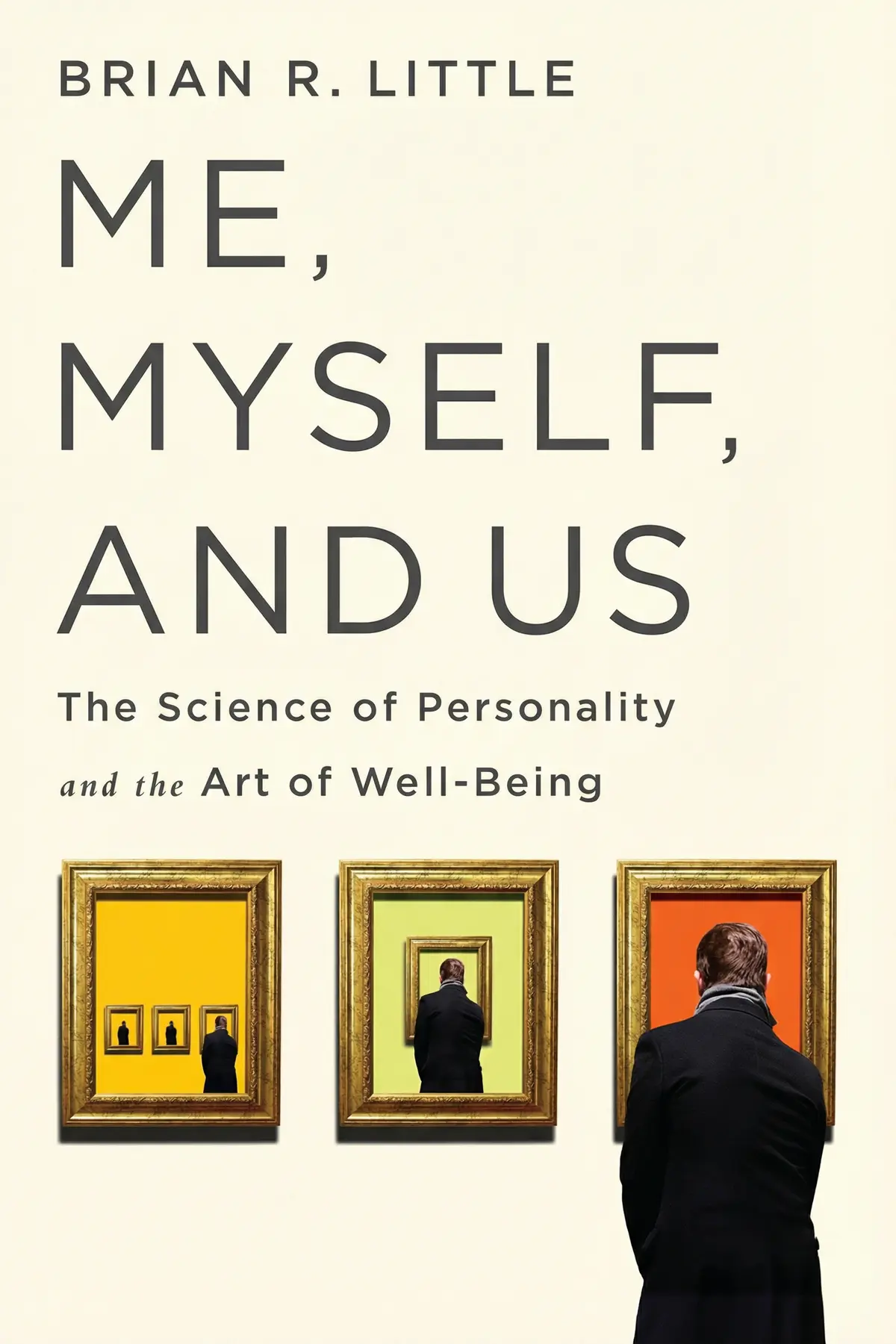
Table of Content
1. Introduction
59 sec
If people keep surprising you, or you keep surprising yourself, the usual fix is a label: shy, rude, lazy, difficult. In Me, Myself and Us, personality psychologist Brian R. Little argues that labels miss most of the story. Some traits stay fairly stable for life, yet people regularly act against them when they care deeply about a goal, and that flexibility shapes much of their well-being.
Little’s throughline is that personality sets your defaults, not your limits, and living well means knowing those defaults and choosing when to step past them. The evidence runs from jazz that listeners enjoy more when its players are less organized, to a steak that reveals how much you care about other people’s opinions, to employees coping with a company in sudden upheaval. By the end you can read yourself and the people around you with more accuracy and more kindness.
2. See past your first judgment of people
1 min 32 sec
A stranger is rude to a waiter, and you have already decided who he is. That split-second verdict says as much about your own way of seeing as about him, and it can trap you after heartbreak.
3. Put your organized or agreeable side where it pays
1 min 43 sec
Being organized and being kind both sound like pure advantages at work. Yet jazz audiences and salary data tell a more complicated story about where each trait helps you and where it holds you back.
4. Read your worry, curiosity and sociability clearly
1 min 46 sec
An ancient alarm system, a hunger for novelty and a loud car stereo each reveal a trait you carry every day. Knowing them explains why two colleagues can write the same report so differently.
5. Act out of character for what you love
1 min 41 sec
Some of your personality was set before you left the delivery room. Another part changes with what you care about, and it lets shy people do surprising things, at a price to their health if overused.
6. Understand why some people change in every room
1 min 41 sec
Some people become someone new in every room, while others never budge. The difference shapes who they fall for, how faithful they stay, and even what they do with the salt shaker.
7. Time your optimism for after the big decision
1 min 33 sec
Most people think they are funnier than average, and that harmless error may protect them. The danger lies in trusting such illusions at exactly the wrong moment in your life.
8. Stay hardy under stress without overdoing it
1 min 49 sec
When a company was thrown into turmoil, some employees coped far better than others. The traits that protected them can also, pushed too far, damage the hearts of the people who rely on them.
9. Conclusion
1 min 10 sec
What Little offers is a more generous way to see a person, yourself included. Traits like conscientiousness or neuroticism give each of us a starting position that changes little over a lifetime. Within that frame there is real room to move: through the lenses we judge with, the projects we commit to, the timing of our hopes and the balance of our efforts. Personality, on this view, is something you live with actively, and well-being comes from handling the mix well.
That points to a few things worth trying. Pick projects you truly care about and have a fair chance of succeeding at, since Little sees meaning as a central part of happiness, and let them pull you past your shyness or your habits when they need to. Be a realist when choosing a job or a partner, and an optimist once you have chosen. When change hits at work, lean on commitment, control and challenge, but stop before they harden into the Type A grip.
The introvert who spoke to 200 students kept her shy nature. She just found something worth stepping out for.
About this book
What is this book about?
A shy introvert who cares about her education speaks to 200 students. A friend never gets over a breakup. Brian R. Little, a personality psychologist who has taught at McGill, Oxford and Harvard, argues that people are far more dynamic than the labels we hand out to them. Little starts with the lenses we use to judge others, then sets out the Big Five traits that stay fairly steady across a lifetime: conscientiousness, agreeableness, neuroticism, openness and extraversion. His central idea is free traits. When people pursue projects they truly care about, they can act out of character, as an introvert does when she addresses 200 students. That flexibility helps, but suppressing who you are for too long has a health cost. The book then turns to well-being. It explains why some people change in every social setting, how positive illusions help or hurt depending on when you hold them, and how commitment, control and challenge protect against stress until they tip into Type A strain. Readers get a clearer map of their own defaults and practical ways to decide when to step beyond them.
Book Information
Who it's for
Professionals feeling pigeonholed
Professionals who feel boxed in by a personality label, such as shy, disorganized or too nice.
Team leads
Team leads trying to understand why colleagues work, react and handle change so differently.
Stressed and wanting balance
People under stress who want to balance ambition and control without harming their health.
About the Author
Brian R. Little
Brian R. Little is a psychology scholar specializing in personality and motivation, with research on how everyday personal projects and free traits shape people's lives. He has taught at McGill, Oxford and Harvard, where graduating classes named him a Favourite Professor three years running, and he is Distinguished Research Professor Emeritus at Carleton University. At Cambridge he holds a fellowship with the Well-Being Institute and leads the Social Ecology Research Group.
Ratings & Reviews
Ratings at a glance

What people think
Listeners find the book an engaging and well-composed read that explores significant practical themes and intriguing new theories in personality psychology. They also enjoy the humor, with many laughing out loud, and one listener highlighting its unique take on the subconscious process. Even so, the writing's clarity is a point of contention, with some finding it accessible while others struggle to follow along.
Top reviews
Luke
Brian Little has a way of making complex psychological frameworks feel incredibly personal and approachable. I was particularly struck by his concept of "personal projects" and how they can override our innate biological tendencies. It’s refreshing to read a psychologist who doesn't view us as mere collections of traits but as active agents in our own lives. The humor sprinkled throughout is a delightful surprise, preventing the science from feeling too dry or inaccessible. While some sections on environmental psychology felt slightly less polished, the overall message about our "mutable selves" is empowering. You start to see your social interactions through a much clearer lens after finishing this.
Show moreMo
Wow, I didn't expect a book on personality science to make me laugh out loud in a public place. Brian Little is that rare academic who can deliver serious research on "personal constructs" with the timing of a stand-up comedian. I loved the exploration of how our environments, from city streets to quiet offices, interact with our core temperaments. This isn't just a list of traits; it's a guide to understanding the "why" behind our most confusing behaviors. By the end, I felt like I had a better handle on my own internal contradictions and a lot more empathy for the "disagreeable" people in my life. It’s a brilliant, humanistic look at what makes us tick.
Show moreFang
Picked this up on a whim and ended up rethinking my entire perspective on social identity. Most personality books want to put you in a box, but Little spends his time showing you how to climb out of one. His focus on "idogenic" traits—the personality we create through our commitments—is a profound defense of human free will. The writing is incredibly engaging, filled with self-deprecating humor and sharp observations about the human condition. I especially appreciated the nuanced take on "restorative niches" and why some of us need to hide in the bathroom during parties. It’s a rare book that manages to be both scientifically rigorous and deeply moving.
Show moreSiriporn
Ever wonder why you're completely drained after a social event even if you were the life of the party? Little's explanation of "pseudo-extraversion" and the necessity of "restorative niches" was a lightbulb moment for me. He manages to bridge the gap between hard science and the lived human experience without falling into the trap of cheesy self-help tropes. The breakdown of the Big Five—Openness, Conscientiousness, Extraversion, Agreeableness, and Neuroticism—provides a solid foundation for understanding why we clash with certain people. My only real gripe is that he occasionally wanders off on long anecdotes that don't always feel strictly necessary to the point. However, the insight into "idogenic" traits—those we adopt to serve our values—is worth the price of admission.
Show moreDivya
The chapter on "personal projects" alone makes this worth the cover price for anyone feeling stuck in a rut. Little shifts the focus from who we are to what we do, which is a vital distinction in the world of psychology. I found the discussion on "High Self-Monitors" versus "Low Self-Monitors" particularly illuminating for my own workplace dynamics. Truth be told, I struggled with some of the more academic jargon in the beginning, and the pacing is a bit uneven. But the "pseudo-extravert" concept—the idea that an introvert can act bold for the sake of a mission—is a game changer. It provides a scientific basis for the masks we all wear without calling us fake.
Show moreAnthony
As someone who has always identified as a "Low Self-Monitor," reading this was like finally getting a manual for my own brain. Little explains that some of us simply don't have the "social antenna" to adjust our behavior to every situation, and that's okay. The book provides a fantastic overview of the OCEAN model without making it feel like a boring list of definitions. While I found the section on environmental psychology a bit disjointed from the rest of the text, the overall insights are incredibly valuable. It’s much more than a self-help book; it’s a study in how to live more authentically. You’ll definitely walk away with a few "aha" moments.
Show moreRafael
This book felt like a bit of a mixed bag for me, landing somewhere between a fascinating lecture and a dense university textbook. I appreciate Little’s mission to move beyond the deterministic nature of tests like the Myers-Briggs. He argues convincingly that we have the agency to act out of character to achieve what matters most to us. Yet, I found myself skimming several chapters where the data felt repetitive or overly technical for a general audience. The writing style is undeniably witty, but the structure sometimes lacks a clear, driving momentum. It’s certainly a respectable deep dive into personality science, but be prepared for some heavy lifting.
Show moreTern
After hearing the author interviewed, I expected a more streamlined argument, but the book itself felt a little padded. The core ideas—specifically the "Big Five" and how we use free will to navigate them—are absolutely stellar. Little is clearly a master of his craft, and his warmth as a narrator is evident on every page. Unfortunately, the middle sections drag with long-winded stories that seem more like filler than essential evidence. I also had some questions about the inclusion of the marshmallow test, which has faced significant criticism in recent years. It’s a decent read if you have the patience, but I think the best insights could have been summarized in half the page count.
Show moreLandon
To be fair, Little is clearly a giant in his field, but the writing here gets bogged down in academic weeds more often than not. I picked this up hoping for a clear-eyed look at modern personality theory, and while I got that, I also got a lot of fluff. Some of the data he cites, like the stuff on Type A personalities, feels a bit dated or at least highly debatable. He tries to balance the "biogenic" and "sociogenic" factors, but the transitions between these sections are often jarring. I did enjoy the bits about how coffee and alcohol affect introverts differently. Overall, it's an okay resource for psych students, but maybe a bit too dense for the casual reader.
Show morePatchara
Finally got around to finishing this, and while I appreciate the debunking of Myers-Briggs, some of the science felt a bit "yesterday." The author relies heavily on the Big Five, which is standard, but he treats controversial studies like the marshmallow test with a bit too much reverence. Look, the writing is clever and Little is obviously a brilliant guy, but the book lacks a cohesive through-line. It feels more like a collection of interesting essays than a unified argument. I enjoyed the anecdotes about his own life as an introvert, yet I wanted more rigorous defense of his model against its critics. It’s a solid three-star read for those curious about the field.
Show moreQuestions about this book
What is the main idea of Me, Myself and Us?
Brian R. Little argues that personality is more dynamic than labels suggest. The Big Five traits stay fairly stable across life, but free traits let people act against them when they pursue projects they care about. Well-being depends on using that flexibility without suppressing who you are, timing positive illusions well, and keeping commitment, control and challenge in balance.
What are free traits in personality psychology?
Free traits are Little’s term for acting out of character in pursuit of a goal you find meaningful. They come from the idiogenic source of personality, the part shaped by your daily choices and commitments. His example is an introvert who cares so much about her education that she speaks to 200 students. He warns that suppressing your real self for too long is linked to more health problems.
What are the Big Five personality traits?
The Big Five are conscientiousness, agreeableness, neuroticism, openness and extraversion. Little notes that psychologists generally see the Ten-Item Personality Inventory, which measures them, as the most reliable test. Each trait has costs and uses: high conscientiousness helps with deadlines but not with improvised jazz, and high agreeableness tends to go with lower salaries.
How can I tell if I am a high or low self-monitor?
High self-monitors adapt to what others expect, while low self-monitors behave the same in every setting. Little describes a quick clue from a Stanford University psychologist: high self-monitors tend to taste a steak before salting it, judging the food in front of them, while low self-monitors salt first according to their usual preference. The difference also shows in romance and relationship stability.
How does Me, Myself and Us suggest handling stress?
Little describes hardiness, made of commitment, control and challenge. In a 1970s study of employees facing abrupt company changes, those who coped best stayed committed to daily work, felt in control and saw opportunity in the change. He warns that pushing these too far, as Type A personalities often do, is linked to high blood pressure and heart problems, so balance matters.
Readers also enjoyed

Acting with Power: Why We Are More Powerful Than We Believe
Deborah Gruenfeld


Age of Propaganda: The Everyday Use and Abuse of Persuasion
Anthony Pratkanis




59 Seconds: Change Your Life in Under a Minute
Richard Wiseman


AUDIO SUMMARY AVAILABLE
Listen to Me, Myself and Us in 15 minutes
Get the key ideas from Me, Myself and Us by Brian R. Little, plus 5,000+ more nonfiction titles.
- 5,000+ titles
- Listen as much as you want
- 7-day free trial
- Cancel anytime









