
11 min 55 sec
Available in: English
May Contain Lies: How Stories, Stats, and Studies Exploit Our Biases
By Alex Edmans
Shows why misleading stories, statistics and studies fool smart people by exploiting confirmation bias and black-and-white thinking. It also gives practical questions for testing any claim before you believe it, act on it or share it.
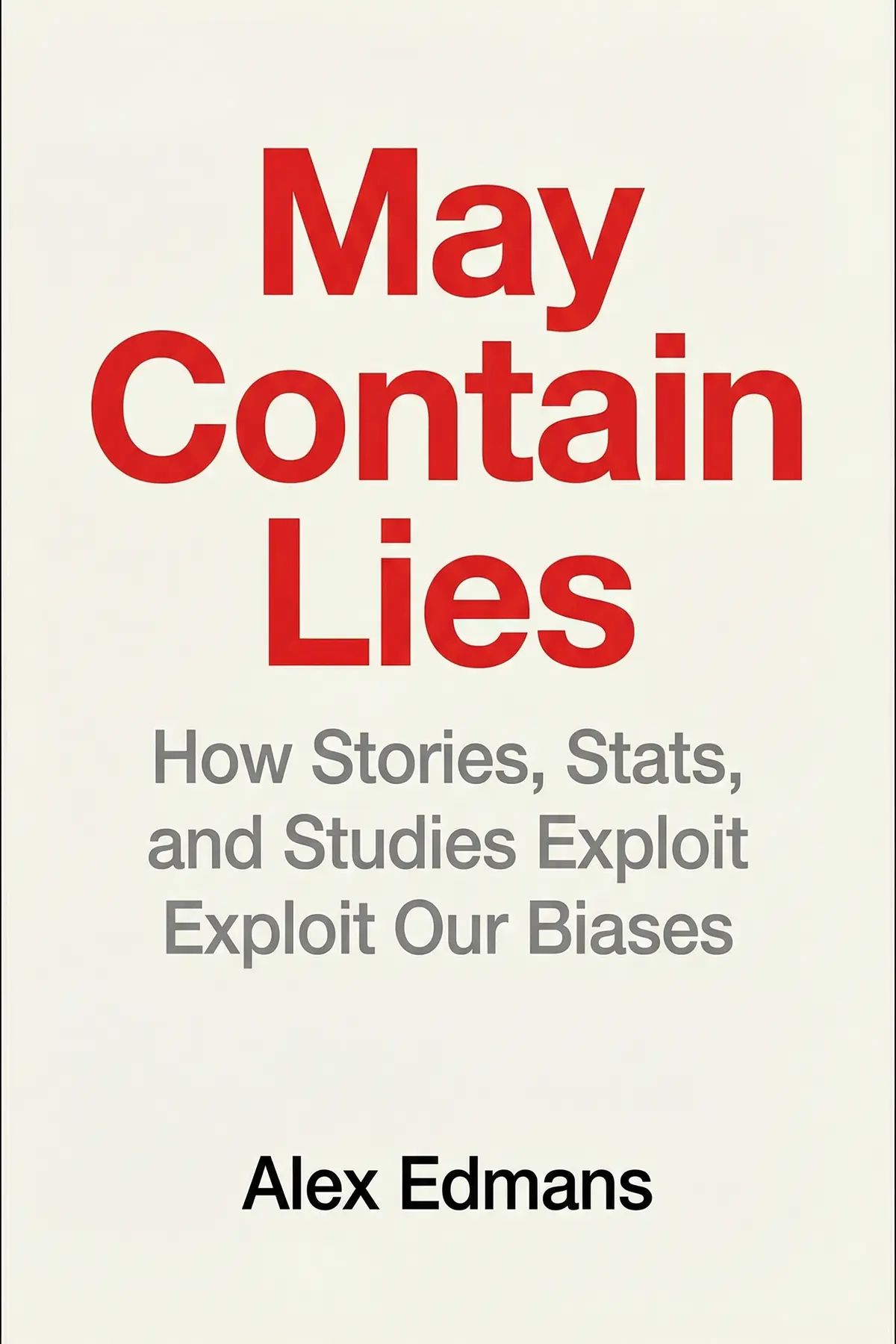
Table of Content
1. Introduction
56 sec
When a bad statistic fools someone, the number usually gets help from the reader: a wish for it to be true. In May Contain Lies, Alex Edmans, a finance professor at London Business School, argues that misleading stories, stats and studies work by exploiting two biases everyone carries, confirmation bias and black-and-white thinking.
His case is that the claims most likely to mislead us are the ones we want to believe, and that a few habits of questioning, aimed first at ourselves, can catch them. Edmans then marks three places where a claim can slip: between a statement and a fact, between data and evidence, and between evidence and proof. Each comes with a test anyone can run without special training.
The payoff is a short set of questions to put to any headline, report or study before you believe it, act on it or pass it along to someone else.
2. Catch yourself wanting a claim to be true
1 min 45 sec
The more you know about a subject, the safer you should be from bad information. Edmans argues the opposite can happen, and the reason lies in a small reward your brain hands out at the worst moment.
3. Spot the absolute words that hide the gray
1 min 45 sec
Some of the most persuasive claims are wrong in a way that is hard to argue with, because each part sounds reasonable. The giveaway is often a single word that most readers skim straight past.
4. Check that a quoted study says what it claims
1 min 32 sec
A footnote can make almost any sentence sound settled. Edmans shows how real research gets turned into claims its authors never made, and what to look for before you repeat one at a meeting.
5. Spot when successful people's habits will not work for you
1 min 42 sec
Data showing that high achievers share a habit can be completely accurate and still lead you somewhere useless. Edmans explains the hidden step between a pattern in the numbers and a reason to change what you do.
6. Test whether a result will travel to your case
1 min 24 sec
A study can be careful, honest and correct about cause and effect, and still be the wrong guide for your decision. The reason is easy to overlook and surprisingly easy to check.
7. Build a news diet that argues back
1 min 40 sec
Good questions cannot rescue you if everything you read already agrees with you. Edmans offers rules of thumb for choosing sources, judging research and deciding what deserves to be forwarded to anyone else.
8. Conclusion
1 min 11 sec
The title reads like a warning printed on a food package, and the label fits more than the news. In Edmans’s account, the claims most likely to mislead us are the ones we are most eager to swallow, and the person who lets them through is usually ourselves. A lie needs a willing reader. The twin biases supply one, and more knowledge, he argues, can make that reader more willing still.
That is why his remedies begin at home. The next time a headline delights you, treat the pleasure as a signal to open the study behind it, and ask whether the people in the data differ in some other way that could explain the result. Before you act on evidence from another company or country, name what is different about yours. And before you share anything, remember that forwarding it puts your name behind its analysis.
Edmans ties this to more than personal accuracy. Misinformation wears down public trust and bends decisions at work and at home, and he argues that critical thinking and basic scientific literacy give anyone a defense. The skill is small and repeatable: notice what you want to believe, then look at it twice.
About this book
What is this book about?
Every day brings reports, headlines and studies that claim to prove something. The hard part is knowing which ones to trust, especially when some of them tell you exactly what you hoped to hear. Alex Edmans, a finance professor at London Business School, argues that misinformation succeeds mostly because of two biases inside the reader. The first is confirmation bias. It makes us wave through claims we like and attack claims we dislike, and Edmans warns that it can get worse as we learn more. The second is black-and-white thinking, which turns complicated questions into all-or-nothing verdicts. Together, he calls them the twin biases. From there, Edmans maps three places where a claim can go wrong: a statement is not a fact, data is not evidence, and evidence is not proof. For each he offers simple checks, from confirming that a cited study says what people claim, to asking whether a correlation hides another cause, to asking whether a result will hold in your setting. He closes with habits for reading and sharing more responsibly: seek opposing views, trust consensus over single studies, and vet before you forward.
Book Information
Who it's for
Professionals guided by research
Professionals who base decisions on reports, studies and other companies' success stories.
Tempted to copy winners
Managers and founders tempted to copy a practice because the data says winners use it.
Hoping to share accurately
Anyone who shares articles online and wants to stop passing on claims that later turn out wrong.
About the Author
Alex Edmans
Alex Edmans is a British economist who teaches finance at London Business School. He earned his doctorate at MIT as a Fulbright Scholar, was earlier a tenured professor at Wharton and worked as an investment banker at Morgan Stanley. He has spoken at the World Economic Forum in Davos and at TED, where his talk covered confirmation bias and weighing evidence carefully. He has also given evidence to the UK Parliament. His earlier book, Grow the Pie, was one of the Financial Times best books of 2020.
Ratings & Reviews
Ratings at a glance

What people think
Listeners find the book does an excellent job of clarifying difficult topics and sharing practical methods for identifying misinformation. They also value its accessible style and how it encourages deep thinking to sharpen analytical abilities. Nevertheless, feedback regarding the writing quality is varied.
Top reviews
Bam
The concept of the 'Ladder of Misinference' is worth the price of admission alone. Edmans does an incredible job of showing how even 100% accurate facts can be weaponized to lead us to the wrong conclusions. I loved the breakdown of how we move from data to actual evidence, then finally to proof. It’s written in a way that feels very accessible, even if you don't have a background in finance or statistics. The summaries at the end of each chapter really helped me consolidate what I was learning. To be fair, some of the examples about the 'shades of grey' (moderate vs granular vs marbled) got a little bit dense, but the overall message is powerful. It’s rare to find a book that actually provides a 'Checklist for Thinking Smarter' that you can use in your daily life. This is essential reading for anyone trying to navigate the noise of modern social media.
Show moreSofia
Picked this up after seeing it mentioned in a WEF report and it lived up to the hype. Having just finished my MBA, I really wish this had been on the curriculum earlier. Edmans manages to simplify incredibly complex statistical pitfalls into something digestible. The way he identifies the move from 'statement' to 'fact' and eventually to 'proof' is masterfully explained. I specifically liked how he didn't just list a hundred different psychological biases, but focused on the big ones like confirmation bias and black-and-white thinking. The tone is smart and authoritative without being overly dry. It’s one of those books that sticks in the back of your mind and makes you pause before you hit 'share' on a sensationalist article. It’s a vital tool for anyone who wants to sharpen their critical thinking skills in an age where misinformation is the top global risk.
Show moreSomchai
Truth is, I’ve been feeling a lot of unease since finishing this last month. It’s one of those books that lingers. Every time I see a stat on the news now, I hear Edmans' voice in my head asking if it’s actually 'evidence' or just a 'statement.' The way he deconstructs popular science books and media reports is both brilliant and a little bit depressing. You realize how much of what we 'know' is built on shaky foundations. I loved the section on how to encourage diversity of thought without falling into the trap of polarization. It’s a masterclass in critical thinking. Even though I don't have a background in statistics, I never felt lost, which is a testament to the writing quality. It’s definitely changed the way I perceive the world and the information I allow to influence my decisions. Truly a 5-star experience.
Show moreRafael
Edmans manages to translate dense economic and statistical concepts into something the average person can actually use. This isn't just a book about 'fake news'; it’s a deep dive into how we deceive ourselves. The structure is very logical, moving from the biases we hold to the framework of the 'Ladder of Misinference.' I especially appreciated the 'Checklist for Smarter Thinking' in the appendix. While some reviewers think it’s too much work, I think it’s a necessary discipline in today's world. The book is full of easily digestible concepts and handy tips that genuinely improve your ability to spot misinformation. Whether you're a student, a business leader, or just someone tired of being misled by headlines, this book is an essential addition to your shelf. It’s masterfully written and incredibly timely.
Show moreMoo
Ever wonder if the 'facts' you see on LinkedIn are actually just manipulated data? This book tackles that head-on. Edmans is an economist, and that perspective definitely shines through, especially when he discusses corporate performance and share prices. I found the section on confirmation bias to be the most impactful part of the whole read. He uses great real-world examples, like the takedown of the Matthew Walker sleep study, which I actually found quite shocking since I’d previously taken that book as gospel. My only gripe is that the 'Checklist for Smart Thinking' feels a bit overwhelming for a casual reader. There are 17 questions to ask yourself, which isn't always feasible when you're just scrolling through the news on your morning commute. Still, it’s a very illuminating read that I’d recommend to anyone who wants to be more critical of the information they consume.
Show morePrayoon
Look, any book that takes a swing at Malcolm Gladwell’s storytelling-over-substance approach has my attention immediately. Edmans does a great job of dismantling how 'science' is often packaged into neat, viral narratives that don't actually hold up under scrutiny. I found the technical sections on 'instruments' and 'randomness' a bit clunky, but the overall message about challenging our innate biases is so necessary right now. The writing is generally very clear, and he uses a variety of examples from medicine to prison reform to keep things interesting. I did feel that he occasionally oversimplified the ease of checking scholarly publications—most people don't have access to those journals! However, the four shortcuts he provides at the end are much more manageable than the full checklist. It’s a solid 4-star read that really makes you question your own assumptions.
Show moreSawit
Wow, this was a real eye-opener, particularly regarding the way information is presented to us. I listened to the audiobook version, which the author narrates himself. He has this very posh, intelligent British accent that makes the material feel very engaging and easy to follow. The core of the book is about confirmation bias, and Edmans gives multiple examples of how this impacts everything from politics to business. It’s a very timely subject. I will say that while the author claims bias is a universal human trait, his perspective feels very rooted in Western corporate culture. He doesn't spend much time on the historical or systemic reasons why certain narratives are pushed. But if you’re looking for a personal guide on how to be less of a 'sheep' when it comes to data and headlines, this is a fantastic resource. Highly recommended for the checklist alone.
Show moreTum
This book is a much-needed antidote to the current age of digital polarization. Edmans focuses on two main errors: confirmation bias and black-and-white thinking. I found his breakdown of 'shades of grey' to be quite thought-provoking, even if the terminology got a bit confusing at times. He successfully proves that even when facts are right, the conclusions we draw are often wrong because we want them to support our existing beliefs. Personally, I found the chapter on how politicians misuse studies to be absolutely terrifying. It’s a relatively quick read that provides plenty of 'aha!' moments. My only criticism is that it favors a very centrist worldview that might not sit right with everyone. But in terms of enhancing your critical thinking skills and learning how to spot bad data, it’s a very useful and readable primer.
Show moreRung
As someone who deals with data daily, I found this to be a bit of a mixed bag. On one hand, Edmans is fantastic at explaining why we fall for misinformation and how our own biases get in the way. On the other hand, it felt like he was advocating for a very specific brand of 'moderated centrism' that he didn't really analyze with the same critical lens he applied to others. He talks about investing in oil companies or executive pay in a way that seems to favor the status quo. Frankly, it felt a bit like the author believes he is immune to the very biases he's warning us about. The writing quality is generally good, but I wish there had been more systemic analysis of why misinformation happens—like the profit motives of big pharma or climate skeptics—rather than just blaming it on human flaws. It’s a decent primer, but it lacks the depth I was hoping for.
Show moreTawee
Finally got around to reading this, but it left me more exhausted than empowered. While I appreciate the effort to debunk misinformation, the 'solutions' offered are just not realistic for the average person. The author suggests we should vet every source, check every reference, and run through a 17-point checklist before believing anything. Truth is, I don't have the bandwidth to spend hours down rabbit holes for every news story I see. It’s the definition of 'ignorance is bliss' because now I just feel anxious about everything I read without having any practical way to fix it. Plus, some of the anecdotes he used to prove his points felt a bit cherry-picked themselves, which is ironic given the subject matter. It’s an interesting academic exercise, but as a practical guide for the general public, it misses the mark. It felt very much like an economist talking down to people from an ivory tower.
Show moreQuestions about this book
What is the main idea of May Contain Lies by Alex Edmans?
Edmans argues that misleading stories, statistics and studies succeed because they exploit two biases in the reader: confirmation bias and black-and-white thinking. He then shows three places where claims go wrong, since a statement is not a fact, data is not evidence and evidence is not proof. For each one he offers simple questions that help readers test a claim before believing it, acting on it or sharing it.
What are the twin biases in May Contain Lies?
Two linked biases do the damage: confirmation bias, and a habit of thinking in absolutes, with everything sorted as black or white. Confirmation bias takes two forms: naive acceptance of claims we like and blinkered skepticism toward claims we dislike. Black-and-white thinking turns complicated questions into absolutes, such as calling carbohydrates simply good or bad. Edmans notes that confirmation bias can grow as people learn more, because knowledge gives them better tools for dismissing evidence they dislike.
How can I tell if a study really proves something?
Edmans suggests checking at three levels. First, confirm the cited study exists and that its findings match the conclusions drawn from it. Second, ask whether the data shows only a correlation, since another factor might explain both the behavior and the result. Third, ask whether the evidence will hold in your setting, because results from one industry or country may not transfer. Prefer meta-analyses and systematic reviews over single studies.
How can I apply the ideas in May Contain Lies?
Start by asking whether you want a claim to be true, and check it harder if you do. Listen for absolute words like always and never. Read sources that disagree with you and look for scientific consensus rather than one study. Before sharing anything, vet it, since Edmans treats sharing as backing the analysis. In arguments, aim to understand the other side and find goals you both share.
Who should read May Contain Lies?
It suits professionals who rely on reports, research and benchmarks to make decisions, such as managers, founders and analysts. It also helps anyone who reads news and social media and wants a reliable way to judge claims. Readers who consider themselves well informed may benefit most, since Edmans argues that greater knowledge can make people better at dismissing evidence they dislike.
Featured in
Readers also enjoyed


59 Seconds: Change Your Life in Under a Minute
Richard Wiseman




A Liberated Mind: How to Pivot Toward What Matters
Steven C. Hayes


Acting with Power: Why We Are More Powerful Than We Believe
Deborah Gruenfeld


Age of Propaganda: The Everyday Use and Abuse of Persuasion
Anthony Pratkanis
AUDIO SUMMARY AVAILABLE
Listen to May Contain Lies in 15 minutes
Get the key ideas from May Contain Lies by Alex Edmans, plus 5,000+ more nonfiction titles.
- 5,000+ titles
- Listen as much as you want
- 7-day free trial
- Cancel anytime









