
14 min 15 sec
Available in: English
Marketing Made Simple: Step-by-Step StoryBrand Guide for Any Business
Shows how to turn a good product into steady sales with one simple funnel: a one-sentence pitch, a homepage that sells, a free guide that collects emails and a patient email sequence.
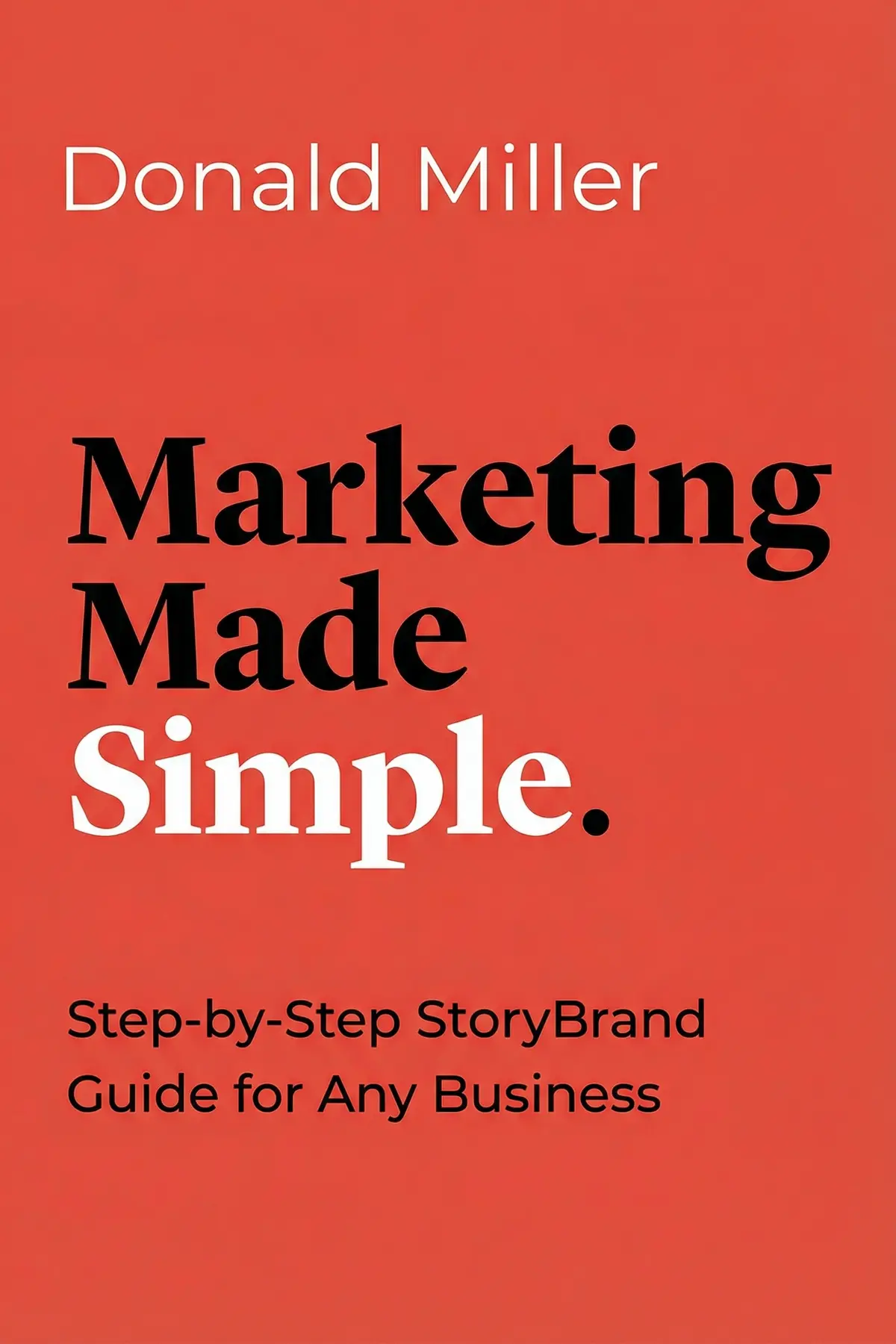
Table of Content
1. Introduction
59 sec
Plenty of businesses sell steadily and still miss a whole world of potential clients they could have reached but didn’t. In Marketing Made Simple, Donald Miller, CEO of the communication company StoryBrand, argues that the fix is not louder branding but a plain sales system anyone can build. Good marketing, in his view, walks a stranger through three stages: curiosity, then enlightenment, then commitment.
Every tool in the book serves one of those stages. A short pitch, a website built to sell, a free resource that collects contacts and a patient run of emails work together as one funnel, and a small team can assemble it in six meetings. Along the way Miller offers a caveman test for any homepage and a three-part formula for describing a business in a single sentence. By the end you will have a sequence you can draft this month, from the sentence on your business card to the email that asks for the sale.
2. Move strangers from curiosity to commitment
2 min 02 sec
A perfect product can still go unsold if no one knows it exists. Miller draws a sharp line between how people feel about a company and what it can actually do for them, and he notes that the two are often confused.
3. Say what you sell in one sentence
2 min 02 sec
Hollywood writers get seconds to sell an entire film to a studio executive. The tool they use is neither a slogan nor a catchphrase, and Miller believes every smart company should craft its own version.
4. A homepage built to do one job
2 min 10 sec
Companies pay web developers thousands of dollars and still end up with sites that impress visitors and sell almost nothing. Miller’s alternative is so plain that he tests it against an imaginary caveman.
5. Trade something useful for an email address
1 min 53 sec
Collecting contact details is what lets a business reach a potential client again and again. Miller compares good marketing to the guest at a party everyone wants to see again, and shows what that guest hands out before going home.
6. Turn a contact list into paying customers
2 min 05 sec
Nobody proposes marriage on a first glance across the room. Miller argues that buyers need a courtship too, and he lays out the two kinds of email that carry a stranger from interest to purchase.
7. Build the whole system in six meetings
1 min 50 sec
A couple standing in front of a leaking, peeling Victorian house felt exactly how most teams feel about fixing their marketing. What they did next turns an overwhelming project into a short calendar.
8. Conclusion
1 min 14 sec
Miller’s book makes marketing feel less like a talent and more like plumbing. Each piece has one job and hands the customer to the next. The one-liner earns a moment of curiosity, the homepage turns it into understanding, the free guide earns permission to keep talking, and the emails build trust until a deadline invites the purchase. A brilliant product, in his view, stays invisible without that path.
The place to start is the sentence. Write your one-liner as problem, solution and result, then put it at the top of your homepage and let the caveman take a look: what you offer, how it helps, how to buy. If any answer is unclear, fix that before anything else. When the page passes, add one short guide worth trading an email address for, and plan a handful of helpful weekly emails before the one that names a deadline.
Then keep the date of that sixth meeting. Find where people stop moving through your funnel, because that is where the next sale is waiting. The customers you have been missing may have been interested all along. Most of them simply never got a clear sentence, an obvious button and a reason to come back.
About this book
What is this book about?
Many businesses have a product people would gladly buy, yet sales stay flat because too few people hear a clear offer. Donald Miller argues that marketing is not branding, logos or clever slogans. It is the practical work of moving a stranger through three stages: curiosity, enlightenment and commitment. His plan turns those stages into a small set of tools. A one-liner describes the business through a problem, a solution and a result. A homepage built from a simple wireframe shows the offer and a buy button within seconds, and it has to pass his caveman grunt test. A short free PDF trades useful advice for an email address. Then two email campaigns, one that nurtures trust and one that makes a time-limited offer, turn contacts into customers. Miller closes with a schedule that makes the whole system buildable: six meetings, each with one job, ending with a review of where customers drop out. Readers get a five-part plan, broken into specific steps, for building a sales funnel that attracts and keeps new customers.
Book Information
Who it's for
Owners relying on referrals
Small business owners with a good product and sales that depend on word of mouth.
Founders and marketing heads
Founders and marketing leads whose website looks polished but rarely converts visitors.
Teams wanting affordable funnels
Teams that want a step-by-step plan for building a funnel without a large budget.
About the Author
Donald Miller
Donald Miller is an American writer, speaker and entrepreneur, born in Houston, Texas, in 1971. He is CEO of StoryBrand, a company that helps businesses communicate more clearly. After early bestsellers on faith and self-discovery, including Blue Like Jazz and A Million Miles in a Thousand Years, he turned to business communication, writing the bestsellers Building a StoryBrand, Marketing Made Simple and How to Grow Your Small Business. He also founded The Mentoring Project, which supports fatherless youth.
Ratings & Reviews
Ratings at a glance

What people think
Listeners find this marketing book both helpful and uncomplicated, providing clear and functional details through a basic framework. Furthermore, it is regarded as essential reading for anyone in business, delivering actionable tips with exercises to finish. They value the stimulating material, with one listener highlighting its ideal mix of "how" and "why" clarifications, and feel it is worth the cost.
Top reviews
Natchaya
This book is a masterclass in clarity for anyone struggling to explain what they actually do. Donald Miller moves beyond abstract theory to provide a literal blueprint for your website and email sequences. I especially loved the section on the 'one-liner'—it’s such a simple concept, but it completely transformed my elevator pitch from a rambling mess into a punchy, value-driven sentence. Truth is, most business owners are too close to their own products to see them clearly, and this framework acts as a much-needed outside perspective. It’s not just about looking pretty; it’s about converting. If you are tired of wasting money on marketing that feels like shouting into a void, just buy this. You won’t regret the time spent on the exercises.
Show moreWipawan
Finally got around to reading this, and frankly, I wish I had picked it up before I spent thousands on a web designer last year. The way Miller breaks down the stages of a relationship—Curiosity, Enlightenment, and Commitment—makes so much sense for digital sales. We often ask for the sale way too early, scaring off prospects before they even understand how we can help them survive or thrive. The five-part sales email sequence is pure gold and provides a specific template that takes the guesswork out of copywriting. I’ve already implemented the 'three-step plan' on my homepage and noticed a significant uptick in engagement. It’s a fast read, but the value is in the execution of the checklists. Essential for small business owners.
Show moreFon
Wow, the section on creating a lead-generating PDF was exactly what my consulting firm needed to break out of a slump. We were offering a 'free consultation' as our primary call to action, but nobody was biting because the commitment was too high. Miller explains that you need to earn trust by solving a small problem for free first. Since switching to a checklist-style lead generator, our email list has grown by 30% in just two months. The writing style is punchy and moves fast. No fluff, just direct instructions on how to write copy that moves the needle. In my experience, most marketing advice is too vague to be useful, but this book gives you the actual words to say. Truly worth the money.
Show moreSamira
Picked this up on a whim during a slow month for my retail business and it completely reframed how I talk to my customers. The concept of 'agitating the problem' before offering the solution was a game changer for our email marketing. We used to just blast product photos, but now we actually speak to the pain points our customers are facing. Not gonna lie, the exercises take some time to get right, but the clarity you gain is priceless. It’s rare to find a book that balances the high-level strategy with granular, tactical instructions so well. If you want to stop guessing and start selling, this is the framework you need to follow. It’s straightforward, effective, and highly actionable.
Show moreMethinee
Ever wonder why your website isn't actually converting the traffic you work so hard to get? Miller identifies the primary culprit as 'the fog'—the confusion caused by using too much industry jargon and clever wordplay. I found the 'clear over clever' mantra incredibly helpful because I’m definitely guilty of trying to sound sophisticated rather than helpful. The step-by-step guide to building a lead generator was eye-opening, specifically the advice on creating a PDF that solves a genuine problem for the customer. My only gripe is that some of the examples felt a bit repetitive if you’ve already read his previous work. Still, it’s a very practical workbook that forces you to sit down and do the hard thinking required to scale a business.
Show moreEvelyn
As someone who finds traditional marketing books incredibly draining, Miller’s approachable tone was a breath of fresh air. He doesn't drown you in data or complex analytics. Instead, he focuses on the human element of story and how to position yourself as the 'guide' rather than the 'hero.' The wireframe layout for the landing page is worth the price of the book alone, as it tells you exactly where to put your call-to-action buttons. Look, it’s not a revolutionary tome of marketing science, but it’s a highly effective execution manual. I do wish there was more talk about differentiation from competitors, but as a starting point for a DIY marketing plan, it's hard to beat. It’s a very solid four-star resource.
Show moreGoy
The chapter on the junk drawer footer was a total 'aha' moment for me. I had twenty different links in my website header, and I didn't realize I was suffering from decision fatigue and scaring away customers. By simplifying the navigation and focusing on a single direct call to action, the site feels much more professional and focused. Donald Miller has a gift for making complex ideas feel intuitive. The book is basically a workbook, so don't expect to just read it and be done; you have to do the work. My only minor complaint is that the 'StoryBrand' branding is laid on a bit thick throughout the chapters. Overall, it’s a great guide for anyone who wants a website that actually works.
Show moreMikael
After hearing Donald Miller on a podcast, I decided to dive into this step-by-step implementation guide. It’s perfect for the business owner who is overwhelmed by the 'how' of marketing. He breaks it down into five manageable pieces: a one-liner, a website, a lead generator, nurture emails, and a sales sequence. The instruction is incredibly linear, which I appreciated. I'm not a natural writer, so having a formula for the 'explanatory paragraph' was a lifesaver for my 'About Us' page. It’s a bit light on the 'why' behind some strategies, but the results speak for themselves. You’ll walk away with a functional funnel, which is more than most marketing books can promise. Definitely a must-read for the DIY entrepreneur.
Show moreSureerat
Not what I expected after the massive hype surrounding Building a StoryBrand. While the tactical advice on wireframing a landing page is solid, the book felt like one long sales pitch for Miller’s other services. Every few pages, there is a prompt to visit their website or hire a 'certified guide,' which got quite distracting after a while. Also, be warned: this isn't a complete marketing manual. It ignores critical components like SEO, paid ads, and social media strategy entirely. It’s a great deep dive into email funnels and messaging, but calling it 'Marketing Made Simple' feels like a bit of a stretch given how narrow the focus actually is. To be fair, the templates provided are usable, but the constant up-selling left a bad taste in my mouth.
Show moreKomsan
To be fair, the advice in here is excellent if you are a total beginner who has never thought about an email list. However, if you’ve been in the digital marketing space for a while, you might find it a bit elementary. The book is almost entirely based on anecdotal evidence rather than rigorous studies. It’s also very much a 'my way or the highway' approach, which ignores the nuance of different industries. I appreciated the chapter on nurture emails, but I struggled with the lack of technical advice on how to actually drive people to the website in the first place. It’s a good supplement to StoryBrand, but it feels like it could have been a long blog post or a series of videos instead of a full book.
Show moreQuestions about this book
What is the main idea of Marketing Made Simple?
Donald Miller argues that even a brilliant product will not sell unless marketing moves people through three stages: curiosity, enlightenment and commitment. He turns that into a simple funnel: a one-sentence pitch, a homepage built to sell, a free resource such as a short PDF that collects email addresses, and two email campaigns that build trust and then make a time-limited offer.
How do you write a one-liner according to Donald Miller?
Miller’s one-liner has three parts in a fixed order. First name a specific problem your customer has, then present your product as the solution, then describe the result the customer can look forward to. His example is a vitamin pitch that starts with fatigue, offers steady energy from morning to night and ends with feeling fresh and strong all day.
What is the grunt test for a website?
The grunt test asks whether a caveman glancing at your homepage could answer three questions: what the company offers, how it would make his life better and what he needs to do to buy. If he would grunt yes to all three, the page passes. Miller uses it as a quick check that a site is simple enough to sell.
What is the difference between a nurture campaign and a sales campaign?
A nurture campaign, also called a drip campaign, sends about one useful email a week, such as industry news, product tips or client interviews, to build trust and keep your business in mind. A direct sales campaign follows once readers are warmer. It makes a clear offer with a deadline, like 20 percent off your best product if bought within 24 hours.
How do I put the StoryBrand marketing plan into action?
Miller suggests six meetings. The first sets goals and a timeline, the second writes the one-liner, the third designs the website wireframe, and the fourth creates the lead generator and both email campaigns. The fifth reviews the whole sequence before launch. The sixth comes after launch, to check results and find where customers drop out.
Readers also enjoyed







AUDIO SUMMARY AVAILABLE
Listen to Marketing Made Simple in 15 minutes
Get the key ideas from Marketing Made Simple by Donald Miller, plus 5,000+ more nonfiction titles.
- 5,000+ titles
- Listen as much as you want
- 7-day free trial
- Cancel anytime









