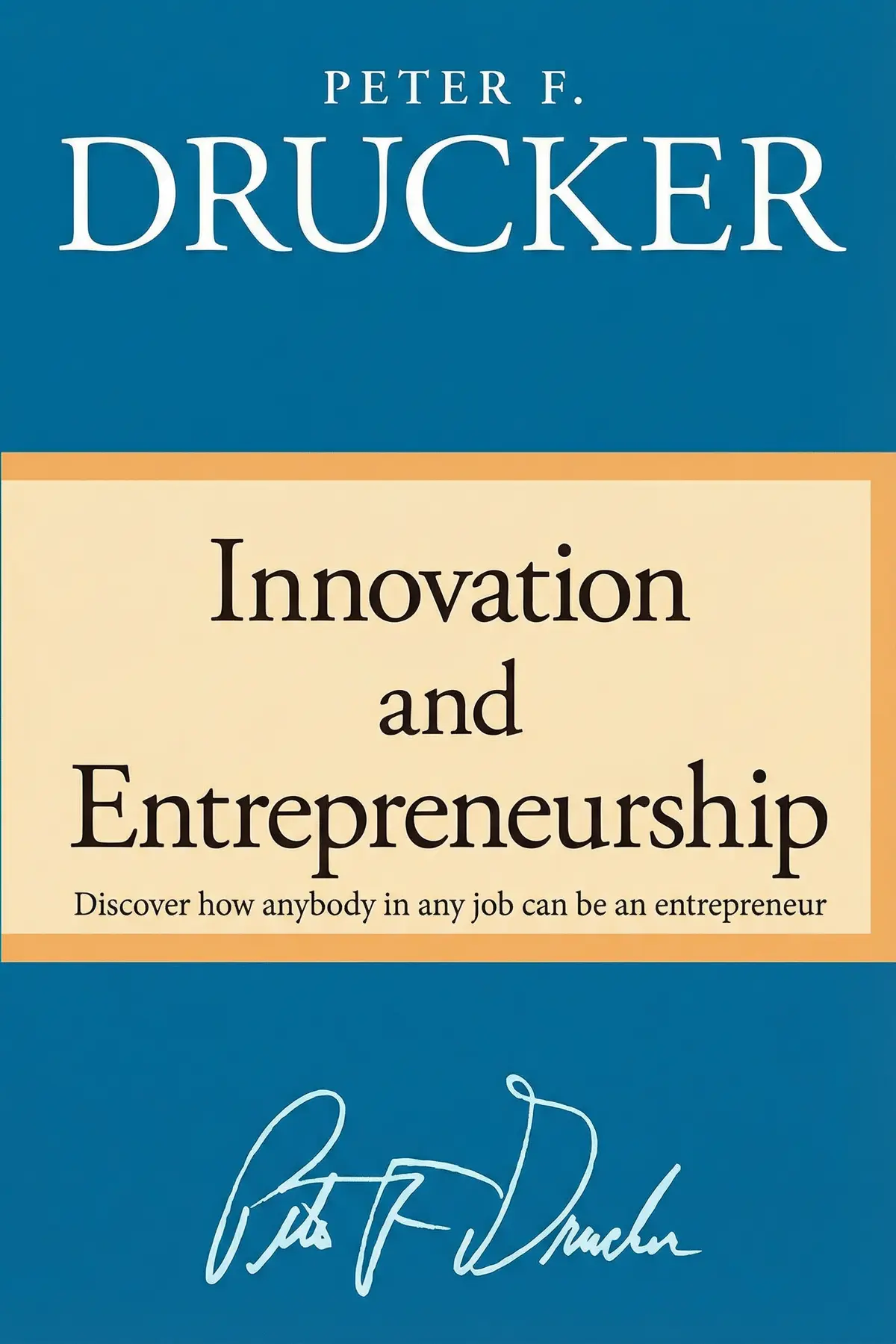
Innovation and Entrepreneurship
Peter Drucker
 English
 ไทย
Shows how to find your real strengths, learn how you read, learn and decide best, and put yourself where you can contribute most, now that employers no longer manage your career for you.
1 min 00 sec
Most professionals are told to play to their strengths, yet few can name them accurately, and the people who feel sure about them are often wrong. In Managing Oneself, Peter Drucker, the management thinker who coined the term knowledge worker, offers a fix that needs only a notebook. Write down what you expect each major decision to produce, then compare it with what actually happens nine to twelve months later.
The essay first appeared in Harvard Business Review in 1999. Drucker argues that employers no longer plan careers for their people, so each of us has to act as the chief executive of our own working life. That job depends on knowing your strengths, how you perform, what you value and where you can contribute most. Once you know those things, you put yourself where they count.
Along the way you get a method for finding your strengths, questions that show how you read, learn and decide, and a test for picking work that shows results within eighteen months.
1 min 31 sec
For most of history, nobody had to work out what to do with their life. Drucker explains why that has changed, and why a habit once kept by geniuses is now everyone’s job.
1 min 39 sec
Ask people what they are best at and most will guess, often badly. A technique first used by religious orders centuries ago replaces that guess with evidence, and it takes only minutes per decision.
1 min 30 sec
When feedback exposes your flaws, the natural move is to attack all of them. Drucker recommends something different, and one of his examples will sound familiar to anyone who has worked in an office.
1 min 38 sec
One American president shone at press conferences as a general and stumbled at them in the White House. Another lost the value of a talented staff. Both cases come down to one overlooked fact.
1 min 37 sec
A weak schoolboy became an acclaimed author, and a composer claimed he never lost an idea. Their methods suggest that people who seem slow to learn may simply be using the wrong method.
1 min 28 sec
An organization promotes its trusted deputy to the top job, and the deputy fails. Drucker sees this happen again and again, and he traces it to a question almost nobody asks before taking a promotion.
1 min 34 sec
Skill alone does not make someone effective, and doing what you enjoy is not the same as contributing. Drucker offers a time frame and a three-part test for deciding what your work should achieve.
1 min 23 sec
Much of the friction at work comes from people who simply do not know how their colleagues operate. Drucker turns self-knowledge into a duty toward others, starting with the person you report to.
1 min 08 sec
Drucker’s essay is short, but it asks a lot. It moves the job of understanding who you are from employers, tests and mentors back to you, and it asks you to gather the evidence yourself. His great self-managers, from Mozart to Napoleon, show what that habit can produce. His point is that it now belongs to everyone: the reader who builds on reading, the writer who learns by writing, the adviser who knows not to take the final chair.
Begin with a decision log, and give each entry a review date nine months away. Think about whether you understood your last important meeting from the document or from the conversation, and tell your manager which works for you. Before you accept a bigger role, ask yourself whether you want to make the final decision or shape it. Then write down one result you could show within eighteen months, ambitious but within reach, and visible to the people who matter.
Lyndon Johnson lost the value of a capable staff partly because he never knew he was a listener. Finding out that kind of fact about yourself costs almost nothing, and it can shape an entire career.
Employers used to plan careers. Today most knowledge workers are on their own, and the old advice to play to your strengths is not much help if you cannot say what those strengths are. Peter Drucker's classic essay, first published in Harvard Business Review in 1999, argues that each of us now has to act as the chief executive of our own working life. Drucker builds his case around a few plain questions. What are my strengths? How do I perform? What are my values? Where do I belong, and what should I contribute? To answer the first, he offers feedback analysis, a method that goes back to religious orders of the fourteenth century: write down what you expect from each key decision, then check it against what really happened. For the rest he draws on presidents, generals and artists, from Lyndon Johnson and Dwight Eisenhower to Winston Churchill and Beethoven. Readers come away with a way to find their strengths, a clear sense of how they take in and learn information, a test for choosing roles and organizations, and a benchmark for results worth delivering within eighteen months.
Knowledge workers who are planning their own careers because no employer will do it for them.
Professionals weighing a promotion or a move into leadership who want to know if they should decide or advise.
Career switchers trying to work out which strengths to carry into their next role.
Peter Drucker (1909 to 2005) was born near Vienna. He worked in banking and journalism, earned a doctorate in international law and settled in the United States in 1937. He taught management at New York University from 1950 to 1971 and later held a professorship in social science and management at Claremont Graduate University. Drucker coined the term knowledge worker in 1959 and came to see the productivity of such workers as management's next big challenge. In 2002 he received the Presidential Medal of Freedom.
Listeners describe the material as easy to digest and full of high-quality information, with one listener mentioning it provides 50 pages of straight-up knowledge. They also value its thought-provoking nature, noting that it helps put life into perspective and provides motivation. The book offers precious insights, especially concerning self-awareness, and listeners consider it an excellent tool for self-improvement. However, the short length draws mixed reactions; while some enjoy the quick read, others wish it were longer. Perspectives on value are similarly split, with some claiming it is worth every penny while others feel it is not worth the price.
Drucker is essentially the godfather of management, and this slim volume proves why his wisdom persists. Truth is, we often spend too much time trying to fix our flaws instead of doubling down on what we actually do well. The feedback analysis method—comparing expected outcomes with actual results—is a game changer for anyone serious about professional growth. It’s a dense, 50-page masterclass that demands you take a hard look at your own habits. My only gripe is that it feels more like a long-form article than a traditional book, which might annoy some looking for more meat. However, the clarity here is unmatched. It forces a level of self-awareness that most modern self-help fluff completely avoids. This is straight-up knowledge.
Show moreEver wonder why you're struggling despite putting in the hours? Drucker’s central thesis—that we should move from first-rate performance to excellence rather than wasting energy moving from incompetence to mediocrity—is a perspective shift every professional needs. Look, most organizations try to fix your weaknesses, which is a total waste of time. This book empowers you to say no to things that don't align with your natural working style. I loved the section on the second half of your life because it highlights the importance of building interests outside of your primary career early on. It’s motivational without being cheesy. Short, punchy, and absolutely essential for anyone feeling stuck in a corporate rut. It really puts life into perspective.
Show moreWow, I didn't expect such a short book to shift my perspective so significantly. Managing oneself is about more than just productivity; it’s about taking responsibility for your relationships and understanding the people you work with. Drucker’s point that trust is built on understanding rather than just liking someone is a powerful lesson for any workplace. The writing style is crisp and every sentence feels like it was placed with purpose. There is zero fluff here. It motivates you to stop trying to change yourself and instead start optimizing how you already operate. If you’re looking for a quick read that offers invaluable insights, this is the one. Truly a classic for a reason. Highly recommended for young professionals.
Show moreFinally got around to this management staple and I was surprised by how much it focuses on personal responsibility. Drucker argues that in the modern world, we are our own CEOs, which means we must understand our values and where we belong. I found the distinction between being an adviser and a decision-maker particularly enlightening for my own career path. It’s a very quick read, but the questions it asks are difficult to answer without some serious soul-searching. To be fair, some of the analogies feel a bit dated, referencing old government structures and religious organizations, but the core logic remains sound. This isn’t a book you read once; it’s one you revisit every few years to see if you’re still on track.
Show moreThe concept of Feedback Analysis alone makes this worth a read for any aspiring leader. Drucker advocates for keeping a record of your decisions and checking back months later to see if your expectations met reality. It’s such a simple, disciplined way to identify your true strengths. I've been doing this for three months now, and the patterns are already starting to emerge. The book is incredibly easy to understand, avoiding the dense jargon you find in most business texts. My only complaint is that the section on how do I learn felt a bit brief. I would have loved more examples of how different learning styles manifest in a team environment. Still, it’s a solid asset for self-improvement.
Show moreThis tiny volume packs a punch that books three times its size fail to deliver. It focuses heavily on self-awareness, urging readers to find their place in an organization based on their values and performance style. I finished it in one sitting on a plane, and it left me thinking for the rest of the trip. The truth is, most of us are just drifting through our careers without a plan for the second half. Drucker’s warning that we must prepare for our later years long before we get there is a sobering wake-up call. It's a great tool for anyone looking to put their life into perspective. I wish it were a bit more substantial, but the quality of information is undeniably high.
Show morePicked this up on a recommendation from a colleague after expressing some frustration with my current role. It helped me realize that I’m much better as an adviser than a primary decision-maker, which explained a lot of my recent stress. Drucker has a way of categorizing human behavior that feels intuitive yet revolutionary when you first read it. The book is essentially about finding your fit in the world of work. Gotta say, the advice on how do I work? helped me restructure my morning routine to better suit my learning style. It’s a small investment of time for a potentially huge payoff in career satisfaction. Definitely a must-read for any knowledge worker. It's short, sweet, and effective.
Show moreIs it worth the price of a full-length book for something that’s essentially a 70-page essay? Personally, I’m on the fence about the value, even if the content is high quality. Drucker’s insights on being a reader versus a listener are fascinating and helped me realize why I clash with certain coworkers. But let's be real: you can find the core of this in a free HBR article online quite easily. The writing is straightforward and easy to understand, yet I finished the whole thing in under an hour. If you want a physical copy to highlight, go for it, but don't expect a deep dive. It's a quick shot of professional motivation that leaves you wishing there was a bit more substance to chew on.
Show moreAs someone who has read a lot of modern productivity books, this felt like visiting the source material. It's interesting to see where people like Simon Sinek or Ray Dalio got their start. Drucker’s tone is very matter-of-fact, which I appreciate, though it can feel a little dry at times. The advice about knowing if you're a reader or a listener is something I've started applying to my meetings immediately. Frankly, it’s a bit of a common sense book, but as they say, common sense isn't always common practice. It’s a good reminder to get back to basics. It didn't blow my mind, but it definitely provided a few aha moments regarding how I communicate with my superiors. A decent, quick read.
Show moreHonestly, this felt like a glorified pamphlet that could have been summarized in a single blog post. While I respect Drucker's legacy, Managing Oneself lacks the actionable depth I was expecting from such a highly-rated title. He tells you to find your strengths but gives very little tactical advice on how to actually do that beyond a vague feedback analysis process. The brevity is often praised, but to me, it felt like he was just skimming the surface of complex psychological hurdles. I’ve read much better modern takes on this that actually dive into the process. Not gonna lie, I felt a bit ripped off by the price-to-page ratio here. It’s just too brief to be truly transformative.
Show moreDrucker argues that companies no longer manage the careers of knowledge workers, so each person has to act as their own chief executive. That means knowing your strengths, how you perform, what you value and where you can contribute most, and then placing yourself where those things count. He organizes the essay as a series of questions you ask yourself, each with practical guidance, and he urges you to build on who you already are.
Feedback analysis is Drucker’s method for discovering your real strengths. Whenever you make a key decision, you write down the result you expect. Nine to twelve months later, you compare it with what actually happened. Drucker traces the technique to religious leaders of the fourteenth and sixteenth centuries and says that, kept up for about three years, it shows where your strengths lie and what stops you from benefiting fully from them.
Drucker says most people take in information best either by reading or by listening, and that one type rarely becomes good at the other. Dwight Eisenhower, a reader, did well at press conferences when he had the questions in advance and struggled when he did not. Lyndon Johnson, a listener, kept John F. Kennedy’s writing staff and, in Drucker’s account, never really understood their memos.
Keep a decision log and review each prediction after nine to twelve months. Figure out if you take in information best by reading or by listening, and how you learn most effectively, then build your work around that. Before taking a promotion, ask whether you thrive as a decision maker or an adviser. Choose one result you could deliver within about eighteen months that is ambitious, meaningful and visible, and tell your colleagues how you work.

Robin Ryan



Marianne Cantwell
William Vanderbloemen
AUDIO SUMMARY AVAILABLE
Get the key ideas from Managing Oneself by Peter Drucker, plus 5,000+ more nonfiction titles.