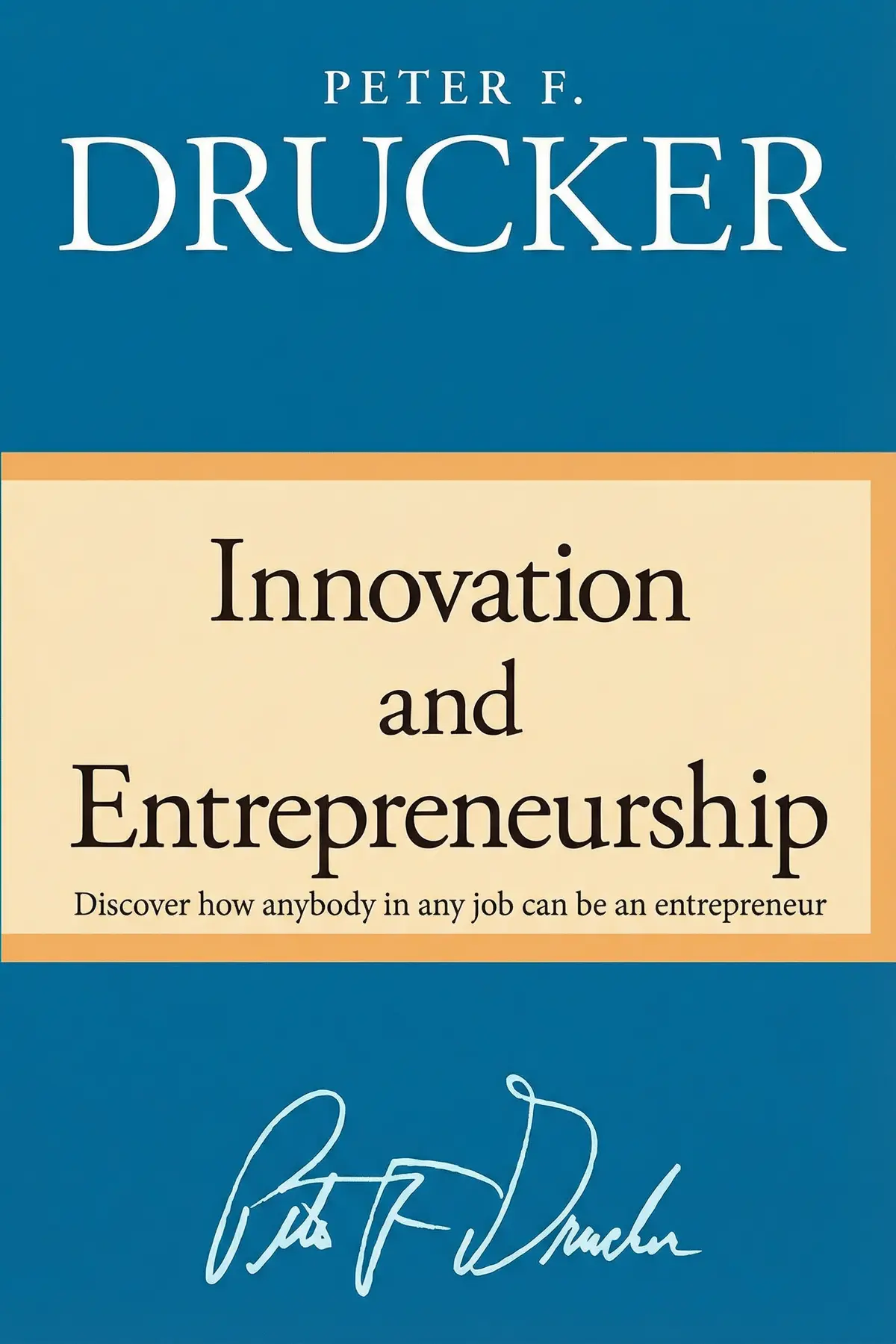
Innovation and Entrepreneurship
Peter Drucker
 English
 ไทย
A practical tour of Peter Drucker's core management ideas: how to turn a clear purpose into targets, hire well, keep innovation alive in an established organization, and manage your own strengths and later career.
1 min 05 sec
Many managers work hard and still feel they are drifting, busy every day without turning big plans into real results. In The Essential Drucker, a collection drawn from sixty years of Peter Drucker’s writing, the first remedy is almost embarrassingly plain: decide what your business is for, seen from the customer’s side, and let that answer drive everything. A luxury carmaker was rescued in the worst economy in American history by asking exactly that.
Drucker’s wider argument is that management means turning purpose into results, layer by layer: clear objectives, the right people in the right roles, structures and strategies that keep innovation alive, and finally the management of yourself. Along the way there is a cheap enzyme that earned enormous rewards, Swedish matchboxes that led a world market for decades, and a plan for the years after your main career. Each layer ends in something you can try with your own team, or your own working life, this week.
2 min 03 sec
A struggling luxury brand made money during the Great Depression after its new manager asked one question most companies never ask out loud. The answer changed what the company thought it was selling.
1 min 53 sec
Three workers doing the identical job give three very different answers when asked what they are doing. Only one answer describes the person worth hiring for an ambitious goal, and finding that person takes more than instinct.
1 min 53 sec
Established companies are excellent at running what already exists, and that very strength tends to smother anything new. Drucker’s fix concerns where new work lives and who is allowed to do it.
1 min 59 sec
One company sold a world-changing invention for a small fee because it thought the timing was wrong. Another built a fortune on a product so cheap that competitors refused to copy it.
2 min 07 sec
For nearly half a century, one country’s producers outsold the world in an ordinary household item. Their edge was so obvious in hindsight that it explains what Drucker thinks good innovation should look like.
1 min 56 sec
Nobody tells most professionals what to do minute by minute anymore, yet few were ever taught how to judge their own work. Drucker argues that this freedom demands a different kind of discipline.
1 min 55 sec
One of history’s greatest scientists did his defining work before forty. Drucker uses that fact to ask what fills the decades afterward, and why waiting until retirement to answer is a risk.
1 min 10 sec
The Essential Drucker can look like a box of separate tools, but one habit links them all: refusing to leave results to chance. Dreystadt did not hope Cadillac would recover; he asked who bought the cars and built the business on the answer. The same refusal shapes how Drucker hires, protects new ventures, picks strategies and asks individuals to manage their strengths and later years. Purpose comes first, then the people and structures that carry it, then patient improvement.
For a manager, the most useful step this week may be the simplest. Write down what your customers are really buying from you, and check that your targets in each important area serve that answer. When you next hire, define the role before you meet anyone, and own the choice afterward. For yourself, notice how you learn and where you do your best work, then begin something small outside your job that could grow into a second calling.
A matchbox with the same count every time led a world market for nearly fifty years. Clear thinking about simple things, Drucker shows, tends to last.
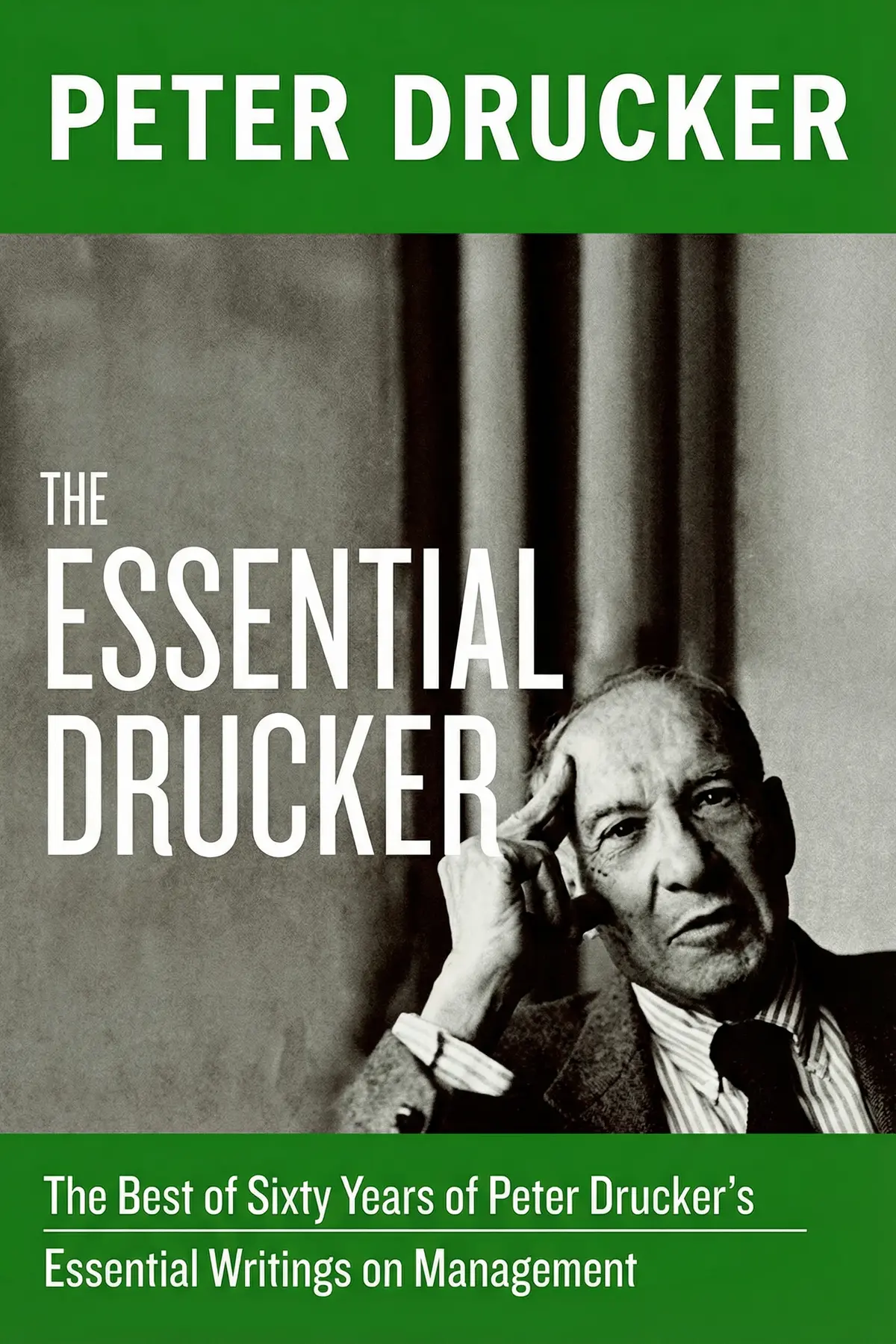
Many managers are busy every day and still feel they are drifting, with big plans that never become real results. The Essential Drucker gathers the central ideas from sixty years of Peter Drucker's writing on management into one argument: results come from purpose that is defined, measured and carried out by the right people. Drucker starts with the customer, showing how Cadillac's new manager rescued the brand during the Great Depression by asking who actually bought its cars. From there he moves to setting balanced objectives, hiring people who see the bigger picture, giving new ventures their own home, and choosing strategies such as Sony's new use for the transistor or Alcon's toll-gate position in cataract surgery. The second half turns inward. Drucker explains why knowledge workers must be effective as well as efficient, how to build a career on strengths, and why planning a second calling long before retirement protects both meaning and stability. Readers get a compact framework for running a team, an innovation effort and their own working life.
New and mid-level managers who want a clear framework for goals, hiring and coaching.
Founders and leaders of established firms trying to keep innovation alive next to the core business.
Professionals planning their strengths, their next role or a second career.
Peter Drucker (1909 to 2005) was born near Vienna, worked in banking and journalism in Germany and earned a doctorate in international law before settling in the United States in 1937. He taught management at New York University from 1950 to 1971 and then at Claremont Graduate University until his death. He coined the term knowledge worker in 1959 and received the Presidential Medal of Freedom in 2002.

Listeners find the material both well-crafted and full of insight, as one review mentions it offers practical life management tools and perspectives. Furthermore, they enjoy how readable it is and view it as essential for anyone studying business, with one review highlighting its comprehensive coverage of business basics. The work also earns praise for its encyclopedia content; one listener describes it as an excellent collection of Drucker's best work. Nonetheless, feedback on the book’s depth is varied, as some listeners find it lacking.
Listening to this compilation feels like playing a 'Greatest Hits' album where every track is a masterclass in organizational logic. Drucker defined the 'knowledge worker' long before the term became a corporate buzzword, and his focus on the customer as the sole purpose of a business remains the golden rule. To be fair, some of the Case Studies involving General Motors and Alfred Sloan feel like they’ve been pulled from a time capsule, yet the core principles haven't lost their bite. It’s a dense read, packed with more insight in 350 pages than most modern business gurus manage in a lifetime. This is essential for anyone leading teams and looking for timeless wisdom rather than just the latest trends.
Show moreEvery business student needs this on their shelf as a definitive reference for the pillars of management. Drucker manages to condense sixty years of wisdom into a single volume that somehow feels both exhaustive and accessible. Not gonna lie, I was skeptical about a book compiled from so many different sources, but the themes of accountability and results tie it together beautifully. He treats management as a human endeavor rather than just a series of cold calculations, which is refreshing in an era of data-obsessed leadership. The focus on social innovation and the idea that success makes its own behavior obsolete are concepts I find myself thinking about daily. It’s not just about running a company; it’s about understanding the reality of the customer.
Show moreManagement isn't just about business; it's about making people capable of joint performance through common goals and shared values. This book captures that sentiment perfectly, serving as a comprehensive guide to the 'human' side of the enterprise. Drucker’s writing is insightful and surprisingly readable, given how complex the subject matter is. He hits hard on the idea that good intentions are no substitute for organization and accountability. Personally, I found the discussion on the rising importance of the non-profit sector and volunteerism to be the most fascinating part. It’s a deep dive into what makes an organization function, and why innovation is the only way to avoid decline. A must-read for anyone in a leadership role.
Show moreWhat strikes me most is how Drucker predicted the rise of the knowledge worker decades before it became our reality. Reading this today feels like looking at a roadmap that was drawn while the roads were still being paved. He captures the essence of the entrepreneurial spirit and the need for constant, focused innovation. In my experience, most modern management books are just watered-down versions of what Drucker says here in a few paragraphs. The book is packed with 'Greatest Hits' like the definition of business purpose and the importance of social impact. While it’s a bit of an 'encyclopedia' and can feel dense, the level of insight is unparalleled. He doesn't just tell you what to do; he teaches you how to think. It's brilliant.
Show morePeter Drucker’s insights have aged remarkably well, though I’ll admit the 'hodgepodge' nature of this anthology makes it feel a bit disjointed in spots. The book acts as a comprehensive encyclopedia of management basics, covering everything from social responsibility to the nuances of entrepreneurial strategy. Truth is, I found the sections on the 'Effective Executive' much more compelling than the somewhat dry chapters on 1970s job descriptions. While the prose is occasionally laborious, the clarity he brings to the concept of 'marketing'—making selling superfluous—is worth the effort. It isn't perfect, and the repetition of certain anecdotes can get a bit tiring, but it’s still a foundational text for business students. If you want a broad overview of how a legendary mind approached business, start here.
Show moreThe chapter on 'Managing Oneself' alone justifies the price of admission for this entire collection. Drucker provides practical tools for life management that go far beyond the boardroom, emphasizing that we must make our strengths effective and our weaknesses irrelevant. Look, some parts are definitely a bit dated—his 1990s predictions are a mixed bag—but the core logic regarding human performance is timeless. I appreciated the direct, no-nonsense tone he takes with his readers. It’s a great way to dip your toes into his philosophy without committing to his entire bibliography. A very solid read for any aspiring manager who wants to build a foundation on something other than flavor-of-the-month management fads.
Show moreAfter hearing so much hype, I finally dived into this 'best of' collection and found it to be a worthwhile, if slightly uneven, journey. The book is essentially a Reader's Digest version of Drucker’s career, which means some sections shine while others are easy to skim. I loved the emphasis on marketing—the idea that the customer defines the business is a lesson many modern startups still haven't learned. My only gripe is that because it’s an amalgamation, there’s a lot of overlap. You’ll hear about Alfred Sloan so many times you’ll feel like you worked at General Motors yourself. Still, it's an excellent way to get the basics without reading ten different books.
Show moreDrucker is clearly a genius, even if his prose can be a bit dense and academic at times. Picked this up to get the basics and was surprised by how much I actually highlighted. The truth is, the advice on hiring decisions and the risks of giving new people major assignments is incredibly practical. It’s a lot to digest, and I can see why some find it lacking in depth since it covers sixty years in one go, but as a summary of his life's work, it’s excellent. It is definitely worth a read if you want to understand the roots of modern corporate structure.
Show moreI struggled to stay awake during the first half of this book, which felt more like a tedious HR manual from 1974 than a revolutionary business guide. Frankly, if you’re looking for excitement, you’re better off reading 'Innovation and Entrepreneurship.' While Drucker is a brilliant prognosticator in some areas, his 'essentials' are just too dated for today's fast-paced, globalist economy. I appreciated the quotes on joint performance and shared values, but the delivery is just so dry and academic. It’s a decent introductory reader if you have never encountered his work, but definitely keep some coffee nearby for the slower chapters. It's informative but lacks the spark of his more focused individual works.
Show moreCall me a skeptic, but I found this collection incredibly repetitive and out of touch with modern globalist capitalism in several key areas. Drucker talks about post-capitalism in a way that just hasn't materialized, and his 'essential' advice often reads like a job description written half a century ago. The first two-thirds of the book are a real slog to get through, and I honestly think his individual books carry much more weight than this fragmented 'best of' attempt. To be fair, his early definitions of the knowledge worker were prophetic, but that doesn't save the rest of the book from feeling like a dusty museum exhibit. I’d recommend skipping this and just reading 'The Effective Executive' instead. It’s a laborious read that lacks the depth needed for today's market.
Show morePeter Drucker argues that management is the work of turning purpose into results. It starts with defining what the business is for from the customer’s point of view, as Cadillac’s Nicholas Dreystadt did during the Great Depression, then translating that purpose into measurable objectives. From there managers hire people who share the purpose, build structures and strategies for innovation, and finally manage their own strengths and the second half of their working life.
Drucker treats hiring as a process the manager fully owns. Write a detailed job description, compare three to five candidates against the role’s demands, and weigh strengths and weaknesses, since a gifted technical expert may not suit a leadership job. Check references, confirm the person understands the assignment, give them a capable boss and a clear role, avoid loading them with huge tasks at first, and keep coaching after they start.
Drucker describes several. Finding a new use for an existing technology, as Sony did after licensing the transistor from Bell Laboratories for $25,000. Entrepreneurial judo, which means entering a segment competitors neglect and expanding from there. The toll-gate strategy, like Alcon’s inexpensive enzyme for cataract surgery that rivals did not bother to copy. And the specialty skill, such as the little-known firms that make car nameplates.
Knowledge workers, a term Drucker coined in 1959, produce ideas and information rather than physical goods. He says they must be effective, doing the right things, and not merely efficient. Because they direct themselves, they need guidance and collaboration instead of close supervision. Drucker urges them to know their strengths, how they learn, and which settings suit them, and to seek feedback instead of spending time on weaknesses.
It suits managers who want one framework for setting objectives, hiring and coaching, and leaders of established organizations who struggle to keep new ideas alive alongside daily operations. It also serves individual professionals, because its later ideas cover building a career around your strengths and planning a second calling well before retirement, for meaning and for stability when life brings sudden loss or change.


Margaret Heffernan





Joseph A. Maciariello



Deborah Gruenfeld
AUDIO SUMMARY AVAILABLE
Get the key ideas from The Essential Drucker by Peter Drucker, plus 5,000+ more nonfiction titles.