

13 min 52 sec
Available in: English
 ไทย
EnglishไทยMake Time: How to Focus on What Matters Every Day
Shows why busyness and endless apps swallow your hours. It gives a four-step daily method, with small testable tactics, to protect 60 to 90 minutes for what you care about most.
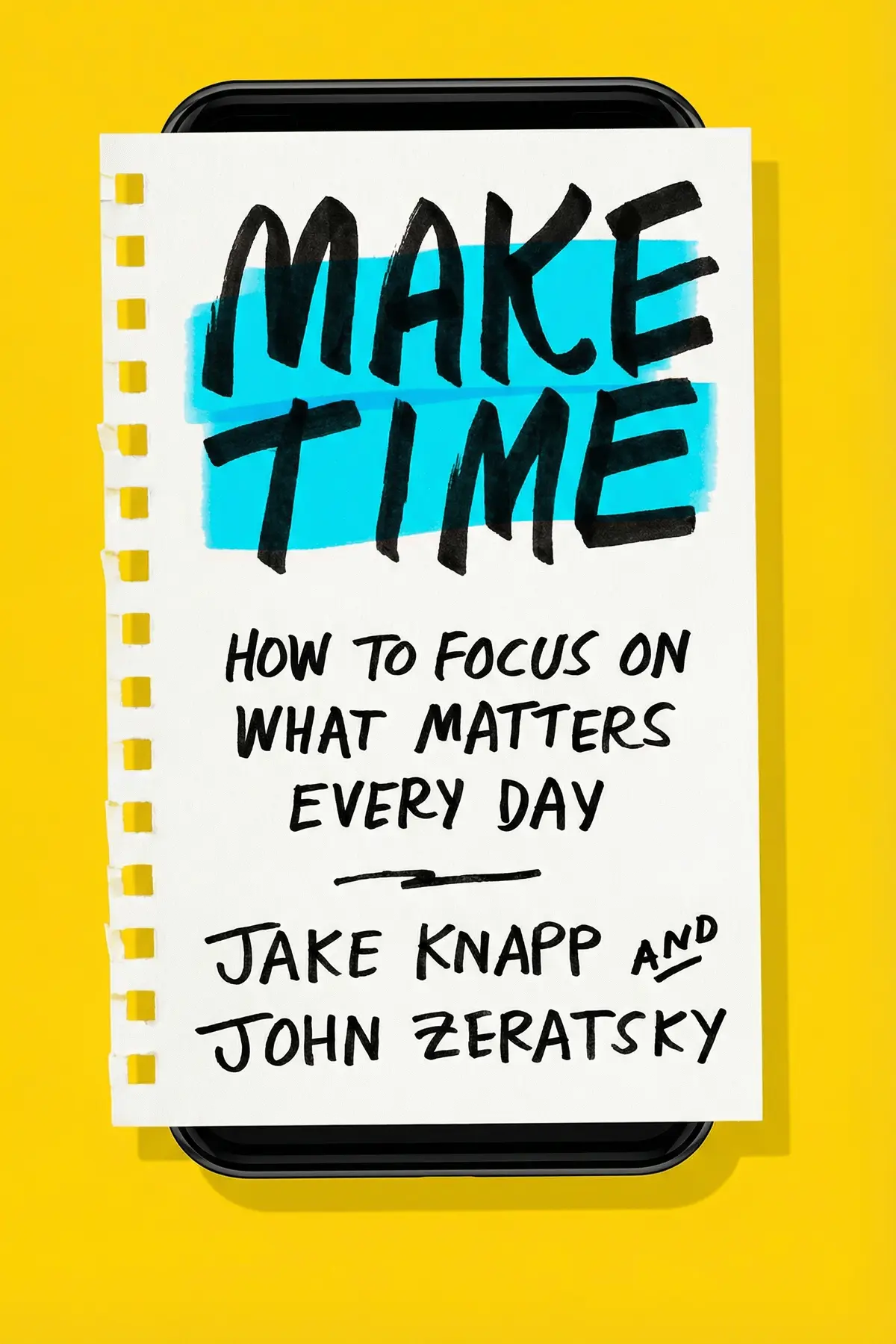
Table of Content
1. Introduction
1 min 04 sec
If your days disappear into email, meetings and scrolling that runs longer than planned, the cause may be your default settings more than your workload. In Make Time, Jake Knapp and John Zeratsky, designers who spent years building products at Google and YouTube, name the two forces that take our hours: the Busy Bandwagon, which pushes work into every spare minute, and the Infinity Pools, the feeds and videos that never run out.
Working faster will not beat them, and neither will willpower, because both feed on the same reflex of reacting without thinking. The fix is to reset your defaults: choose one highlight each day, guard the time for it, keep your body charged enough to use it, and check each night what worked. Along the way you get a menu of small, testable tactics, from logging out of social media to putting salad in the middle of the plate, and a way to keep only the ones that fit your life.
2. Find where your free hours go and take them back
1 min 31 sec
Eight hours a day go somewhere most people never notice. Two forces share the blame, and the way they hand you back and forth explains why evenings feel shorter than they should.
3. Stop racing through other people's priorities
1 min 30 sec
The standard cure for being busy is to work faster. A simple bit of arithmetic shows why that cure keeps you busier, and whose goals end up eating your day.
4. Beat irresistible apps by deciding in advance
1 min 45 sec
If willpower worked, nobody would lose an evening to a feed. Engineers and ancient instincts stack the odds against you, and a story from Homer shows the way out.
5. Pick one highlight worth 90 minutes a day
1 min 45 sec
To-do lists are too small and life goals too large to shape a single day. One target in between changes what you remember about your day, and its size matters.
6. Build walls between your highlight and your phone
1 min 45 sec
Finding an hour is hard; keeping it is harder. The phone app the authors are boldest about deleting may surprise you, and so may how little you miss it.
7. Energy that makes the reclaimed hours count
1 min 54 sec
Reclaimed time is useless if you meet it exhausted. A look at how humans lived for most of our history yields simple fixes, including a caffeine trick timed to the half hour.
8. Test tactics like recipes and keep the winners
1 min 26 sec
Dozens of tactics can feel like homework. A kitchen comparison turns them into an experiment, and a few minutes each evening decide which ones become yours.
9. Conclusion
1 min 12 sec
Make Time recasts a familiar complaint. The hours you miss were claimed, by a culture that rewards looking busy and by apps built to keep you watching, and both run on the reflex to react. Faster work and firmer resolve keep failing because they leave that reflex in charge.
What Knapp and Zeratsky offer is a small, protected core inside each day, tested and adjusted as you go. No new personality is required, and no perfect schedule. You need one block of 60 to 90 minutes you chose yourself, a few walls around it and enough energy to use it.
Tomorrow, prior to checking your email, pick the thing you hope will stand out most about your day and assign it a slot on the calendar. Choose a single barrier, such as logging out of the account you check most or removing the email app from your phone, and notice how the day feels. Before bed, write two lines on what worked and what you will try next.
Odysseus still heard the Sirens. He simply chose, before the music started, where he would be standing.
About this book
What is this book about?
Most people feel they never have time for what they actually want to do. Jake Knapp and John Zeratsky argue that the shortage is partly self-made. Two forces take our hours: the Busy Bandwagon, a culture that rewards cramming work into every minute, and the Infinity Pools, the feeds, streams and news sites that never run dry. Exhausted by one, we sink into the other. The authors, designers who built products at Google and YouTube, explain why the usual fixes fail. Getting more productive only brings more tasks, most of them set by other people. Willpower is no match for apps refined to hold attention, or for brains shaped in prehistory to chase novelty and gossip. What works is changing your defaults. Their method has four steps: pick one daily highlight of 60 to 90 minutes, build barriers that keep distraction away from it, keep your energy up with habits borrowed from our ancestors, and reflect each evening on what worked. Readers get a menu of tactics, from deleting the email app on their phone to timing coffee before the afternoon crash, and a way to build a personal system from the ones that fit.
Book Information
Who it's for
Overscheduled knowledge workers
Knowledge workers whose calendars and inboxes leave no room for their own projects.
Professionals losing evenings online
Professionals who lose their evenings to feeds, videos and news and want practical barriers.
Putting off side projects
People who keep postponing a side project, a novel or a hobby to someday.
About the Author
Jake Knapp
Jake Knapp is a designer, investor and New York Times bestselling author of Sprint, Make Time and Click. At Google he helped create Gmail and co-founded Google Meet, and he has helped more than 300 startups launch products. John Zeratsky spent nearly 15 years designing for technology companies, including YouTube and Google. At Google Ventures he helped shape the design sprint method and worked with close to 200 startups. His writing has appeared in The Wall Street Journal, TIME and Wired.
Ratings & Reviews
Ratings at a glance

What people think
Listeners find this time management guide packed with actionable tips and highly accessible, featuring brief chapters that are easy to finish over a weekend. The work encourages people to reevaluate their concentration and bypass interruptions, enhancing their overall daily efficiency. They value the no-nonsense strategy and witty prose, while also highlighting the excellent quality of the material and the hands-on advice offered.
Top reviews
Maksim
Stop scrolling for a second and look at your phone usage stats. Truth is, most of us are drowning in what Knapp and Zeratsky call 'Infinity Pools,' those apps that provide an endless stream of content designed to hijack our attention. This book isn’t just another dry lecture on productivity; it feels like a tactical manual for reclaiming your sanity in a world designed to distract you. I loved the concept of picking a single 'Highlight' each day because it shifts the focus from mindless busywork to intentional living. The writing is punchy, humorous, and incredibly easy to digest over a single weekend. While some tactics like deleting every social media app might feel extreme for certain professionals, the menu-style format allows you to ignore what doesn't work. It’s a refreshing take that prioritizes energy over mere output.
Show moreThawee
The authors, two former Google designers, have created something that feels more like a friendly conversation than a lecturing textbook. Gotta say, the way they explain the 'Busy Bandwagon' perfectly describes the corporate trap I’ve been stuck in for years. They provide very practical techniques to ring-fence your time, and the focus isn't just on working harder, but on having the energy to enjoy your life. I particularly appreciated the section on reflection, which encourages you to track what works and what doesn't without feeling a sense of failure. It is incredibly refreshing to read a productivity book that actually encourages you to spend more time on your passions rather than just squeezing out more billable hours. This book genuinely helped me lower my daily stress levels and find a bit of calm in a chaotic schedule.
Show moreAisha
This book is essentially a toolbox filled with 87 different tactics, allowing you to pick and choose what actually fits your lifestyle. Personally, I loved the silly sketches and the 'opinion battles' between Jake and John because it made the reading experience feel interactive. It’s not a book you have to follow cover-to-cover; it’s more about finding the few strategies that help you reclaim your focus. I’ve already started 'distraction-proofing' my phone by moving my social media apps off the home screen, and the results were almost immediate. The authors’ honesty about their own struggles with distraction makes the advice feel much more attainable than your average self-help guru. It’s a light, enjoyable, and ultimately very useful guide to being more intentional with your twenty-four hours.
Show moreTim
Rarely do I find a non-fiction book that I can finish in two sittings, but the snappy chapters made this incredibly digestible. In truth, the core message is simple: you have to be the architect of your own time or someone else will build it for you. The concept of 'Infinity Pools' really hit home for me, especially regarding how I used to mindlessly scroll through Netflix every single night. The book gives you permission to be 'unproductive' in the traditional sense so you can be more effective at what actually matters to you. It’s funny, practical, and devoid of the usual corporate jargon that plagues this genre. Even if you only implement 10% of what’s in here, you’ll likely feel a massive improvement in your daily focus. This is a must-read for anyone feeling burnt out by their digital life.
Show moreAir
Finally got around to reading this over the weekend and I’m pleasantly surprised by how low-friction the advice is. In my experience, most self-help books try to force a rigid system on you, but this feels more like a buffet of 87 different experiments. I started implementing the 'Highlight' method immediately, and it has already changed how I view my morning routine. Instead of reacting to a never-ending to-do list, I’m actually making space for the things that bring me joy. The sketches throughout the book are a nice touch and keep the tone lighthearted rather than preachy. Some of the tips, like not using Wi-Fi on a plane, felt a bit dated or irrelevant to my life, but the core philosophy is sound. It’s definitely worth a read if you feel constantly overwhelmed.
Show moreNatchaya
Ever wonder why you finish a workday feeling exhausted yet like you accomplished absolutely nothing of value? Look, this book is specifically designed to solve that modern malaise by helping you rethink your relationship with technology. The chapters are incredibly short and snappy, making it the perfect choice for a quick weekend read that won't feel like a chore. I really appreciated the focus on 'Energy' because most management books completely ignore the biological side of focus. From eating real food to taking breaks, these small adjustments add up to a much more sustainable way of living. While I didn't agree with their stance against all to-do lists—I find mine essential—the overall framework is flexible enough to accommodate different styles. It’s a solid, practical guide for anyone looking to escape the mindless scrolling of modern life.
Show moreAey
While it sits comfortably on the shelf next to heavy-hitters like Atomic Habits, this book focuses much more on the 'how' of daily focus. Not gonna lie, I was skeptical about the 'Highlight' idea at first because it seemed too simple to actually work. However, after trying it for a week, I realized how much time I was wasting on low-priority tasks just to feel 'productive.' The authors do a fantastic job of explaining the psychological traps of social media and 'Infinity Pools' without being condescending. The advice is divided into four clear parts: Highlight, Laser, Energize, and Reflect, which makes the whole system easy to memorize. It’s a very tactical book that gives you permission to ignore the demands of the 'Busy Bandwagon.' I’d recommend it to anyone who feels like their days are being stolen by their smartphone.
Show moreSkylar
After hearing several people rave about the 'Highlight' method, I decided to see if the hype was justified. Basically, the book teaches you how to design your day around one meaningful task rather than reacting to everyone else’s priorities. I found the section on 'Laser' focus particularly helpful, as it provides dozens of small ways to kill distractions before they start. The authors’ writing style is very personable, and they don’t take themselves too seriously, which I appreciated. To be fair, a few of the chapters on email management felt a bit repetitive, and some suggestions were a little too basic for my taste. Still, the overall message about redefining productivity is powerful and much needed in our current 'always-on' culture. I walked away with at least five new habits that I plan to keep.
Show moreNora
As someone who has obsessed over productivity hacks for a decade, this felt a little like 'Time Management 101' for the digital age. To be fair, the book is exceptionally well-organized and the authors’ background at Google adds a layer of credibility to their war on distractions. However, I found many of the suggestions—like deleting Netflix or avoid checking email—to be somewhat common sense for anyone already familiar with this genre. The 'Highlight' framework is a solid mental model, but the book spends a lot of time on anecdotes that didn't always resonate with my specific career path. If you’ve never read a book on focus, this is a five-star masterpiece. For the rest of us, it’s a pleasant but somewhat shallow reminder of things we likely already know we should be doing.
Show moreSara
Frankly, I’m not entirely sure I’m the target audience for this particular brand of Silicon Valley minimalism. While the writing is undeniably funny and the layout is great, many of the suggestions felt a bit too extreme or privileged for my daily reality. For instance, the idea of an 'internet-free phone' or skipping Wi-Fi on long flights just isn't feasible for someone in my line of work. It felt a bit like being told the secret to happiness is just deleting every joy-inducing app from your life. I did enjoy the sections on energizing the body, but the heavy focus on email management felt like it was solving a problem I don't really have. It’s a well-written book with good intentions, but it often prioritizes a very specific tech-centric lifestyle that doesn't translate well for everyone.
Show moreQuestions about this book
What is the main idea of Make Time?
Knapp and Zeratsky argue that our time is taken by two forces: the Busy Bandwagon, which pushes us to fill every minute with work, and Infinity Pools, apps and sites with endless content. Both run on unthinking reactivity, so faster work and willpower fail. The answer is to change your defaults with a four-step daily method: choose a highlight, focus on it, energize your body and reflect on the results.
What is a daily highlight in Make Time?
A highlight is one sustained activity, roughly 60 to 90 minutes long, that you choose each morning and want to look back on with satisfaction that night. It can be urgent, like a proposal a client expects, satisfying, like a postponed pet project, or joyful, like learning a guitar song. Shorter tasks don’t let you reach deep focus, and longer ones are hard to sustain.
How does Make Time suggest dealing with phone distractions?
The authors favor barriers over willpower, inspired by Odysseus tying himself to the mast. They suggest deleting social media apps from your phone, and even the email app, using blockers on your computer, logging out of accounts so each visit needs a password, reading the news once a week, and writing passing questions on paper instead of searching them right away.
How do I start applying Make Time?
Try one tactic per step instead of all 87 at once. Tomorrow morning, decide what you want your highlight to be and schedule it. Add one barrier, such as logging out of your most-checked account. In the evening, note what worked, rate your focus and energy from 1 to 10 and record one moment you were grateful for, then adjust for the next day.
Readers also enjoyed



AUDIO SUMMARY AVAILABLE
Listen to Make Time in 15 minutes
Get the key ideas from Make Time by Jake Knapp, plus 5,000+ more nonfiction titles.
- 5,000+ titles
- Listen as much as you want
- 7-day free trial
- Cancel anytime









