

13 min 27 sec
Available in: English
Magic Words: The New Science of Language for Persuasion, Communication, and Driving Action
By Jonah Berger
Shows how small word swaps, such as nouns for verbs, definites for hedges and pointed questions for vague ones, make people more likely to listen, agree and act, and when each swap backfires.
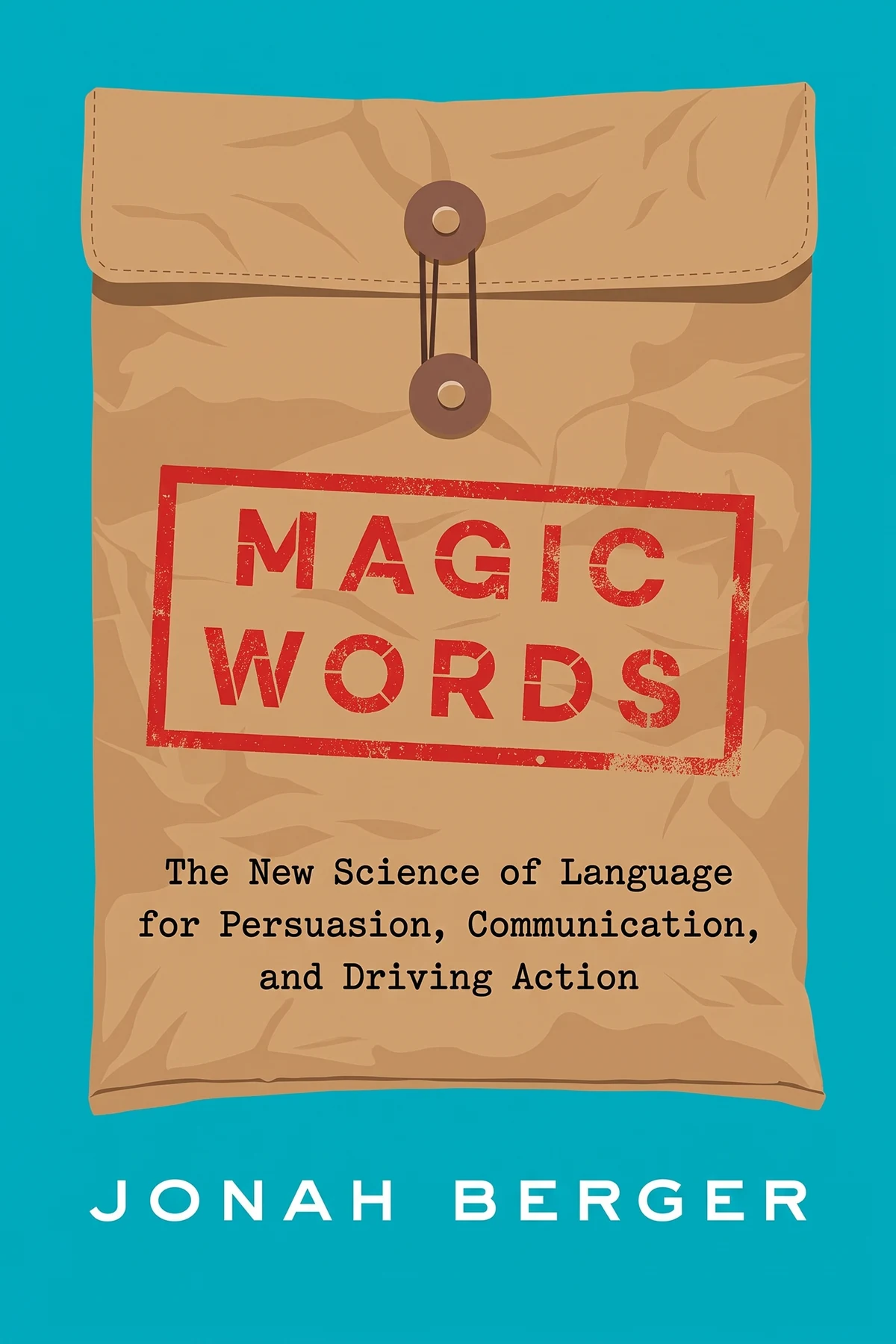
Table of Content
1. Introduction
1 min 03 sec
If you have ever made a good case and watched it go nowhere, the problem may have been a single word. In Magic Words, Wharton marketing professor Jonah Berger reports that people are 34 percent more likely to take your suggestion when you say you recommend it than when you say you like it. That is roughly a third more, from swapping one verb.
Berger’s larger argument is that the words we choose shape how others see us and what they do next, and that each tool works only when it fits the situation. Confidence helps with the undecided and hurts with the opposed. Concrete language wins customers, while abstract language wins investors.
What follows are six of those levers: words that call on identity, words that sound sure, questions that build trust, the right level of detail, emotion used with care, and the choice between fitting in and standing out. Each one ends in something to try in your next email, meeting or conversation.
2. Turn a request into an identity people want
1 min 54 sec
Two groups of small children got almost the same request to tidy their toys. One word was different, and it changed who actually did the cleaning. The same trick works on voters, colleagues and your own diet.
3. Sound sure when the room is undecided
1 min 53 sec
A few small words that feel polite and modest can drain the force from everything you say. Yet sounding completely certain has a cost too, with one kind of listener in particular.
4. Ask the questions that build trust and reveal the truth
1 min 57 sec
Many people stay quiet in conversations for fear of looking ignorant or nosy. Research on first dates and on online sellers suggests that asking the right question can do a lot for how you come across and what you learn.
5. Match concrete or abstract words to your goal
1 min 47 sec
One small change in how service staff described their next step made customers spend more for weeks. Yet startup founders who did the opposite raised more money. Both results hold, and the reason matters.
6. Put emotion where it holds attention
1 min 57 sec
Feeling words fill restaurants and keep people glued to films and articles. The same words can make a review of a kitchen appliance look less useful, and Berger explains where the line falls.
7. Fit in to stay, stand out to be remembered
1 min 42 sec
Matching your colleagues’ writing style tracked closely with who got promoted and who got fired at one firm. In music, the opposite habit produced a global hit. Knowing which game you are in changes how you should talk.
8. Conclusion
1 min 14 sec
Berger’s research adds up to a simple claim with a demanding edge. Words are never neutral, and the same word can help in one room and hurt in the next. Sounding certain wins the undecided and loses the opposed. Detail reassures a customer and shrinks a pitch. Emotion sells a novel and sinks a review of a razor. Persuasion, in his account, is mostly a matter of noticing which situation you are in.
That makes it practical, because small swaps are cheap to test. This week, try turning one request into a role, the way the children became helpers, and phrase one personal rule as I don’t. Go through your next important email, cut the hedges and fillers, and put your claims in the present tense. In your next conversation, ask a follow-up question before giving your own view, and when you need the truth, ask about the problem directly. Before any pitch, decide whether your listener needs the green sneakers or the transportation solution.
Most of the 16,000 words you say tomorrow will come out on autopilot. Choosing even a handful on purpose is where the magic in Berger’s title begins.
About this book
What is this book about?
Most of us choose our words on autopilot, then wonder why a good idea fell flat or a request went ignored. Jonah Berger, a marketing professor at the Wharton School, argues that specific words reliably shift outcomes. Saying you recommend something instead of saying you like it makes people about a third more likely to follow your advice. Berger draws on studies of children tidying up, thousands of first dates, customer service calls, startup pitches, blockbuster films, product reviews and office emails. He groups what works into six levers: words that call on identity, words that sound confident, well-aimed questions, the right level of concreteness, emotional language, and the choice between sounding like your group and standing apart from it. The book's most useful lesson is that almost every lever has a flip side. Confidence persuades the undecided and hardens the opposed. Concrete words win customers while abstract ones win investors. Readers come away knowing which words to use and when to use them, in sales, at work and at home.
Book Information
Who it's for
Professionals going unheard
Professionals whose emails, pitches and requests often get ignored or lose force.
Salespeople, founders, service staff
Salespeople, founders and service staff who want customers and investors to say yes.
Hoping to spur action
Parents and anyone changing a habit who want words that make people act, themselves included.
About the Author
Jonah Berger
Jonah Berger teaches marketing at the Wharton School of the University of Pennsylvania and has spent more than 15 years researching social influence. He has published dozens of articles in leading academic journals and has consulted for Fortune 500 companies. His other books include Contagious: Why Things Catch On, Invisible Influence and The Catalyst: How to Change Anyone's Mind.
Ratings & Reviews
Ratings at a glance

What people think
Listeners find the work very enlightening, and one listener points out that it is supported by research. They also value the book’s perspective on language use and find the concepts easy to grasp, with one listener specifically mentioning its 6-step framework. Finally, the audio performance earns praise, with one listener characterizing it as nicely narrated.
Top reviews
Rung
Magic Words isn't just another dry business book; it’s a fascinating dive into the mechanics of how we speak and why it matters. Jonah Berger breaks down the power of language into a clear, six-step framework that feels both intuitive and deeply researched. I loved the examples of how subtle shifts—like using 'helper' instead of 'help'—can completely change the outcome of an interaction. The writing style is punchy and accessible, making complex concepts from computational linguistics feel like common sense. Not gonna lie, I started paying attention to my own emails immediately after finishing the first chapter. While some might find the data-driven approach a bit clinical, I found it incredibly grounding. It’s the kind of book you want to keep on your desk for quick reference to sharpen your persuasion skills.
Show moreChloe
The 6-step framework outlined here is a total game changer for anyone in marketing or sales who wants to understand the hidden drivers of persuasion. Berger has a gift for taking dense academic research and turning it into simple, actionable steps that anyone can follow. I found the chapter on leveraging concreteness to be the most helpful, especially the tips on how to make descriptions more vivid and memorable for customers. The narration in the audiobook version is also excellent, which made the data-heavy sections much easier to follow during my commute. People often take words for granted, but this book proves that even the smallest change in phrasing can lead to a 30% increase in success. If you want to communicate more effectively and inspire those around you, you need to read this.
Show moreWanida
Berger has a knack for taking complex linguistic patterns and distilling them into simple, actionable steps that feel immediately useful. This book is a fascinating exploration of how we can use specific types of words to persuade, connect, and lead more effectively. I was particularly impressed by the research on how 'present tense' increases perceived authority and impact. The real-world examples, ranging from loan applications to boardroom pitches, keep the content grounded and relatable throughout. Not everyone will agree with the heavy reliance on data and algorithms, but for me, it added a layer of credibility that is often missing from the self-help genre. It’s a must-read for anyone who wants to understand the hidden influence of the language we use every single day.
Show moreVimolwan
Ever wonder why some people just seem more convincing than others? This book answers that question by focusing on the specific words that drive action and build connection. I particularly liked the section on conveying confidence and how avoiding 'filler words' like 'um' or 'uh' can drastically change how you're perceived by an audience. The 6-step framework provides a solid structure that makes the information easy to digest and apply. Look, it’s not reinventing the wheel if you’ve already read a lot of Adam Grant, but Berger adds a modern twist with his focus on hard data. My only gripe is that some chapters felt a bit repetitive towards the end, hitting the same points multiple times. Still, the practical tips on using present tense to sound more authoritative were worth the read.
Show moreKamol
Frankly, I was skeptical about the NLP elements at first, but Berger backs his claims with enough research to make you think twice about your vocabulary. The book explores how we can use language to build trust and foster deeper connections in our personal and professional lives. I liked how he emphasized the importance of asking 'follow-up questions' rather than just checking off a list of inquiries. It makes the conversation feel more authentic and less like a transaction. Some of the statistics mentioned are truly mind-blowing, like how specific words in a cover letter can predict job success. However, it’s important to remember that words are just one piece of the puzzle. Overall, it is a very insightful read that provides a new lens through which to view our daily interactions.
Show moreWichai
Finally got around to reading this and the chapter on asking questions was worth the price of admission alone. Berger explains how the right questions can deflect tension or build intimacy, depending on how they are phrased. This is practical advice that I could use in my very next meeting. The writing is clear and simple to understand, which I appreciated given how much data is being thrown at the reader. My only real complaint is that some of the 'magic' words feel a bit like common sense once they are explained. Nevertheless, seeing the numbers behind the theories makes them much more convincing than just taking an author's word for it. It’s a solid book that delivers exactly what it promises: a data-driven look at the power of words.
Show moreSirinat
As someone who works in communication, I found the section on 'identity vs action' particularly insightful for crafting better messaging. Instead of just telling people what to do, Berger suggests we invite them to be a certain type of person through our word choice. It’s a subtle shift, but the data suggests it makes a massive difference in how people respond. The book is well-structured and the '6-step framework' makes it easy to remember the core principles long after you finish. Gotta say, I enjoyed the sections on NLP more than I thought I would, as they highlight how much our word choices reveal about our subconscious thoughts. While a few of the examples felt a bit repetitive, the overall message is powerful and well-supported.
Show moreRungrat
After hearing so much buzz about Jonah Berger, I expected a bit more punch from this one. While it starts out strong with interesting insights into identity and agency, it eventually devolves into a list of fifty different use cases that don't always feel relevant to the average person. I somehow doubt that a manager pitching a new project needs the same advice as a policeman or a novelist. The book tries to be everything to everyone and, as a result, feels a bit thin in certain areas. To be fair, the research is presented clearly and the writing is engaging enough to keep you turning the pages. It’s a decent introductory text for someone new to the psychology of language, but seasoned readers might find the advice a bit basic and the examples oversimplified.
Show moreEvelyn
It’s a quick read with some decent takeaways, but it tries to do too much in such a small package. I found the concepts of 'similarity' and 'emotion' to be interesting, yet they lacked the depth I’ve come to expect from this author. The book often feels like a collection of interesting anecdotes rather than a rigorous scientific study. Personally, I struggled with how some of the advice felt a bit manipulative if taken to the extreme. If you’re looking for a light overview of linguistic psychology, this is perfect. If you want a deep dive into the 'why' behind human behavior, you might find yourself wanting more. It’s useful for a quick brush-up on communication skills, but don't expect it to change your life overnight.
Show moreA
This felt like peak pop-psychology fluff where the data is stretched thin to fit a pre-determined narrative. Truth is, many of the 'magic' examples felt stripped of their actual context, leaving me wondering if these linguistic hacks would actually work in the real world outside of a controlled study. Berger relies heavily on Natural Language Processing studies, but he never really addresses the replication issues common in social sciences. I've read his previous work and loved Contagious, but this one misses the mark by being too broad and lacking actual depth. It tries to cover everything from courtroom testimony to dating profiles in one go. Instead of deep, meaningful insights, you get a collection of 'did you know' facts that don't always translate into a cohesive strategy for a professional setting. It’s not terrible, but it’s definitely not the manual for life it claims to be.
Show moreQuestions about this book
What is the main idea of Magic Words by Jonah Berger?
Berger argues that specific word choices reliably change how people respond. Saying you recommend something instead of saying you like it makes people 34 percent more likely to follow your advice. He groups the effective choices into six levers: identity, confidence, questions, concreteness, emotion and linguistic similarity. Each lever works in some situations and backfires in others, so the skill lies in matching your words to the moment.
Why does using nouns instead of verbs persuade people?
Nouns put people in a category, and categories feel like a lasting part of who they are. In a 2014 study, young children asked to be helpers tidied up more readily than children asked to help. Campaigns in 2008 asked people to be voters instead of to vote, and turnout rose 15 percent. Saying I don’t instead of I can’t uses the same effect on yourself.
When should you speak with confidence and when should you show doubt?
Berger says confidence works best with an undecided audience. Cut hedges like I think and sort of, use definites like clearly, drop fillers like um, and speak in the present tense. But when someone already strongly disagrees, too much certainty triggers a defense against persuasion, so admitting some doubt about your own view can make them more open to it.
How can I apply Magic Words at work?
Use concrete language with customers and colleagues who need help, since retail service staff who did so saw customers spend 30 percent more. Switch to abstract language when pitching an idea’s potential to investors or bosses. Ask follow-up questions in meetings, and match your coworkers’ writing style: at one firm, matching colleagues tracked with promotion and a different style with being fired.
Who should read Magic Words?
It suits professionals, salespeople, founders and managers who want their messages to land, along with parents and anyone trying to change a habit. Its tools are small swaps you can test right away, such as asking a seller what problems a laptop has, or telling a story with setbacks in it, and it explains when each swap stops working.
Readers also enjoyed


A Liberated Mind: How to Pivot Toward What Matters
Steven C. Hayes


Acting with Power: Why We Are More Powerful Than We Believe
Deborah Gruenfeld


Age of Propaganda: The Everyday Use and Abuse of Persuasion
Anthony Pratkanis



AUDIO SUMMARY AVAILABLE
Listen to Magic Words in 15 minutes
Get the key ideas from Magic Words by Jonah Berger, plus 5,000+ more nonfiction titles.
- 5,000+ titles
- Listen as much as you want
- 7-day free trial
- Cancel anytime









