

A Liberated Mind: How to Pivot Toward What Matters
Steven C. Hayes
 English
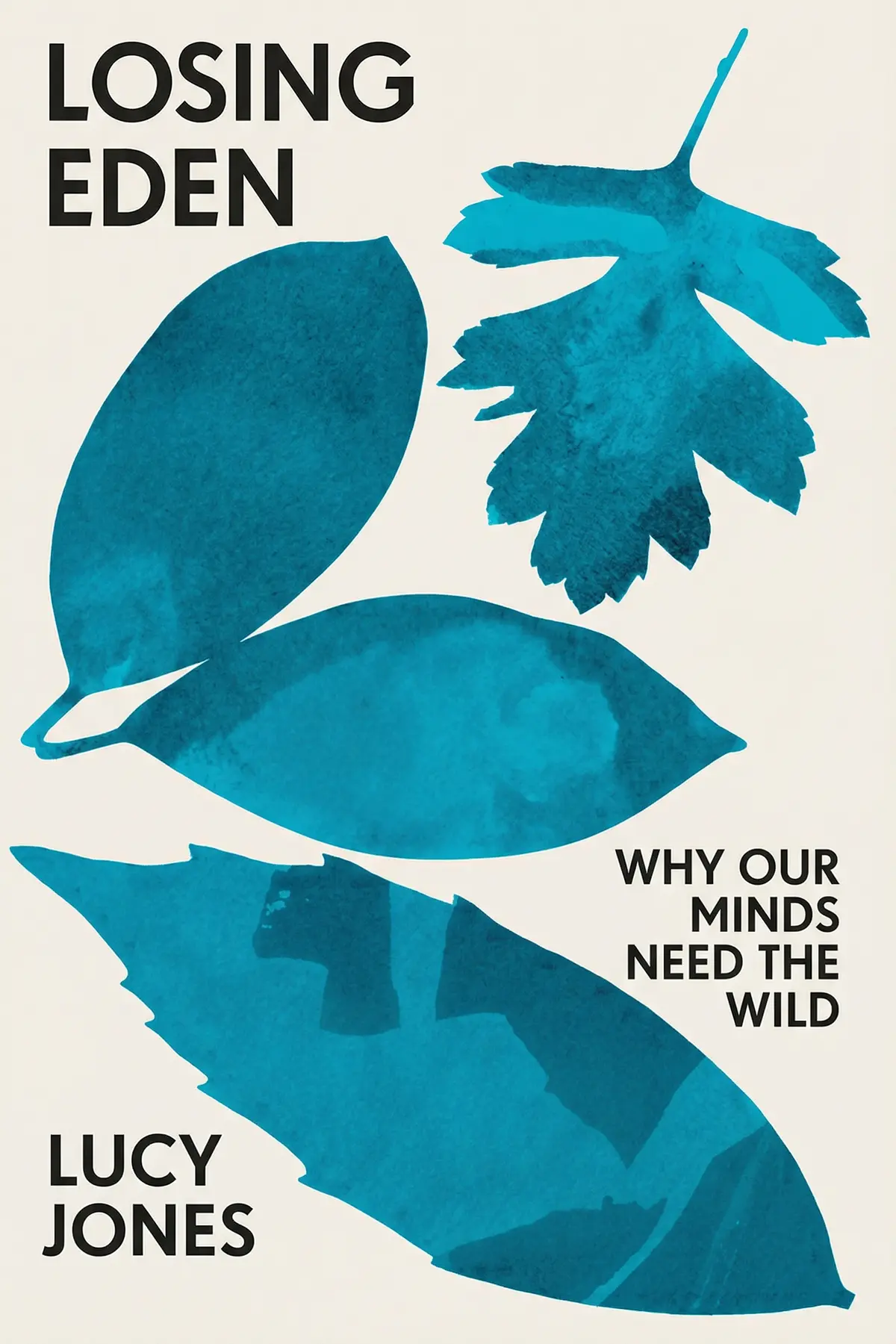
Lucy Jones gathers research showing why human minds need contact with living nature. She shows how losing it harms mood, focus, children and communities, and what people, cities and laws can do to restore it.
57 sec
If your days pass mostly indoors and you feel frayed in a way rest doesn’t fix, Lucy Jones offers a striking explanation: your mind may be missing the living world it was built to expect. In Losing Eden, the journalist gathers research showing that nature works on us down to our cells, from a soil bacterium that raised serotonin in mice to forest walks that strengthen immune defenses. Her argument is that our drift away from the wild causes real psychological harm, to individuals and to whole societies, and that reconnecting is both possible and urgent.
The evidence runs from a pear tree outside her window to a Chicago housing project, an Oregon prison and an ancient Polish forest. By the end, contact with nature looks less like a weekend treat than a need you can plan around, for yourself, your children and the place you live.
1 min 52 sec
A writer in recovery found her mood slipping when builders blocked her view of one ordinary tree. Her search for the reason led to soil bacteria, inflamed blood and a cycle that feeds on itself.
1 min 49 sec
A famous garden designer of the 1700s kept making the same choices for wealthy clients, and newborn babies make a similar one within days of birth. Both point to a preference nobody had to teach.
1 min 48 sec
Most British children now get less fresh air than people serving prison sentences. Screens explain only part of it, and one small outdoor nursery shows what children gain when the classroom moves under the sky.
2 min 03 sec
A swim in a Scottish cove left Jones feeling as if her brain had been washed. Two very different explanations compete for why, one about the air near water and one about the way attention wears out.
2 min 08 sec
In a notorious Chicago housing project, some towers had a patch of grass and some had only concrete. The difference showed up in crime figures, and a prison in Oregon later tested something similar.
2 min 08 sec
A Glasgow researcher gave up hoping to fix health inequality the obvious way. What he found instead, across 34 countries, suggests parks may do something economic policy has so far failed to do.
2 min 06 sec
Europe’s largest ancient primeval forest lost thousands of trees to logging despite years of protection. A handful of countries have tried a bolder answer, and Jones thinks even our everyday vocabulary needs to change.
1 min 15 sec
Losing Eden adds up to one claim with wide reach: we were shaped among living things, and cutting ourselves off from them costs us in our microbes, our attention, our children and our neighborhoods. Carl Jung, the founder of analytical psychology, pictured the mind as an old house. We live on the modern upper floors, but below lie medieval stonework, a Roman cellar and a Neolithic cave. We rarely go down there, yet the whole house rests on them.
Jones believes the bond can be reawakened at any age, and her most direct advice is to seek awe. In a University of Toronto experiment, awe led to clearly lower levels of the cytokines behind harmful inflammation, and other studies link it to less narcissism, more generosity and greater happiness. So when stress closes in, go somewhere natural that makes you feel small. Give a child unhurried hours outdoors. Spend two hours under trees, or push for trees where you live; Chicago’s 20,000 show that a city can choose green on purpose.
The pear tree outside Jones’s window was never decoration. It was holding up part of the house.
Most of us now live and work indoors, in cities, surrounded by screens rather than living things. Lucy Jones argues that this drift does real harm. Her starting point is her own recovery from alcoholism, when a pear tree outside her window turned out to matter far more than she expected. From there she follows a growing field of research into how contact with nature shapes the mind and body. The evidence ranges from soil bacteria that raised serotonin in mice to newborns who prefer watching a walking hen, and from forest bathing to Attention Restoration Theory. Jones then widens the lens. Trees cut crime in a Chicago housing project, nature videos reduced violence in an Oregon prison, and a European study suggests green space can shrink the mental health gap between rich and poor. Readers get a clear account of why time outdoors calms and restores us, what children lose when they stay inside, and how cities, schools and even laws could give nature back its place. It closes with a simple personal practice: seeking out awe.
Desk workers who feel drained after long indoor days and want a reason to step outside.
Parents and teachers worried about how little time children spend outdoors.
Planners, managers and community organizers deciding what shared spaces should look like.
Lucy Jones is a writer and journalist based in England who began her career at NME and the Daily Telegraph. Her work on culture, science and nature has appeared in GQ, The Sunday Times, the Guardian and the New Statesman. Her book Foxes Unearthed won the Society of Authors' Roger Deakin Award in 2015, and Matrescence was longlisted for the first Women's Prize for Nonfiction. Losing Eden was longlisted for the Wainwright Prize and chosen as a book of the year by The Times and The Telegraph. She also co-wrote The Nature Seed.

Listeners consider *Losing Eden* a compelling and revelatory investigation into the vital connection between the environment and psychological well-being. They enjoy the way Lucy Jones blends intricate scientific findings—ranging from neuroscience to soil biology—with her own poignant story of healing. Furthermore, listeners prize the work's pressing plea for ecological preservation, describing the author’s stance as both expert and intensely fervent. They also remark that the writing remains very approachable for the public, with one listener highlighting how the "fascinating tidbits" concerning nature’s ability to reduce heart rates and cortisol levels offer a welcome scientific basis for our improved mood outside.
Lucy Jones has written something that feels like a vital love letter to the planet. It’s a rare book that manages to weave raw, personal vulnerability—specifically her own path through addiction recovery—with hard-hitting neurological data. I was particularly moved by the descriptions of the 'extinction of experience' as we lose species like swifts and hedgehogs. The way she describes nature 'picking her up by the scruff of the neck' during her darkest times resonated deeply with my own experiences of finding solace in the woods. While the science on cortisol and the prefrontal cortex is dense, Jones makes it accessible for anyone. It isn't just a book about plants; it's a book about what it means to be a human being in an increasingly artificial world. Essential reading for 2024.
Show moreWow, this was exactly the nudge I needed to get back into my garden. I loved the 'fascinating tidbits' scattered throughout—did you know that simply smelling cedar or looking at the patterns in ferns can physically alter your brain chemistry? Jones makes a brilliant case for why we need the 'wild' rather than just manicured parks. Her writing is incredibly evocative; you can almost smell the damp earth and green leaves as you read. Not gonna lie, the sections on species extinction were a tough read and made me quite emotional, but that discomfort is necessary. It’s more than just a science book; it’s an urgent call to fall back in love with the living world before it’s too late. I’ve already bought copies for three of my friends.
Show moreRarely does a book change the way I look at my daily walk, but this one did. Lucy Jones writes with such clarity and passion about the 'biological annihilation' we are currently witnessing. The way she links our mental health to the health of the planet is genius. We aren't just observing nature; we are part of it, and its decline is our decline. I was particularly struck by the concept of 'ecological grief.' It put a name to a feeling I’ve had for years but couldn't quite articulate. The book is beautifully balanced—part scientific inquiry, part memoir, and part manifesto. It’s deep, it’s beautiful, and it’s absolutely necessary for the times we are living in. I finished it feeling both heartbroken and incredibly motivated.
Show moreEver wonder why your heart rate drops the moment you step into a forest? Losing Eden dives deep into the 'biophilia' hypothesis to explain that very sensation. Jones explores fascinating research on how soil bacteria can actually boost our immune systems and even affect our mood. I found the section on 'nature therapy' and forest schools to be the strongest parts of the book. To be fair, a few chapters felt a little heavy on the statistics, which slowed the pacing down, but the overall message is too important to ignore. It really challenges the idea that green space is a luxury. Instead, Jones argues convincingly that access to the wild should be treated as a fundamental human right for everyone, regardless of their socioeconomic status. A very thoughtful, well-researched piece of non-fiction.
Show moreAfter hearing it compared to Rachel Carson’s Silent Spring, I had high expectations, and for the most part, Losing Eden delivers. It’s a powerful explication of the biological and spiritual toll that our modern, 'boxed-in' lives are taking on us. Jones is incredibly thorough, visiting everything from ancient woodlands to the Svalbard Global Seed Vault. One statistic that absolutely floored me was that UK children spend less time outside than prison inmates. That alone should be a wake-up call for our society. The book is at its best when it bridges the gap between the internal world of our minds and the external world of the ecosystem. It's a sobering read, yet it remains hopeful by highlighting the biophilic urban planning that could save our collective sanity.
Show moreAs a city dweller who often feels 'nature-starved,' this book hit home. Jones does a fantastic job of highlighting the inequality of nature access, showing how the 'health gap' is often tied to how much green space is available in a neighborhood. The fact that trees can actually lower crime rates was an eye-opener for me. The truth is, we’ve built our cities as if we are separate from the earth, and Losing Eden shows the psychological price we’re paying for that arrogance. My only minor gripe is that the tone can get a little dry when she lists study after study, but her personal anecdotes usually pop up just in time to save the momentum. It’s a very persuasive argument for changing how we design our future.
Show moreTruth is, we've always known instinctively that the woods make us feel better, but having the empirical evidence to back it up is incredibly satisfying. Jones covers everything from wild swimming to the calming effect of fractals in nature. I appreciated that she didn't shy away from the darker side of things—the looming climate chaos and what it will do to the human spirit. The book is quite compact at 200 pages, yet it manages to cram in a massive amount of information without feeling too cluttered. There were a few points where the language got a bit academic, but she always brings it back to the big picture. It’s a motivating read that makes you want to go out and touch some dirt immediately.
Show morePicked this up because I loved Jones’ previous book on foxes, and while this is a very different beast, it’s just as meticulously researched. She has a real knack for taking complex biological findings and making them feel relevant to our everyday lives. Her exploration of how our estrangement from the wild leads to negative rumination and sadness was especially enlightening. Frankly, the middle section drags slightly with the sheer volume of data, and I agree with other reviewers that the 'Xena' future-scenarios felt a bit out of place in a non-fiction work. However, the core of the book is so strong and the writing is so earnest that these are small complaints. It’s a vital reminder that we ignore our connection to the land at our own peril.
Show moreTo be fair, while I agree with every word of the author’s message, the execution felt a bit repetitive for me. If you’ve already read much about the climate crisis or the benefits of the outdoors, a lot of this will feel like familiar ground. The chapters on rising stress levels in urban environments and the 'fight or flight' response cover well-trodden territory in the world of psychology. Look, the prose is lovely, and Lucy Jones is clearly passionate, but I couldn't help feeling this might have worked better as a long-form essay rather than a full-length book. I also found the speculative fiction prologue about the year 2100 a bit jarring compared to the scientific tone of the rest of the work. It’s a good primer, just not quite as groundbreaking as I’d hoped.
Show moreI'll be blunt: I struggled with the methodology in some of the studies cited here. Jones relies on a lot of psychological research where the link between cause and effect feels a bit tenuous. Is it the trees that lower stress, or is it just the break from our screens? Without lab-controlled conditions, it's hard to be certain. However, I found the chapters where she veers into soil biology and the medicinal use of bacteria to be much more compelling and grounded. The book is definitely well-written, but I think a more skeptical eye toward some of the 'nature-as-panacea' claims would have made it stronger. Still, it’s a nice reminder to get out of our urban boxes more often, even if the science isn't always 100% airtight.
Show moreJones argues that humans are genetically drawn to living nature, so our move indoors and into cities is causing real psychological harm. She gathers research on soil bacteria, inflammation, attention and stress, then shows how green space affects children, neighborhoods, prisons and health inequality. Her conclusion is that reconnecting with nature, personally and through city design and law, helps both people and the planet.
Biophilia is the idea, introduced by biologist E.O. Wilson in his 1984 book of that name, that humans have an inherited attraction to living things. Jones cites support for it: newborns in a 2008 study preferred watching a walking hen to random dots, and a 2009 Norwegian review of 50 studies found that nature helps the mind and that the trait can be strengthened or weakened by learning.
Jones gives several explanations. Negative ions near water and wild places can help the brain release serotonin and calm the nervous system. Forest bathing, at least two hours among trees, raises natural killer cells linked to lower depression and anxiety. And Attention Restoration Theory, from Rachel and Stephen Kaplan, says gentle sights like moving leaves let attention worn out by focused work recover.
Jones’s most direct advice is to seek out awe in natural places when stress builds, since a University of Toronto experiment linked awe to lower levels of inflammatory cytokines. Beyond that, the book supports spending real time among trees rather than relying on screens, protecting children’s unstructured outdoor play, and pushing for green space where you live and work.
Glasgow professor Rich Mitchell’s research suggests it can. A 2015 survey covering 20,000 respondents across 34 countries in Europe found that time spent in nature was the only factor that narrowed the income-linked gap in mental health, cutting it by 40 percent. Jones adds that access is not enough on its own: communities should be welcomed in and involved in designing their parks.
Steven C. Hayes




Leanne Maskell



AUDIO SUMMARY AVAILABLE
Get the key ideas from Losing Eden by Lucy Jones, plus 5,000+ more nonfiction titles.









