
15 min 43 sec
Available in: English
Long Life Learning: Preparing for Jobs that Don't Even Exist Yet
Explains why a single degree can no longer carry careers that run longer and change faster, and what schools, employers and learners can do to make reskilling easier to find, afford and fit around work.
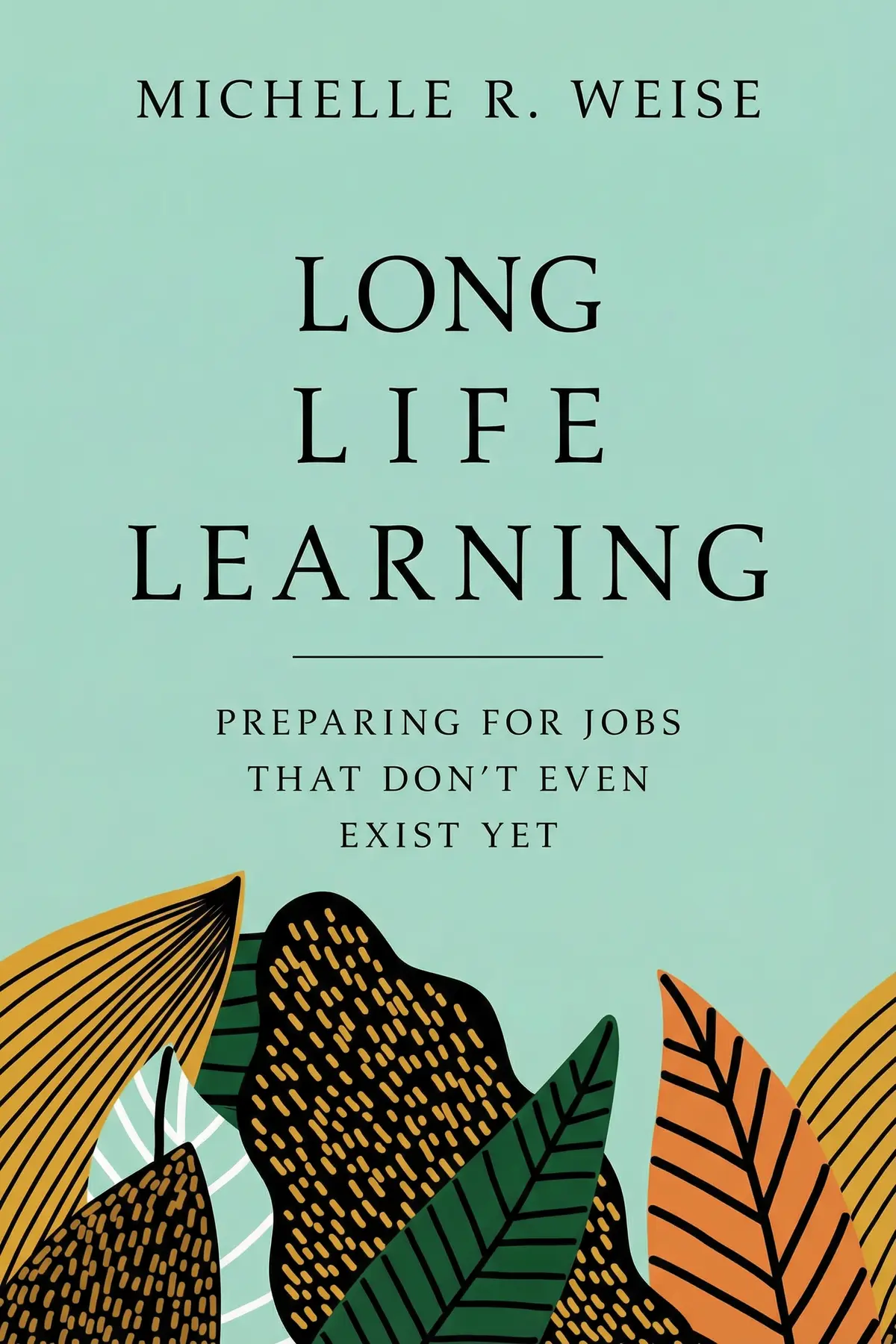
Table of Content
1. Introduction
1 min 00 sec
If your career still rests on the degree you finished years ago, it was planned for a shorter life than the one you will probably live. In Long Life Learning, education innovator Michelle R. Weise argues that longer lifespans and automation have broken the old sequence of school, work and retirement. When retirement might come at 100 instead of 65, and machines force job changes every few years, a few years of study at the start cannot last.
Her case is that learning and work must become one connected system, built so people can find their way through it, get support, learn only what they need, study while earning and be hired fairly. The examples run from a barista who is most of the way to a human resources job to a free transit pass that helped New York students afford the trip to class. You will see where today’s system fails people like you, and which tools already exist for reskilling again and again.
2. Judge any course by the job skills it builds
1 min 39 sec
Fifty years of survey answers reveal what students actually want from college, and a single statistic shows how rarely they get it. The fix Weise favors once looked like a cheap toy sold for children.
3. Make the case for developing the people you have
1 min 39 sec
A 51-year-old wants to change careers but cannot afford to stop working. Ideally his employer would help, but companies are often unwilling or ill-equipped to, and strained safety nets like Social Security suggest that will soon have to change.
4. Name the skills your past jobs gave you
1 min 38 sec
A ten-dollar cable gets more reviews than a degree costing thousands. Meanwhile, a former barista may be much closer to a new career than she thinks, if only she could see her own skills clearly.
5. Small supports that keep adult learners in class
1 min 44 sec
Adult learners often drop out for reasons that have nothing to do with ability. In New York, one surprisingly ordinary fix changed the picture, and it required nothing complex or highly creative.
6. Get the exact skills a new role needs
1 min 43 sec
A Kansas machinist faces automation, and night school looks impossible with a family at home. Faster routes exist, but the numbers show how few people can actually reach them today.
7. Learning that fits around rent and a paycheck
1 min 36 sec
For adults who must earn to survive, both money and time block learning. Two financing models and one store associate’s story show how study can be funded and how training can be tied to real performance.
8. Hire for skills, not degrees, to find capable people
1 min 51 sec
Most employers say they cannot find talent, yet their own job postings keep shutting candidates out. A 90-minute test and one distribution center point toward a fairer way to choose who gets hired.
9. Shared data can match people to the right jobs
1 min 38 sec
A forest of 47,000 trees in Utah behaves as one living thing. Weise sees in its roots exactly what schools and employers are missing, and a few groups are already trying to build it.
10. Conclusion
1 min 15 sec
Weise’s argument comes down to a mismatch in time. People live and work far longer, and machines reshape jobs every few years, yet schools, employers and hiring still act as if one round of learning at the start should last for life. Every failure she describes, from Steve stuck at 51 to Jaylen facing automation, grows from that gap, and every fix she admires makes learning easier to find, easier to afford and closer to real work.
The Strada Institute for the Future of Work offers a lens for spotting those gaps, which it calls skill shapes: the mix of skills a role demands in a given region. A cybersecurity specialist in Washington, DC needs to know federal information security systems, while the same job in St. Louis leans on data science. Comparing those shapes with local supply shows where gaps and surpluses really are.
The idea works at personal scale too. Look up the skill shape of the role you want where you live, set it beside what you can already do, and choose the shortest program that closes the difference. Then treat it as the first round of many, because on Weise’s account learning is no longer something anyone finishes.
About this book
What is this book about?
Most people were taught to see education as a single stage: finish school, maybe college, then work until retirement. Michelle R. Weise argues that plan no longer holds. As lives lengthen and automation reshapes jobs every few years, a degree earned in your twenties cannot carry a working life that may stretch far beyond 65. Weise examines why schools, employers and hiring systems fail adult learners, and what is already working. She follows people like Steve, an IT specialist in his fifties eyeing a second career, and Jaylen, a machinist threatened by automation. She looks at AI tools that help job seekers name their skills, transit passes and case managers that keep learners enrolled, short programs linked to employers, income share agreements and skills tests that replace degree filters. Her frame is five principles: the system should be easy to find your way through, supportive, targeted, integrated with work and transparent in hiring. Readers get a clear picture of where reskilling breaks down and practical ideas for planning their own next round of learning, or for building better training inside an organization.
Book Information
Who it's for
Considering a second career
Mid-career workers, like a 51-year-old IT specialist, weighing a second career they cannot afford to stop working for.
Managers and training leads
Managers and training leads deciding whether to develop current staff or keep hiring from outside.
Lost in online applications
Job seekers lost in online applications and degree requirements that shut them out.
About the Author
Michelle R. Weise
Michelle R. Weise, PhD, has been chief innovation officer at two organizations, Southern New Hampshire University and Strada Education Network. She has advised at Imaginable Futures and served National University System as a vice chancellor focused on strategy and innovation. Earlier she headed the higher education practice at Clayton Christensen's institute, and the two coauthored Hire Education in 2014. Long Life Learning earned her the Phillip E. Frandson Award for Literature in 2021, and that year Thinkers50 listed her as one of 30 leadership and management thinkers worth watching. She is a former Fulbright Scholar who studied at Harvard and Stanford.
Ratings & Reviews
Ratings at a glance

What people think
Listeners find this work highly beneficial for education, with one listener emphasizing its focus on readying students for a 60-year career. They regard it as a must-read for anyone in the workforce. Feedback on the volume of content is varied; one listener mentions the thoroughness of the endnotes while another notes the absence of tables and diagrams.
Top reviews
Araya
This is the ultimate summary of the intersection between education and the modern economy. After seeing so much discussion about the 'Great Resignation,' it’s refreshing to read something that digs into the systemic roots of why people are feeling lost. Weise, a former apprentice of the late Clayton Christensen, brings a sharp analytical eye to the way our training systems are failing. She argues convincingly for a 60-year career model that requires constant 'on and off-ramps' for learning. For anyone working in higher education or corporate HR, this is a must-read. The depth of the research is impressive, evidenced by the extensive and informative endnotes that allow for further exploration into specific case studies. While the text is dense, the vision of a more equitable and transparent hiring process is incredibly compelling. It’s a call to action for institutions to finally catch up.
Show moreSupranee
Not what I expected, but it turned out to be exactly what I needed to read for my master's program. While some complain that it is for administrators, that is exactly why it is so valuable. We need the people at the top to grasp that the 'one-and-done' college model is obsolete. Weise’s focus on the 'left behind' workers is poignant and necessary. She outlines a learning ecosystem that is navigable, supportive, and transparent. I especially liked the section on 'Wraparound Supports' because it recognizes that adult learners have real-life barriers like childcare and transportation. It’s a massive summary of what exists now and what our future needs to look like. If you're looking for a self-help book, keep moving. But if you want to understand the architecture of future education, this is the gold standard. Excellent research throughout.
Show moreHang
As someone who works in workforce development, I found this to be an essential piece of the puzzle for 21st-century planning. Weise has clearly applied the lessons from her time with Clayton Christensen to the world of higher ed. The book provides a compelling vision for how we can bridge the gap between education and industry. I was particularly impressed by the 'Integrated Earning and Learning' chapter. We often forget that learning isn't just about the curriculum; it's about the life circumstances of the learner. While some critics say the title is misleading, I think it perfectly captures the shift we need to make toward a 60-year career mindset. The research is top-notch and the case studies are enlightening. It’s a guidebook for what our future needs from the education and industry collaboration. I highly recommend it for anyone researching these intersections.
Show moreMilk
Is it possible to prepare for jobs that don't exist yet? Michelle Weise attempts to answer this by outlining a new learning ecosystem, and for the most part, she succeeds. To be fair, she provides excellent examples of new initiatives designed to help workers navigate career transitions, even if there’s a distinct lack of hard data to prove they actually work. I wanted more specifics on the costs of these programs, but the vision is solid. I did appreciate the chapters featuring interviews with underemployed people, which added a much-needed human element to the otherwise dense text. However, those stories felt a bit disconnected from the chapters on data infrastructure and institutional reform. It’s a strong read for those in workforce development, though it definitely needs more visual aids like charts or tables to help visualize the concepts.
Show morePrayoon
Finally got around to finishing this after hearing about it in a work seminar. The book does a fantastic job of explaining why our current educational model is rigged against the lifelong learner. I was particularly struck by the concept of a '100-year work life' and how we need to dismantle the traditional four-year degree gatekeeping that holds so many back. The author highlights several organizations I’d never heard of before that are doing great work in targeted education. My only real gripe is that the tone can get a bit clinical at times. It occasionally reads more like a formal report than a narrative. Still, the insights into how we can create a more supportive learning ecosystem are invaluable for the future of us all. Truth is, we can’t keep relying on old structures if we want to thrive in a globalized, tech-heavy economy.
Show moreElise
The chapter on transparent and fairer hiring was definitely the standout for me in this volume. Weise tackles the 'broken journey' of the American worker with a lot of empathy, using first-hand stories of frustration to highlight where our systems fail. I love how she frames the need for a 'navigable and supportive' ecosystem. It’s not just about more school; it’s about better connections between learning and earning. I’ll admit the writing style isn't always artful, and she leans a little too heavily on trendy management cliches like 'seamless on-ramps.' However, the core message is vital. We are living through a massive industry shift, and this book provides a reasonable overview of how we might survive it. It’s a dense read with a lot of information packed into the endnotes, so take your time with it. It's a solid four stars.
Show moreKamol
Ever wonder why it's so hard to pivot careers in your 40s? Michelle Weise lays out the systemic reasons in 'Long Life Learning,' but be warned: it’s an academic deep-dive rather than a quick read. I appreciated her mentions of COVID-19 and how the pandemic accelerated these trends toward digital transformation. She talks a lot about ambitious entrepreneurs and new technologies, yet we rarely see the data on their long-term efficacy. Gotta say, it’s a bit of a dry read if you aren't already passionate about educational infrastructure. It’s also missing the kind of charts and tables that would make the complex 'learning ecosystem' easier to grasp. That said, it is a valuable resource for anyone who wants to understand how globalization is shifting the economic landscape. It offers a compelling vision for strengthening the links between learning and earning.
Show moreKwame
Picked this up during the pandemic to better understand the shifting job market, but I have mixed feelings. The insights into how technology is reshaping the economic landscape are spot-on. Weise argues that we need to move away from a 'rigged system' that only serves the young and wealthy. However, I do agree with other reviewers that the book is a bit light on visual data. It would have been much more tangible if she’d included diagrams of the type of learning ecosystem she envisions. Instead, it's a lot of text and endnotes. Personally, I found the writing style a bit repetitive and full of management cliches. It’s a solid enough overview of trends in higher education, but it lacks the 'how-to' for the actual worker. It’s more of a 3.5-star read that I'm rounding down because of the misleading title.
Show moreYaowaluk
The title of this book is incredibly misleading. I went in expecting a personal guide on how to become a better student in middle age, but what I found was a dry policy manual for university administrators. If you aren't currently running a college or working in government, there isn't much here for you. It's frustrating because the core message—that the current system of 'four years then work' is dying—is so obvious to anyone under 40. I found the total lack of actionable advice for individual learners to be a major letdown. Frankly, the writing feels a bit too stuck in management-speak and trendy buzzwords. While the author clearly knows her stuff, it feels like she's talking to a room of deans rather than the workers who are actually struggling to survive. Not what I wanted at all.
Show moreJoy
Wow, I really wanted to like this more than I did, but it was a slog. I’m a millennial who already knows that the 'college-then-work' model is broken; I didn't need 200 pages to tell me that. This book offered me almost no advice on what I should actually do to succeed as a learner. It's written entirely for people at the top—university administrators and politicians who are apparently out of touch. The title makes it sound like a personal development book, but it’s actually a dense policy analysis. Look, the interviews with the unemployed were interesting, but they felt like an afterthought compared to the dry sections on data infrastructure and theories. If you are a student or a worker looking for career guidance, this isn't for you. It's for the people who run the institutions that are currently failing us.
Show moreQuestions about this book
What is the main idea of Long Life Learning?
Michelle R. Weise argues that longer lifespans and automation make one-time education obsolete. People will need to reskill quickly and repeatedly across long, changing careers, so schools and employers must build a connected system of learning and work. She sets out five principles for it: easy to find your way through, supportive, targeted, integrated with work and transparent, especially in hiring.
Who should read Long Life Learning?
It suits mid-career workers considering a second career, adults without a degree who feel stuck in low-wage work, and managers or training leads deciding whether to develop staff or hire from outside. Educators and policymakers will also find examples of what works, from free transit passes for students in New York to lifelong learning accounts in Singapore.
How can AI help people identify their skills, according to Weise?
Weise describes AI guidance tools that build a profile from a person’s past jobs. Type in barista, for example, and the tool proposes skills that work may have developed, including accounting, managing a team and serving customers. After you confirm the ones that apply, it estimates how close you are to other careers, perhaps 85 percent of the way to human resources or 30 percent toward network analyst.
Why do entry-level jobs ask for years of experience?
Weise blames upcredentialing, also called credential inflation. Once a degree becomes the standard requirement for almost every role, it stops distinguishing candidates, so employers keep adding extra requirements. She favors skills tests such as the Collegiate Learning Assessment, résumés built on short stories of skills in action, blinding software that hides identifying details, and open hiring like the Body Shop tried at one distribution center.
How can I apply Long Life Learning?
Start by listing the skills each past job demanded and comparing them with postings you want, the way AI skills tools do. Look at the skill shape of your target role in your region, then choose the shortest program that closes the gap, ideally one linked to a real employer. If you lead a team, offer a route into a new role before you hire from outside.
Readers also enjoyed

AUDIO SUMMARY AVAILABLE
Listen to Long Life Learning in 15 minutes
Get the key ideas from Long Life Learning by Michelle R. Weise, plus 5,000+ more nonfiction titles.
- 5,000+ titles
- Listen as much as you want
- 7-day free trial
- Cancel anytime









