

Alcoholics Anonymous
Alcoholics Anonymous World Services
 English
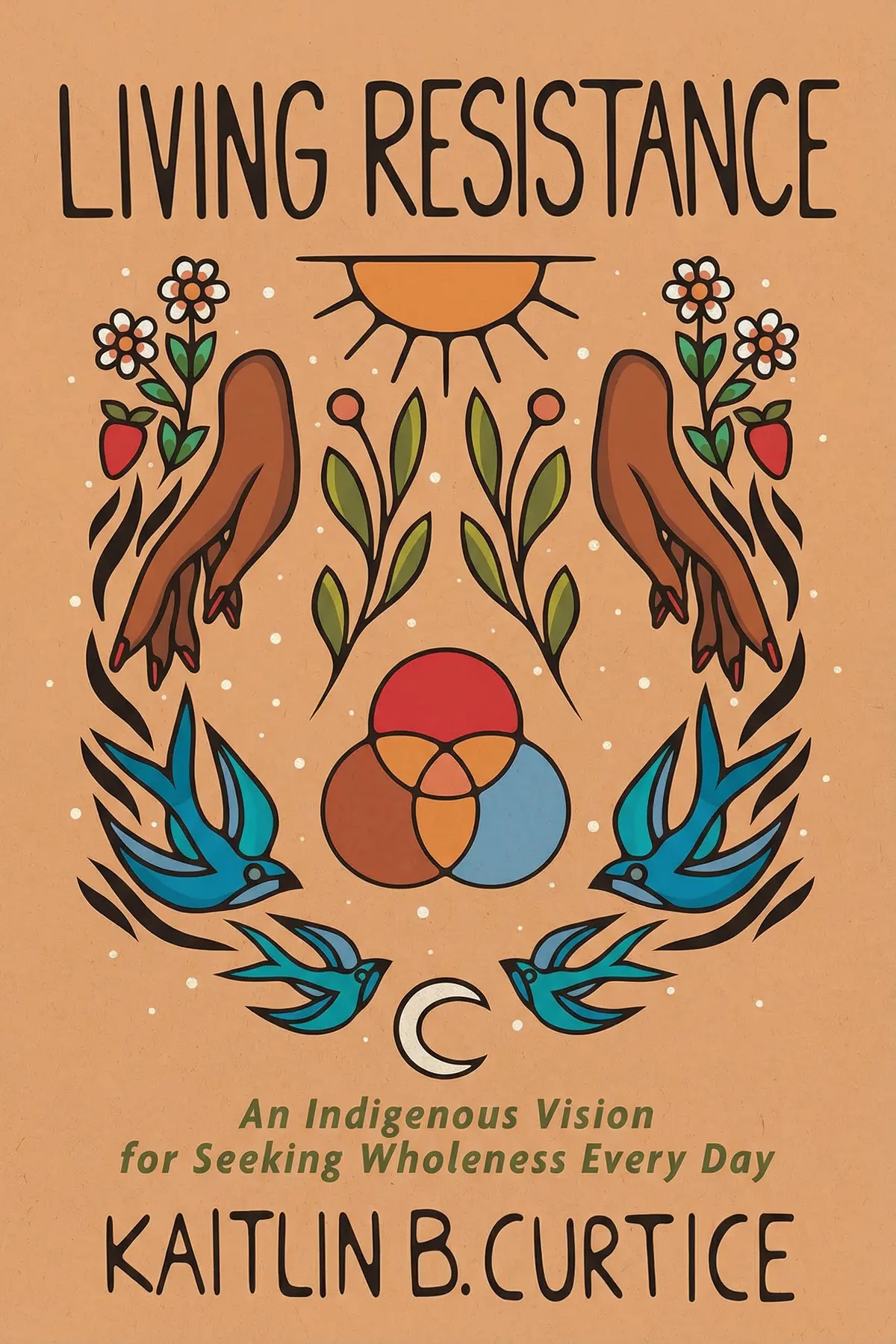
Shows how resistance to oppressive systems can be a daily practice: asking honest questions, loving yourself and the land, standing with people on the margins, honoring ancestors, giving generously and pacing yourself through life's seasons.
1 min 01 sec
If you care about justice but feel worn down by the news, it can seem that resistance belongs only to people on the front lines of protests. In Living Resistance, Potawatomi writer and worship leader Kaitlin B. Curtice offers a wider definition: when the world rewards speed and progress above life’s sacred rhythms, choosing to reconnect with what makes us human already counts as an act of resistance. For her, resistance means pushing against systems that cut us off from our humanity, and choosing what to build in their place.
Her argument is that this work happens every day and in many forms: in the questions we ask, the way we love ourselves and the earth, the people we stand beside, the ancestors we remember and the gifts we give. Drawing on Potawatomi teaching and on movements from Brazil to Kenya, she shows how ordinary habits can grow into a lifelong practice of wholeness, one with room for rest as well as courage.
1 min 55 sec
Before any march or petition, Curtice places something most adults gave up long ago. Recovering it, she argues, changes how you see your home, your neighbors and the ground under your feet.
1 min 58 sec
Most self-love on sale today ends with you. Curtice describes a version that keeps going, outward to your community and down into the soil, and asks what colonial history did to break that link.
1 min 58 sec
Unity sounds like the goal of any movement, yet Curtice warns that the wrong kind of unity can harm the very people it claims to help. Her test for real solidarity is sharper than most.
2 min 05 sec
A Potawatomi teaching asks you to weigh every choice against people you will never meet. Curtice pairs it with a familiar holiday whose origins most families never discuss at the table.
2 min 00 sec
In one British Columbia ceremony, whoever gives away the most earns the greatest respect. Curtice uses it to challenge a belief about scarcity that many of us never chose.
1 min 48 sec
Anyone who cares about justice eventually hits a wall of exhaustion. Curtice offers a way to keep going that does not depend on constant intensity, and it starts with looking at a winter tree.
1 min 12 sec
Curtice’s picture of resistance turns out wider and gentler than the word suggests. It looks like the Potawatomi habit of weighing seven generations before acting, a Kwakwaka’wakw host giving away blankets and canoes so the whole community shares in them, an ancient seed kept alive in Peru. Each of these is ordinary, repeated and rooted in relationship. That is the book’s real claim: wholeness is something you practice, and the practice itself pushes back against systems that would rather keep us busy, separate and afraid of running out.
The practices she offers are small enough to begin tonight. Write a letter to Mother Earth and notice what you need to unlearn. Sit quietly, imagine the faces of your forebears, and ask what kind of ancestor you are becoming. Think of someone who was generous with you and pass that gift on this week. And when the work feels endless, name the season you are in and rest without guilt if rest is what it asks of you.
Resistance, as Curtice sees it, is a song you keep singing, softly in some seasons and loudly in others, until it is finished.
Many people who care about justice picture resistance as something done by others: activists on the front line, protesters facing police. Kaitlin B. Curtice, a Potawatomi writer and worship leader, widens the picture. In a world that values efficiency and progress above the sacred rhythms of life, she argues, simply reconnecting with what makes us human is already a way of pushing back. Drawing on Potawatomi teaching and on Indigenous practices from Canada to Kenya and Peru, Curtice describes resistance as both a refusal and a choice. It starts with questions, grows through a radical self-love that extends to the earth, and shows up as solidarity with people whose differences need protecting. It looks back to ancestors and forward seven generations, and it answers a colonial scarcity mindset with generosity, as in the potlatch ceremony. Readers get practices small enough to start now, such as a letter to Mother Earth, an ancestor visualization and a habit of passing generosity on, along with permission to rest, since resistance moves in seasons and lasts a lifetime.
People who care about justice but feel exhausted or unsure where everyday action fits.
Readers of faith and spirituality curious about Indigenous ways of relating to land, ancestors and community.
Organizers and allies who want solidarity that protects differences and lasts beyond one campaign.
Kaitlin B. Curtice is an enrolled citizen of the Potawatomi Citizen Band who grew up in the Christian faith. Her writing explores where Native American spirituality, everyday faith and the church meet, and she also serves as a worship leader. She has written online for Sojourners, Religion News Service, On Being and Oprah Daily, and speaks to audiences interested in truth-telling and healing.
Listeners find this book deeply insightful, with one listener noting it offers actionable advice throughout. They describe the writing as beautiful and poetic, highlighting that each section opens with a poem and calling it a must-read. It receives praise for its themes of resistance; one listener points out how it explores into cracks and crevices, while another appreciates the included cultural snippets. Listeners value the guide’s helpful nature, with one listener describing it as an expansive resource for groups.
Wow, this was the exact literary companion I needed for my current season of life. Curtice moves beyond the typical rage-filled activism to offer a 'whole-help' approach that feels sustainable and deeply spiritual. I loved how each section opened with a poem; it invited me to slow down and actually inhabit the words rather than just consuming them. The breakdown of resistance into the personal, communal, ancestral, and integral realms provided a helpful roadmap for seeking wholeness every day. It’s not just about the big gestures, but the quiet, generative moments of belonging to ourselves and our land. Not gonna lie, I cried during the ancestral section. It pairs so perfectly with Patty Krawec’s Becoming Kin. If you are looking for a guide that centers community and justice without the crushing pressure of 'doing it all,' this is an essential addition to the genre.
Show moreKaitlin Curtice has a way of weaving together Indigenous wisdom and modern activism that feels incredibly grounding. This isn't your typical self-help book; it’s a comprehensive framework for how we can exist in a world that often feels designed to pull us apart. The four realms—personal, communal, ancestral, and integral—overlap in ways that finally made sense to me after reading this. I especially appreciated the cultural snippets she included, which provided a rich context for her Potawatomi heritage. The writing is poetic and soulful, making it easy to digest even when she’s challenging you to look at your own complicity in toxic systems. It’s an expansive guide that would be perfect for a book club or a small group. I’ve already recommended it to several friends who are struggling with how to integrate their spirituality with their desire for social justice. This is a bold and necessary vision.
Show moreThe poems at the beginning of each section set such a sacred tone for the entire reading experience. I sat down with this book during a very difficult personal time and found it to be a soulful, transparent companion that didn't demand too much of me. Curtice doesn’t just talk about abstract concepts; she brings them to life through her own story as an Indigenous woman navigating a complex world. The idea that we are 'always arriving' is something I will carry with me for a long time. This book is a radical departure from the 'fire and rage' style of activism, opting instead for a path that is gentle and generative. It’s about more than just rest; it’s about a holistic flourishing for everyone. Every page feels like an invitation to dig deeper for your own roots. This is easily one of the most empowering books I’ve read this year.
Show morePicked this up on a whim and found myself highlighting passages in every single chapter. Kaitlin B. Curtice has a charismatic presence on the page that makes you feel like you’re having a conversation with a wise friend. Gotta say, I was skeptical about another book on 'resistance,' but this one feels different because it centers on wholeness and belonging rather than just fighting. The actionable guidance provided throughout is actually useful for groups wanting to grow together. While it touches on many themes I’ve seen elsewhere, the way she synthesizes Indigenous vision with daily practices is unique. My only gripe is that it occasionally felt a little out of touch in its lifestyle examples, but that didn't detract from the powerful core message. It’s a poetic and insightful must-read for anyone who longs for a more equitable world built on love and justice. I'm passing my copy to my sister immediately.
Show moreEver wonder what resistance looks like when it's not just shouting in the streets? Kaitlin B. Curtice explores the hidden corners of existence to show how we can embody justice in the smallest ways. I found her perspective as an Indigenous, ex-evangelical woman to be full of deep perception, even if I didn’t agree with every single point. The structure of the book is fantastic, offering steps you can actually take that make the heavy concepts feel manageable. Personally, the chapter on the integral realm was the most challenging and rewarding for me. I did find some of the personal anecdotes—like the fitness stuff—a little out of touch with the broader themes of decolonization, but the overall message of seeking wholeness is vital. It’s a book about dreaming of a good future instead of just drowning in the news cycle. It definitely provides a vision that our world needs right now.
Show moreFinally got around to reading this, and the section on ancestral resistance hit home in ways I didn't expect. Look, I’m someone who has a lot of complicated feelings about the church, and while Curtice spends a good chunk of time on decolonizing Christianity, she does it with a grace that even I could approach with an open heart. The book isn't a set of rigid rules; it’s more of a vision for surrendering to the possibilities of love and mutuality. I did feel that some of the 'real-world' examples felt a bit localized to a specific socioeconomic experience, but the core message remains universal. The prompts at the end of the sections are actually helpful and don't feel cheesy, which is a rare feat in this genre. It’s a solid 4-star read that encourages you to be present to the unlearning. I’ll be turning back to those poems whenever I need a reminder to breathe.
Show moreIf you enjoyed Becoming Kin, you'll find this to be a beautiful extension of those themes. Curtice focuses on 'Living Resistance' as a daily practice rather than an end goal, which feels much more sustainable for the long haul. I appreciated how she didn’t smooth over the edges of her own struggle with identity and belonging. The book is filled with sacred whisperings that remind us of our inherent worth and our connection to the earth. To be fair, some sections felt a bit repetitive, and the tone occasionally leaned a little too heavily into the 'self-help' vibe for my taste. However, the insights on community growing and the ripple effects of our actions are too important to ignore. It’s a heart-centered guide for anyone who wants to lead with hope instead of fear. This is the kind of book you read slowly, letting the ideas marinate over several weeks.
Show moreAfter hearing Kaitlin speak on a podcast, I was curious to see how her ideas translated to a full-length book. I think this is primarily aimed at folks who are currently deconstructing their relationship with the church, and for that audience, it’s a home run. As someone outside of that circle, some of the specific faith-based resistance examples didn't resonate as deeply with me, but I still found immense value in the communal and ancestral sections. The writing is undeniably beautiful, and I liked the structure of the four realms. In my experience, the 'integral' section felt a bit abstract compared to the more practical 'communal' section, but it gives you plenty to chew on. I also found the inclusion of some modern wellness trends to be a bit of a stretch. Overall, it’s a decent read with some great quotes and a very necessary perspective on Indigenous land and justice.
Show moreAs a reader who has spent years engaging with decolonial literature, I found this to be a bit of a mixed bag. Curtice writes with a lyrical, aesthetically striking flow, and I appreciate the four realms of resistance she outlines—especially the focus on ancestral connection. However, much of the material felt like a primer rather than a deep dive into new territory. Frankly, the citations of dictionary definitions for complex structural issues felt a bit elementary for a book that aims for the soul. It is a solid introduction for someone just starting to question Western systems, particularly those coming from an evangelical background. I liked the focus on the communal realm, but I didn’t find the 'Peloton as a sacred practice' bit very grounded compared to her other insights. It’s a nice read, but it didn’t quite push the conversation forward for me personally. Look at the bibliography if you want the heavy hitting stuff.
Show moreNot what I expected after seeing so much hype on social media. I really wanted to love this, but it felt a bit like a collection of undergraduate essays that rely too heavily on other thinkers' work without adding much that is truly innovative. The truth is, I couldn't get past the part where she compares a Peloton workout to a sacred practice; it felt strangely consumerist for a book about decolonizing our lives. Citing Merriam-Webster to define complex sociological ideas felt basic and took me out of the narrative flow. It’s probably a great resource for someone who is just beginning to grapple with their faith and identity, but for those already steeped in these topics, it might feel a bit repackaged. I’d suggest looking at the references list and reading those books instead. It’s well-intentioned, but for me, it lacked the intellectual depth required for such heavy topics.
Show moreCurtice argues that resistance is more than protest. In a world that values efficiency above life’s sacred rhythms, taking back our connection to our humanity is itself resistance. Drawing on Potawatomi teaching, she describes it as a daily practice: asking questions, loving yourself and the earth, standing with marginalized people, honoring ancestors, giving generously and moving through life’s seasons with grace.
She contrasts it with the commodified self-love that capitalism sells. Radical self-love is a deep respect, without conditions, for yourself, your community and the world. Extended beyond the individual, it becomes communal and connects to the land. The Potawatomi call Mother Earth Segmekwe, a source of life and light, and caring for her is part of loving well.
The potlatch of the Kwakwaka’wakw people of British Columbia shows generosity as resistance. Hosts give away blankets, food, canoes and even land to share resources, and the person who gives the most earns the greatest respect. Curtice sets this against the scarcity mindset she says colonizers brought to North America, which taught competition and stockpiling.
Curtice suggests concrete practices. Write a journal letter to Mother Earth about what you need to unlearn. Try Resmaa Menakem’s visualization of your ancestors’ faces and ask what kind of ancestor you want to be. Recall a time someone was generous with you and pass it on. Tell the truth about holidays like Thanksgiving, and rest when your season calls for it.
It suits readers who care about justice but feel overwhelmed, people of faith interested in where Native American spirituality and everyday life meet, and allies who want their solidarity to protect differences. Its emphasis on seasons, rest and grace makes it especially useful for anyone close to burnout from activism or caregiving.
Alcoholics Anonymous World Services

Fay Bound Alberti


Virginia Woolf

Tracy Rosenthal

Jessica Valenti


Johny Pitts

AUDIO SUMMARY AVAILABLE
Get the key ideas from Living Resistance by Kaitlin B. Curtice, plus 5,000+ more nonfiction titles.









