

11 min 26 sec
Available in: English
Living in Flow: The Science of Synchronicity and How Your Choices Shape Your World
Shows how to notice meaningful coincidences, keep acting toward goals that look out of reach and retrain the imaginary fears that keep you quiet, so more of the right openings find you ready.
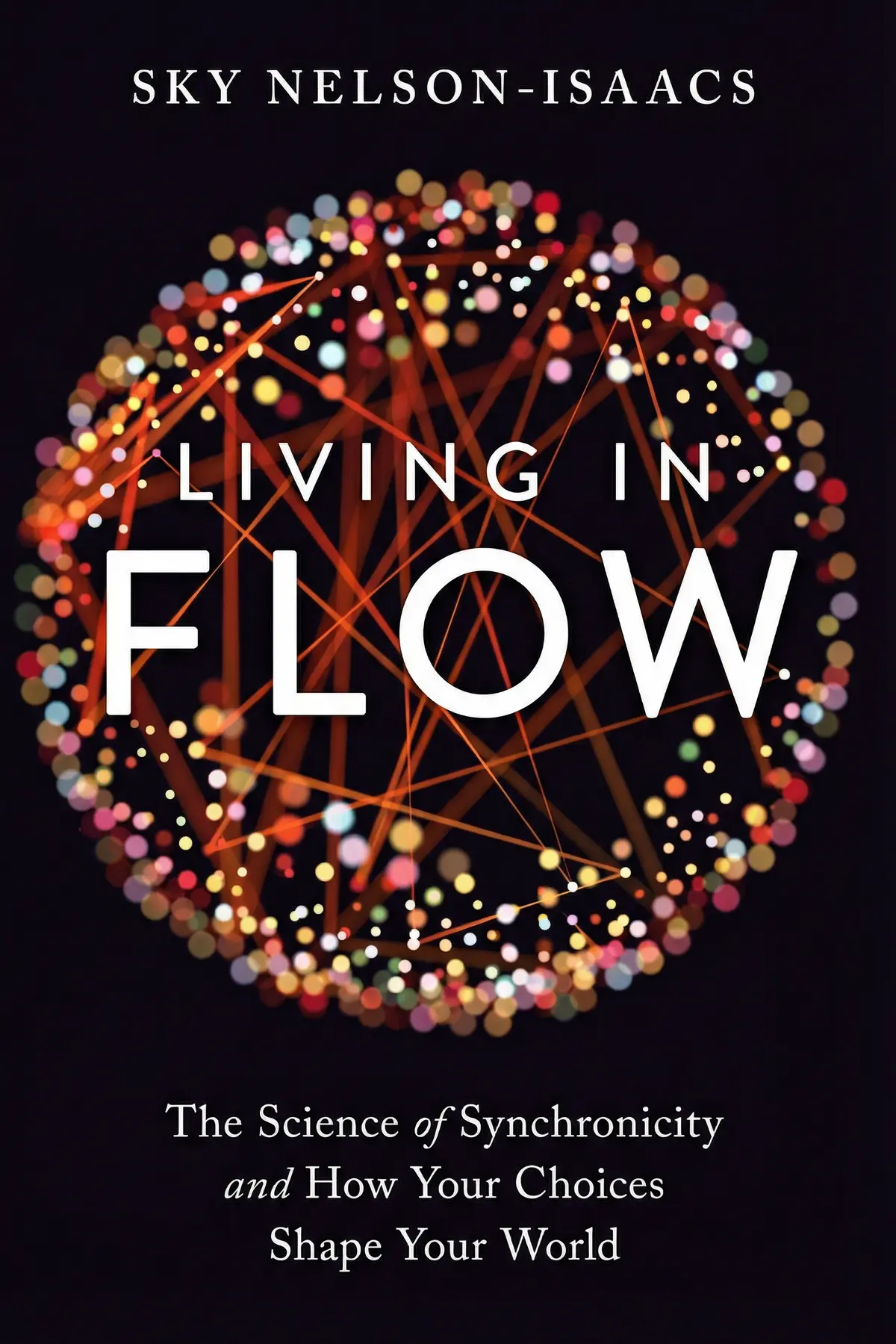
Table of Content
1. Introduction
58 sec
If life feels like one uphill decision after another, Sky Nelson-Isaacs offers a different way to read the moments when things suddenly line up. In Living in Flow, the physicist argues that meaningful coincidences can be shaped by what you do: your choices, he proposes, change the odds of which ones reach you. His name for those coincidences is synchronicity, a term first used by the psychologist Carl Jung.
The argument comes down to one line. Pay attention, act with commitment and stop obeying fears that never come true, and more of the right openings appear while you are ready to use them.
Along the way there is a woman racing for a train, a chemist whose choice of metal produced a cancer drug, and a six-step cycle for staying absorbed in your work. There is also a short exercise for the fears that keep you silent in meetings, one you can try the next time your voice catches.
2. Spot the coincidences that point your way
1 min 53 sec
A job article and a chance meeting landed on the same day for a man thinking about leaving his career. Nelson-Isaacs argues that pairs like that deserve attention, and he explains how to catch them.
3. Your effort makes lucky breaks more likely
2 min 07 sec
A woman sprints for a train she can already hear arriving, and a random delay saves her. The author asks whether her running changed the odds of that delay itself.
4. A six-step cycle for staying in flow
2 min 07 sec
An entrepreneur buried in decisions about her first store finds a way to keep moving forward. Her method is a repeating cycle of steps, and its final step is the one that never ends.
5. Tell imaginary fears from the useful kind
1 min 31 sec
Some fears push you to finish the job on time. Others keep you silent when you have something worth saying. Learning to tell them apart changes how much of yourself you let others see.
6. Teach your body that false alarms are false
1 min 43 sec
Knowing a fear is irrational rarely makes it go away, because the body keeps reacting long after the mind agrees. A short exercise built on memory and a journal goes after that reaction directly.
7. Conclusion
1 min 07 sec
Living in Flow rests on one wager: that the world answers the person who shows up for it. Nelson-Isaacs asks you to treat coincidence as information, effort as something that may bend the odds, and imaginary fear as the main reason people never make that effort in the first place. The physics he proposes is the frame, but the daily practice is ordinary and close at hand.
It starts with a notebook. Write down each day the coincidences that felt meaningful, and look for the themes they share over a few weeks. When a goal seems lost, move toward it anyway, the way Anya ran for a train she could already hear. When a lifeshock throws you off, go back through the cycle of listening, staying open, reflecting and acting. And when a fear tells you to stay quiet, test it, then record what really happened, so your body learns from the evidence instead of the alarm.
The cyclist caught in the train door was luck. Being on the platform, already running, was Anya’s choice.
About this book
What is this book about?
Many people feel that life is a steady uphill push, with good luck arriving rarely and by accident. Physicist Sky Nelson-Isaacs offers another reading. He takes Carl Jung's idea of synchronicity, coincidences that carry real meaning, and proposes that our choices help decide which of those coincidences actually happen. The book builds that case with everyday stories: a man considering a new career who meets two signs on the same day, a woman racing for a train, and a chemist whose platinum electrodes led to a cancer drug. It then turns practical. A six-step cycle called LORRAX helps readers stay absorbed in their work and recover when sudden upsets knock them off course. The final part deals with fear. Nelson-Isaacs separates useful fears from the imaginary ones he calls ego habits, and gives a simple exercise, backed by a journal, for teaching the body to stop reacting to alarms that never come true.
Book Information
Who it's for
Weighing a career change
Professionals weighing a career change who want a way to read the signals around them.
Stuck on decisions
Founders and freelancers stuck on decisions who want a repeatable cycle for moving forward.
Quiet in meetings
People who stay silent in meetings because of fears that rarely come true.
About the Author
Sky Nelson-Isaacs
Sky Nelson-Isaacs is a physicist, speaker, writer and award-winning musician. He studied physics at the University of California, Berkeley, and wrote his master's work at San Francisco State University on string theory. He taught for nine years, and his research has appeared in the journal Quantum Reports. He began studying with the yogic master Sri Swami Satchidananda before the age of five, and Living in Flow brings that lifelong search for purpose together with his science. He is also the author of Leap to Wholeness.
Ratings & Reviews
Ratings at a glance

What people think
Listeners find the material accessible and mentally stimulating, praising its deep dive into synchronicity and its considerate perspective. They also appreciate the combination of academic precision and practical guidance, with one listener highlighting how effectively it connects usually unrelated disciplines. Conversely, the underlying reasoning draws varied reactions, as one listener felt the logic was insufficient.
Top reviews
Aim
Sky Nelson-Isaacs manages to create a bridge between rigid scientific principles and the more ethereal concepts of synchronicity. It’s a fascinating read that doesn’t just rely on common Law of Attraction tropes, but actually tries to ground those feelings in quantum mechanics through Part II of the text. While some of the physics got a bit heavy for my casual brain, the core message about symbolic momentum really resonated with me. I’ve started paying much more attention to the patterns in my daily life after finishing this. Truly, it’s a thorough account that left me feeling inspired.
Show moreVarinee
Ever wonder why certain coincidences seem to happen at exactly the right moment in your life? Nelson-Isaacs provides an intellectually engaging framework that suggests these aren't just flukes of selective attention, but a responsive cosmos. I loved how he integrated the concept of meaningful history selection with real-world scenarios that felt relatable and grounded. This isn't your typical fluffy self-help; it’s a deep dive into how our internal state mirrors the external world. Absolutely life-changing if you're willing to keep an open mind.
Show moreKru
Frankly, I was skeptical about a physicist writing what looked like another Law of Attraction book, but the scientific rigor here is impressive. The apple tree metaphor used to describe deterministic outcomes was a bit long-winded, yet it served its purpose in the end. I appreciated that he didn't just ignore apophenia, but addressed it head-on in the appendix as a counter-argument to his theory. It's an ambitious project that mostly sticks the landing, providing a thoughtful approach to living more intentionally. This is exactly what a modern science-meets-spirituality book should look like.
Show moreOlivia
A truly insightful read that blends science and spirituality in a way that few authors can actually pull off. I found the stories about symbolic momentum especially helpful for understanding why some projects take off while others stagnate despite our best efforts. Not gonna lie, some of the quantum mechanics sections required a second read, but the payoff for my personal growth was worth the extra effort. It’s rare to find a book that challenges your brain while also speaking to your soul so clearly.
Show moreSirirat
After hearing so much about the flow state, I was surprised to find this book tackles synchronicity from a physicist's perspective instead. The LORRAX method is probably the most practical takeaway for me, offering a clear framework for navigating life's unexpected turns. Truth is, the author’s personal anecdotes sometimes feel a bit like middle-class aspirations, but his breakdown of how our choices shape our reality is genuinely compelling. It’s a solid 4-star read for anyone looking to align their intent with their actions in a more meaningful way.
Show moreTaw
The first half of the book provides a really thorough account of synchronicity that kept me hooked throughout the weekend. However, I found that the author starts using flow and synchronicity interchangeably by the middle. This shift in terminology gets a bit confusing for the reader. To be fair, the author tries his best to make the quantum mechanics accessible, but the logic felt a bit stretched in the final chapters. It’s a solid 4-star effort that bridges two very different worlds, even if some distinctions get blurred.
Show moreLena
Look, if you want a fresh perspective on how to navigate life's obstacles, this is a great place to start. The LORRAX principle alone is worth the price of the book because it gives you something to actually do with the information. While I think the author sometimes overcomplicates the why behind synchronicity, his passion for the subject is contagious and highly motivating. It’s an engaging, thorough exploration of how we can live more in tune with the world around us. Pick this up if you enjoy a thoughtful approach to self-help.
Show moreChloe
Picking this up was a bit of a gamble, as I’ve read so many books on Mihayl Czikszentmihalyi’s version of flow. This is a very different beast, focusing on external flow and how the universe seems to shift based on our commitment to a path. While the writing style is easy to follow, I struggled with the transition from the philosophical Part I to the technical Part II. It’s a 3-star experience that provides some cool aha moments but leaves some scientific questions unanswered. The branch theory is interesting, but the connection to my daily life felt thin.
Show moreRuangrat
Not what I expected and honestly quite frustrating if you’re looking for a productivity guide. I wanted a book about getting into the zone during work, but this is more about meaningful coincidences and the universe responding to you. It felt a bit like a meat stew when I was hoping for a grounded steak—a lot of abstract ideas without enough application. The apple tree metaphor was way too deterministic for my taste as well. This simply was not the right fit for me.
Show moreDarawan
This felt like a mercenary utilization of philosophy disguised as cutting-edge science. The author adopts a bit of a back off, I'm a scientist swagger while failing to deliver on the actual proof for his more trippy claims. I found the logic to be incredibly circular, often using the very coincidences he’s trying to explain as the only evidence for his theory. Plus, the random mentions of social issues felt totally out of place in a book supposedly about the mechanics of the universe. This book was an absolute miss for me.
Show moreQuestions about this book
What is the main idea of Living in Flow by Sky Nelson-Isaacs?
Nelson-Isaacs argues that meaningful coincidences, which Carl Jung called synchronicity, are linked to the choices we make. He proposes that acting with commitment makes helpful coincidences more likely, much as a woman racing for a train might be saved by a random delay. The book pairs that idea with a cycle for staying in flow and an exercise for retraining imaginary fears.
What is the LORRAX process?
The letters in LORRAX represent six steps: listen, open, reflect, release, act, and finally x-repeat. In the book’s example, an entrepreneur named Sarah listens to her intuition about a store location, stays open to options like online sales, reflects on a chance meeting with a fabric supplier and then acts by signing a lease. X-repeat reminds you the cycle never ends, especially after sudden upsets the author calls lifeshocks.
What are ego habits?
Ego habits are habitual, imaginary fears that keep you from being your authentic self, such as holding back a comment in a meeting. Nelson-Isaacs contrasts them with useful fears, like worry about a deadline, which give you the energy to get work done. Ego habits usually predict outcomes that never happen and mainly cause you to hide.
How can I apply Living in Flow in daily life?
Keep a daily journal of meaningful coincidences and look for recurring themes. Keep acting toward goals that seem out of reach. When fear stops you, do the thing anyway, check whether the feared result happened, then replay the fearful moment while reminding yourself nothing went wrong. Record each attempt so you build evidence that your fears are poor predictors.
Readers also enjoyed

A New Earth: Awakening to Your Life’s Purpose
Eckhart Tolle

A Return to Love: Reflections on the Principles of a Course in Miracles
Marianne Williamson

Aflame: Learning from Silence
Pico Iyer

59 Seconds: Change Your Life in Under a Minute
Richard Wiseman

Alcoholics Anonymous
Alcoholics Anonymous World Services




AUDIO SUMMARY AVAILABLE
Listen to Living in Flow in 15 minutes
Get the key ideas from Living in Flow by Sky Nelson-Isaacs, plus 5,000+ more nonfiction titles.
- 5,000+ titles
- Listen as much as you want
- 7-day free trial
- Cancel anytime









