
14 min 20 sec
Available in: English
Life Leverage: How to Get More Done in Less Time, Outsource Everything and Create Your Ideal Mobile Lifestyle
By Rob Moore
Shows how to stop chasing extra hours and multiply the ones you have instead. You set a clear vision, filter every task, hand work to a team and build income that keeps arriving when you step away.
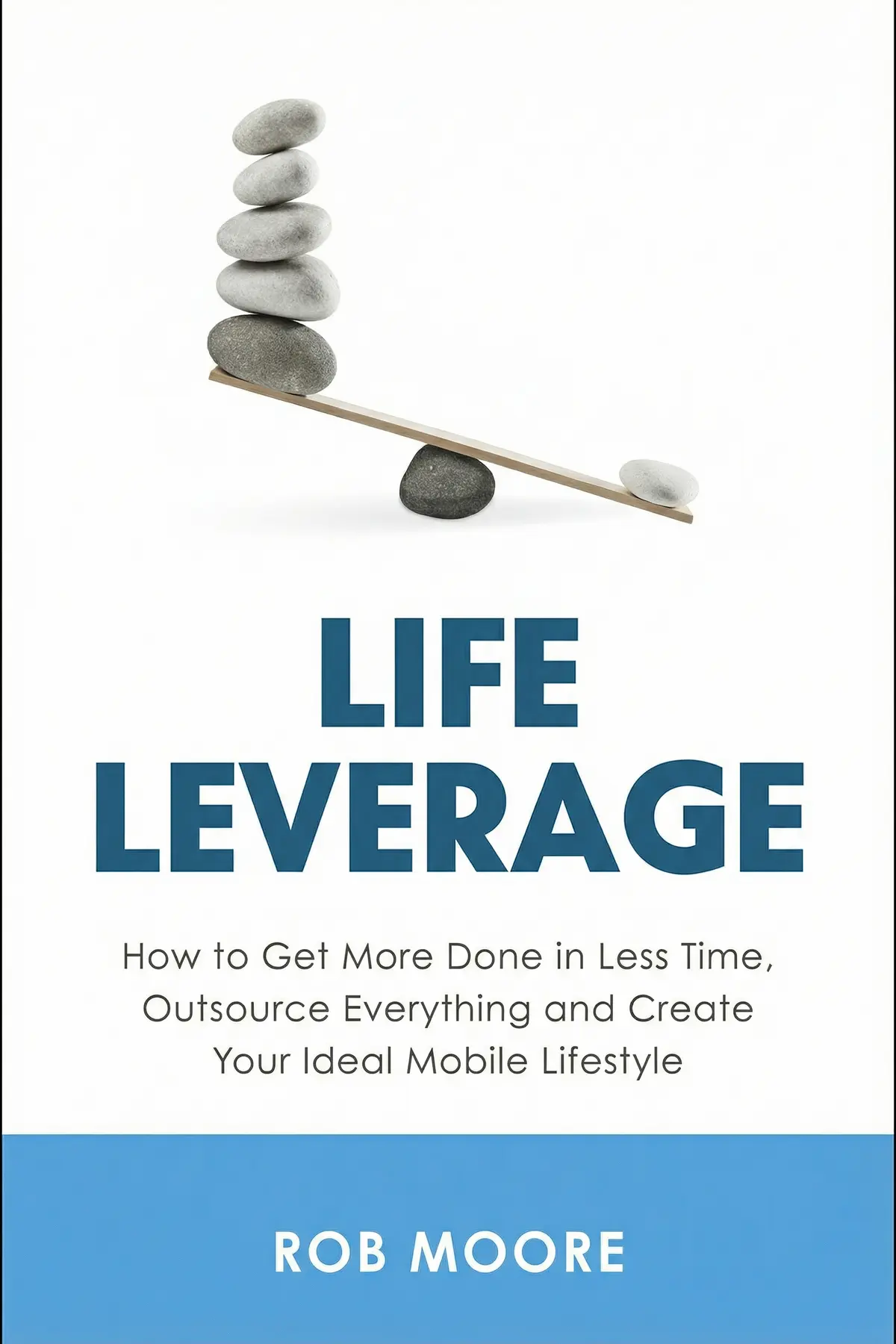
Table of Content
1. Introduction
56 sec
If your days are full and your real goals still sit untouched, Rob Moore’s diagnosis is blunt: you do not need more hours, you need to stop doing work that someone or something else could do. In Life Leverage, the British investor and entrepreneur argues that time management is a myth, because nobody can control time. All you can manage is your life: what you spend your limited hours on, and what you give away.
Moore’s case is that once you know what your life is for, you can outsource, automate or delete almost everything else, and the hours you win back compound into work you love doing from anywhere. The method that follows is practical: a way to decide what matters, filters for every task on your list, a team to carry the rest, and a plan for income that does not need you in the room.
2. Stop managing time and start multiplying it
1 min 48 sec
Working longer feels like the responsible answer to a crowded week. Moore’s research and his own property business point the other way, and they raise an uncomfortable question about whose plans your hours are really serving.
3. Know what your freed hours are for
1 min 39 sec
Handing off work can backfire if the empty hours simply fill up with new busyness. Moore’s fix starts far from any to-do list, and it comes with a surprising early warning sign that you have lost your way.
4. Get two returns from every hour
1 min 41 sec
A commute, a walk or a lunch can be dead time or the most productive part of the day. Moore names five ways to stretch an hour, then shows how to hand off even the stretching.
5. Push trivial tasks to the bottom deliberately
1 min 52 sec
Small jobs have a way of eating whole afternoons, and one repeated hour a week adds up to a staggering total over a career. Moore offers a set of filters that decide what deserves your time at all.
6. Hand off work before you feel ready
1 min 44 sec
Many business owners keep doing everything because nobody else seems good enough or cheap enough. Moore calls that belief a ceiling, and his four-week plan and a lesson from a rock band show what replaces it.
7. A working life you won't want to retire from
1 min 50 sec
Work-life balance sounds like a sensible goal, yet Moore calls it futile. His reasons involve weekends, office hours and a heart condition linked to retirement, and they point toward a very different shape for a career.
8. Income that keeps growing when you step away
1 min 48 sec
Some of the biggest companies of the age own almost nothing they sell. Moore uses them to explain how wealth really scales, and how an individual can build income that survives a month off.
9. Conclusion
1 min 02 sec
Moore’s book is finally an argument about ownership. Either you decide where your hours go, or circumstance and other people decide for you. Vision tells you what the time is for. Filters like the 4 Ds and posterioritizing strip away what does not serve it. A team and a set of systems carry the rest, and income built on solving problems at scale pays for the freedom without needing you in the room.
The method asks for effort up front, like the rocket spending its fuel to escape gravity, and only then does it start to compound. You can begin small. Write down your three to seven key result areas and compare them with where last week’s hours actually went. Start a to-leverage list today and put the task you resent most at the top. Then give yourself four weeks to hand off the things you neither enjoy nor do well, and watch what you do with the time that comes back.
The landlords Moore watched were never short of hours. They were spending all of them on work someone else could have done.
About this book
What is this book about?
Most busy people answer overload by working longer. Rob Moore argues that this is the wrong fix. Nobody can control time, so time management, in his view, does not really exist. What you can manage is your life: which tasks get your hours, and which ones go to other people, software and systems. Moore built his own wealth in property by letting others find, buy, rent out, refurbish and manage his buildings while he kept a fair share of the income. Life Leverage turns that approach into a method for anyone. It starts with strategy: values, vision, three to seven key result areas, income-generating tasks and honest performance numbers. Then come the tactics. Moore offers posterioritizing, the 4 Ds, NeTime, seasonal clear-outs and a time model that separates wasted, spent and invested hours. The final part is a blueprint for a mobile life. You spend four weeks outsourcing what you neither enjoy nor do well, build a layered remote team, merge your work with your passion and spread your income across several kinds of assets. Readers get a practical system for working fewer hours on things that matter more.
Book Information
Who it's for
Founders and the self-employed
Founders and self-employed people who do every task themselves and feel stuck at their current size.
Professionals with packed calendars
Busy professionals whose calendars are full but whose real goals keep slipping.
Planning to live anywhere
Anyone planning a location-independent life who needs a team, systems and income to support it.
About the Author
Rob Moore
Rob Moore is a British investor, entrepreneur and bestselling author. In his twenties he built a multi-million pound music promotions business, then moved into property, investing and education ventures. He has hosted the podcasts The Disruptive Entrepreneur and Money, and has twice held the world record for the longest individual speech marathon. Through the Rob Moore Foundation he supports, invests in and mentors under-privileged individuals, start-ups and small businesses.
Ratings & Reviews
Ratings at a glance

What people think
Listeners find that although some feel the material can be repetitive or akin to the author’s earlier publications, the work delivers an enthusiastic and highly actionable system for taking back your time. They value the functional techniques for productivity, especially the emphasis on outsourcing, automation, and strictly prioritizing high-impact tasks. Furthermore, the prose is viewed as easy to follow and very inspiring for those wanting to avoid the "hard-working delusion," with one listener remarking that reframing time management as life management allowed them to better navigate a demanding schedule. They also highlight the beneficial use of the 80/20 principle to target activities with the highest return on investment.
Top reviews
On
Finally got around to reading Rob Moore’s take on productivity, and it’s a total game-changer for my daily workflow. I’ve been stuck in what he calls the 'hard-working delusion' for years, thinking that more hours equaled more success, but this book completely flips that script. The concept of Life Leverage isn't just about doing more; it’s about using systems, VAs, and automation to reclaim your freedom. Frankly, the way he explains Income Generated Tasks (IGTs) helped me cut out three hours of fluff from my schedule immediately. While some of the sections on mobile lifestyles felt a bit ambitious for my current situation, the core philosophy is undeniable. If you’re feeling overwhelmed by a never-ending to-do list, his 80/20 approach to time investment is exactly the wake-up call you need. It’s punchy, aggressive, and highly motivating for anyone starting a business.
Show moreSomrutai
Ever wonder why you're grinding sixty hours a week and still feel like you're falling behind your peers? Moore’s philosophy suggests that you aren't lacking effort, you’re lacking leverage, and this realization changed everything for me. I started implementing 'NeTime' (No Extra Time) by stacking my learning during my commute, and the compounding results are already showing up in my professional growth. The writing style is incredibly easy to digest, full of passion, and feels like a direct conversation with a mentor. Not gonna lie, I was skeptical about the idea of 'outsourcing everything' initially, but the way he explains the value of time versus the cost of labor makes perfect sense. It’s about focusing on your Key Result Areas (KRIs) and letting go of the rest. This is a must-read for entrepreneurs seeking a mobile lifestyle.
Show moreGin
Stop what you're doing and look at your to-do list through the lens of the 80/20 principle as Moore describes it in these pages. I’ve always known about the Pareto principle, but this book actually gave me the permission I needed to ruthlessly prioritize and say no to low-value tasks. The section on 'Life Leverage' as a way to create a mobile, untethered lifestyle is incredibly inspiring and practical for the modern digital age. I loved the concept of 'leveraging the leverage'—using others' skills to build your own assets while you focus on what makes you feel alive. Some might find his tone a bit arrogant, but I think it’s just the confidence of someone who has actually done what he’s preaching. This is a manual for anyone tired of the traditional 9-to-5 grind and ready for something more.
Show moreTawee
The concept of 'Life Leverage' isn't necessarily reinventing the wheel, but Moore packages it with such relentless intensity that you can't help but feel motivated. I particularly appreciated the focus on emotional mastery as a prerequisite for time management. He argues that if you can’t manage your reactions, you can’t manage your life, which hit home for me. To be fair, the book is quite repetitive in places and probably could have been fifty pages shorter without losing any impact. However, the '4 Ds' framework—Do, Delegate, Defer, Delete—is presented so clearly that I’ve already started applying it to my overflowing inbox. It’s a great companion for those who found Seneca’s 'On the Shortness of Life' a bit too abstract and want something more modern. Definitely worth a read for the practical strategies on outsourcing low-value tasks.
Show morePop
The chapter on emotional mastery was the standout for me, shifting the focus from simple schedules to how we actually react to daily stress. Moore argues that time management is actually life management, and life management is emotional management. This hit a chord because I often find myself reacting to emergencies rather than following a strategic vision. In my experience, his advice on 'eating the fat frog' and tackling vision-based tasks before operational firefighting is pure gold for small business owners. My only gripe is that the book is a bit disorganized, jumping between philosophical advice and very specific tactics without a clear transition. Despite that, the motivation I gained from his 'compounding' theory made the purchase price more than worth it. He pushes you to stop being a servant to your business.
Show moreNora
Gotta say, I was skeptical about the 'outsource everything' mantra at first because it sounds like a recipe for a chaotic lifestyle. However, Moore’s framework for identifying Key Result Areas (KRAs) and focusing single-mindedly on one task at a time really helped clarify my vision. The book is easy to understand and digest, making it perfect for busy people who don't have time for dense academic texts. I did notice several typos and some repetitive sections that felt like they were just filler to reach a certain page count. Regardless of those minor editorial flaws, the actionable content is high quality. Using the '4 Ds' has already saved me hours of mental energy every week. It’s a solid 4-star read that encourages you to value your time as your most precious commodity.
Show moreNam
Moore’s philosophy on 'Life Leverage' essentially argues that if you aren't using systems, you are the system, and that's a terrifying thought for any freelancer. The book does a fantastic job of breaking down the 'hard-working delusion' and showing how to shift into a mindset of strategic investment rather than just trading time for money. I found the section on the 'Law of Compounding' especially useful for understanding why I keep failing when I start over from zero too often. It’s a passionate, fast-paced guide that forces you to confront your own inefficiencies without mercy. While it leans heavily into the business side of things, the principles of decluttering your life and focusing on your values are applicable to anyone. A few parts felt repetitive, but the core message is vital for long-term success and fulfillment.
Show moreSing
As someone who already finished 'Money' by the same author, I found this volume a bit too familiar for my liking. Moore has a habit of recycling the same stories and examples across his work, which makes the middle section feel like a bit of a slog if you’re a long-time follower. Truth is, there are a few too many pointless calculations and some distracting typos that pull you out of the experience. That being said, his breakdown of the '3 Ms'—Manage, Master, and Misuse of emotions—provided a solid perspective on why we spiral into unproductivity. It’s a decent introductory text for those new to the world of outsourcing and the Pareto principle. Just don't expect a radical departure from his previous advice. It's solid, actionable, but ultimately a bit redundant for his hardcore fans.
Show morePing
Rob Moore definitely has a specific style—lots of passion and short, punchy sentences—which makes for a very quick read over a weekend. Personally, I felt the book glossed over some of the actual 'how-to' logistics of building remote teams in favor of high-level mindset shifts. There’s a lot of recycling from other productivity gurus, though Moore’s specific focus on wealth generation gives it a unique edge. Look, the ideas here are foundational, but if you’ve already read Tim Ferriss or Brian Tracy, you might find yourself skimming large portions of the text. I did appreciate the '4 Ds' model and the reminder to prune my commitments twice a year. It's a good motivational kick, but it lacks the deep technical detail I was hoping for regarding automation software and specific outsourcing platforms.
Show moreBam
This book could have been a long blog post instead of a full-length publication if I'm being honest. It felt like Moore was trying to hit a word count by repeating the same three or four core ideas in every single chapter. I found the constant focus on making money a bit tiring after a while, as it seemed to ignore other aspects of a balanced life. The math he uses to justify his points feels a bit simplified and occasionally misleading to make the 'leverage' look more dramatic than it is. While the 80/20 principle is always a good reminder, you can find better explanations of it elsewhere without the aggressive sales-pitch tone. I actually felt more overwhelmed after reading his 'anti-overwhelm' advice because of the sheer volume of things he suggests you should be outsourcing simultaneously.
Show moreQuestions about this book
What is the main idea of Life Leverage by Rob Moore?
Moore argues that time cannot be managed because nobody controls it. What you can manage is your life: where your effort goes. Life leverage means using people, software, systems and processes so your own hours go only to the few high-value tasks that serve your vision. Everything else is outsourced, automated, deferred or deleted, and the time you win back compounds into better work and income.
What is NeTime in Life Leverage?
NeTime stands for No Extra Time. It means getting several benefits from one block of time. Moore’s examples include listening to audiobooks while commuting, taking calls while walking, holding meetings over meals, planning while traveling and bundling errands into one trip. He also suggests handing off parts of the process, such as using a ghostwriter, a virtual assistant or a videographer who turns a normal day into content.
What are the 4 Ds in Life Leverage?
Moore’s filter for every task or commitment is the 4 Ds, which means you either handle it personally, hand it off to someone else, push it to later, or drop it entirely. Anything you want off your plate but cannot drop yet goes on a to-leverage list, a queue of work waiting to be outsourced or automated. He pairs it with posterioritizing, which means deliberately pushing low-value tasks to the bottom of your list.
How do I start outsourcing using Life Leverage?
Moore’s blueprint begins with four weeks of handing off every part of life you neither enjoy nor can easily do yourself. Then you build a team in layers: a personal or virtual assistant, an operations manager, a managing director, specialists such as lawyers and accountants, and financiers. He suggests freelance sites where you pay per task, and he urges you to start even before you feel ready.
Who should read Life Leverage?
It suits business owners and self-employed people who hold on to tasks because they think no one else will do them as well, as well as professionals overwhelmed by full calendars. It also fits readers who want a mobile, location-independent life and need a practical plan for teams, systems and several income streams to pay for it.
Readers also enjoyed






AUDIO SUMMARY AVAILABLE
Listen to Life Leverage in 15 minutes
Get the key ideas from Life Leverage by Rob Moore, plus 5,000+ more nonfiction titles.
- 5,000+ titles
- Listen as much as you want
- 7-day free trial
- Cancel anytime









