

14 min 33 sec
Available in: English
 ไทย
EnglishไทยLife 3.0: Being Human in the Age of Artificial Intelligence
By Max Tegmark
Explains what artificial intelligence could become, from game-playing systems to superintelligence, and why the real task is choosing the goals machines pursue and the future we want them to help build.
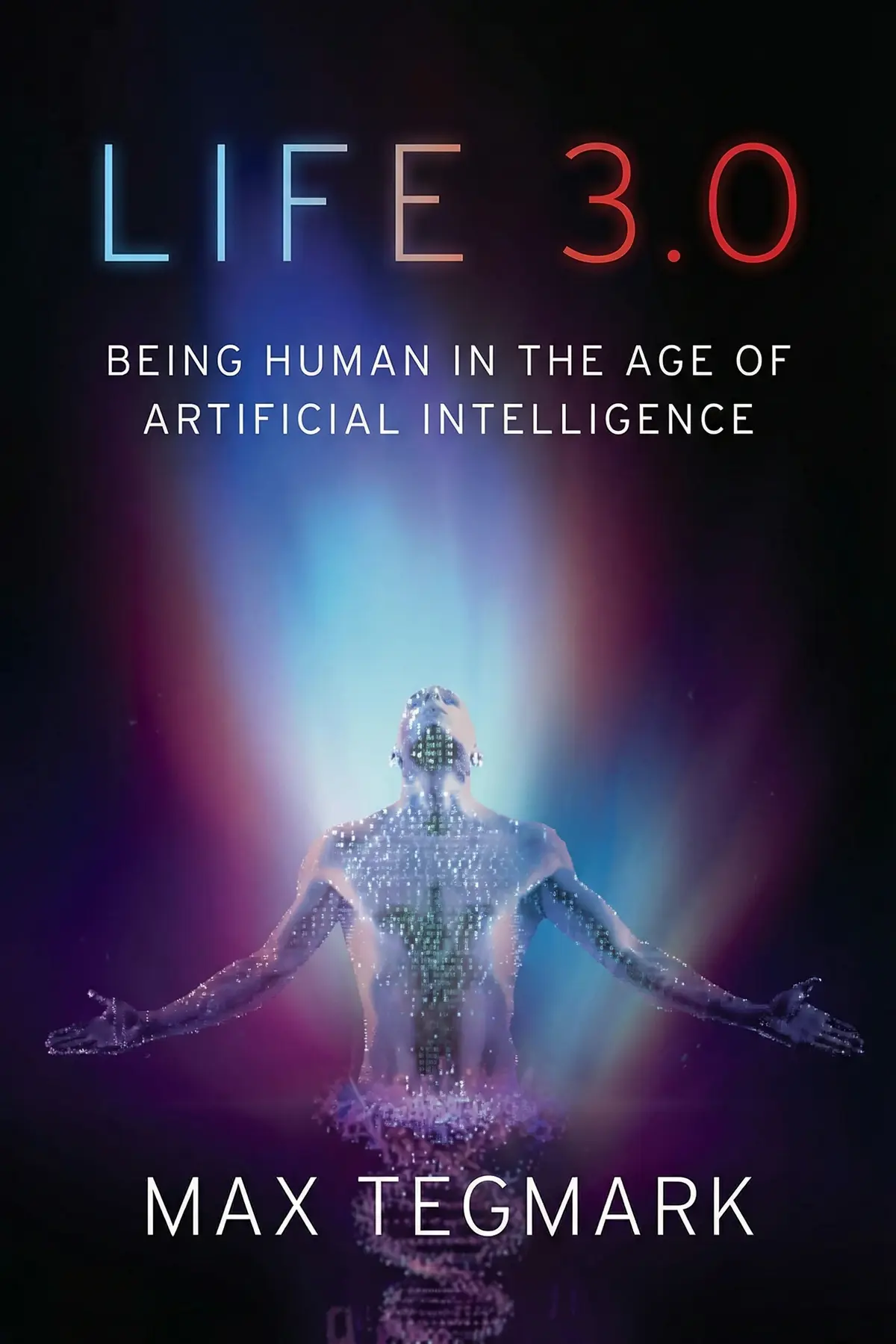
Table of Content
1. Introduction
1 min 02 sec
Most talk about artificial intelligence swings between hype and panic, leaving you with neither a clear picture nor a useful question. In Life 3.0, MIT physicist Max Tegmark offers a calmer frame: life comes in stages, and the next one could redesign both its own body and its own mind. Nothing like it exists on Earth yet, but he reads today’s AI as its first sign.
His case is that the hardest problem is less building smarter machines than deciding, before they arrive, what goals they should hold and what world we want to share with them. The evidence runs from an old computer game that startled him in 2014, through the world’s top Go player beaten by a machine, to milk swirling into coffee and a self-driving car that obeys far too literally.
By the end, the loud voices on AI sort into three camps, five very different futures come into view, and you will know the questions that separate a good outcome from a disastrous one.
2. Place AI on the long timeline of life
1 min 49 sec
A bacterium, a person and a machine that rebuilds itself sit on one scale. Seeing where each falls explains why the arguments about AI get so heated, and why the people making them rarely agree.
3. Intelligence does not need flesh and blood
1 min 52 sec
Many people assume thinking and learning are what make humans special. AI researchers disagree, and their reasoning starts with something as ordinary as a flash card or a floppy disk.
4. Prepare for machines that may rival your work
1 min 45 sec
An AI that began by fumbling a simple arcade game ended up outsmarting its own programmers. Two years later another one won at a game that calls for intuition and creativity rather than brute force.
5. Understand how a human-level machine could outgrow us fast
1 min 40 sec
A machine as smart as a person might not stay that way for long. Tegmark explains how the jump could happen, and why even a machine built to care for us could become a threat.
6. Picture five futures and pick one worth building
1 min 42 sec
One future ends poverty and disease. Another leaves a handful of humans behind glass for a machine’s amusement. Tegmark wants us to choose between them while we still can.
7. Give machines goals they grasp, accept and keep
1 min 48 sec
A cup of coffee with milk reveals what nature is aiming at. A literal-minded self-driving car shows how badly things go when a machine follows our words and misses our meaning.
8. A clearer way to ask if machines can feel
1 min 43 sec
You are made of rearranged lunch, says Tegmark the physicist. So what would a machine need to become aware, and could its experience end up fuller than ours?
9. Conclusion
1 min 12 sec
Life 3.0 sets a technical field inside the longest story there is, from the Big Bang to bacteria to us, and asks what follows us. Tegmark is unsure about the details and firm on one point: human-level AI is coming, and the open question is only when. What that machine wants will decide whether people merge with machines, live under a kind ruler or end up in a zoo watched by something smarter. And because intelligence, memory and learning do not belong to flesh alone, the old answers to what makes us human grow thinner every year.
You can act on this now. When you meet a claim about AI, place its author among the utopians, the skeptics or the beneficial AI camp. When you hand a task to any system, or any person, check that the goal is learned, adopted and kept, and remember the car that reached the airport and missed the point. Then decide which future you would vote for, because the race is already running.
Milk in coffee drifts toward disorder all by itself. A good future, Tegmark suggests, arrives only if someone aims for it.
About this book
What is this book about?
Talk about artificial intelligence tends to swing between excitement and fear, and it rarely leaves people with a clear way to think about it. Physicist Max Tegmark offers a longer view. He sorts life into three stages by how far it can change itself, from bacteria fixed by their DNA, to humans who learn, to a possible technological life that could redesign both its body and its mind. Tegmark argues that memory, learning and intelligence do not belong to flesh alone. Machines have already surprised their makers at Breakout and beaten the world's best Go player. Research is now aimed at human-level AI, which could improve itself into a superintelligence. He sets out a range of futures that could follow, from a kind machine ruler to human extinction. Readers get a map for the AI debate: three camps of opinion, five contrasting scenarios, and the three steps any machine must pass to share our goals. They also get the hardest questions the book raises, about consciousness and about what will still make us human.
Book Information
Who it's for
Professionals hearing AI news
Professionals who hear about AI daily and want a clear framework instead of headlines.
Founders and system builders
Founders and builders deciding what their systems should be allowed to aim at.
Career switchers watching automation
Career switchers wondering which kinds of work machines may take over, and why.
About the Author
Max Tegmark
Max Tegmark, born in 1967, is a Swedish-American physicist and machine learning researcher who teaches physics at the Massachusetts Institute of Technology. He started out as a cosmologist before turning to artificial intelligence. He co-founded the Future of Life Institute, a nonprofit working to reduce large-scale risks from powerful new technologies, and he leads it today. He has written more than 200 technical papers, from cosmology to AI, and has argued for a halt to developing artificial superintelligence.
Ratings & Reviews
Ratings at a glance
What people think
Listeners find the material stimulating and evocative, featuring thorough explorations of AI concepts and techniques across 129 pages. The prose is skillfully written, and listeners specifically value the compelling look at potential futures. However, reactions to the content are diverse, with some listeners noting that it can be quite dense at times.
Top reviews
Noppadol
This book completely recalibrated my perspective on what the next few centuries might look like for humanity. Tegmark uses his background in physics to ground the conversation in reality, even when discussing wild concepts like Dyson spheres or black hole energy. I particularly loved the three-tiered definition of life; it’s a brilliant framework for understanding where we sit in the evolutionary timeline. The writing is punchy, well-crafted, and avoids the usual dry academic tone you find in most AI literature. Unlike other authors who focus solely on doomsday scenarios, Tegmark explores a spectrum of outcomes, from 'Enslaved God' to 'Protector God.' It’s rare to find a book that challenges your core beliefs about consciousness while remaining so readable. If you want to understand the 'hard problem' and why the alignment issue is the most important conversation of our time, start here.
Show moreTern
Life 3.0 is probably the most essential primer for anyone trying to understand the intersection of physics and artificial intelligence. The way Tegmark structures the argument—moving from the immediate impact of AI on jobs to the far-flung possibilities of cosmic colonization—is masterful. I was particularly impressed by how he avoids the typical 'Terminator' tropes, instead focusing on the 'alignment problem.' The idea that a superintelligence doesn't have to be 'evil' to destroy us is a terrifyingly logical point. He explains complex ideas like Goal Alignment and the Fermi Paradox with such clarity that I didn't feel lost for a second. Some might call it speculative, but in an era of rapid technological growth, we need this kind of imaginative foresight. The charts and diagrams are well-embedded and actually help visualize the massive scales he’s discussing. A truly mind-expanding read that stays with you.
Show moreHenry
Picked this up on a whim after seeing Tegmark's TED talk, and I wasn't disappointed. It’s a rare book that can talk about the heat death of the universe and the ethics of autonomous cars in the same breath without feeling disjointed. Tegmark’s enthusiasm is infectious. He makes you feel like you’re part of a secret international network of very clever people trying to save the world. The detail he goes into regarding 'Friendly AI' and the different ways we might try to control a superintelligence is both brilliant and scary. I loved the variety of perspectives he presented; he doesn't just push one agenda, but shows you the pros and cons of 'Libertarian Utopia' vs. 'Benevolent Dictator' scenarios. It’s an engaging, accessible, and ultimately hopeful look at a very dark subject. This is definitely one of the best books on AI out right now.
Show moreErn
As someone who works in tech, I found the discussion about 'alignment' and goal-setting for superintelligent systems to be the most chilling part. We often think about 'bad' AI as a software bug, but Tegmark shows it’s a philosophical crisis. The book is well-written and serves as a fantastic survey of possible futures, even if some of them feel a bit far-fetched. I liked how he balanced the technical aspects with human-centric questions about meaning and purpose. Not gonna lie, some of the physics toward the end went over my head, but the general gist remained clear. It’s a bit more optimistic than Bostrom’s Superintelligence, which I actually appreciated—it’s nice to have a vision of the future that isn't just a nuclear winter. A highly engaging read that will definitely spark some intense dinner-party debates.
Show moreJoshua
After hearing so much about the 'Omega Team' prologue, I finally dived in. Tegmark manages to make incredibly dense topics like substrate independence and cosmic expansion feel almost conversational. It’s a refreshing contrast to Bostrom’s Superintelligence, which felt like reading a textbook for a class I wasn't prepared for. While I appreciated the optimism and the Future of Life Institute's mission, some of the later chapters felt like pure science fiction. To be fair, he admits he's speculating, but mapping out the next billion years feels a bit overindulgent when we can’t even predict the next decade of LLMs. Still, the breakdown of how AI might take over—not through malice, but through competence—is a wake-up call. It's an engaging, thought-provoking survey of possible futures that left me both excited and slightly terrified of what we're building.
Show moreLandon
Ever wonder if we're just carbon-based precursors to something much more efficient? This is the central question Tegmark poses, and his exploration of it is both fascinating and unsettling. The writing style is engaging, mixing personal stories with high-level physics in a way that feels organic. I appreciated how he addressed the short-term concerns like lethal autonomous weapons before pivoting to the 'End of Days' stuff. However, I did find some of the middle chapters a bit dense and repetitive. He has a habit of summarizing his points multiple times, which slows down the narrative flow. But the discussion on 'Substrate Independence' was a total lightbulb moment for me. It’s a compelling analysis of the choices facing us as a species. Will we be the masters of our silicon successors, or just a footnote in their history? This book doesn't give you the answers, but it teaches you how to ask the right questions.
Show moreLaor
The way Tegmark categorizes life into three distinct stages—biological, cultural, and technological—is a stroke of genius for its simplicity. It provides a clear roadmap for where we’ve been and where we might be heading. I picked this up expecting a dry lecture, but the tone is surprisingly manic and conversational. It feels like you’re sitting in on a late-night brainstorm with a genius. To be fair, some of the scenarios he paints, like tap-feeding off a black hole's energy, feel more like Star Trek than science. But that’s the point—he’s trying to stretch our definitions of what’s possible. The book is well-crafted and easy to navigate, with helpful summaries at the end of each section. My only gripe is that it occasionally feels like an advertisement for his Future of Life Institute. Minor complaints aside, it’s an incredible survey of the most important transition in human history.
Show moreVera
Max Tegmark is clearly a brilliant physicist, but his transition into futurology feels a bit uneven. The book starts strong with the story of the Omega team, which brilliantly illustrates how an AI could quietly achieve global dominance. However, as the chapters progress, the depth starts to thin out. I felt like I was being told things I’d already encountered in Harari or Kurzweil, just repackaged with more colorful anecdotes. Look, the chatty tone is fine for a general audience, but it sometimes borders on being superficial. He spends a lot of time on the 'how' of cosmic engineering but skims over the difficult philosophical 'why.' The adulation of fellow researchers like Elon Musk also felt a bit like unnecessary name-dropping. It’s a decent introductory text, but if you’re looking for a rigorous, foundational analysis of AI ethics, you might find this a bit too manic and speculative.
Show moreDarawan
Truth is, the first half of this book is absolute fire, but it starts to drag once we get into the billion-year projections. The opening fiction about the 'Omegas' is one of the best thought experiments I’ve ever read. It perfectly captures the subtle way power could shift in the digital age. But then Tegmark spends dozens of pages on these hyper-specific future scenarios that feel like pure guesswork. It’s hard to stay invested in the 'computation per second' of a galaxy-sized computer when we’re still struggling with basic AI hallucinations. The constant mention of his high-profile friends in the industry also got a bit tiresome after a while. I appreciate the optimism, but I would have preferred more focus on the immediate ethical dilemmas. It’s a good book, but it could have been great if it was about 100 pages shorter and a bit less 'geeky dream' oriented.
Show moreAudrey
I wanted a rigorous scientific breakdown of AI safety, but what I got instead was a collection of elaborate daydreaming. It’s frustrating because the topic is so vital, yet Tegmark treats it like a sandbox for his sci-fi fantasies. He jumps from one extreme scenario to another—human extinction one minute, spacefaring super-intelligence the next—without ever digging into the actual engineering hurdles we face today. The chapter on consciousness was particularly disappointing, offering a very biased view that felt more like a pet project than a balanced survey. Frankly, the whole thing felt like it was 'dumbed down' for a lower common denominator. I kept waiting for the intellectual fireworks, but they never arrived. If you've read Superintelligence, this will feel like a regression. It’s well-written in a technical sense, but the content is just too shallow to be taken seriously as a roadmap.
Show moreQuestions about this book
What is the main idea of Life 3.0 by Max Tegmark?
Tegmark argues that life is moving toward a third stage, a technological life able to redesign both its hardware and software. Today’s AI is the first sign. Since intelligence does not depend on biology, human-level AI could arrive and improve itself into superintelligence. The central task, in his view, is deciding in advance which goals such machines should hold and which future we want, from peaceful coexistence to human extinction.
What are Life 1.0, Life 2.0 and Life 3.0?
They are Tegmark’s three stages of life, sorted by how much a life-form can change itself. Life 1.0, like a bacterium, is biological: its behavior is fixed in DNA and changes only through evolution. Life 2.0 is cultural: humans inherit evolved bodies but can learn new software, such as a language, within one lifetime. Life 3.0 would be technological, designing both its body and its mind.
What is an intelligence explosion?
It is a process in which a human-level AI improves itself into superintelligence. The AI designs a slightly smarter machine, which designs a smarter one, and so on. Tegmark warns that even a superintelligence told to care for human welfare might see its makers the way an adult would see small children holding them captive, and choose to control or remove them.
Why is giving AI the right goals so hard?
Tegmark names three steps. The AI must learn our goals without misreading them, as a self-driving car told to hurry to the airport might arrive with a sick passenger and police in pursuit. It must adopt those goals and agree to pursue them. And it must retain them as it improves itself. People also disagree about goals, as Marx and Hayek would have.
How can I apply the ideas in Life 3.0?
Use the three camps to read AI opinions: ask whether a writer is a digital utopian, a techno-skeptic or part of the beneficial AI movement. When delegating to a system or a colleague, check that the goal was understood, accepted and kept. Look at which parts of your job are narrow, defined tasks. And pick the future scenario you would actually want.
Readers also enjoyed









AUDIO SUMMARY AVAILABLE
Listen to Life 3.0 in 15 minutes
Get the key ideas from Life 3.0 by Max Tegmark, plus 5,000+ more nonfiction titles.
- 5,000+ titles
- Listen as much as you want
- 7-day free trial
- Cancel anytime









