
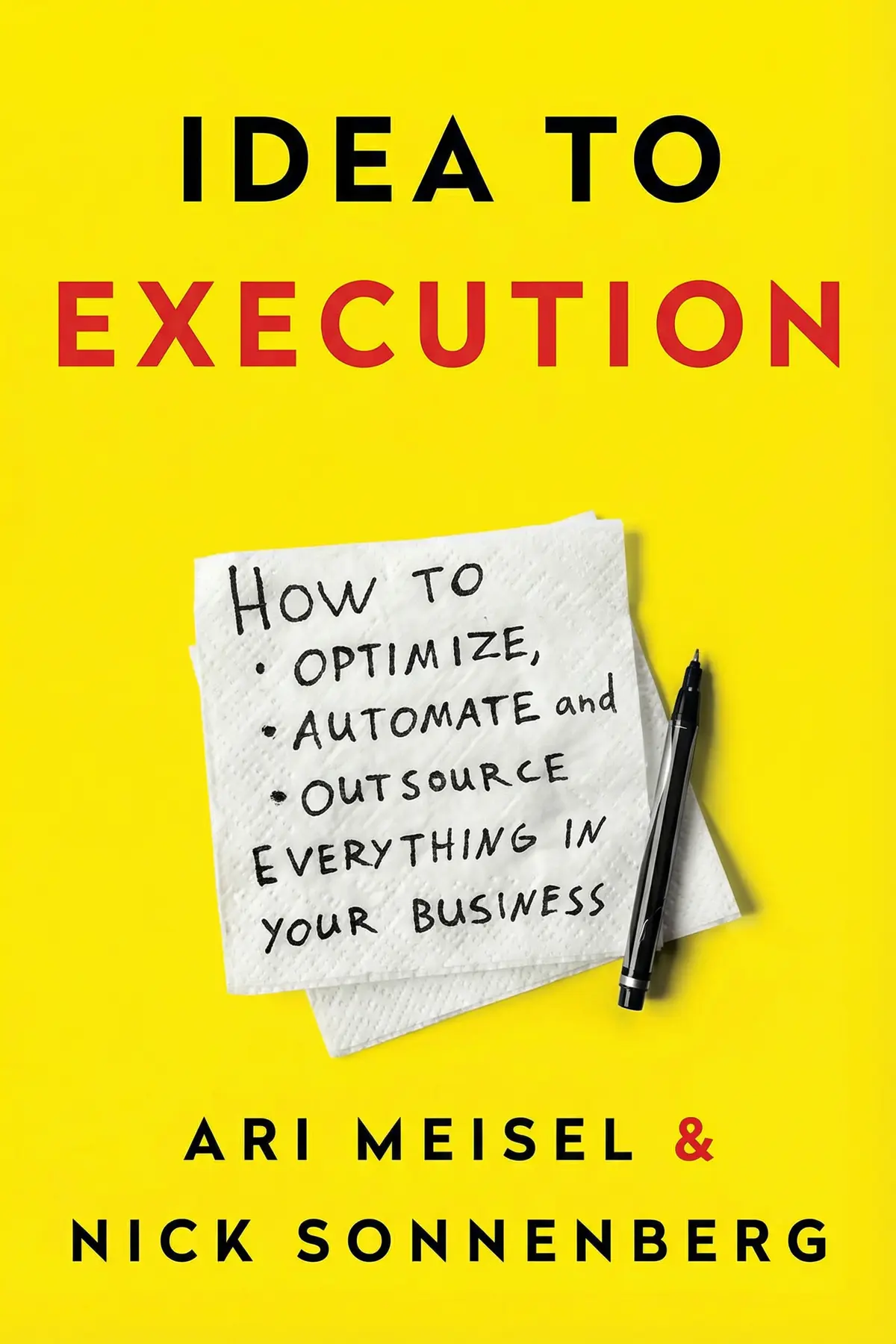
14 min 45 sec
Available in: English
Less Doing, More Living: Make Everything in Life Easier
By Ari Meisel
A practical guide to winning back hours from email, errands, bills and clutter. It shows how to simplify each task, hand repeat work to tools and pass the rest to other people.
Table of Content
1. Introduction
1 min 06 sec
If your week vanishes into email, errands and small chores, Ari Meisel suggests the fix is doing far less of it yourself. In Less Doing, More Living, Meisel, a self-described Overwhelmologist, starts from a lopsided ratio: roughly 80 percent of what you achieve comes from about 20 percent of your time and energy. Find that small share, and most of the rest can be simplified, put on autopilot or handed to someone else.
Those three moves, which Meisel calls Optimize, Automate and Outsource, carry the whole book. He applies them to work, money, shopping, clutter and health, and he names the apps and services he actually uses, from a note-taking tool holding about 4,000 of his notes to a delivery plan that keeps his smoke detectors powered. His case is that any repeated task can pass through those three filters, and what survives is time for the people and pursuits you care about. Expect a test you can run on any recurring chore, and tools that already do the work.
2. Find the fifth of your effort that counts
1 min 41 sec
Most busy people cannot say where their hours really go, so they cannot protect the ones that matter. A furniture company’s assembly instructions turn out to be a surprisingly good model for fixing an ordinary day.
3. Give your memory a backup brain
1 min 45 sec
Most of us believe we juggle details well, and most of us are wrong. A second brain sounds like science fiction, yet Meisel says anyone can have one, in two very different forms.
4. Make the workweek run on your best hours
1 min 57 sec
Late suppliers, indecisive clients and meetings that take a week of emails to arrange all eat into your day. Meisel’s fixes start with a simple question most people never ask about their own energy.
5. Never make another trip for toothpaste
1 min 44 sec
A quick dash to the store feels like nothing. Add up a month of them and the total is startling. Meisel’s fix even covers the errands you cannot predict, including a birthday gift delivered across the country.
6. Let services watch your money and build your gear
1 min 51 sec
Keeping track of several accounts, cards and loans by hand mostly breeds stress. Meisel found a tool that spotted thousands in yearly waste, and a sketch on paper that ended up earning him money.
7. Set ceilings on clutter and floors for joy
1 min 41 sec
A closet stuffed with cables and a calendar with no room for a run come from the same missing rule. Meisel uses it in two directions, one to shrink what you own and one to protect what you love.
8. Sleep and eat well to beat any productivity app
1 min 52 sec
You can automate every bill and errand and still drag through the afternoon. Meisel points to a hunger hormone, a common belief about fat and an exercise plan with three distinct parts.
9. Conclusion
1 min 08 sec
Meisel’s book reads less like a theory than a toolbox, and that is its strength. Underneath the apps sits one habit of mind. Before doing any task again, ask whether it could be simpler, whether something could repeat it for you, or whether someone else could do it. Asked often enough, that question gives a crowded week room to breathe, the way a closet of tangled cables shrank to one box.
The specific tools will change over time. The question won’t. Begin with a week of honest tracking, through RescueTime or a paper journal, so you know where the hours go. Choose one purchase you repeat and set it to arrive on its own. Write down a floor for something you love, a monthly trip or a weekly run, and treat it like a commitment you cannot cancel. Then guard the base under all of it: enough sleep, real food and regular movement.
Optimize, Automate, Outsource: three words worth keeping on a card by your desk. Meisel’s measure of success is a nephew in Los Angeles playing on a slide his uncle never had to carry.
About this book
What is this book about?
Most people want more time for family, hobbies and rest, and most people never seem to find it. Ari Meisel starts from the point that most of us never seem to have enough time. It comes from doing, by hand and from memory, dozens of small tasks that could be simplified, put on a schedule or done by someone else. His method rests on three moves: Optimize, Automate and Outsource. He starts with the 80/20 rule and honest tracking, then works through the week: an external memory, control over working hours and meetings, delivery plans that end routine errands, software that watches your money, and limits that cap clutter while protecting exercise and travel. The book is full of named tools and services, from RescueTime and Evernote to TaskRabbit and BillShark, plus Meisel's own examples, such as a 3D-printed wall bracket that ended up making him money. It closes with sleep, food and exercise, which Meisel sees as the energy source under every productivity gain. Readers get a repeatable test for any chore and a starting set of tools to try straight away.
Book Information
Who it's for
Admin-swamped professionals
Professionals whose days disappear into email, meetings and admin they never chose.
Delegation-ready founders and freelancers
Founders and freelancers ready to hand off small tasks but unsure what to delegate or to whom.
Errand-heavy parents and commuters
Busy parents and commuters who want errands, bills and clutter to stop eating their evenings and weekends.
About the Author
Ari Meisel
Ari Meisel calls himself an Overwhelmologist and works with entrepreneurs whose opportunities have grown faster than their businesses can handle. He is a Wharton School graduate and the author of the bestselling The Art of Less Doing, as well as Idea to Execution. After a 2006 diagnosis of severe Crohn's disease, he rebuilt his health through yoga, nutrition, supplements and hard exercise, and went on to compete in Ironman France in 2011. That experience showed him how much of his time went to tasks others could do.
Ratings & Reviews
Ratings at a glance

What people think
Listeners find the content straightforward to process and follow, offering actionable suggestions for enhancing lifestyle and optimizing workflows. The work is brief and effectively composed, presenting thought-provoking and inventive concepts, and one listener notes how it has changed their life. While many listeners consider the material worth the time spent, some feel it was a waste of time and money.
Top reviews
Mai
If you need a shot of adrenaline for your workflow, this is a much more digestible version of the 4-Hour Work Week. I loved how Ari focuses on optimizing the things you already do before trying to automate them. The book is incredibly concise, which is ironic and fitting given the title's promise of saving you time. I’ve already started tracking how long my daily tasks take, and the results were eye-opening. There are some goofy suggestions, like hiring people for tiny errands, but the core philosophy is sound. This is the best productivity book I've come across in a while for just getting straight to the point. Definitely recommended if you're looking for quick wins.
Show moreTippawan
Ari Meisel’s personal story is genuinely inspiring, especially how he used these systems to manage his health challenges with Crohn's disease. This background gives the productivity tips a sense of urgency and purpose that you don't always find in this genre. While I’m not about to hire someone to assemble my IKEA furniture or sing happy birthday to my kids, I did find the automation sections very practical. The writing is punchy and direct, which I appreciate because I don't have time for fluff. My only gripe is that some of the specific app recommendations are clearly outdated. Still, the mindset shift toward 'less doing' is worth the price of admission for anyone feeling overwhelmed by their daily to-do list.
Show moreYindee
Finally got around to reading this, and while it's a bit dated now, the core philosophy of 'optimize, automate, outsource' still holds water. It is a very fast read, which I appreciated because I was able to finish it during a single commute. Some of the apps mentioned are ancient history, but the logic behind why you should use them is what matters. To be fair, some people might find the focus on hiring virtual assistants a bit elitist. I personally found a few gems regarding email management that I’m already putting into practice. It’s not a life-changing manifesto, but it’s a very practical toolkit for anyone trying to reclaim their schedule from the chaos of modern life.
Show moreOmar
Stop running errands and start living—that’s the message I took away from this concise little guide. Meisel makes a compelling case for why our time is worth more than the cost of a delivery fee. I never thought about how much mental energy I was wasting on things like buying paper towels or managing my inbox. Some of the ideas are definitely over the top for my lifestyle, but the overarching theme of 'less doing' is powerful. The writing is clear and the chapters are short enough to read in between meetings. I did find the constant website shoutouts a bit distracting after a while. Regardless, it’s a stimulating read that pushed me to rethink my daily habits.
Show moreEli
As someone working a standard 9-to-5, I wasn't sure if this would apply to me, but I found some real gems buried in the text. You don't have to be a billionaire or a high-powered executive to benefit from automating your bills or using an external brain. Some of the suggestions are definitely geared toward entrepreneurs, but the logic of 'reclaiming your mind' is universal. Frankly, I think people who dismiss it as just a list of websites are missing the broader point about efficiency. I did have to ignore a few of the more expensive suggestions, like hiring a personal shopper for everything. But overall, it provided several creative ideas that have actually streamlined my work week.
Show moreSamira
Frankly, I didn't expect to finish this in one sitting, but the layout makes it incredibly easy to skim for the best parts. It reads like a condensed, modern productivity manual that doesn't waste time with flowery language or unnecessary anecdotes. I really enjoyed the sections on how to monitor your own energy levels to figure out when you're most productive. It’s true that some of the links are dead, which is a bit of a letdown for a book that positions itself as a tech guide. However, the author’s background as an 'achievement architect' shines through in the way he structures the advice. It’s a solid resource for anyone who feels like they’re drowning in busywork.
Show moreCherry
The concept of an 'external brain' is easily the highlight here, even if it requires a massive time investment to set up properly. Using Evernote to store everything and free up mental space is a strategy that has actually helped my anxiety. However, the book suffers from being a bit of a compilation of website reviews rather than a cohesive strategy. Many of the chapters are just shoutouts to specific apps, and some of those sites have been shut down for years. It's a quick read, but you have to do a lot of sifting to find the parts that are still relevant today. It’s a solid 3-star book that could have been a much more effective long-form blog post.
Show moreJavier
Look, I appreciate the enthusiasm, but half of this book feels like a glorified list of bookmarks for websites I already know about. It’s frustrating to pay for a book only to find out it’s basically an advertisement for services like Fancy Hands and TaskRabbit. I was hoping for more deep-seated psychological tricks to improve focus, not just a list of things I can pay other people to do. That said, his perspective on being an 'achievement architect' is interesting, and the book is definitely easy to digest. It just feels a bit thin on actual substance once you strip away the app reviews. It’s okay as a starter guide for tech-clueless people, but for everyone else, it’s a bit redundant.
Show moreTee
Does anyone actually have the budget to outsource their entire existence to random people on the internet? I picked this up hoping for some clever ways to manage my time better, but it mostly felt like a guide on how to spend money to solve problems. It's written like a long infomercial for virtual assistants and specialized delivery services. Some of the advice is just common sense, like using Amazon for recurring orders, which isn't exactly a revelation in 2024. Not gonna lie, I felt like the author was a bit oblivious to how the 'regular working schmo' actually lives. If you aren't a high-earning entrepreneur, you can probably skip this one because it's mostly 'Let Me Google That For You'.
Show moreRyan
After hearing all the hype about productivity hacking, I finally picked this up and was immediately disappointed. This book feels like a walking advertisement for a bunch of websites, half of which are probably defunct by now. Truth is, unless you have a massive budget to hire people for every minor task, most of these 'tips' are completely useless for the average person. I found it frustrating that he promotes services as life-changing when they really just feel like expensive shortcuts. To be fair, the book is very short, so at least I didn't waste weeks of my life reading it. But overall, it lacks the depth I expected from a real productivity guide. It is basically a list of other people's inventions rather than original thought.
Show moreQuestions about this book
What is the main idea of Less Doing, More Living?
Ari Meisel argues that most of our lost time goes to tasks we could simplify, hand to a system or give to someone else. He organizes everything around three moves: Optimize, Automate and Outsource. Starting from the 80/20 rule and honest tracking, he applies those moves to work, errands, money, clutter and health, naming the specific apps and services he uses.
What does Optimize, Automate, Outsource mean in Ari Meisel's method?
Optimizing means stripping a task down to its fewest steps, the way IKEA reduces its assembly instructions to a few picture steps. Automating means letting tools repeat the work, such as scheduled deliveries of toothpaste or batteries. Outsourcing means handing tasks to people, through virtual assistant services like Fancy Hands or marketplaces like TaskRabbit for unexpected errands.
How does Ari Meisel suggest using limits to manage your life?
He uses limits in two directions. An upper limit caps what you keep: after selling most of his electronics, Meisel kept only what fit in one box, and anything new means something old goes. A lower limit sets a minimum for things that improve life, like his commitment to one trip a month, 30 miles of running a week and home cooking three days a week.
Who should read Less Doing, More Living?
It suits people who feel their days are swallowed by small tasks: knowledge workers buried in email and meetings, founders who need to delegate, and anyone tired of errands and bills. It is especially useful for readers who like concrete tools, since Meisel names services for tracking time, storing notes, scheduling meetings, watching finances and ending routine shopping trips.
How can I start applying Less Doing, More Living this week?
Track a week of your time with RescueTime or a paper journal to find where hours go. Batch similar tasks, such as checking email only in the first ten minutes of each hour. Set one repeat purchase to arrive automatically. And protect your energy by taking vitamin D with breakfast and avoiding screens in the hour before bed, as Meisel recommends.
Readers also enjoyed






AUDIO SUMMARY AVAILABLE
Listen to Less Doing, More Living in 15 minutes
Get the key ideas from Less Doing, More Living by Ari Meisel, plus 5,000+ more nonfiction titles.
- 5,000+ titles
- Listen as much as you want
- 7-day free trial
- Cancel anytime









