
A Bigger Prize: How We Can Do Better Than the Competition
Margaret Heffernan
 English
A social psychologist's field guide to seven kinds of difficult coworkers and bosses, with calm and specific moves for each: protecting your credit, reclaiming meetings, escaping micromanagement and getting out from under a manipulator.
1 min 00 sec
Most bosses believe people quit over pay. In Jerks at Work, social psychologist Tessa West reports that 89 percent of bosses think so, yet money explains only 12 percent of departures, and the most common reason is unhappiness with management. That gap shows how much damage a difficult person at work can do, and how rarely it is taken seriously.
West, a professor at New York University, argues that no workplace is free of jerks, and that venting to friends after hours is far from your only option. Her case is that most toxic coworkers can be handled without a dramatic showdown: identify exactly what the person is doing, check the facts, recruit allies and choose a measured move. The exception is the manipulator who bends your sense of reality, and that one you leave behind.
Seven types follow, from the colleague who flatters upward to the boss who vanishes until launch day, each with a concrete move to try at your next meeting.
1 min 38 sec
A colleague presents your idea as her own and the room nods along. Before you call it theft, West points to a few reasons the picture may be less clear than it feels, and a fix that starts earlier.
1 min 42 sec
The coworker making your days miserable may be your manager’s favorite. West learned this on a department store floor, and her method for building a case starts with doubting yourself.
1 min 34 sec
One colleague speaks first, talks longest and cuts in whenever you start. His real strength is not his voice, and West shows how a team can take that strength away from him.
1 min 39 sec
The best teams, West finds, are the ones most likely to carry a passenger. The very qualities that make a group strong give him cover, and a three-question check can take it away.
1 min 41 sec
Most workers have had a boss who checks every comma, and many have thought about quitting over it. West suggests a conversation that never uses the word micromanaging at all.
1 min 32 sec
A manager who leaves you alone sounds like a gift until the night before a deadline. West describes the cycle behind that last-minute flood and two ways to break it.
1 min 43 sec
It can begin with an invitation to a secret project and end with you doubting what you saw with your own eyes. West explains why this jerk cannot be fixed, and how to protect yourself.
1 min 10 sec
What West offers, finally, is a change in posture. A jerk at work stops being bad weather you endure and becomes a problem you can study. The colleague who poaches customers, the one who talks over everyone, the boss who hovers and the boss who vanishes each follow a recognizable pattern, and patterns can be interrupted. Most of her remedies are mild: a neutral question, a meeting about goals, a three-question survey, a short email asking for half an hour. Bigger moves, like taking a case to your manager or finding a respected advocate, are saved for when the mild ones fail or when someone holds power over you.
Start by describing what the difficult person in your working life actually does, in one plain sentence about behavior, not character. Check that sentence with someone well connected before you act on it. And if the behavior involves secrecy and denial of what you saw, keep written notes and widen your circle instead of trying to change the person.
Dave rearranged a storeroom to win. West’s answer is slower and calmer, and it works because you stop facing him alone.
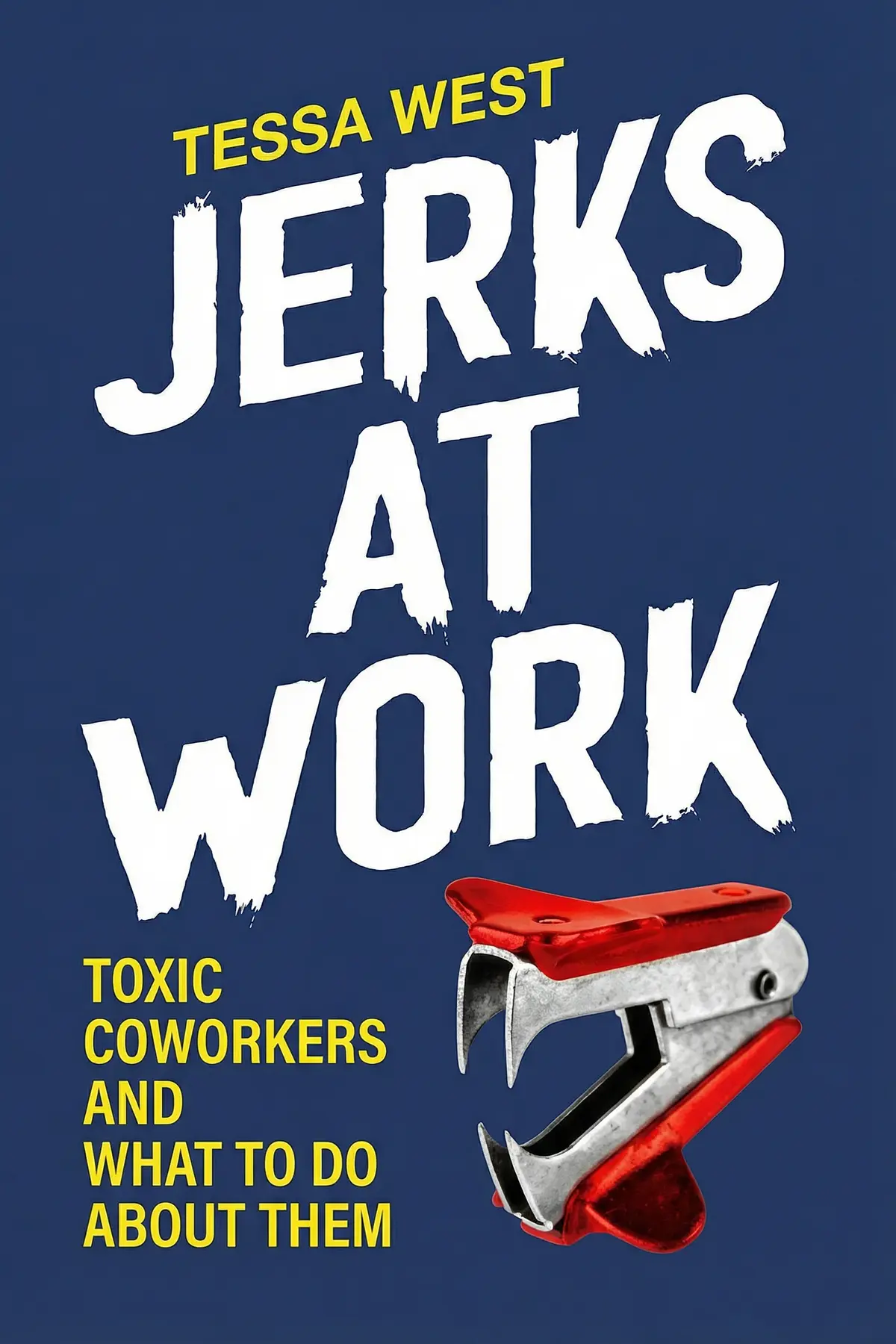
Almost everyone who works meets a jerk sooner or later: the colleague who charms the boss and undercuts everyone else, the one who takes credit for shared work, the boss who hovers or the one who disappears until the night before launch. Most people respond by venting to friends and hoping the problem goes away. Tessa West, a social psychologist at New York University, argues there is a better option. She sorts toxic coworkers into recognizable types, among them the kiss up/kick downer, the credit stealer, the bulldozer, the free rider, the micromanager, the neglectful boss and the gaslighter, and explains what drives each one and why they often get away with it. For each type she offers a measured response built on research about how people interact: neutral questions instead of accusations, meetings about shared goals, a short team survey that exposes who is coasting, and allies who back you up when you are interrupted. She also draws a firm line around the gaslighter, the one jerk she says cannot be changed, and explains how to document what you see and rebuild your network so you can get out.
Employees stuck beside a colleague who steals credit, interrupts or coasts on everyone else's work.
People squeezed by a boss who hovers over every detail or disappears until the deadline.
Team leads who want to spot free riders and bulldozers before good people leave.
Tessa West is a social psychology professor at New York University who grew up in Southern California and now lives in New York. Her research looks at how people interact and communicate, including uncomfortable social situations and what gives some people more influence when they negotiate or collaborate. She has published more than 60 articles in academic psychology journals and has written about her work in the Wall Street Journal, often on using relationships to solve everyday workplace problems.

Listeners find the book highly insightful, with one listener highlighting its thorough content and another noting its value for collaborating with groups. The writing also earns praise for being accessible and humorous, including one listener who noted that it made them laugh hard.
Finally finished this masterpiece and I'm still reeling from how much it accurately depicts my daily grind. Tessa West has managed to bottle the essence of office toxicity while keeping the prose light enough to avoid a total existential crisis. The breakdown of the 'Kiss-Up/Kick-Downer' was so hauntingly accurate I had to check if she was spying on my last department meeting. While some of the scenarios feel a bit heightened for dramatic effect, the underlying psychology is incredibly sound and provides a roadmap for sanity. I found the humor peppered throughout to be a necessary relief because, let's face it, dealing with professional jerks is exhausting. If you are struggling with a team that feels more like a battlefield than a workplace, this is your survival guide. It isn't just a list of complaints; it's a toolbox for actual change.
Show moreWow, I didn't expect to laugh this much at a business book, but West’s humor is surprisingly sharp and effective. She takes the soul-crushing experience of dealing with a 'Credit Stealer' and turns it into a masterclass on reclaiming your professional narrative. The book is incredibly insightful, especially when discussing how to build alliances within your team to counteract a single bad actor. I loved how readable the text was; it felt like getting advice from a very smart friend over drinks. To be fair, the book forces you to look in the mirror, which isn't always comfortable, but it’s necessary growth. The anecdotes are hilarious and poignant, reminding us that we aren't alone in these frustrating situations. It’s a must-read if you want to understand the hidden dynamics of your office. I’ll be recommending this to everyone in my department immediately.
Show moreThis book is essentially a field guide for surviving the modern jungle of office politics. I was blown away by the detailed breakdown of 'Reputation Thieves,' as I’ve seen that exact behavior play out in every company I’ve ever worked for. West manages to be both deeply insightful and incredibly funny, making it one of the few professional development books I couldn't put down. The focus on working with groups rather than just isolated individuals is what sets this apart from other titles in the genre. I found the readability to be top-notch, with short chapters that get straight to the point without unnecessary fluff. Frankly, I think this should be required reading for anyone in a leadership position. It provides a shared language for identifying toxic patterns before they become systemic failures. An absolute five-star gem.
Show moreThe chapter on gaslighting was a total eye-opener for me, providing a level of detail I haven't seen in other career books. West's background in psychology really shines when she deconstructs how these manipulators slowly erode your confidence. I especially appreciated how the book addresses working with groups, showing that a single jerk can poison an entire team's productivity if left unchecked. The readability is excellent, making complex communication science feel accessible even during a stressful commute. However, I did find that the 'What to Do' sections required a bit more homework than I was prepared for on a casual Sunday. You really need a pen and paper to get the most out of her strategies. Despite that small hurdle, the insights are well worth the effort for anyone feeling trapped in a toxic office loop. It turns a spotlight on behaviors we often ignore.
Show moreAfter hearing about West's research on communication science, I had to grab this to help manage some friction in my current project group. The way she breaks down team dynamics is incredibly detailed and offers a fresh perspective on why certain people clash so violently. I found the section on 'Bulldozers' particularly useful, as it provided tangible scripts for standing my ground without becoming a jerk myself. The readability is high, but the book doesn't sacrifice depth for the sake of being 'breezy.' One minor criticism is that the questionnaire at the start can be a bit overwhelming if you aren't in the right headspace. However, once you push through the initial data gathering, the payoff is substantial. It’s a practical guide that focuses on group health rather than just individual survival. Highly recommended for managers who care about their culture.
Show moreAs someone who has survived three different corporate restructuring rounds, I found the descriptions of the 'Negligent Boss' to be painfully relatable. This book is undeniably detailed, offering a comprehensive look at the various phenotypes of workplace toxicity that we all encounter. My main gripe is that most of the scenarios feel geared exclusively toward large, traditional corporate structures. If you work in a small startup or a non-profit, some of these strategies might feel a bit clunky or impossible to implement. To be fair, the self-reflection quizzes at the end were a sobering reality check that I might be a 'Bulldozer' in certain situations. It’s a solid read, but it lacks the universal application I was expecting from such a high-profile release. It sits right in the middle of being a great textbook and a casual self-help guide.
Show moreEver wonder if you're actually the problem in your office? This book certainly isn't afraid to ask that question, and the quizzes at the end are designed to be a bit of a gut punch. Personally, I liked the detailed content regarding the 'Negligent Boss,' which helped me understand my manager's behavior through a lens of fear rather than malice. However, the tone fluctuates between being a serious textbook and a comedy routine, which was a bit jarring at times. While the strategies are sound, they require a level of emotional labor that might be too much for someone already on the brink of burnout. It’s a useful resource, but it requires a lot of active participation from the reader. If you’re just looking for a light beach read, this isn't it. It’s a workbook masquerading as a business guide.
Show moreTo be fair, the advice here is solid, but the execution felt a bit hit-or-miss depending on which 'Jerk' type you are currently dealing with. The chapter on 'Bulldozers' was fantastic and offered a lot of new ideas, but the section on 'Gaslighters' felt a little repetitive. I appreciated the readability and the fact that it didn't take itself too seriously, which is a rarity for professors writing about communication. Still, some of the anecdotes felt a bit too 'perfect' to be entirely believable, which pulled me out of the experience. It’s a good starting point for anyone feeling frustrated at work, but it’s not the definitive solution for every toxic environment. I’d say it’s a strong three-star book that hits the mark about 70% of the time. Good for a quick refresh on soft skills, but don't expect it to fix everything overnight.
Show moreLook, I really wanted to love this, but it felt like it was treading water in some very shallow pools. The categories West provides—like the 'Bulldozer' or the 'Credit Stealer'—feel a bit like caricatures that you'd see in a mid-level sitcom rather than a nuanced psychological study. Frankly, the solutions offered were too basic for anyone who has spent more than a year in a corporate environment. 'Talk to them like adults' is good advice in a vacuum, but it doesn't account for the power dynamics that make these jerks so dangerous in the first place. I also found the anecdotes to be a bit too polished to feel authentic, which made it hard to connect with the material. It’s an easy read, but I was hoping for something that went much deeper into the systemic issues of workplace culture. It might be helpful for someone's first internship, but seasoned pros might find it lacking.
Show moreMaybe I'm just looking for something more academic, but this felt a bit too much like a collection of workplace tropes. Tessa West is clearly brilliant, yet the advice here leans heavily on cliche examples that don't always translate to the messiness of real life. The 'Jerk' types are a bit too one-dimensional, and I found myself wishing for more data-driven insights rather than just snappy stories. Not gonna lie, I was disappointed that the strategies didn't account for remote work as much as I’d hoped. Dealing with a 'Gaslighter' over Zoom is a different beast entirely, and the book felt slightly dated in that regard. It's a quick read, but it didn't provide the 'eureka' moment I was craving for my current situation. If you've read a few HR blogs, you've likely seen most of this advice before.
Show moreIt is a guide to difficult coworkers and bosses written by a social psychologist at New York University. West describes types such as the kiss up/kick downer, the credit stealer, the bulldozer, the free rider, the micromanager, the neglectful boss and the gaslighter. For each she explains why the behavior happens and offers a measured response, arguing that you rarely need a direct confrontation to improve the situation.
Avoid accusing them, which tends to make them defensive. Ask instead for a meeting about big picture goals and how your work serves them, then compare priorities, since a mismatch often drives the hovering. West’s friend Matt agreed to finish his boss Karen’s priority articles first and use any spare time for his own leads. When asking for changes, be specific, such as naming the number of daily emails, and mention what you appreciate too.
West suggests first allowing for innocent explanations: shared work blurs who did what, people overestimate their own contribution, and similar ideas can arise independently. Then have a neutral conversation where you share your view and ask for theirs, and move on to the facts of who did which tasks. To prevent repeats, agree on task ownership before the next project begins.
West describes a pattern that starts with isolation, either by making you feel part of something special and secret or by eroding your confidence and making you feel indebted. Then the gaslighter uses you, often in an unethical scheme, and denies what you saw, as Kunal’s boss Julie did. West advises writing everything down and rebuilding your network up to a respected advocate.
It suits anyone dealing with a difficult colleague or manager who wants options beyond venting or quitting. Individual contributors get scripts for credit disputes, interruptions and overbearing or absent bosses. Team leads get tools for spotting free riders, such as a short three-question survey, and for redistributing power that one person has hoarded.
AUDIO SUMMARY AVAILABLE
Get the key ideas from Jerks at Work by Tessa West, plus 5,000+ more nonfiction titles.