
14 min 54 sec
Available in: English
 ไทย
EnglishไทยIrresistible: The Rise of Addictive Technology and the Business of Keeping Us Hooked
By Adam Alter
Explains why phones, games, social feeds and email are so hard to put down, why anyone can get hooked in the right setting, and how to change surroundings and routines to regain control.
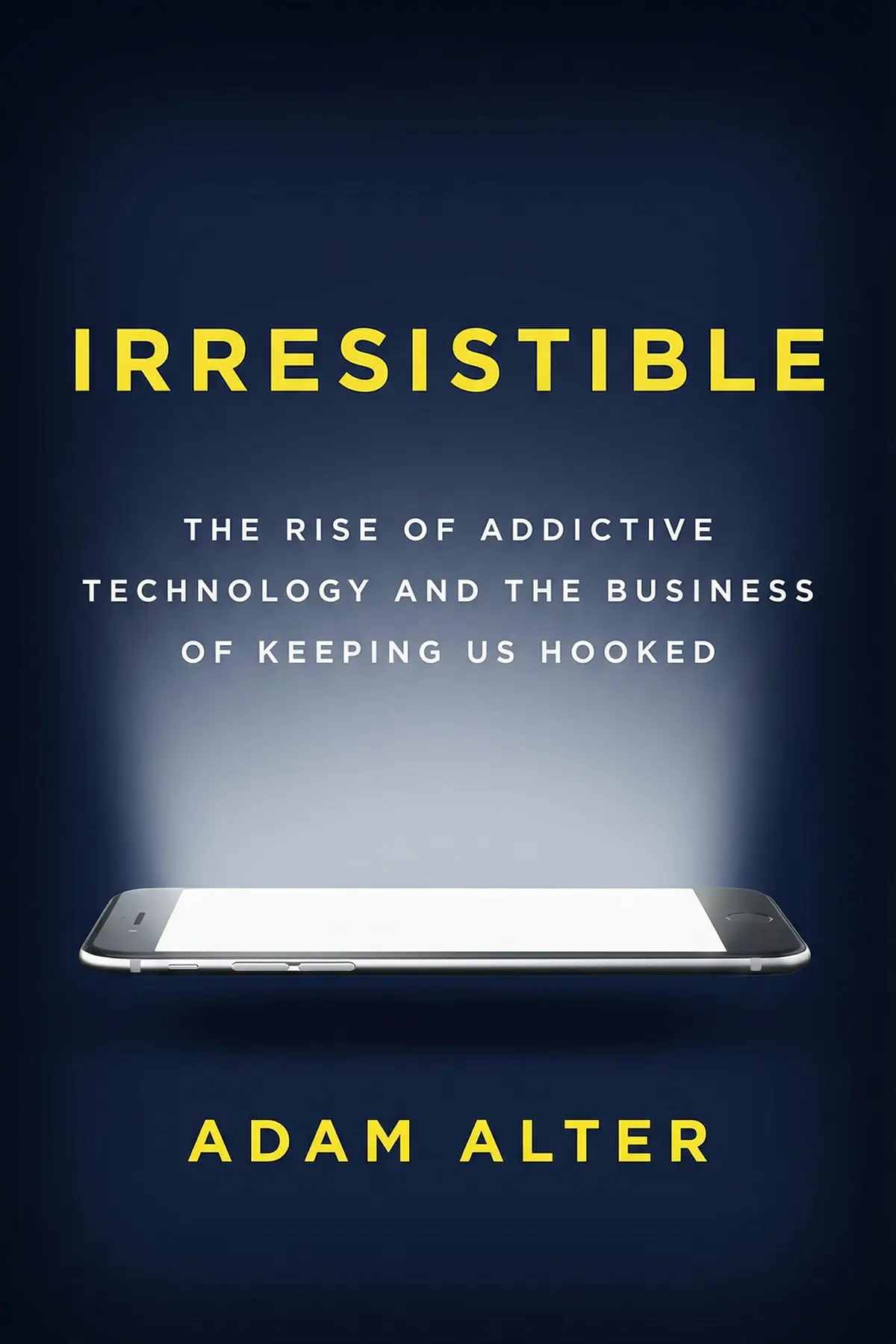
Table of Content
1. Introduction
57 sec
If you think you spend about an hour and a half a day on your phone, the real number is probably closer to three. In Irresistible, psychologist and marketing professor Adam Alter explains why that gap exists and why it is so hard to close. His argument is that addiction has little to do with weak character. Place almost anyone in a setting packed with pleasure triggers and unpredictable rewards, and compulsive behavior follows.
Phones, games, feeds and inboxes now build that setting around all of us. So the way out lies in changing the setting and swapping in better routines, because willpower alone tends to fail. The evidence includes heroin-addicted soldiers who stayed clean, pigeons pecking for uncertain food, students who chose electric shocks over sitting still, and a fake phone with no screen. Each one points to a change you can make to your own devices this week.
2. Measure the screen time you never notice
1 min 20 sec
Ask people how long they spend on their phones and they will give you a confident number. An app that measured the real figure found something most users did not expect, and a popular game shows the same pattern.
3. Anyone can get hooked, so learn the warning signs
1 min 41 sec
American soldiers came home from Vietnam addicted to an unusually pure heroin, yet almost all of them stayed clean. Their surprising recovery rewrote what experts believed about who becomes an addict and why.
4. Spot the habits that work like a drug
1 min 37 sec
Behaviors with no chemicals in them can light up the same brain regions as cocaine. That sounds alarming, but it carries an encouraging side, along with a warning about the device sitting beside your bed.
5. Understand how unpredictable likes turn every post into a bet
1 min 32 sec
Pigeons in a 1970s lab pecked hardest when food came only some of the time. That odd finding explains a small button that now appears on nearly every social platform you open.
6. Win back deep focus by silencing your inbox
1 min 34 sec
Fast replies look like good work. Office research suggests otherwise, and a group of workers cut off from email for days ended up calmer and more productive in ways they had not predicted.
7. Recognize the restless urge behind overwork
1 min 43 sec
Given twenty minutes to relax, many students chose to give themselves electric shocks instead. That strange result helps explain why some successful people in Japan keep working until their hearts give out.
8. Help children rebuild empathy away from screens
1 min 43 sec
A single week at a nature camp changed how well a group of children could read other people’s faces and voices. The size of that shift says something uncomfortable about everyday screen habits.
9. Replace the routine instead of fighting the urge
1 min 41 sec
Quitting cold turkey usually ends in relapse, and search data from some of the most conservative US states shows why. A strange screenless gadget points to a method that works with the urge.
10. Conclusion
1 min 06 sec
Irresistible moves the blame for constant checking away from the person and onto the setting. The soldiers who came home clean had left the stress and the easy supply behind them. Olds’s rats and Zeiler’s pigeons were simply placed where pleasure sat one press away and arrived at unpredictable moments. Phones, feeds, inboxes and games now recreate those conditions for almost everyone, which is why Alter treats addiction as something that can happen to anyone.
That is encouraging news, because a setting is far easier to change than a character. Begin by measuring how much time your phone really takes, and set the figure beside your guess. Silence the alerts that keep pulling you back, check email at fixed times and keep your browser down to one or two tabs. Keep screens away from the bed, and give children longer stretches without them than feels normal. When the urge to reach still comes, hand it a different routine to follow.
The device in your pocket was designed to be hard to put down. Where it sits, and when you pick it up, is still your call.
About this book
What is this book about?
Most people underestimate how much time their phones take, often by half. Adam Alter, who teaches marketing and psychology, argues that this is a predictable response to the environment modern technology creates, and has little to do with poor discipline. Alter starts by taking apart the idea that addicts are weak. Soldiers who came home from Vietnam stayed off heroin at rates that astonished doctors, and rats given a button wired to their brain's pleasure center pressed it until they died. Addiction, he argues, can happen to anyone placed in the right conditions. He then shows how phones, games, social media and email supply those conditions, through dopamine, unpredictable rewards like the Facebook like button and the small thrill of a cleared inbox. He also looks at workaholism, children's screen time and the costs to sleep and health. Readers get a clear explanation of why devices are so hard to put down, along with practical ways to respond: silencing notifications, checking email at set times, limiting browser tabs, protecting children's time offline and replacing the scrolling routine instead of simply trying to resist it.
Book Information
Who it's for
Distracted office workers
Office workers who check email and phones all day and rarely reach deep focus.
Worried parents and teachers
Parents and teachers worried about how much time children spend on screens.
Scrolling in bed
People who scroll in bed at night and suspect it is costing them sleep and calm.
About the Author
Adam Alter
Adam Alter teaches marketing and psychology at New York University's Stern School of Business. He studied psychology at the University of New South Wales and earned a master's degree and a doctorate in psychology at Princeton. His earlier book, Drunk Tank Pink, a New York Times bestseller, explored the hidden forces shaping how people think, feel and act. His writing has appeared in The Atlantic, Wired, the New Yorker, the New York Times and the Washington Post, and Poets and Quants named him among outstanding business school professors under 40.
Ratings & Reviews
Ratings at a glance
What people think
Listeners find this work both captivating and a necessary read, particularly for 21st-century parents, featuring persuasive data on tech dependency and fresh perspectives on behavioral addiction. The prose is skillfully crafted, and listeners view the subject matter as deeply pertinent to their generation. Although the book offers an excellent exploration into the world of behavioral addiction, listeners point out that it lacks practical solutions.
Top reviews
Soontorn
This book is a wake-up call for anyone who feels tethered to their smartphone. Adam Alter dives deep into why our gadgets are designed to be impossible to put down. I found the section on how Steve Jobs and other tech titans didn't even let their own kids use iPads particularly chilling. It really makes you rethink the educational value we attribute to these devices. The research is compelling and the writing is accessible, though it left me wanting more concrete steps to break the cycle. Frankly, it’s essential reading for modern parents who are trying to navigate this landscape without losing their minds. We are essentially living in a giant social experiment where the rules change every day, and Alter is one of the few voices providing a clear map of the terrain.
Show morePawinee
After hearing about how tech titans treat their own products, I knew I had to read this. Alter delivers a stinging critique of the modern digital landscape that is impossible to ignore. I was particularly moved by the discussion on how children learn empathy through face-to-face interaction, and how that's being eroded by screens. The book isn't just about phones; it’s about the human condition and our vulnerability to feedback loops. Personally, I think this should be required reading for every high school student and educator. It’s a brilliant, slightly scary, but ultimately necessary exploration of the world we’ve built for ourselves. The way he connects ancient Roman history to modern app design is nothing short of masterful.
Show moreTaweesak
Finally got around to reading this and I’m genuinely glad I did. The Don't break the streak concept finally explains why I feel such irrational pressure to finish mundane tasks on my phone. Alter has a gift for taking complex psychological concepts—like the Zone of Proximal Development—and showing exactly how they are used to keep us scrolling. It’s a fascinating, if somewhat alarming, look at how our social reward systems have been hijacked by silicon valley. While it lacks a magic pill for fixing our addictions, simply knowing how the machinery works makes it easier to resist. Every page offers a new insight into why our modern life feels so frenetic. This is a must-read for the 21st century.
Show moreAnong
Ever wonder why that little red notification bubble feels like a shot of adrenaline? Alter explains the neuroscience of behavioral addiction with such clarity that you’ll never look at Instagram the same way again. The truth is, these apps are engineered to exploit our biological need for social validation. I was fascinated by the discussion of stopping rules and how they have been systematically removed from our digital lives. Unlike a book that ends or a newspaper that has a final page, the bottomless feed ensures we never find a natural place to pause. While the book is heavy on the why and a bit light on the how-to, the insights into dopamine loops are worth the price alone. It’s a great dive into the mechanics of the 21st-century brain.
Show moreRatthapong
Picked this up because I’ve been feeling like my attention span is shrinking to the size of a TikTok video. Alter’s analysis of the Zeigarnik Effect—that psychological tension we feel with unresolved tasks—really hit home for me. It explains why cliffhangers in games and streaks on Snapchat are so effective at keeping us hooked. The writing is incredibly smooth, making complex psychological theories feel like casual conversation. I did feel that some of the examples, like the Tetris history, went on a bit long, but the overall message is powerful. It’s a sobering look at how a thousand engineers are on the other side of the screen working to break your willpower. You will definitely feel the urge to put your phone in a drawer after finishing this.
Show moreAndrei
As a parent in the digital age, I found this research both fascinating and terrifying. Alter doesn't just blame a lack of willpower; he points out that we are fighting against billion-dollar industries. The concept of nomophobia or the fear of being without a mobile phone felt all too real as I read this. I appreciated the distinction between substance addiction and behavioral patterns like exercise or shopping. My only real gripe is that the solutions chapter felt a bit rushed compared to the deep dive into the problems. Still, the insights into how near-wins keep us gambling with our time are eye-opening. Personally, I found the chapter on the Dollar Auction Game to be a brilliant illustration of how we get trapped in losing battles.
Show moreCooper
Wow, I didn't expect to feel so targeted by a non-fiction book on technology. I’ve always thought of myself as someone with decent self-control, but seeing the metrics on how we engage with likes was a reality check. The way Alter describes our brains being pickled by these rewards makes so much sense. I loved the section on the butt-brush effect and how subtle environmental cues dictate our behavior without us even realizing it. It’s a very readable book that manages to be academic without being dry. If you’re looking for a step-by-step detox guide, you might be disappointed, but for understanding the why, it’s top-tier. It really highlights how the illusion of progress sustains us in destructive digital loops.
Show moreChloe
The chapter on the Zeigarnik Effect was easily the highlight for me, but the rest of the book felt a bit uneven. Alter spends a lot of time warning us about the dangers of metrics and gamification, only to suggest gamifying our own lives as a solution in the final chapters. It felt slightly contradictory to me. Not gonna lie, I was hoping for more practical, everyday tips that don't involve donating to a political party I hate just to wake up on time. The anecdotes about World of Warcraft and Tetris were fun cocktail-party facts, but they didn’t always feel new. It’s a good introduction to the topic, but seasoned tech-critics might find it a bit repetitive. A decent read, just not the life-changing manual I expected.
Show moreHazel
To be fair, much of what Alter discusses here has been covered in various long-form articles over the last few years. If you follow tech news closely, the anecdote about tech titans keeping their kids away from screens won't be news to you. I also found some of the statistical claims a bit shaky, especially when he describes small percentage shifts as dramatic. However, the writing style is very engaging and he does a great job of synthesizing different fields of study into a cohesive narrative. It’s a solid 3-star read that serves as a good entry point for someone who isn't already obsessed with the attention economy. It just didn't quite provide the breakthrough insight I was looking for, despite the compelling research presented.
Show moreAroha
Look, I wanted to love this because the topic is so timely, but I struggled with the scientific rigor. The author often presents experimental results as absolute proof when they actually seem like statistical flukes or minor differences. For instance, claiming a dramatic improvement for a group that only gained a few points more than the control seems misleading. Also, the irony of using the same addictive metrics he decries to propose solutions in the final chapter was distracting. I felt like the book was more of a collection of interesting stories rather than a solid scientific argument. It’s fine for a casual reader, but if you’re looking for deep neurological evidence or actual peer-reviewed substance, you might find it a bit thin and overly anecdotal.
Show moreQuestions about this book
What is the main idea of Irresistible by Adam Alter?
Alter argues that addiction is less about weak character than about circumstances. Anyone placed in a setting full of pleasure triggers and unpredictable rewards can become hooked, as heroin-addicted Vietnam soldiers and lab rats with a pleasure button showed. Phones, games, social media and email create exactly that setting today. The response he recommends is changing your environment and replacing habits with better routines, instead of relying on willpower alone.
Is smartphone addiction real according to Adam Alter?
Yes. Alter cites research by Cambridge neuroscientist Claire Gillian showing that behaviors such as gaming and online gambling excite the same brain regions as heroin and cocaine. Users of the Moment app picked up their phones about 40 times a day and spent around three hours on them, double what they guessed. Behavioral addictions are milder than drug addictions, though, which makes them easier to break.
Why are social media likes so addictive?
Alter links likes to Michael Zeiler’s pigeon experiments from the 1970s. When food showed up on just 50 to 70 percent of tries, the birds pecked harder and for longer, since an unpredictable payoff triggers a bigger dopamine rush. Since likes arrive unpredictably, every post becomes a small gamble, and many people read silence as rejection. That is why nearly every platform, from LinkedIn to YouTube, uses similar buttons.
How can I reduce technology addiction, according to Irresistible?
Alter favors substitution over repression. Keep the cue but change the routine, as the screenless Realism device does by letting you look at the world instead of a feed. He also suggests turning off email notifications and checking at set times, keeping no more than two browser tabs open, and protecting children from too much screen time; in one study, a week without technology raised children’s empathy scores by 33 percent.
Readers also enjoyed









AUDIO SUMMARY AVAILABLE
Listen to Irresistible in 15 minutes
Get the key ideas from Irresistible by Adam Alter, plus 5,000+ more nonfiction titles.
- 5,000+ titles
- Listen as much as you want
- 7-day free trial
- Cancel anytime









