


Aflame: Learning from Silence
Pico Iyer
 English
 ไทย
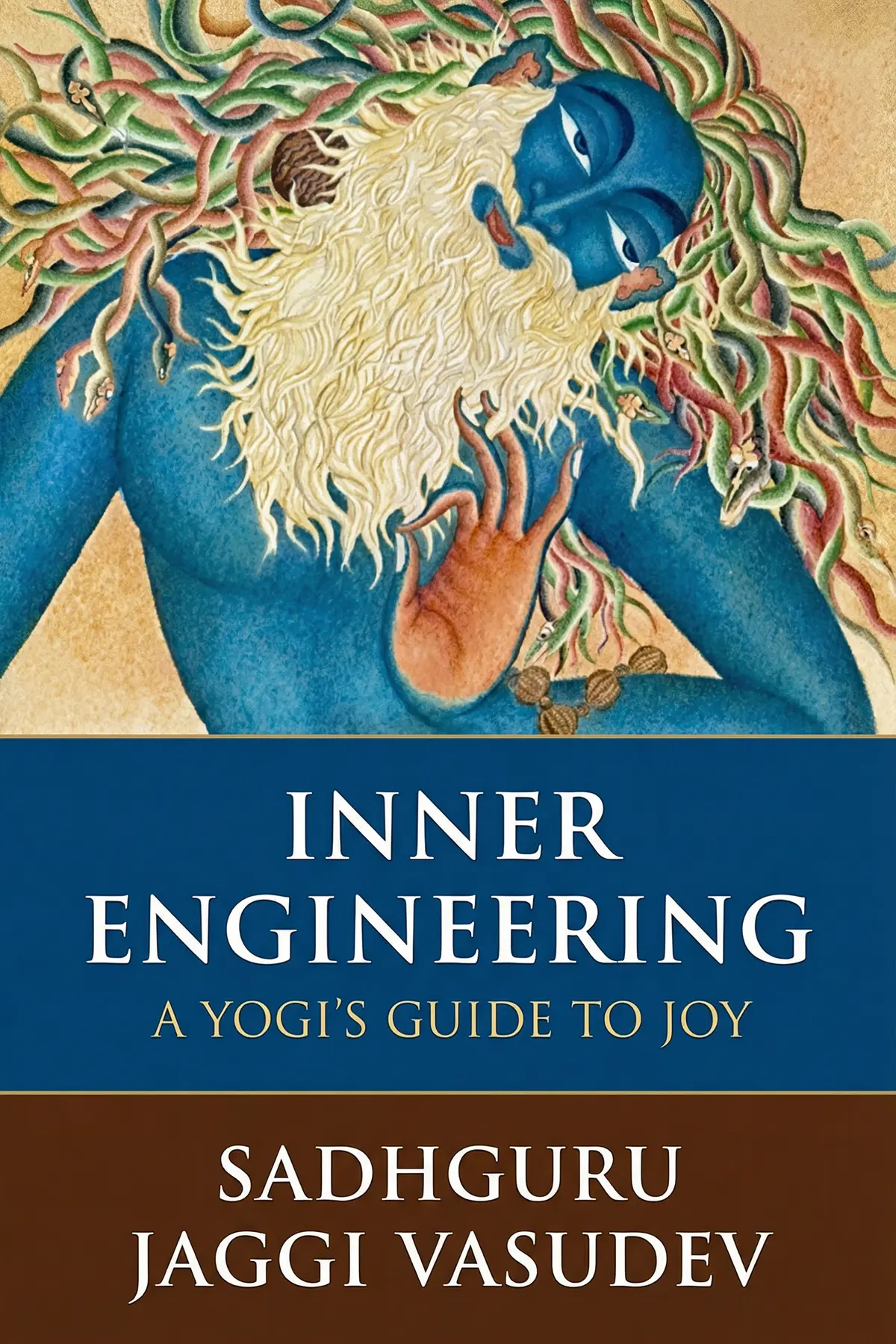
Sadhguru argues that every feeling and perception is produced inside you, so joy can be cultivated from within. He shows how to meet pain consciously, rethink responsibility and bring body, mind, emotion and energy into balance.
1 min 03 sec
Plenty of people reach the goals they set and still feel something is missing. In Inner Engineering, yoga teacher Sadhguru Jaggi Vasudev traces that emptiness to one mistake: hunting for joy in the outside world, when every sight, feeling and mood is actually produced inside you. Many people treat yoga as a workout that readies the body for another long week. Sadhguru presents it as far more, a philosophy and a way of praying that works on the body’s energy centers and sharpens the mind.
His central claim is easy to say and harder to live: because your experience of life is made within you, you can learn to shape it. The ideas ahead move from that claim to its uses, from how you meet an insult or an old heartbreak to what responsibility really asks of you, and on to the practices and places he believes deepen the work. Expect old Indian stories, one chemist’s discovery and a habit you can try at your next meal.
1 min 34 sec
A bird finally reaches the top of the tree it always dreamed of, and the view costs it everything. An old Indian fable explains why so many successful people still feel empty.
1 min 40 sec
The same hug can feel warm one day and irritating the next. That small puzzle points to a chemical your body can make for itself, and to the everyday activities that release it.
1 min 39 sec
A child in wartime Austria spoke a few careless words to her brother and never saw him again. What she did with that moment shows a way out of the memories people replay for years.
1 min 40 sec
Leaving your family to tour the world in a small bus might be the most responsible choice you ever make. Sadhguru’s redefinition also eases the guilt of watching every disaster on the news.
1 min 40 sec
Four proud yogis spent their lives praying, yet God only appeared during a rainstorm in a temple with no walls. The reason says something about why one practice on its own rarely brings balance.
1 min 40 sec
A farmhand nobody else would hire took the plow out early because he said rain was coming that day, and a philosopher with a spoon mocked Aristotle on a beach. Both stories ask how much your thinking actually lets you notice.
1 min 33 sec
Doctors could not name the illness wearing Sadhguru down for years. What he says happened on a Tibetan mountain in 2007 explains why he tells seekers where to travel, not only what to practice.
1 min 10 sec
Every idea in Inner Engineering points to the same address: inside you. The book you read, the hug you welcome or resent, the memory you replay and the headline you dread are all experienced within, so that is where Sadhguru wants the work to happen. Balance the body and mind, respond by choice, and the outside world loses much of its power to set the tone of your day.
The pheasant on its treetop is the image worth keeping. It climbed on bad advice and became an easy target, the way success built on straying from yourself can leave you exposed.
The book’s own first step is modest enough to try at lunch. Pay full attention to what you eat: the flavors, the textures, the way your body responds, without drifting toward a crush or the promotion you want. Nothing more is required. And when an old hurt or an angry voice arrives, pause long enough to choose your answer, as the woman from Austria learned to do with every conversation. Joy, on this account, is built from the inside, one meal and one response at a time.
Many people reach their goals and still feel empty, and many practice yoga only as a workout that prepares the body for another busy week. Sadhguru Jaggi Vasudev argues that both habits come from the same mistake: looking for fulfillment in the outside world, when everything we see and feel is actually experienced inside us. Drawing on traditional Indian stories, a chemist's discovery of the body's own bliss molecule and episodes from his own life, Sadhguru presents yoga as a philosophy and a way of praying as well as a physical practice. He shows how to replace compulsive reactions with conscious ones, why responsibility enlarges freedom, and why body, mind, emotions and energy must work together. He also shares his belief that certain sacred places hold spiritual energy. Readers get a different way of seeing where happiness comes from, along with simple starting points, from learning a lesson from an old hurt to paying full attention to the next meal.
Successful professionals who have reached their goals and still feel something is missing.
People who practice yoga as exercise and want to understand its philosophy and spiritual side.
Anyone stuck replaying an old hurt or worn down by bad news who wants calmer, more deliberate reactions.
Jaggi Vasudev, widely known as Sadhguru, has taught yoga since 1982. In 1992 he founded the Isha Foundation, a non-profit based in Coimbatore, India, that runs an ashram and yoga center. Inner Engineering became a New York Times bestseller. He has started environmental campaigns in India, including Rally for Rivers and Cauvery Calling, received the Padma Vibhushan civilian award from the Indian government in 2017, and has spoken at the United Nations and the World Economic Forum.

Listeners find this spiritual guide enlightening and useful, featuring straightforward descriptions of intricate ideas. The work offers superb direction for achieving internal tranquility and happiness, and listeners view it as an essential listen that provides resources for personal evolution. They value the way Sadhguru's wisdom encourages shifting the mind into the heart, and one listener mentions the clear way it portrays the internal domains of awareness.
Finally got around to reading this after seeing so many clips of Sadhguru online, and I must say, the experience is much more profound in print. This isn't your typical self-help book that offers a temporary band-aid for your problems; it’s a comprehensive look at the 'technology' of wellbeing. I loved how he translates ancient, complex concepts into something a modern mind can actually grasp without feeling like it's being lectured. The way he describes bringing the mind into the heart is particularly moving. It made me realize that joy isn't a goal to be reached but a base state that we simply lose touch with. While the first half is quite autobiographical and tells his story of enlightenment, the second half provides real, practical insights into managing your internal environment. It has genuinely helped me shift my perspective on daily stressors. A must-read for any seeker.
Show moreWow, what an incredible shift in perspective this book offers. For years, I’ve been looking for a way to achieve self-actualization without getting bogged down in religious dogma or empty affirmations. Sadhguru lucidly describes the inner realms of consciousness in a way that feels accessible yet deeply mystical. The core message—that your life is 100% your responsibility—is both terrifying and liberating. I found the section on 'Responsibility' to be the most impactful part of the entire book. It’s not about blame; it’s about the ability to respond. Since finishing the chapters, I’ve felt a sense of intrinsic calmness that I haven't experienced in a long time. It really feels like he’s providing the tools for a total self-transformation. I'm already planning a re-read because there is just so much to digest in these pages. Truly a guide to joy.
Show moreAs someone who has struggled with anxiety and a racing mind for years, this book was a breath of fresh air. It doesn't tell you to stop thinking or to suppress your emotions. Instead, it teaches you how to create a distance between yourself and your mind. The concept of 'Inner Engineering' as a technology for well-being is brilliant. Why do we spend so much time fixing our external world while our internal world is a mess? The prose is simple but the insights are razor-sharp. I particularly loved the exercises at the end of the chapters, like the one about looking at everything in a loving way. It sounds corny, but when you actually try it, the shift in your energy is palpable. This book is a rare gem that manages to be both inspirational and highly practical. It has definitely inspired me to take my yoga and meditation practice much more seriously.
Show moreThis book doesn't just offer advice; it offers a whole new way of existing. I’ve read a lot of self-help, but nothing has resonated as deeply as Sadhguru’s explanation of how we create our own suffering. He has this incredible ability to take these high-level spiritual truths and turn them into something you can use while you're sitting in traffic or dealing with a difficult boss. The writing is lucid and the flow is excellent. I felt a sense of preemptive separation anxiety as I got to the final chapters because I didn't want the wisdom to end! It’s a beautiful reminder that joy is our natural state. If you are even slightly curious about yoga or meditation beyond the physical exercise, buy this book. It’s an essential tool for self-transformation that brings the mind into the heart. It really is a masterclass in living well.
Show moreAfter hearing about the Isha Foundation from my yoga community, I finally dived into this bestseller. It’s a phenomenal piece of work. Sadhguru manages to bridge the gap between ancient wisdom and modern life perfectly. He doesn't ask you to believe in anything; he just asks you to explore your own experience. That approach really worked for me as a skeptic. The way he explains that 'responsibility' is just the 'ability to respond' changed my entire outlook on my career and relationships. This book is a guide for anyone who wonders why they aren't happy despite having their 'Maslow’s pyramid' sorted. It’s insightful, practical, and filled with a kind of common-sense wisdom that is rare these days. It has helped me bring a sense of peace into my daily routine that I didn't think was possible. Highly recommended for everyone.
Show moreSadhguru has a knack for making you look at the obvious in a way you’ve never considered before. The book starts with his personal journey, which is fascinating, though some might find his tone a bit smug at times. I appreciated the demystification of the 'guru' status—he really emphasizes that he isn't a messiah, but a map-maker. To be fair, some of the scientific claims he makes about 'energies' and 'molecular changes' in water or food feel a bit anecdotal and lack empirical backing, which might irritate the more rationalist readers. However, if you can look past the shaky 'science' and focus on the philosophy, the logic is incredibly sound. The chapters on the mind and body provide excellent guidance toward inner peace. It’s a solid introduction to his teachings, even if it leaves you wanting a bit more of the 'how-to' which is apparently reserved for his in-person programs.
Show moreWhile I was initially skeptical of the 'rockstar yogi' persona, I found the actual content of this book to be surprisingly grounded. Sadhguru avoids the usual religious propaganda found in many Eastern spiritual texts. Instead, he focuses on the human condition and the mechanics of the ego. The way he breaks down the 'body,' 'mind,' and 'energy' sections makes a lot of sense, even if the 'energy' part gets a bit out there for my liking. Truth is, the book is quite enjoyable to read; his voice is conversational and often funny. There are moments where it feels a bit repetitive, and he does have a habit of making very grand, sweeping declarations about the universe that are impossible to verify. Still, the underlying message of self-mastery is powerful. It’s a great place to start if you’re looking for a way to live more joyfully without joining a cult.
Show moreThe division of the book into a philosophical first half and a more practical second half works well for the most part. I found the autobiographical stories quite entertaining, even the parts that felt a bit apocryphal. Sadhguru is a master storyteller. He uses metaphors and similes that make you go 'Aha!' every few pages. Personally, I was most impressed by his discussion of how we can 'leapfrog' Darwinian evolution by taking charge of our own consciousness. It’s a bold claim, but he makes a compelling case for it. My only gripe is that the book leans a bit too heavily into mysticism toward the end—talking about black magic and chakras—which might alienate some readers. However, the core advice on breathing and awareness is life-changing. It’s a solid 4-star read that offers a lot of food for thought for any seeker.
Show moreThere is a strange paradox at the heart of this book. On one hand, the writing is witty and the parables are often quite charming. Sadhguru is clearly a very intelligent man who knows how to communicate with a global audience. On the other hand, I felt like I was being sold a very long brochure for the Isha Foundation’s paid courses. He constantly hints at powerful 'Kriyas' or practices that can change your life, but then tells you that they can't be taught in a book. It’s a bit frustrating! The first half is a meandering collection of personal anecdotes that, while interesting, don't offer much in terms of guidance. I did enjoy the sections on mindfulness and the difference between the mind and the self, but by the end, I felt like the 'Inner Engineering' title was a bit of a tease. It’s an okay spiritual primer, but don’t expect a full manual.
Show moreTruth is, I don't get the hype around this one. I picked it up because of the massive popularity, but it felt like a meandering mess of vague declarations. The first 100 pages are just his life story, which feels more like a hagiography than a guide. He talks about 'consecrating the planet' and 'mystic mountain energies,' which sounds cool but offers zero value to the average person trying to reduce stress. It feels like clickbait in book form—promising a 'guide to joy' and then telling you that you need a guru to actually unlock anything significant. The exercises are superficial at best. 'Look at a flower for five minutes' isn't exactly groundbreaking engineering. I found the tone to be quite patronizing, as if the reader is a 'lowly imbecile' for not being enlightened yet. Honestly, it was a struggle to finish and I didn't find it practical at all.
Show moreSadhguru argues that lasting joy cannot come from the outside world, because everything you see and feel is actually experienced inside you. Even a book in your hands is seen through light landing on your retina. Since perceptions and emotions are self-generated, you can learn to guide them by responding consciously, taking real responsibility and bringing body, mind, emotions and energy into balance.
The book cites the Israeli chemist Raphael Mechoulam, who showed that the body produces anandamide, a chemical that acts on the nervous system somewhat like marijuana and brings deep pleasure without harmful side effects. Exercise and states of ease and flow during work can trigger it. Sadhguru adds that yogis can release it through concentration and will alone.
For Sadhguru, responsibility is the ability to pause, consider your options and decide how to respond, which makes it a source of freedom. It does not always require action. When you hear of a distant disaster, honestly asking whether you have the money, skills or freedom to help counts as a conscious response, even if the answer is that you cannot.
The book’s simplest advice is to savor what you eat, paying full attention to tastes and textures instead of drifting into thoughts about work or romance. Beyond that, when an old hurt returns, ask what lesson it holds, as the woman who lost her brother in wartime did. And try combining practices, such as meditation alongside physical yoga.
It suits people who have found outside success but not contentment, yoga practitioners who want more than a workout, and anyone caught in painful memories or anxious about the news. Readers open to spiritual ideas, including Sadhguru’s belief that places like Mount Kailash hold spiritual energy, will find the most in it.
Pico Iyer


Daniel Goleman


Marianne Williamson

Deepak Chopra

Alcoholics Anonymous World Services

Eckhart Tolle

AUDIO SUMMARY AVAILABLE
Get the key ideas from Inner Engineering by Sadhguru Jaggi Vasudev, plus 5,000+ more nonfiction titles.









