

15 min 09 sec
Available in: English
In This Economy?: How Money & Markets Really Work
By Kyla Scanlon
Kyla Scanlon explains how money, banks, GDP, markets and the Federal Reserve work. She also shows why the economy runs on trust and stories, so strong data can sit beside people feeling worse off.
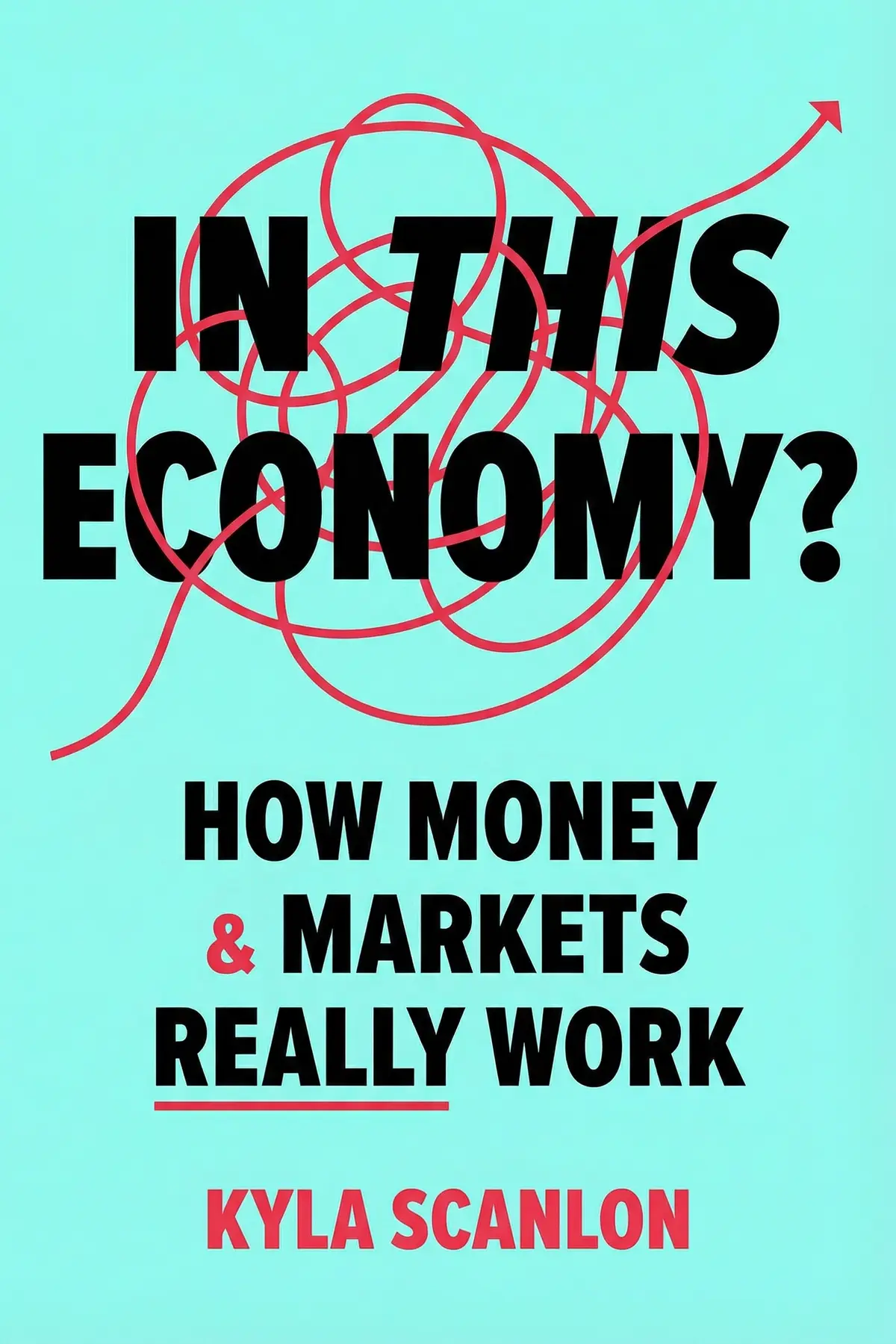
Table of Content
1. Introduction
59 sec
If the headlines say the economy is strong while your rent and groceries say otherwise, you are not imagining things. Kyla Scanlon, author of In This Economy?, gave that feeling a name in 2022: the vibecession, a gap between healthy official numbers and how people actually live. Her argument is that the feeling itself matters economically, because public mood shapes how people spend, and spending shapes what happens next.
In her telling, the economy is a system of trust and stories as much as a machine of rates and output. She walks through money, banks, the measures we rely on, stock and bond markets and the Federal Reserve, often through hand-drawn comics and a childhood game of castles. Afterward, a jobs report or a rate decision becomes something to read twice: once for what the numbers say, and once for what people believe about them.
2. Read the gap between the data and the mood
2 min 00 sec
In 2022 the job market was thriving and the indicators looked good, yet Americans still felt things were bad. Scanlon’s word for that split spread all the way to the US Treasury, and the gap it names still drives what people do with their money.
3. Money is a promise banks create by lending
2 min 01 sec
A paper bill buys you a latte, yet nothing printed on it explains why. Where new money really comes from surprises most people, and it explains both how banks grow and how they collapse.
4. Question the numbers that say the economy is fine
2 min 11 sec
The figure politicians quote to prove the economy is growing cannot see a free app, and it does not care who gets richer. Other trusted warning signs have misfired too, and some rest on surprisingly loose foundations.
5. Spread your risk and watch who holds power
2 min 17 sec
Index funds promise safety in numbers, yet a handful of companies and fund giants now carry an outsized share of the market. A fund can look spread out and still lean heavily on just a few names.
6. Learn what the Fed's tools do to prices and jobs
2 min 12 sec
A childhood game of toy castles turns out to be a sharp map of how the Federal Reserve works. It also shows why the Fed’s biggest cannon can miss its target entirely.
7. Understand why the economy feels different to each person
2 min 10 sec
The pandemic made some households far richer and left others poorer, all inside one set of national figures. Scanlon looks at who pays for inflation, who gets blamed, and what a summer selling cars taught her.
8. Conclusion
1 min 19 sec
Scanlon’s childhood game had simple rules: fire at a castle and it fell. The real economic kingdom refuses to behave that way. Money is a promise, banks multiply it by lending, markets spread risk while gathering power, and the Fed’s shots land late, bounce off moats or hit the wrong drawbridge. Running through every castle is something official charts struggle to capture: what people believe and feel, which shapes what they do next. For Scanlon, economics is a tool for understanding the choices a society makes together, and those choices begin with stories.
That view turns into a few habits. When the data says one thing and daily life says another, hold both, and ask what the statistic measures and what it leaves out. Check whether a fund that looks diversified is leaning on seven companies. Read a Fed decision as a slow signal, not an instant fix. And when an online voice offers one villain for rising prices, notice how comforting that is, then look for the duller explanation with more moving parts.
The numbers describe the kingdom. The people inside it, and how they feel, help decide what happens next.
About this book
What is this book about?
Official figures say the economy is doing well, yet plenty of people feel squeezed by prices, rent and debt. In 2022 Kyla Scanlon coined a word for that split, the vibecession, and In This Economy? builds on it. She argues that the economy runs on trust and shared stories as much as on rates and output, and that how people feel shapes what they do with their money. From there she explains the machinery in plain terms. She covers how banks create money by lending, why the dollar strengthens in hard times and what GDP measures and misses. She shows how ETFs spread risk while a handful of firms gain power, and how the Federal Reserve's tools work, pictured as a kingdom of castles where a rate hike can bounce off a moat. She also questions trusted signals, from the two percent inflation target to the yield curve, and looks at who actually felt the pandemic economy, and how. Readers come away with the words they need to follow economic news, along with a habit of reading every headline twice: once for the data and once for the mood behind it.
Book Information
Who it's for
Young professionals
Young professionals who feel worse off than the headlines suggest and want to understand why.
New to investing
New investors who want to make sense of ETFs, bonds and Fed decisions before putting money in.
Following economic news
Curious readers who follow economic news but struggle to connect rates, inflation and jobs.
About the Author
Kyla Scanlon
Kyla Scanlon, born in 1997, studied finance, economics and data analytics. Early in her career she sold cars, then worked as an associate at Capital Group, where she did macroeconomic analysis. She helped an education startup spin out its investment education arm and then founded her own financial education company. She writes a weekly newsletter, makes YouTube videos and short clips about the economy and markets, hosts the podcast Let's Appreciate and contributes to Bloomberg. Her work has appeared in the Financial Times and The New York Times.
Ratings & Reviews
Ratings at a glance
What people think
Listeners find this work both educational and accessible, featuring thorough breakdowns of economic frameworks and how financial systems operate. The prose is skillfully written, and listeners value the high caliber of the material, with one listener noting it contains several chapters on the Federal Reserve. The book is praised for its readability, with one listener mentioning it's required reading for high school juniors. The political viewpoint draws mixed reactions from listeners.
Top reviews
Omar
Finally got around to reading Scanlon’s debut, and it’s basically the survival guide my generation needed for the 2020s. She takes these massive, terrifying concepts like inflation and housing shortages and strips away the stuffy academic gatekeeping. I love how she centers the human element, reminding us that the economy isn't just a series of cold charts but a reflection of how we live and interact. The "vibecession" concept is brilliant and explains so much of the current social anxiety. Truth is, most of us feel the disconnect between what the news says and what our bank accounts feel. This book bridges that gap perfectly. It's written in a style that feels like a long-form version of her videos—punchy, relevant, and deeply empathetic.
Show moreThongchai
Scanlon has a unique way of making the dismal science feel, well, not so dismal. I picked this up because I was tired of feeling like I needed a PhD just to understand why my rent is so high. This book is a phenomenal explainer that treats the reader like an intelligent human being who just happens to be outside the financial bubble. The way she links the Federal Reserve’s decisions to everyday life is eye-opening. Frankly, the economy IS people, and Kyla never lets you forget that moral core. Even though it’s very US-centric, the themes of inequality and community are universal. It’s a fast, engaging read that actually made me feel more empowered as an economic citizen.
Show moreSirirat
This book does exactly what it says on the tin: it explains the economy in a way that actually matters to real people. Ever wonder why the stock market is up while everyone you know is struggling? Kyla explains that disconnect better than anyone else writing today. The structure is clear, the writing is sharp, and the tone is perfectly balanced between informative and entertaining. I loved the chapters on the Federal Reserve; they took a topic that is usually incredibly boring and made it fascinating. It’s a vital tool for anyone who wants to stop being confused by financial news. This is exactly the kind of economic education we should be providing in schools.
Show moreDuang
The chapters on the Federal Reserve alone make this a worthwhile purchase for anyone trying to understand the plumbing of our financial system. Kyla manages to break down the mechanics of interest rates and monetary policy without putting the reader to sleep, which is no small feat. That said, I did find some sections a bit repetitive, and the heavy reliance on "meme-speak" occasionally distracted from the weight of the topics. While the information is solid, some of the policy suggestions in the latter half felt a bit idealistic rather than grounded in historical trade-offs. Still, for a primer, it’s incredibly effective and much more engaging than any textbook I’ve ever picked up. It's refreshing to see a young woman leading this conversation with such confidence.
Show moreRapee
As a parent looking for resources for my teenager, I think this should be required reading for high school juniors. My daughter actually finished it, which is the highest praise I can give an economics book. Kyla Scanlon speaks the language of the youth without being patronizing or overly simplistic. She explains how the American economy functions in a way that feels immediate and personal. I appreciated the emphasis on how policy impacts real people on the ground. There were a few spots where the definitions felt a bit shallow, and the focus is almost exclusively on the US, but as a primer, it hits all the right notes. It’s a great jumping-off point for more serious study.
Show moreNatalie
While I don't agree with every policy recommendation Kyla makes toward the end, I have to give her credit for making macroeconomics accessible. The book functions like an expanded glossary for the modern age. It's smart, witty, and surprisingly comprehensive when it comes to the basics of money and fiscal policy. My only real gripe is that she occasionally ignores the unintended consequences of some of the "people-centric" solutions she advocates for. Every economic choice involves a tradeoff, and I wish the book explored those complexities a bit more deeply. Regardless, it’s a refreshing voice in a field dominated by dry, out-of-touch academics. It’s definitely worth a read if you want to understand the "why" behind the headlines.
Show moreJiraporn
Economics always felt like a foreign language to me until I read this. Scanlon manages to distill incredibly complex theories into something that feels like a conversation at a coffee shop. I particularly enjoyed the breakdown of how the different parts of the economy—from the Fed to the labor market—are all interconnected. Not gonna lie, I was expecting something a bit more "fin-bro" given the topic, but this was the opposite. It’s compassionate and grounded. My only critique is that some of the earlier chapters felt a bit like a list of definitions, which slowed the momentum. Once it gets into the "vibecession" and current sentiment, though, it really picks up speed.
Show moreBank
I wanted to love this more than I actually did. Look, Kyla’s "vibecession" term is a work of genius, and her ability to identify the disconnect between sentiment and data is unmatched. However, the book feels a bit disjointed, almost like a collection of scripts for her videos rather than a cohesive narrative. The transition from objective definitions to highly specific policy recommendations was a bit jarring. One minute you’re learning about GDP, and the next you’re reading about supply-side progressivism. It’s an interesting perspective, certainly, but I worry some of the more complex issues are glossed over to maintain the breezy tone. It’s a decent entry-level book, but seasoned investors won’t find much new here.
Show moreSamart
If you follow Kyla on TikTok or Twitter, you already know her "voice," and that’s exactly what you get here. For some, the heavy use of current online language will be a plus, but for me, it felt like it might not age very well. The book is essentially a modern textbook for Zoomers. The truth is, the content is quite good, especially the sections on how the Federal Reserve operates. However, I found the second half to be a bit preachy. The shift from "here is how it works" to "here is what we should do" felt rushed. I respect the effort to center human needs, but the execution felt a bit like a long-form opinion column.
Show moreChatchai
Maybe I’m just not the target audience for this specific brand of economic commentary. I was expecting a deep dive into market mechanics, but instead, I found the writing to be filled with word salads and excessive "vibe" talk. To be fair, Kyla is a great communicator on social media, but that high-energy, short-form style doesn't always translate well to a 200+ page book. The first half is a very basic glossary that anyone over thirty probably already knows by heart. By the time we get to the actual policy discussion, it becomes an opinion piece that lacks the nuance I was hoping for. It’s not a "bad" book per se, but it definitely feels misaligned with the promise of being a definitive guide for everyone.
Show moreQuestions about this book
What is the vibecession in In This Economy?
Vibecession is the word Kyla Scanlon coined in 2022 for the gap between strong economic data and how people actually felt. The job market was thriving and standard indicators looked healthy, yet many Americans felt worse off. Scanlon puts this mismatch at the heart of her vibe economy idea, the view that public feelings shape consumer sentiment, which in turn shapes real economic outcomes. The term was later used by Treasury Secretary Scott Bessent and in research by Jared Bernstein.
What is the main idea of In This Economy? by Kyla Scanlon?
Scanlon argues that the economy runs on trust and shared stories as well as on money, rates and output. She explains how banks create money through lending, what GDP measures and misses, how stock and bond markets spread risk and concentrate power, and how the Federal Reserve’s tools work. Throughout, she shows how beliefs form through social signals and stories, and why they can persist after the evidence changes.
How does Kyla Scanlon explain the Federal Reserve?
She pictures the economy as a kingdom of castles, drawn from a childhood game she played with her brother. The Fed holds the biggest castle, monetary policy, and watches over inflation and the labor market. Among its tools are reserve requirements, the buying and selling of Treasury securities, the federal funds rate and the discount rate. But markets like housing and stocks have moats, so a rate hike can miss or cause damage elsewhere, and its effects arrive with long, uneven delays.
Who should read In This Economy?
It suits people, especially younger ones, who feel the economy is worse than official numbers say and want to know why. Scanlon’s own audience is mostly aged 20 to 35. It also helps new investors who want to understand ETFs, bonds, the Magnificent Seven and Fed decisions, and readers who follow economic news but find terms like GDP, quantitative easing or the yield curve confusing.
How can I apply the ideas in In This Economy?
When the data and your daily life disagree, take both seriously and ask what a statistic measures and what it leaves out. Check how much of an index fund rests on a few large companies. Expect Fed decisions to work slowly and unevenly. Be wary of online explanations that blame one villain for inflation. And before any loan or big purchase, make sure you understand its interest rate and total cost, which many of the car buyers Scanlon met at 19 did not.
Readers also enjoyed


Adults in The Room: My Battle With Europe’s Deep Establishment
Yanis Varoufakis


1929: Inside the Greatest Crash in Wall Street History--and How It
Andrew Ross Sorkin

23 Things They Don’t Tell You About Capitalism
Ha-Joon Chang
A Little History of Economics
Niall Kishtainy


A Splendid Exchange: How Trade Shaped the World
William J. Bernstein
AUDIO SUMMARY AVAILABLE
Listen to In This Economy? in 15 minutes
Get the key ideas from In This Economy? by Kyla Scanlon, plus 5,000+ more nonfiction titles.
- 5,000+ titles
- Listen as much as you want
- 7-day free trial
- Cancel anytime









