
13 min 02 sec
Available in: English
Impromptu: Amplifying Our Humanity Through AI
By Reid Hoffman
Shows how tools like GPT-4 can raise the quality of teaching, creative work, legal help and journalism, and why human judgment, fact-checking and sensible rules decide whether that promise holds.
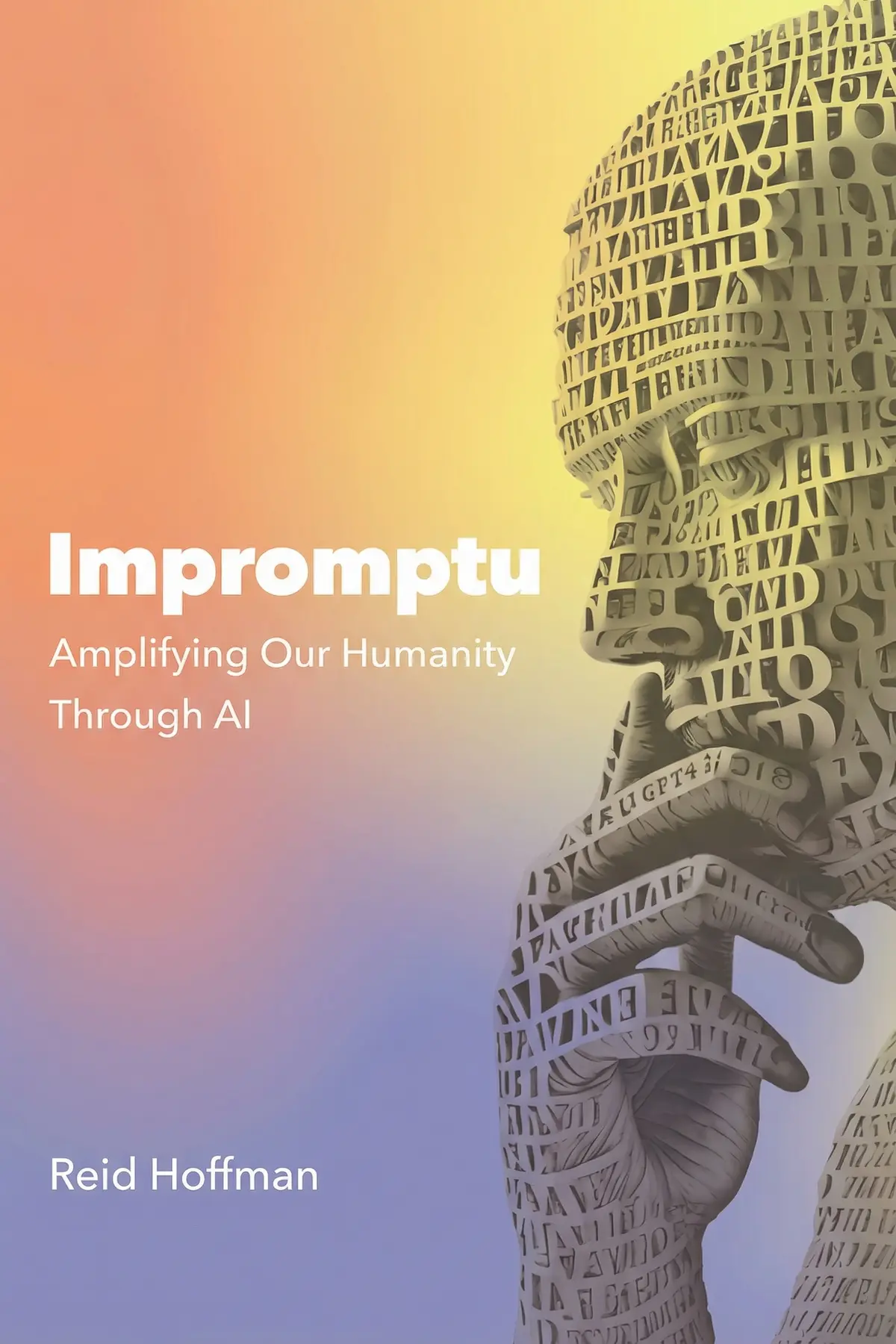
Table of Content
1. Introduction
1 min 02 sec
Most people meet AI with fear that it will replace them, or with no clear idea what it is for. In Impromptu, LinkedIn co-founder Reid Hoffman offers a third response: treat a model like GPT-4 as a partner that multiplies what humans do well. Pose the question of the number of restaurant inspectors needed to change a light bulb, and it offers two replies: one, provided safety rules are followed, or four, the last of whom writes a citation over the wrong wattage.
GPT-4 is a Large Language Model, a system that draws on huge amounts of written text to produce believable answers from a short prompt, and Hoffman built much of the book from its replies to his questions. His throughline is that such tools can lift what people achieve in classrooms, studios, courts and newsrooms, as long as humans keep the judgment, checking and rules the machine cannot supply. What you take from it is a working sense of which tasks to hand to AI and which to keep.
2. Stop racing AI and ask better questions
2 min 14 sec
Many people saw AI in schools as a cheating machine. A beloved professor of seventy saw something else entirely, and his reasoning applies to anyone whose job involves answering questions a computer can now answer.
3. Turn one creative spark into many drafts
2 min 04 sec
A machine that writes passable songs in the style of John Lennon sounds like bad news for musicians. Hoffman asks what would happen if Lennon himself held the tool, and the answer changes who the threat is aimed at.
4. Legal help that no longer depends on wealth
2 min 11 sec
AI in courts and policing makes many people nervous, and with good reason. Hoffman sets out one simple rule for using it there, and shows how it could narrow the gap between rich and poor defendants.
5. Get faster news without losing the truth
2 min 10 sec
The world is producing more data than anyone could read in millions of years, and almost none of it is news. AI can find what matters faster, but it also has a habit no newsroom can tolerate.
6. Spot the four ways AI gets things wrong
2 min 07 sec
Respected critics once called a now trusted website irresponsible and a danger to the public. Hoffman uses that history to put AI’s errors in proportion, then shows which kind of mistake deserves your closest attention.
7. Conclusion
1 min 14 sec
Impromptu is an argument about who stays in charge. In every field Hoffman visits, GPT-4 does something people find slow or dull: drafting lesson plans, sketching songs, sorting contracts, transcribing interviews. And in every field, its value depends on a person who decides which question to ask, which draft to keep and which claim is true. The book itself works this way, built from the author’s prompts and the machine’s replies, with Hoffman choosing what to keep.
He admits the dangers, from biased algorithms to confident falsehoods, and argues that progress has never come without risk. His larger worry lies elsewhere: that people will let the tool replace the values, creativity and judgment that make them human, when they should expect more of themselves as the tool grows stronger.
The habits that follow are modest. Spend your effort on the questions a machine would never think to ask. Request many rough versions and do the choosing yourself. Check every confident claim before it travels further.
The restaurant inspector joke is a fair picture of the deal. The machine can offer two answers, and a person still decides which one to use.
About this book
What is this book about?
Most people meet generative AI with one of two reactions. Some fear it will replace them. Others are unsure what it is really good for. Reid Hoffman offers a third view: a Large Language Model such as GPT-4 is a partner that can multiply human abilities, as long as people stay in charge of it. To make the case, Hoffman did something unusual. He built much of the book by questioning GPT-4 directly, about education, creativity, justice and journalism, and then weighed its answers. The result covers a professor who rushed to bring ChatGPT into his lessons, a thought experiment about a machine writing songs like John Lennon, AI that might have caught Bernie Madoff sooner, and a fact-check button under every news article. Hoffman is open about the risks, from biased algorithms to confident falsehoods, and he sorts AI's mistakes into four clear types. He also argues for perspective, comparing today's fears with the old complaints about Wikipedia. Readers come away knowing where to hand work to AI and which human skills matter more because of it.
Book Information
Who it's for
Professionals worried about AI
Professionals worried that AI will make their skills less needed and wanting a clear way to work with it.
Choosing tasks for GPT-4
Teachers, managers and creators deciding which tasks to hand to GPT-4 and which to keep.
Uneasy about AI errors
Readers uneasy about AI errors and misinformation who want a balanced, practical view.
About the Author
Reid Hoffman
Reid Hoffman is an American entrepreneur, venture capitalist, podcaster and author. He co-founded LinkedIn in 2003 and was its chief executive for its first four years, after serving as an executive vice president at PayPal. He joined the venture firm Greylock in 2009 and co-founded the AI company Inflection AI in 2022. He hosts the podcasts Masters of Scale and Possible, and he studied symbolic systems at Stanford and philosophy at Oxford as a Marshall Scholar.

Ratings & Reviews
Ratings at a glance

What people think
Listeners find this work deeply insightful regarding artificial intelligence, and one review mentions how well it examines real-world responses. Furthermore, the content is accessible and useful for learning objectives, while one listener points out the emphasis on the flexible applications of AI. They also value the informal style that strengthens human bonds, along with the captivating investigation into the subject and its hopeful outlook on what lies ahead. The prose is skillfully written, and listeners appreciate the infusion of humor throughout the text.
Top reviews
Carter
Ever wonder how the people building the future actually view these tools? Hoffman’s Impromptu is a fascinating look at the synergy between human creativity and machine logic, structured through real-time interactions with GPT-4. It’s not just a book about tech; it’s a manual for amplifying our humanity, as the subtitle suggests. The dialogues between historical figures like Plato and H.G. Wells (generated by the AI) were surprisingly witty and served as a great proof-of-concept for educational use cases. To be fair, some parts might feel outdated by next month given how fast LLMs move, but the philosophical framework Hoffman provides for the AI-human partnership is timeless. It really opened my eyes to the potential benefits of using GPT-4 in my daily workflow.
Show moreHassan
This book is an essential resource for anyone feeling overwhelmed by the recent AI explosion. Hoffman writes with a humorous, light touch that keeps the complex subject matter from feeling too dense or intimidating. I found the chapter on creativity especially eye-opening, particularly the idea that GPT-4 can serve as a tireless collaborator for artists and writers. It’s a very human-centric approach to a very mechanical subject. While the author's financial ties to Microsoft and OpenAI are clear, the insights he provides into the versatile use of these models are genuinely helpful for my own small business goals. The conversational tone makes the reading experience feel very personal. I think Reid has a great point of view and has really opened my eyes to the potential benefits.
Show moreOoi
Wow, I didn't expect to enjoy this as much as I did! Hoffman manages to create a sense of genuine human connection while discussing algorithms and neural networks. The book is structured as a series of explorations, making it easy to jump around to the topics that interest you most, whether that’s the justice system or artistic expression. It’s a very 'pro-human' book that views technology as a tool for expansion rather than a replacement for our natural talents. Even the parts that feel a bit like marketing are still packed with enough practical insight to make the read feel worthwhile and empowering. I love the idea of how GPT-4 can help with creativity and specifically writing lyrics. It is a motivating and inspiring read with a very unique ghostwriter!
Show moreElise
Picked this up because I wanted to see how a Silicon Valley heavyweight actually uses GPT-4 day-to-day. The conversational style makes it feel like you're sitting in on a high-level brainstorming session, which is refreshing compared to drier tech manuals. I particularly enjoyed the section on how LLMs can overhaul our justice system—it's an optimistic take that we rarely hear in the typical AI doomsday cycle. My only gripe is that it feels a bit like a victory lap for OpenAI given Hoffman’s board seat at Microsoft. He does disclose the conflict, but the bias is evident throughout the chapters. Still, the practical examples of prompt engineering are gold for anyone trying to stay relevant in this fast-moving field. It is well worth the few dollars for the ebook version.
Show moreStella
After hearing about this on a few podcasts, I decided to dive in, and I'm glad I did. The book does an excellent job of de-mystifying the concept of 'prompts' and turning it into a recognizable craft that anyone can learn. I loved the optimistic view of the future where AI doesn't replace us but acts as a force multiplier for our own curiosity and work ethic. Some of the AI-generated lyrics and poetry were a bit cringey, but they served the purpose of showing the current limits of the tech. Look, it’s a quick read, it’s cheap, and it gives you a front-row seat to how the tech elite are thinking about the next decade of human progress. Even with the Microsoft bias, the versatile use cases for education make it a worthwhile read.
Show moreWatcharee
As someone who spends way too much time on ChatGPT, I found this to be a well-executed analysis of where we’re headed. The book avoids the usual doomsday rhetoric and instead focuses on how we can use these tools to solve real-world problems in education and governance. I appreciated the transparency regarding how the book was put together, even if some of the AI’s responses were a little long-winded and lacked the 'moral authority' a human writer brings. The truth is, the world is changing, and this serves as a solid bridge between the old way of working and the new AI-integrated reality. It’s not a deep technical dive, but it’s a great high-level strategic overview that manages to stay engaging throughout.
Show moreOtt
This is a time-sensitive but incredibly thought-provoking look at the current state of GPT-4. I picked it up mainly for the prompt examples, and I wasn't disappointed—Hoffman illustrates how the way we ask questions determines the value of the answers we get. While it’s true that some of the specific technical details are already becoming obsolete as newer models drop, the fundamental principles of AI-human collaboration are solid. To be fair, you have to take the optimism with a grain of salt given the author's background on the Microsoft board, but his vision for a more efficient and creative society is hard to ignore. It’s a fast, engaging read for anyone in the tech space or anyone curious about how AI will integrate into our society, for good and bad.
Show moreWanida
Finally got around to reading this, and while the price point for the ebook is a steal, I’m left with mixed feelings. On one hand, the exploration of how AI can assist in the legal and educational sectors is genuinely enlightening and easy to grasp for a non-techie like myself. On the other hand, the book leans very heavily into the 'everything is great' camp, brushing over the ethical nightmares of hallucinations and data privacy far too quickly. It's essentially a long-form advertisement for GPT-4 wrapped in a philosophical wrapper. Personally, I found the constant quoting of the AI a bit tedious after a while. If you can look past the obvious conflict of interest, there’s some practical advice on prompting that's worth the hour it takes to skim through.
Show moreEli
The chapter on education was the highlight for me, as it paints a vivid picture of personalized learning that could actually help overworked teachers. However, the rest of the book felt a bit like a collection of ideas expanded into a PDF. There’s a lot of focus on the 'what' but not enough on the 'how' when it comes to the risks of these Large Language Models. Personally, I would have liked more depth on the technical side and fewer pages of GPT-4 talking to itself in the voices of dead philosophers. It’s an interesting experiment in book publishing, but it lacks the weight of Hoffman’s previous work like 'The Start-up of You.' It's a decent read if you want to understand the Silicon Valley perspective, but take it with a grain of salt.
Show moreYongyut
Not what I expected from someone of Hoffman’s caliber. The 'co-author' gimmick with GPT-4 wears thin after the first fifty pages, leading to a structure that feels disjointed and repetitive. It’s hard to shake the feeling that this was rushed out to capitalize on the ChatGPT hype cycle before the technology moved on. Frankly, seeing a billionaire pitch his own investment while ignoring the labor concerns of the teachers and artists he claims to be 'empowering' felt a bit tone-deaf. There are a few interesting thought experiments regarding the future of public intellectuals, but they are buried under mountains of AI-generated fluff that I could have prompted myself for free. The whole thing could have been a series of blog posts or even a long Twitter thread. Disappointing.
Show moreQuestions about this book
What is the main idea of Impromptu by Reid Hoffman?
Hoffman argues that Large Language Models like GPT-4 can amplify human abilities in education, creativity, justice and journalism. The machine drafts, sorts and summarizes, while people keep the judgment: choosing the questions, picking the best output and checking facts. He wrote much of the book by questioning GPT-4 and weighing its replies, and he calls for careful regulation so that the tool supports human values instead of replacing them.
What are AI hallucinations according to Impromptu?
Hoffman describes four types. The AI may produce plain nonsense, which is easy to spot. It may give a convincing but wrong answer, which is harder because the model speaks with confidence. It may claim abilities it lacks, such as feeling love or cooking. Or a person may deliberately feed it false information to cause harm. He expects these errors to shrink as the models improve and rules develop.
How does Impromptu say AI will change education?
Through professor Stephen Mintz, the book argues that humans should stop competing with AI on tasks it already does well and focus on asking good questions, learning skills outside its training data and acting on its insights. GPT-4 itself suggested personalized tests and lesson plans, group problem-solving games and AI-run debates, while warning that cost and privacy concerns could limit the benefits to a privileged few.
How can I apply the ideas in Impromptu at work?
Separate the parts of your job a machine can match from the questions only you would ask, and put your effort there. Ask AI for several rough versions of an idea and do the choosing yourself, as Hoffman imagines John Lennon doing with songs. Treat confident AI answers as leads to verify, and favor projects that give individuals more power over faceless automated processes.
Who should read Impromptu?
It suits knowledge workers, teachers, managers and creators who want a hopeful but realistic picture of what GPT-4 can do in their field. It also fits readers concerned about bias, misinformation and AI mistakes, since Hoffman addresses each one directly. Its examples range from classrooms and recording studios to police body cameras, court briefs and the Bernie Madoff fraud.
Readers also enjoyed










AUDIO SUMMARY AVAILABLE
Listen to Impromptu in 15 minutes
Get the key ideas from Impromptu by Reid Hoffman, plus 5,000+ more nonfiction titles.
- 5,000+ titles
- Listen as much as you want
- 7-day free trial
- Cancel anytime









