

15 min 06 sec
Available in: English
How You Say It: Why We Judge Others by the Way They Talk―and the Costs of This Hidden Bias – A Social Psychology Study of Speech Prejudice, Identity, and Social Justice
Explains why accents and speaking styles shape how we judge people, often more than looks do. It shows how this bias forms in infancy, what it costs in jobs, housing and courts, and why early bilingualism helps.
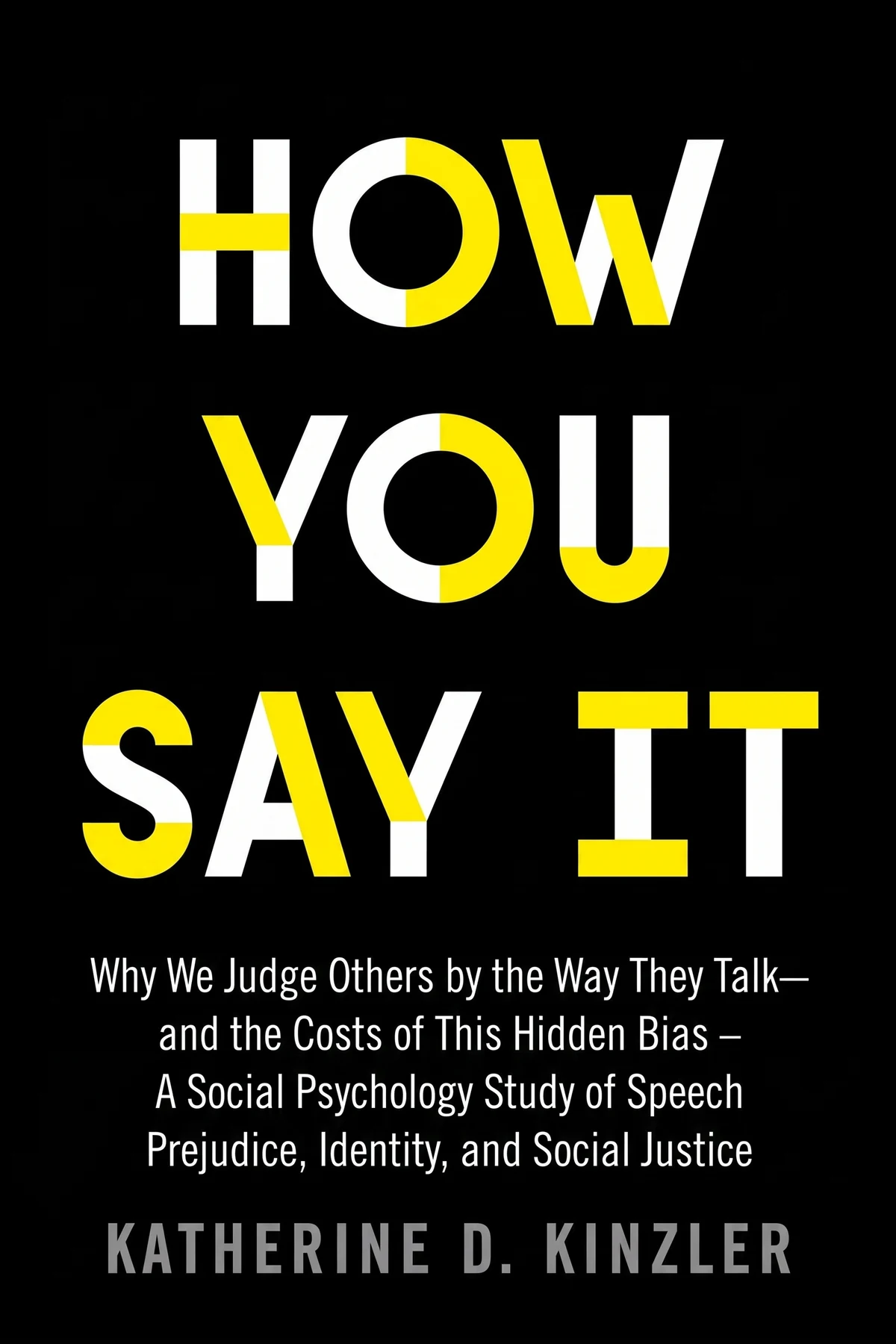
Table of Content
1. Introduction
1 min 01 sec
If you have ever been judged by your accent, or judged someone else by theirs without noticing, the cause goes deeper than manners. In How You Say It, University of Chicago psychologist Katherine D. Kinzler argues that the way a person talks shapes how others see them more than their face does. In one study she describes, people sorted faces by skin tone until they heard those faces speak, and then the accent decided everything.
Kinzler’s case is that speech is among the oldest ways humans divide the world into us and them. The habit starts before birth and still decides who gets hired, housed and believed. Follow her argument and conversations start to sound different. You will hear the group signals packed into a single vowel and catch the moment an accent tilts a judgment at work. You will also see why giving children a second language early may be one of the fairest gifts a society can offer.
2. Hear the group identity inside every accent
1 min 52 sec
A Texas filmmaker’s voice changed after he came out, though nothing about his body had. His story, and two high school cliques who said one vowel differently, reveal what our speech is really announcing.
3. Your voice outweighs your face in first impressions
1 min 40 sec
Researchers asked people to label faces as German or Italian, and skin tone guided every choice. Then the faces started talking, and the participants changed their answers in a way few would predict.
4. Spot the accent lessons children absorb early
1 min 40 sec
Babies who cannot yet speak already choose whom to trust, and family films may be teaching them which voices belong to villains. The experiments show how early the sorting begins.
5. Teach languages while the brain is still open
1 min 52 sec
Two great novelists wrote brilliant English, yet one spoke it with a far lighter accent than the other. The difference came down to a governess, and it explains why age seven matters so much.
6. Read the power struggle behind language rules
2 min 00 sec
In 1976, furious students filled the streets of Soweto, South Africa, to protest a law dictating which language their schools could use. Their anger points to a struggle that still shapes offices and classrooms.
7. Catch accent bias before it costs someone
1 min 56 sec
A veteran with a law degree topped every other applicant on the exam and still lost the job, and then lost in court. The research on why listeners struggle with accents is more uncomfortable than it sounds.
8. Raise sharper thinkers with two languages
1 min 55 sec
For decades, experts warned parents that two languages would confuse a child. Better research turned that warning on its head, and the possible benefits reach from childhood puzzles to old age.
9. Conclusion
1 min 10 sec
Kinzler’s book leaves you with an odd new awareness: a voice works like a passport, and most of us approve or reject it without thinking. The instinct that once helped a forager trust a familiar sound now leads a hiring panel to pass over a top-scoring candidate, a seller to turn away a buyer with the same income, and a jury to weigh one witness above another. The bias starts in the cradle, gets reinforced by cartoon villains and is still widely treated as acceptable, even by a court.
So it is worth catching in yourself. When an accent makes someone seem harder to follow, less capable or less trustworthy, pause and ask whether the same words would sound different in a voice like yours. If you run meetings or classes, make room for the people linguistic insecurity keeps silent. And if there are children in your life, give them more than one language early, before seven if you can, and protect the one they speak at home.
Remember the students of Soweto, who marched for the right to learn in their own words. How someone sounds can tell you where they grew up. It tells you nothing about what they can do.
About this book
What is this book about?
We rarely talk about it openly, but people judge one another by accent, pronunciation and tone. Psychologist Katherine D. Kinzler argues that speech is one of the oldest and deepest ways humans sort the world into us and them. In some studies it outweighs even skin color. Kinzler traces the bias from the womb, where babies begin tuning in to their mother's language, through playgrounds and cartoon villains, and into adult life. A highly qualified job candidate is rejected for his accent. Home buyers with identical incomes get different answers. Jurors trust some witnesses more than others. She also shows how language has been used as a weapon, from apartheid South Africa to Franco's Spain, and why so many capable speakers stay silent out of linguistic insecurity. The book closes with a hopeful case. Children who grow up with two languages lose nothing, and they may become more flexible thinkers who find it easier to read other minds. Readers learn to hear the hidden signals in everyday speech, catch their own snap judgments and see why giving children languages early matters for a fairer society.
Book Information
Who it's for
Recruiters and managers
Managers and recruiters who want to catch snap judgments about how candidates and colleagues sound.
Accent-conscious second-language speakers
Non-native speakers who hold back at work or in class because of their accent.
Teachers and parents
Parents and teachers deciding whether to raise children with more than one language.
About the Author
Katherine D. Kinzler
Katherine D. Kinzler is a professor of psychology at the University of Chicago. Her research studies the links between language and socialization, including how the way people speak shapes how they interact with one another. Besides publishing in many academic journals, she has written for the New York Times and Quartz.
Ratings & Reviews
Ratings at a glance

What people think
Listeners find the book immensely accessible and engaging, offering profound perspectives that cover a broad spectrum of topics. Furthermore, the prose is exceptionally well-crafted, and they value the material on language development, with one listener noting how language and accent serve as powerful markers of the social world. However, the content elicits some divided feedback, as one listener found the ten-page afterword wildly off-topic.
Top reviews
Rung
Wow, I had no idea my own unconscious prejudices were so deeply tied to the way people speak rather than just what they are saying. This book provides a fascinating examination of linguistic bias and the social assumptions we make the second someone opens their mouth. Kinzler’s research is eye-opening, especially regarding how we treat non-native speakers or those with regional dialects. It made me realize how I’ve benefited from certain linguistic privileges while unknowingly judging others for theirs. The writing style is incredibly well-written and engaging, making complex sociological concepts feel personal and urgent. It’s a powerful look at language as a marker of identity that has genuinely changed my world view. I cannot recommend this enough if you're interested in human psychology.
Show moreJom
This book should be required reading in our current social climate where we are finally starting to talk seriously about bias. We often focus on visual cues, but Kinzler proves that "how you say it" is just as significant in shaping our social world. The research on how linguistic markers influence everything from employment to basic human empathy is both shocking and necessary to understand. I found myself reflecting on my own experiences with regional accents and how they’ve shaped my career. Truth is, we all have these biases, and this book gives us the tools to start recognizing and dismantling them. It’s an excellent, insightful read that manages to be both scientifically grounded and deeply human. I'll be thinking about these studies for a long time.
Show moreMaja
Finally got around to reading this and the timing couldn't be more perfect given how much we are discussing systemic prejudice right now. This book is so insightful because it highlights a form of discrimination that is often socially acceptable or even encouraged. I’ve realized I’m guilty of linguistic prejudice in subtle ways, especially when listening to non-native English speakers, and this book helped me understand why that happens. The research is presented brilliantly, covering a wide array of topics from childhood development to legal implications. It’s an uncomfortable truth to face, but I’m grateful for the awareness this book provided. If you want to be a better communicator and a more empathetic human being, you need to read this. It’s absolutely fascinating.
Show moreRin
As someone who has always been fascinated by how we communicate, this was a real eye-opener regarding our hidden linguistic biases. Kinzler dives deep into how we use speech to categorize others, often without even realizing we are doing it. I found the sections on how children develop these social assumptions particularly brilliant and well-researched. To be fair, the book does lean heavily on an American perspective, but the core lessons about how accents serve as powerful social markers are universal. It’s written in a very accessible way that doesn’t require a PhD in linguistics to follow along. While some of the points felt a bit drawn out and repetitive, the overall insight into our "native" prejudices is invaluable for anyone trying to be a better listener.
Show morePop
Ever wonder why you automatically trust some voices more than others or why certain accents make people sound "smarter" in your head? Kinzler tackles these uncomfortable questions head-on, exploring the connection between language, culture, and our innate desire to form "in-groups." The chapter on how infants prioritize native speakers was particularly fascinating and helped explain why these biases are so hard to shake as adults. Personally, I found the insights into language development to be the strongest part of the book. While the middle sections dragged slightly and could have been tightened up, the overall message about the power of speech is incredibly relevant. It’s a readable, thoughtful exploration of a social marker we often ignore in favor of race or gender.
Show moreEye
Kinzler presents a compelling case for why we need to stop judging people by how they sound. This book is a highly readable exploration of how language functions as a primary social glue, often trumping other physical markers in how we categorize "us" versus "them." I loved the data-driven approach, even if some of the psychology felt a bit simplified for a general audience. To be honest, I never realized how much linguistic prejudice I carried until I read the sections on foreign accents and non-standard dialects. The book is well-written and manages to be educational without feeling like a textbook, though the afterword did feel a bit disconnected from the rest of the work. Overall, it’s an insightful read that provides plenty of food for thought.
Show moreNikolai
After hearing a podcast interview with the author, I was eager to dive into the full text and it did not disappoint. The book offers a brilliant look at how language and accents serve as powerful markers of our social identities and the world around us. Kinzler’s tone is analytical yet accessible, making the scientific studies feel relevant to everyday life and interactions. I particularly enjoyed the discussion on bilingualism and the social advantages of being exposed to multiple ways of speaking from a young age. My only real criticism is that the focus stays very narrow at times, and I would have loved to see more global examples. Regardless, it’s a fascinating look at a topic that deserves way more attention in public discourse.
Show moreLayla
The central premise here is definitely intriguing, but the execution felt a bit uneven for my taste. I appreciated the deep dive into how accents influence our perceptions of others, yet I felt like I had encountered much of this content in similar psychology books before. It’s a solid 3-star read that offers a decent look at linguistic discrimination without necessarily breaking new ground for seasoned readers of the genre. One minor gripe: the book is very American-centric, which makes some of the specific dialect examples feel less relatable if you aren't from the States. Still, the author’s tone is friendly and the research is presented in a way that is easy to digest. It's fine for a casual read, but don't expect a revolutionary academic breakthrough.
Show moreKenji
Not what I expected at all when I picked this up based on the interesting cover and premise. While the initial chapters on how we perceive different accents were somewhat engaging, the narrative quickly devolved into what felt like a dry, repetitive expository essay. Frankly, the author spends a lot of time rehashing the same few points about social categorization through speech without adding much new depth as the book progresses. It felt like pop psychology at its most surface level, occasionally misconstruing complex studies to fit a very specific narrative about communication. I struggled to stay focused, and by the time I reached the afterword—which felt completely off-topic—I was just ready to be done. It’s a pass for me.
Show moreKasemsan
I really tried to get into this one, but it felt incredibly repetitive after the first few chapters and ultimately missed the mark. The author takes a few interesting studies on language development and stretches them out into a full-length book that could have been a long-form article. Look, the core idea is important, but the writing style felt more like an over-explained essay than a cohesive narrative. I also found some of the conclusions to be a bit of a stretch, as if the data was being forced to support a specific pop-psychology agenda. To make matters worse, the ending of the book wanders off into topics that felt totally unrelated to the primary thesis of linguistic bias. It was quite boring and honestly a chore to finish.
Show moreQuestions about this book
What is the main idea of How You Say It by Katherine Kinzler?
Kinzler argues that people judge each other by the way they speak, often more than by how they look. Accent and speaking style mark us as insiders or outsiders, a bias that begins in infancy and may be older than race as a dividing line. It shapes who gets jobs, homes and credibility in court, and it is widely accepted rather than challenged.
Is accent more important than race in how people judge others?
In studies Kinzler describes, it often is. People asked to label faces as German or Italian first sorted them by skin tone, but once the faces spoke, they labeled anyone with perfect German as German regardless of skin. Children choosing playmates from photos picked kids of their own race, yet when voices were added they chose kids who shared their accent instead.
Does raising a child bilingual slow their development?
No, according to Kinzler. Older studies that claimed delays mixed up language with economic hardship. When both languages are counted, bilingual children know as many words as monolingual ones; they just use each language for different topics. Bilingual children often think more flexibly, solve problems better and find it easier to imagine others’ thoughts, and bilingualism may help guard against dementia later in life.
How can I reduce accent bias at work?
Start by questioning the feeling that someone is hard to understand. Kinzler reports that students wrote down accented speech without trouble when told the speaker was a native, so expectation drives much of the difficulty. Notice whether hiring or credibility judgments lean on how a person sounds, and watch for capable colleagues who stay silent because of linguistic insecurity.
Why is it harder for adults to learn a language without an accent?
Young brains are more flexible. Kinzler reports that the ability to master a new language starts to decline around age seven and levels off by about 20. In a sign language study, people who learned as infants or toddlers were fluent, while those who learned as adolescents still made errors decades later. Adults can learn well, but most keep some accent.
Readers also enjoyed


Acting with Power: Why We Are More Powerful Than We Believe
Deborah Gruenfeld



Afropean: Notes From Black Europe
Johny Pitts

Age of Propaganda: The Everyday Use and Abuse of Persuasion
Anthony Pratkanis



All About Love: New Visions
bell hooks
AUDIO SUMMARY AVAILABLE
Listen to How You Say It in 15 minutes
Get the key ideas from How You Say It by Katherine D. Kinzler, plus 5,000+ more nonfiction titles.
- 5,000+ titles
- Listen as much as you want
- 7-day free trial
- Cancel anytime









