
14 min 40 sec
Available in: English
How We Learn: The Surprising Truth About When, Where and Why It Happens
Shows how the brain stores and retrieves what you learn, and how spacing study sessions, testing yourself, sleeping well and varying practice help you keep more without studying longer.
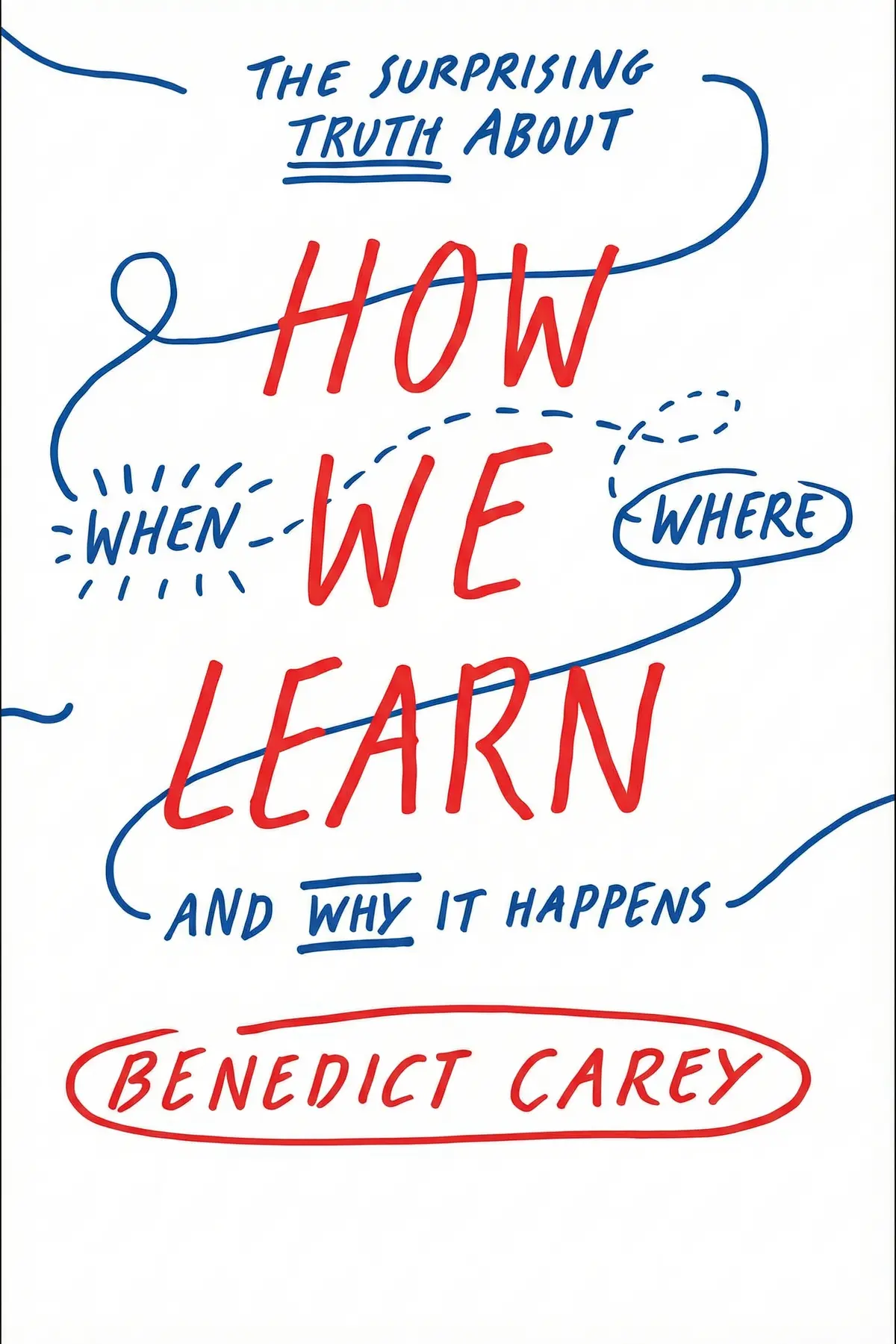
Table of Content
1. Introduction
1 min 01 sec
Most people study the way they were taught: one quiet desk, long sessions, rereading until the page looks familiar, and a late night before the test. In How We Learn, science reporter Benedict Carey argues that much of this works against the brain. Cramming may get you through tomorrow’s exam, yet the same nine hours spread over three days would stay with you far longer, at no extra cost in time.
Carey’s case is that memory follows rules of its own, and that learning gets easier once your routines follow those rules instead of fighting them. Spacing, self-testing, variety, sleep and even interruptions all help, often in ways that feel wrong at first. The evidence includes a memory study with colored eggs, blindfolded children tossing beanbags and medical students who learned to read skin rashes in a glance. What you get is a set of study habits to try on your next course, exam or new skill.
2. Give each memory more ways back in
1 min 51 sec
Some memories stay sharp for decades while a name heard five minutes ago vanishes. The difference lies in how the brain files what it takes in, and in how many separate places it can look later.
3. Spread the same study hours across more days
1 min 42 sec
A name heard a few times at a party is usually gone by the time you leave, yet hearing it again a few days later helps it stick. That odd pattern explains why the night-before cram fails you.
4. Test yourself before you think you're ready
1 min 42 sec
Rereading your notes feels like progress, yet it may be the weakest way to study. Students who took a quiz on material they had never seen gained something rereading could not give them.
5. Match your sleep to what you must remember
1 min 44 sec
Two groups saw the same colored eggs, and one remembered far more of what they learned. The question of whether to study late or rise early turns out to have a different answer for different tasks.
6. Change the room and the drill
2 min 00 sec
A favorite desk and a coach’s endless repetition both seem like good discipline. A music experiment and a group of blindfolded children suggest that sameness can leave your skills stuck in one place.
7. Let an unfinished task keep working for you
1 min 38 sec
Being stopped halfway through a job feels like a loss. One study found people remembered their interrupted tasks best, and that stepping away is often how stuck problems finally give way.
8. See what matters at a glance, like an expert
1 min 47 sec
An experienced pilot reads a wall of dials in one look while a beginner drowns in them. That kind of fast judgment usually comes from long experience, but medical students trained it another way.
9. Conclusion
1 min 15 sec
How We Learn takes the familiar picture of the good student, the one who sits in the same chair for hours and finishes everything in a single push, and shows how much of it works against memory. The brain Carey describes prefers coming back to material after a gap, effortful recall over rereading, a proper night’s sleep, variety in place and practice, and even the occasional interruption. None of it demands more hours. It asks you to arrange the hours you already have.
That makes the changes easy to try. Take the time you would have spent cramming and spread it across several days, opening each session with a few questions before you look at your notes. Move between rooms, or between laptop and paper, and mix different kinds of problems instead of drilling one. Before a fact-heavy test, go to bed early; when the task needs creativity, study late but protect the hours before dawn. And when you are stuck, walk away and let the unfinished problem keep working.
The neighbor’s name you forgot at the party sticks the second time you hear it. Learning well, for Carey, mostly means arranging that second time.
About this book
What is this book about?
Most of us were taught to study one way: a quiet desk, long sessions, plenty of rereading and a late night before the exam. Benedict Carey, a science reporter, argues that many of these habits work against the brain, and that learning becomes easier once your routines follow the rules memory actually runs on. He starts with how memories form, as networks of linked brain cells that strengthen each time we recall them, and then turns that biology into practice. Spacing the same study hours across several days beats cramming. Quizzing yourself, even before you know a topic, beats rereading. The stage of sleep you protect depends on whether you need facts or fresh ideas. Changing where and how you practice makes skills travel to new situations, and interruptions can help you remember a task and see a problem anew. Along the way come a sleep study with colored eggs, blindfolded children tossing beanbags, a UCLA experiment with early quizzes and medical students trained to read skin rashes at a glance. Readers get study routines they can use for an exam, a new job or a skill picked up later in life.
Book Information
Who it's for
Students cramming for exams
Students who cram before exams and forget everything a week later.
Professionals learning new skills
Professionals learning a new field, tool or language around a full workday.
Teachers and lifelong learners
Lifelong learners and teachers who want study habits grounded in how memory actually forms.
About the Author
Benedict Carey
Benedict Carey is a science journalist. Born in San Francisco in 1960, he began reporting on health and medicine at the Los Angeles Times in 1997 and moved to The New York Times as a science reporter in 2004. Besides How We Learn, his books include Poison Most Vial and The Unknowns.
Ratings & Reviews
Ratings at a glance
What people think
Listeners find the material highly educational, with one listener highlighting the abundance of evidence-based illustrations, and they value its user-friendly take on the science of learning. The structure is well-organized, and listeners consider the ideas both clear and stimulating, effectively debunking typical misunderstandings. They describe it as a pleasant experience with strong anecdotes, though perspectives on the narrative quality are divided.
Top reviews
Weera
Finally, a book that validates my messy habits by explaining the power of interleaving and spaced repetition. In my experience, most advice tells you to focus on one thing until you master it, but Carey proves that mixing it up is actually superior. The idea that forgetting is a functional part of building stronger memories blew my mind. I have started applying the 1/3 study to 2/3 rehearsal ratio he suggests, and the results are already visible in my daily workflow. It is an incredibly accessible guide for anyone who wants to stop fighting against their brain’s natural rhythms and start working with them. If you want to maximize your time, ignore the old-school rules and lean into the chaos. This is easily one of the best books on learning science I have ever found.
Show moreWanida
Ever wonder why a good night’s sleep seems to magically solve the math problem you were struggling with the night before? Truth is, Carey explains this phenomenon through the lens of memory consolidation and REM cycles in a way that is both fascinating and practical. I loved the concept of the "left brain interpreter" and how our minds construct narratives even when information is missing. This isn't just a book for students; it is a manual for anyone who uses their brain for a living. The chapters on "incubation" and "percolation" are absolute game-changers for creative professionals who feel like they are constantly hitting a wall. Sleep is not a waste of time. It is actually the moment your brain organizes your world. This changed my entire perspective on rest.
Show moreDuang
Carey has a way of making high-level cognitive science feel like a casual conversation over coffee. The most fascinating section for me was on "interleaving," which is the idea that practicing different skills in one session is better than repetitive drills. It is counter-intuitive, but the data he presents is hard to argue with, especially regarding motor skills and academic learning. By forcing the brain to constantly adjust to new types of problems, we build a deeper level of mastery. This book is an essential read for teachers, coaches, or anyone trying to pick up a new hobby in their spare time. It turns everything we know about practice on its head. I am recommending this to everyone in my study group. Truly enlightening stuff.
Show moreGun
As someone who always felt guilty for procrastinating, Carey's insights into the "percolation" of ideas felt like a personal redemption. He breaks down the science of why our brains need those breaks to actually solve complex problems. To be fair, some of the historical context regarding clinical trials felt a bit dry, but the payoff in practical strategies is immense. I particularly appreciated the discussion on varying your study environment to avoid being tied to a specific desk or room. It is a relief to know that my restless nature might actually be an asset to my learning process rather than a hindrance. If you have ever felt stuck, this book provides a roadmap for letting your subconscious do the heavy lifting. I am definitely going to experiment with his suggestion of changing up locations during my work week.
Show moreOtt
After hearing about the "spacing effect" for years, it was refreshing to see the actual data behind it presented so clearly here. Personally, I found the breakdown of the "Four Bahrick Study" to be one of the most compelling parts of the entire book. It is a bit denser than your average self-help title, but the structured approach to explaining how we retain information makes it worth the effort. My only gripe is that the author downplays the initial effort required before "distraction" becomes useful. You still have to put in the hard work first. That is a detail that could easily be missed if you are reading too quickly. Regardless, the advice on self-quizzing and avoiding the illusion of knowing is worth the price of admission alone.
Show moreAnchalee
This book changed the way I look at my own "failures" during self-testing, showing they are actually vital steps in the learning process. Not gonna lie, I used to hate getting questions wrong on practice exams. Now I see those moments as the best way to destroy the fluency illusion that plagues so many students. Carey’s tone is conversational and light, which makes the complex neuroscience of "perceptual intuition" much easier to digest. It is packed with research-backed examples. These challenge the traditional "sit still and focus" mantra we were all taught in school. Even if you only apply two or three of these techniques, you will see a massive improvement in your ability to recall information. It’s an empowering read for anyone who has ever felt like they were bad at studying.
Show moreMichael
Picked this up on a whim and was pleasantly surprised by how much it challenged my existing study habits. To be honest, I always thought that a quiet, dedicated study space was the gold standard, but Carey argues that environmental variety is actually the key to robust memory. The advice to vary your location or even the time of day you study is so simple yet backed by decades of research. While the book can be a bit chatty at times, the core message is powerful. Our brains are evolved for foraging, not just rote memorization. It is a thought-provoking look at the "lazy" habits we usually try to suppress. I wish I had read this back in college; it would have saved me so many nights of useless cramming.
Show moreBoss
The writing style in this one is definitely an acquired taste. It is almost like a spongecake that has way too much air and not enough substance at times. Gotta say, while the research is clearly there, the author often buries the lead under a mountain of chatty personal anecdotes and long-winded histories of scientists. I found myself skimming through the parts about split-brain surgery just to get to the actual tips for retention. The section on the "fluency illusion" was a standout, though, explaining why we often think we know material better than we do. It is a decent read if you have the patience for his storytelling, but it will not be for everyone. I think a more direct approach would have served the scientific content better.
Show moreLars
The first chapter started strong with some wild stories about epilepsy surgery and the brain's internal storyteller, but then it got a bit muddy. Look, I understand that forgetting is supposedly "good" for us, but the way it was explained in Chapter Two left me more confused than enlightened. I had to go back and re-read several sections just to find the actual takeaway among all the anecdotes. There is some brilliant advice in here about pre-testing and the value of ignorance, but you really have to dig for it. It feels like a 50-page toolkit trapped inside a 250-page narrative, which can be frustrating for busy readers. It is informative, certainly, but the organization left a lot to be desired for a book about efficiency.
Show moreJoseph
Not what I expected at all, and frankly, it was a bit of a slog to get through even half of it. I was looking for a concise guide on how to study better. Instead, I got a memoir-style dive into the history of psychology. There are just too many irrelevant personal stories that distract from the core scientific principles he is trying to convey. If you want the same information without the fluff, I would suggest picking up "Make It Stick" instead. It is much more direct. It does not spend chapters wandering around the point before finally arriving. I appreciate the effort, but the signal-to-noise ratio is just too low for my liking. It feels like the book is trying too hard to be approachable.
Show moreQuestions about this book
What is the main idea of How We Learn by Benedict Carey?
Carey argues that memory follows its own rules, and that studying works better when routines follow them. Memories form as networks of brain cells that strengthen with each recall. So spacing sessions, testing yourself, sleeping well, varying where and how you practice, and allowing interruptions all help you retain more, often without adding any study time.
What is the spacing effect in How We Learn?
The spacing effect means information sticks better when you return to it after a gap than when you repeat it many times in one burst. Carey’s example is a test two weeks away with nine hours to study: three sessions of three hours on different days beat nine hours the day before, using exactly the same total time.
Does sleep help you remember what you studied?
Yes, according to Carey. In one study, people who slept before a test remembered 93 percent of a set of egg rankings, against 69 percent for those who did not. He adds that early-night sleep helps with facts, so go to bed early before a vocabulary test, while early-morning REM sleep supports creative thinking.
How can I apply How We Learn to my studies or work?
Spread study time across several days instead of cramming. Quiz yourself before and after reading, or explain the material to someone. Change locations and formats, such as handwriting one day and typing the next. Practice varied versions of a skill. Take breaks when stuck, and for pattern recognition, train with many quick examples, as medical students did with images of skin rashes.
Who should read How We Learn?
It suits university students trying to raise their grades, professionals picking up new skills on the job and retirees learning for pleasure. Anyone who rereads notes, crams the night before or practices one drill endlessly will find concrete alternatives backed by the studies Carey describes, from blindfolded beanbag tossing to early quizzes at UCLA.
Featured in
Readers also enjoyed

AUDIO SUMMARY AVAILABLE
Listen to How We Learn in 15 minutes
Get the key ideas from How We Learn by Benedict Carey, plus 5,000+ more nonfiction titles.
- 5,000+ titles
- Listen as much as you want
- 7-day free trial
- Cancel anytime









