

11 min 51 sec
Available in: English
How to Win at the Sport of Business: If I Can Do It, You Can Do It
By Mark Cuban
Mark Cuban shows how he went from sleeping on a friend's floor to owning an NBA team, and which habits of learning, effort, focus and customer care any beginner or small business owner can copy.
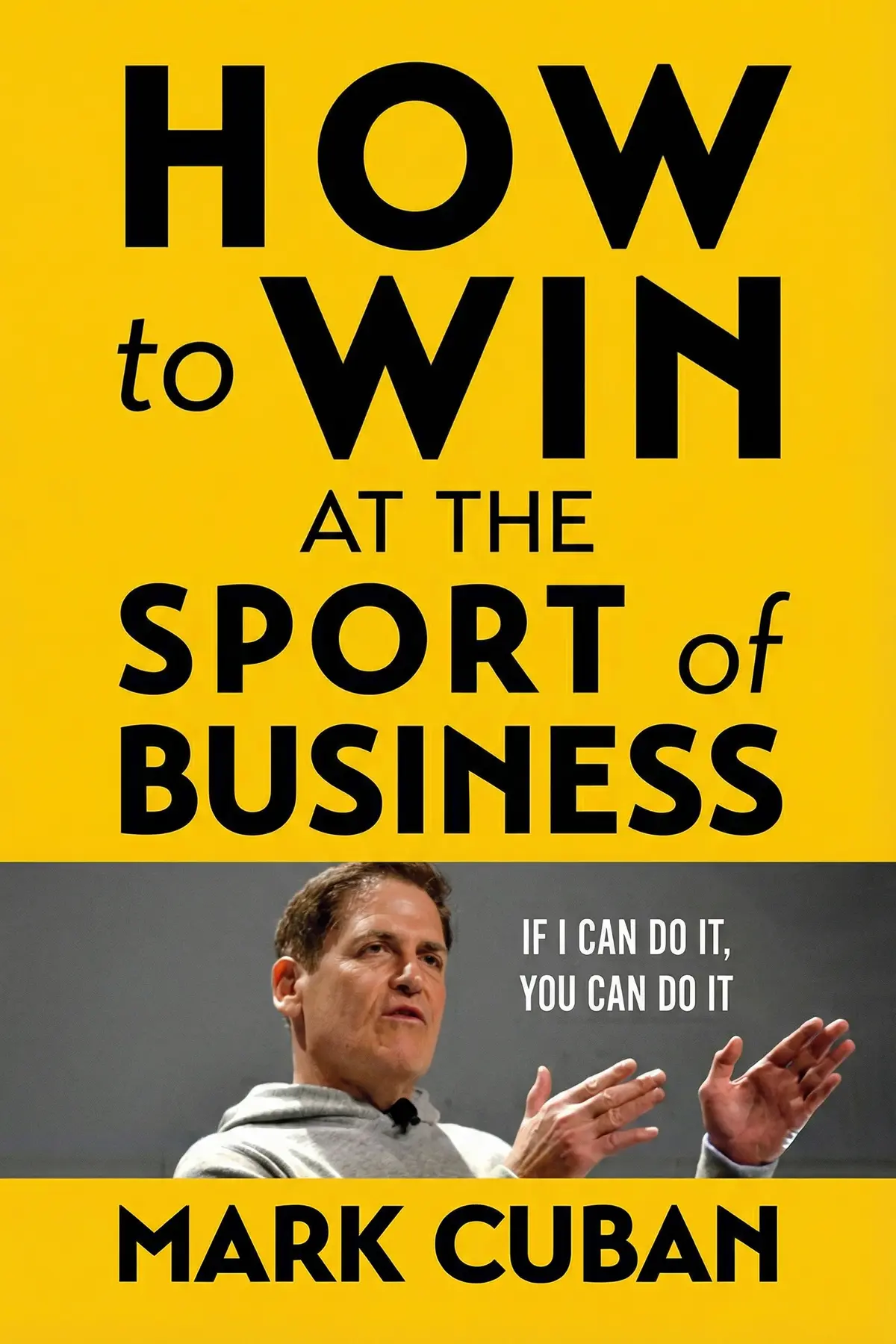
Table of Content
1. Introduction
58 sec
A first job or a small company can feel like a place you will never leave, yet Mark Cuban began in Dallas sleeping on a borrowed floor and later sold a business to Yahoo for $5.9 billion. In How to Win at the Sport of Business, Cuban argues that he covered that distance with habits anyone can copy. He sees business as a game that never stops. You cannot control the score, but you can always control your preparation and your effort.
That is the thread running through his advice: learn more than your rivals, work harder, say no to distractions, grow at a pace that keeps you in charge and stay closer to your customers than anyone else. Along the way come a $99 computer, a secretary who stole nearly all the company’s money, two-dollar basketball tickets and an unexpected defense of whining. What it adds up to is a set of plain rules for your next job or your first company.
2. Collect skills before you hunt for the perfect job
1 min 38 sec
Cuban was fired from one of his first jobs for trying to make the company better. That setback, and a cheap computer bought soon after, taught him what a first career move is really for.
3. Out-learn the rivals who want your business
1 min 40 sec
Somewhere a competitor is studying your weak spots right now. Cuban’s answer is a habit most people skip and an exercise that feels strange at first: attacking your own company before anyone else does.
4. Own your effort and guard your focus
1 min 38 sec
Working harder sounds like the whole answer, until success starts sending offers your way. When there was talk in the NBA of expanding internationally, Cuban said no, and his reason says a lot about where effort should go.
5. Grow slowly with people who care as much
1 min 44 sec
When cash runs short, a big investor can look like a rescue. Cuban sees a different risk in that deal, and he built his first company another way, starting with one friend who went all in.
6. Turn a good complaint into your next move
1 min 41 sec
Most of us are taught that complaining is weak and unattractive. Cuban disagrees, and one lackluster opening night at a Mavericks game left him convinced he could do better, so he bought the team.
7. Win by sitting where your customers sit
1 min 27 sec
Cuban could have watched every game from the best seat in the arena. He chose somewhere else, and the reason explains why he kept reading complaints long after becoming a billionaire.
8. Conclusion
1 min 05 sec
Cuban’s story works as proof more than as instruction. A young man with a broken-down car and a borrowed floor became the owner of an NBA team, and the book argues that the path between those two points was built from ordinary choices made with unusual consistency. He studied while others relaxed, worked when others stopped, refused distractions, kept control of his companies and never moved far from his customers. Business, in his telling, is a sport with no final buzzer, and the players who stay in it longest tend to win.
That gives you a simple place to begin. Treat your current job as paid training, and read about your field every day. Play your own rival for an hour and repair the weakness you uncover. When something annoys you, turn the complaint into a plan, then check that plan against what your customers actually experience, from the seats where they sit.
Cuban started with a $99 computer he had to teach himself to use. What he never ran short of was effort, and that part is open to everyone.
About this book
What is this book about?
Many people feel stuck in a first job, or in a small company that seems likely to stay small forever. Mark Cuban started in Dallas with a broken-down car and a borrowed floor to sleep on. He went on to build MicroSolutions, sell Broadcast.com to Yahoo for $5.9 billion and buy the Dallas Mavericks. His book argues that the habits behind that climb are open to anyone. Cuban treats business as a competition that never ends. Rivals are always looking for a way in, so he urges readers to out-learn and out-prepare them, to work harder than they think they should, and to refuse opportunities that pull them off course. He warns against handing control to big investors, makes the case for slow growth with committed teammates, and even defends whining as the first step toward fixing a problem. Readers get a short, direct set of rules for building a career or a company. Each one rests on Cuban's own story, from teaching himself to program on a $99 computer to selling $2 tickets and sitting among ordinary fans.
Book Information
Who it's for
Unsure about first jobs
Graduates and young professionals unsure whether their first jobs are leading anywhere.
Tempted by fast funding
Small business owners tempted by fast funding or every new opportunity that comes along.
Curious about NBA ownership
Sports fans curious how a borrowed floor turned into ownership of an NBA team.
About the Author
Mark Cuban
Mark Cuban was born in Pittsburgh in 1958 and started in business young, selling garbage bags and handling newspapers during a strike. After graduating from Indiana University Bloomington, he founded the computer consulting firm MicroSolutions, which he sold to CompuServe in 1990. With Todd Wagner he started Broadcast.com, an early internet audio streaming service later sold to Yahoo!. He bought the Dallas Mavericks in 2000, and the team won the NBA championship in 2011. He appeared as an investor on Shark Tank from 2012 to 2025.
Ratings & Reviews
Ratings at a glance
What people think
Listeners find this business book to be a superb brief read that offers valuable life wisdom and actionable commercial tips. The content is easy to digest, taking just about 100 pages to cover everything, and listeners consider it a great value. They appreciate the inspirational tone, with one listener remarking that it serves as an excellent quick-hitter for business and motivation.
Top reviews
Gabriel
Mark Cuban is exactly who you think he is—blunt, driven, and unapologetically ambitious. This isn't a long-winded autobiography that takes weeks to finish; instead, it’s a punchy collection of his most impactful blog entries. I particularly appreciated the raw stories from his early days, like when he was sleeping on the floor and driving a beat-up car. It’s refreshing to see a billionaire admit that success often starts with a lot of "dumb" mistakes and a high tolerance for grind. The 12 mantras at the end provide a solid framework for anyone looking to sharpen their business edge. Truth is, for less than the price of a coffee, you get direct access to one of the sharpest minds in the NBA. Some parts feel a bit repetitive, and the editing isn't perfect, but the motivation factor is off the charts. If you need a quick-hitter to get your head back in the game, this is it.
Show moreSirinat
Ever wonder what a billionaire's mindset looks like before the private jets and NBA championships? Cuban lays it all out here by focusing on the grit required to move from nothing to something. I loved the details about his two cheap polyester suits and the general chaos of his early career. It humanizes him in a way that "Shark Tank" usually doesn't. He doesn't sugarcoat the fact that he was often just winging it, fueled by a desire to win at the "sport" of business. The writing style is very conversational and direct, which makes it an easy read for a busy afternoon. My favorite takeaway was the emphasis on time being more valuable than money. It's a cliché, sure, but the way he frames it within his own failures makes it resonate differently. Not gonna lie, I felt significantly more productive the morning after I finished this. Definitely worth the small investment.
Show moreParichat
Wow, this was a surprisingly punchy read for under three dollars. Most business books are filled with 300 pages of fluff to justify a $25 price tag, but Cuban keeps it lean. He gets right to the point about what it takes to scale a business and stay ahead of the competition. I found his perspective on the NBA lockout and his "win-win" negotiation tactics to be very insightful. The way he describes the thrill of the "game" makes business feel much more exciting than a standard 9-to-5 grind. I did find the formatting a bit flimsy, and the text size is oddly small in some sections. Despite that, the "12 Mantras" section at the end is pure gold. If you're looking for deep academic theories, look elsewhere. But if you want some "time-worn and tried" principles from a guy who actually did it, this is a steal.
Show morePairot
The chapter on the twelve mantras for success is worth the price of admission alone. I've read several books by "sharks," and this one feels the most authentic to the author's voice. Mark Cuban doesn't care if he comes across as rude or intense; he just wants to get "it" right. His advice on "pigs get fat, hogs get slaughtered" has already changed the way I look at my current contract negotiations. The book is short—around 100 pages—which makes it the perfect thing to read on a flight or during a long lunch break. It’s motivational without being cheesy, mostly because the advice is backed by his actual experiences in the trenches. While I didn't agree with every single one of his thoughts, particularly his stance on yelling in the workplace, there is enough treasure here to make it a must-buy. It’s a great addition to any business library.
Show moreAurora
Picked this up on a whim because of the low price tag and finished it in a single sitting. For three bucks, you really can’t complain about the value provided here. While it's true that this is essentially a curated list of blog posts, having them organized chronologically makes the narrative of his rise much clearer. You get to see the transition from a party-loving college grad to a tech mogul who was willing to stay up all night reading manuals. Frankly, his advice on sales—the idea that you aren't just selling, but helping—is a lesson every young entrepreneur should tattoo on their brain. I did notice one blog post appears twice under different titles, which is a bit of a sloppy editing oversight. Regardless, the substance outweighs the minor formatting quirks. It’s a fast, energetic read that reminds you that being "right once" is all it takes to change your life forever.
Show moreRodrigo
After hearing Cuban on Shark Tank for years, I finally decided to see what his 'sport' was all about. This eBook is a collection of his best online writing, and honestly, the editing makes it much more digestible than the raw blog feed. He talks a lot about his time at MicroSolutions and the sheer amount of effort he put into learning the PC industry while it was still in its infancy. It makes you realize that his success wasn't just a lucky break during the dot-com bubble. He did his homework. The book is quite short, maybe 73 pages or so, but it's packed with practical tips on management and sales. I was especially fond of the mantra about "no balls, no babies"—it’s classic Cuban. There are a few typos here and there, and the transition between tenses can be jarring. However, the energy of the prose is infectious enough that you just keep turning pages.
Show moreSureerat
This book won't give you a step-by-step blueprint for a startup, but it will definitely light a fire under you. It’s more about the psychology of winning than the logistics of running a company. Cuban emphasizes that you only have to be right one time to be set for life. That single thought is incredibly liberating for someone who has faced multiple failures. The stories of his early "unplanned" life were fascinating, even if he spent a lot of time partying back then. He makes it clear that while he was having fun, he was also outworking everyone else in the room. Some might find the tone a bit arrogant, but I think it’s just authentic to who he is. Look, for the price of a snack, you get a front-row seat to the evolution of a billionaire. It’s a great quick-hitter for anyone who needs a kick in the pants.
Show moreWachira
As an entrepreneur struggling with the day-to-day grind, reading about Mark's early failures was incredibly validating. We often see the billionaire version of these people and forget they once slept on couches and drove cars that barely started. This collection of blog posts captures that "hustle" phase perfectly. He doesn't shy away from his mistakes or the times he was just plain lucky. It's a very fast read, which is perfect for my schedule. The truth is, his advice on "random acts of kindness" being a business tool was a nice, unexpected touch. It shows a different side of the "Maverick" persona. Some of the storytelling jumps around because of the blog-post format, but the central message remains consistent throughout. It’s a solid reminder that business is a competitive sport, and you have to be ready to play every single day.
Show moreGung
To be fair, I expected something a bit more substantial than a glorified blog archive. If you have already spent hours digging through "Blog Maverick" over the years, there isn't much here that will surprise you. The book is incredibly thin—barely 100 pages—and some of the formatting still feels like it was copied and pasted without much thought. He brushes past the massive Broadcast.com sale quite quickly, which felt like a missed opportunity to discuss the nuances of timing versus skill. That said, I can’t deny the guy’s passion. His "pigs get fat, hogs get slaughtered" mentality is a great reminder for negotiators. Personally, I think it’s a decent buy for college students who need a reality check on what "working hard" actually looks like. Just don't go in expecting a deep dive into corporate strategy or complex financial modeling.
Show moreTen
Not what I expected in terms of depth, though the value is certainly there if you haven't read his blog before. I’ll be frank: if you’re looking for a traditional biography, this isn't it. It’s a patchwork of entries that sometimes feels a bit disjointed. I also wish he had spent more time on the technical aspects of how he sold Broadcast.com instead of just the emotional "mantras." It feels like he attributes a lot to "hard work" while downplaying the once-in-a-lifetime market conditions he benefited from. However, his principles for college graduates are actually quite stellar. They provide a much-needed dose of reality for young people entering the workforce. It’s a reasonable story and an affirmation of some useful life principles, even if it lacks the polish of a professional ghostwriter. For three bucks, it’s hard to stay mad at the lack of original content.
Show moreQuestions about this book
What is the main idea of How to Win at the Sport of Business?
Mark Cuban argues that business is a competition that never ends, and that anyone can win it through steady learning, hard work, focus and attention to customers. He tells his own climb from sleeping on an acquaintance’s floor in Dallas to founding MicroSolutions, selling Broadcast.com to Yahoo for $5.9 billion and buying the Dallas Mavericks, and he presents each step as something a reader can copy.
What does Mark Cuban say about venture capital?
Cuban warns that money from big investors can harm a small company. A venture capitalist may help early on, but whoever pays for your business gains control over it, and if you miss your promises you can even be replaced. He prefers slow growth with a small, committed team, the way MicroSolutions began with just Cuban and his friend Scott.
Why does Mark Cuban say whining is good?
In his view, the urge to complain shows that something is wrong and motivates you to fix it, while holding it in keeps you stuck. His own example is the Mavericks’ 1999 opening night, when he disliked the lack of energy in the arena and then bought the team to improve it. He adds that a complaint must lead to action and to work your team loves.
How can I apply Mark Cuban's advice at work?
Treat each job as a chance to build skills, and read about your field while others relax. Imagine you are a competitor and find your own weak spots before someone else does. Say no to opportunities that pull you away from your main goal. Experience your product as an ordinary customer would, as Cuban did by sitting among regular fans, and read the complaints yourself.
Who should read How to Win at the Sport of Business?
It suits graduates who feel pressure to find the perfect first job, early-career professionals who want to get ahead, and small business owners weighing outside funding or fast growth. It is short and built on Cuban’s personal story, so it works best for readers who want direct rules backed by one entrepreneur’s experience.
Readers also enjoyed



Alibaba: The House That Jack Ma Built
Duncan Clark



7 Powers: The Foundations of Business Strategy
Hamilton Helmer
Bad Blood: Secrets and Lies in a Silicon Valley Startup
John Carreyrou
AUDIO SUMMARY AVAILABLE
Listen to How to Win at the Sport of Business in 15 minutes
Get the key ideas from How to Win at the Sport of Business by Mark Cuban, plus 5,000+ more nonfiction titles.
- 5,000+ titles
- Listen as much as you want
- 7-day free trial
- Cancel anytime









