
13 min 13 sec
Available in: English
How to Solve It: A New Aspect of Mathematical Method
By George Pólya
A mathematician's method for hard problems: understand what is being asked, connect it to problems you already know, check every step, look back for lessons, and handle the frustration of being stuck.
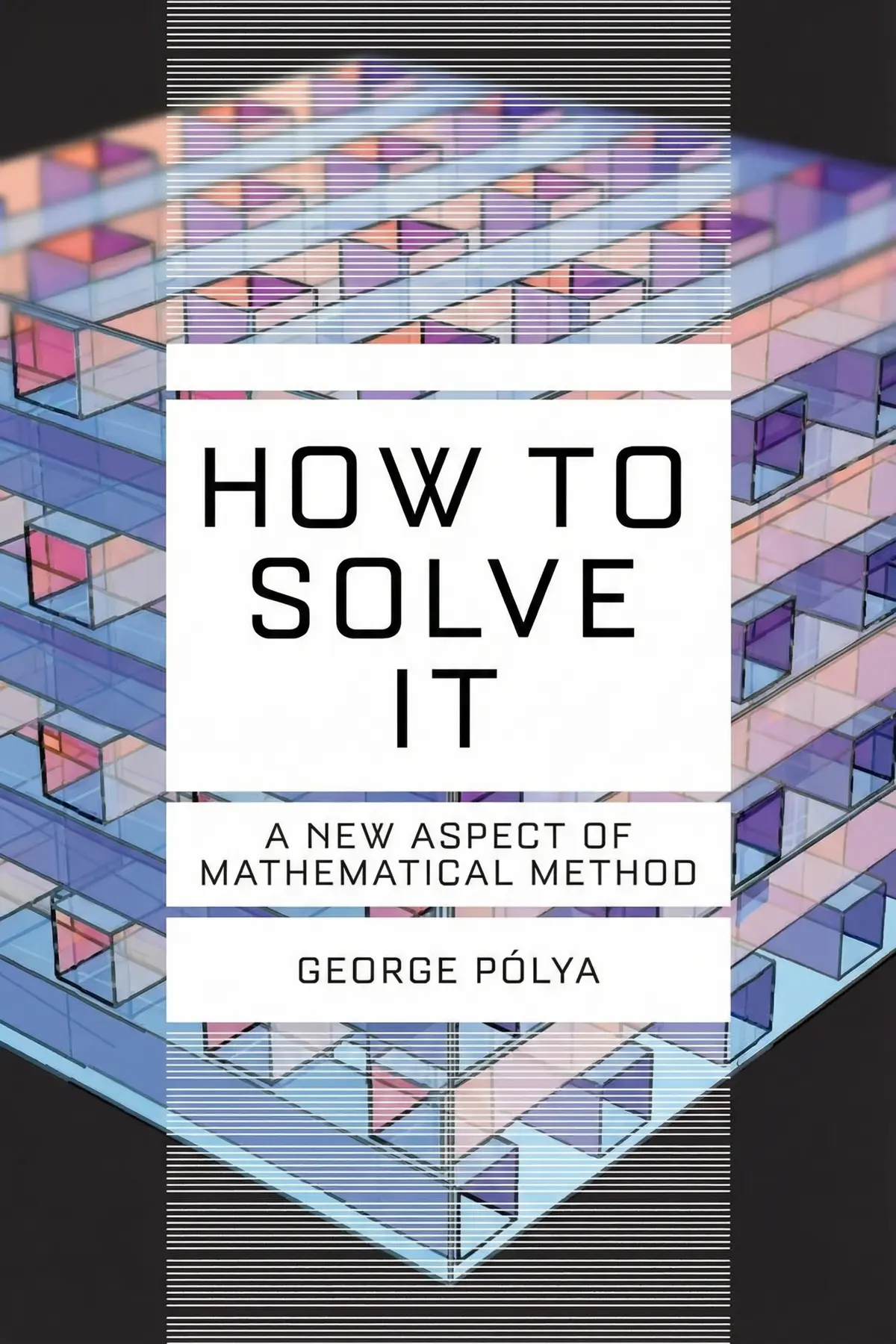
Table of Content
1. Introduction
55 sec
Most people stuck on a hard problem do the same thing: they start pushing numbers or ideas around before they know what is being asked. In How to Solve It, the mathematician George Pólya, who taught at ETH Zürich and later at Stanford, argues that strong problem solvers do the opposite. They pause, look and ask questions first. That same thinking once guided sea traders plotting routes and helped astronomers predict eclipses, and you rely on it when you split a dinner bill or fit luggage into a car boot.
His central claim is that problem solving is a method you can learn, in stages. You understand the problem. You find a plan by linking it to something you know. You carry it out in checked steps, then look back and keep what you learned. Pólya also covers the mental side of being stuck. By the end you will have questions to ask yourself the next time something looks impossible.
2. Read the problem before you reach for tools
1 min 54 sec
Grabbing the calculator feels like progress, yet it is often the reason a problem stays hard. A square drawn inside a triangle shows what strong solvers do in the first minute, before any work begins.
3. Turn a new problem into one you've solved
1 min 49 sec
Finding the center of a pyramid sounds like a fresh challenge. It stops being one the moment you notice a familiar shape hiding inside it, and that noticing is a skill you can practice.
4. Catch mistakes by checking from a second angle
1 min 46 sec
An error made early can sit unnoticed until everything built on top of it collapses. Pólya borrows a habit from detectives to find those errors while they are still cheap to fix.
5. Make a problem smaller, bigger or simpler
1 min 55 sec
Sometimes the fastest way through a stubborn problem is to make it larger. That sounds backward, and it is only one of four ways Pólya reshapes a question until it gives way.
6. Turn every solved problem into a shortcut
1 min 39 sec
The moment you finally get the answer feels like the finish line. Pólya treats it as the step that turns a single solution into lessons for later problems, and explains why notes that feel like extra work end up saving you time.
7. Step away and let the answer arrive
2 min 03 sec
Hours of effort produce nothing, then the answer shows up in the shower. Pólya explains why that pattern is no accident, and how to read the signals that tell you it is time to stop.
8. Conclusion
1 min 12 sec
Pólya’s method can sound like common sense until you notice how rarely anyone practices it. Most people jump in, push hard, and either guess right or give up. He describes a calmer loop. Look carefully. Connect the new to the known. Move in checked steps, then look back and keep what you learned. Even the hours of being stuck have a place in that loop, since failed attempts and well-timed breaks prepare the answer that eventually arrives. The thinking that guided sea traders and eclipse-watching astronomers works just as well on a schedule, a budget or a career choice.
A good place to begin is one problem you face this week. Write down what you want to find, what you already know and how the two connect. Then ask what it reminds you of, and borrow that method. When you reach an answer, test it from a second direction before you trust it. And when your thinking starts going in circles, stop and walk away for a while.
The square inside the triangle became easy to draw once someone stopped to ask what a square demands. Most hard problems are waiting for that same pause.
About this book
What is this book about?
Most people facing a hard problem start pushing numbers or ideas around before they know what is being asked. Then they either guess right or give up. George Pólya, a mathematician who spent decades teaching students, argues there is a better way, and that anyone can learn it. His method moves through stages. First, understand the problem by asking what you want to find, what you already know and how the two connect. Next, find a plan by spotting a problem you have solved before that works the same way. Then carry out the plan in small, checked steps, testing the result from more than one direction. Finally, look back at the finished solution to find shortcuts and methods you can reuse. Pólya adds tools for problems that resist a first attempt: splitting them into parts, using analogy, widening the problem and testing simple special cases. He also deals with the mental side of the work, including frustration, breaks and the unconscious mind. Readers get a set of questions to use on geometry exercises, budgets, career decisions or a stuck colleague.
Book Information
Who it's for
Students and professionals
Students and professionals who freeze on hard problems or jump in before they understand them.
Wanting better guiding questions
Team leads and teachers who want better questions to ask someone who is stuck.
Hoping to solve faster
Analysts and builders who solve similar problems again and again and want shortcuts.
About the Author
George Pólya
George Pólya (1887 to 1985) was a mathematician who taught at ETH Zürich from 1914 to 1940 and at Stanford University from 1940 to 1953. His research covered probability theory, complex analysis, number theory, combinatorics and numerical analysis, and he is also known for his studies of heuristics and of how mathematics is taught. How to Solve It forms a trilogy with Mathematics and Plausible Reasoning and Mathematical Discovery. His honors include the Lester R. Ford Award and the American Mathematical Society's award for Distinguished Service to Mathematics.
Ratings & Reviews
Ratings at a glance

What people think
Listeners find this work to be a superb manual for tackling problems, specifically in mathematics, and they value its useful directions. Furthermore, the text offers a methodical approach to deconstructing challenges, and one listener mentions it provides a solid foundation in problem-solving fundamentals. On the other hand, the prose is quite wordy, and though the book arrives in fine shape, some listeners find the content tedious to read.
Top reviews
Noi
Finally got around to reading this foundational text on mathematical heuristics, and I must say the logical progression is masterfully handled. While some might find the 1945 prose a bit stiff or dated, the core methodology for deconstructing complex problems remains incredibly relevant for anyone in STEM. Truth is, the famous four-step process mentioned at the beginning is worth the price of admission alone. I spent hours working through the sample problems in the back, finding the clues helpful without being overly revealing. Some sections feel slightly repetitive, yet this repetition serves to drill in the mindset required for genuine mathematical discovery. It’s not about magic tricks or shortcuts; instead, it provides a systematic way to think when you are stuck. This is an essential addition to any serious student’s library, even if you have to ignore some of the old-fashioned phrasing.
Show moreKofi
Ever wonder why some people seem to have a natural 'knack' for math while others struggle just to start a problem? Pólya demystifies this talent by showing that problem-solving is actually a systematic process that anyone can learn through practice and common sense. I love how he emphasizes that a student hasn't truly understood math until they can appreciate the idea of strict reasoning. The book doesn't offer quick fixes or esoteric knowledge; it offers a solid framework that demands active participation from the reader. My experience with the 'Short Dictionary' was mostly positive, as it allows you to dip in and out of specific strategies as needed. While the lack of female representation in the examples reflects its era, the actual logic remains universal. If you want to move beyond rote memorization and actually learn how to think, this is the gold standard.
Show moreCaleb
Unlike modern study guides that focus on rote memorization, this book asks you to slow down and truly understand the nature of the unknown. It offers no magic or tricks, only a systematic overview of how to approach a problem from multiple angles until it yields. I've found the advice about 'working backwards' and 'symmetry' to be applicable even in my non-mathematical daily work. Got to say, the author’s passion for 'strict reasoning' is infectious, even if the prose is a bit dense and wordy at times. He challenges the reader to not just solve the problem, but to look back at the solution and see if it can be improved. This reflective practice is what separates a student who just 'gets through' math from one who masters it. It’s a classic for a reason, providing a blueprint for the mind that remains remarkably sturdy.
Show morePloy
After years of hearing about the legendary 'List' from the first few pages, I finally decided to dive into the full text of Pólya’s masterpiece. What I discovered was an incredibly instructive guide that turns the 'art' of discovery into a teachable science. The author has a wonderful way of explaining complex heuristics so simply that they seem like common sense once you hear them. While the alphabetical layout of the dictionary section is a bit eccentric, the individual entries are packed with wit and historical anecdotes. It is a great example of lucid literature that transcends its specific subject matter to teach general logic. Some might find it a bit boring or 'pedestrian,' but there is beauty in the way he deconstructs the thought process. If you have ever felt defeated by a difficult problem, this book will give you the tools to fight back.
Show moreJeeranan
As a teacher who wants to inspire better reasoning skills in my classroom, I found Pólya's insights into the instructor's role to be particularly profound. The book argues that we often fail our students by focusing on facts rather than the beauty of a rigorous geometric proof. Not gonna lie, the middle section of the book is structured like a glossary, which makes a linear read quite difficult and occasionally tedious. However, the way he breaks down 'Reductio Ad Absurdum' and other strategies is remarkably lucid and accessible. You have to be patient with the verbose descriptions and the author's somewhat pedantic tone regarding terminology. If you can push past the formal language, you’ll find a treasure trove of advice on how to guide a student unobtrusively. It is a slow burn, but the fundamental concepts of looking at the unknown are timeless.
Show moreRatchanee
The 'Short Dictionary of Heuristic' section makes up the bulk of this book, and your enjoyment will depend entirely on how much you like alphabetical glossaries. Personally, I found the layout a bit frustrating because it prevents a natural flow of ideas, forcing you to jump around to connect related themes. That said, the actual content regarding the 'mental operations' of solving problems is top-notch and still feels fresh despite being decades old. Polya has a way of taking 'plain common sense' and turning it into a rigorous toolkit for the mind. Look, it’s definitely verbose, and you might find yourself skipping pages of examples that feel too basic or overly detailed. But if you are looking for a systematic introduction to the fundamentals of mathematical thought, you can't really ignore this one. It's a foundational text that has influenced almost every modern book on the subject for a reason.
Show moreMason
Pólya’s work feels more like a philosophy of education than a dry mathematics textbook, which was a pleasant surprise for me. He captures the essence of how a teacher should guide a student discreetly and unobtrusively toward their own 'aha' moment. The book is definitely a product of 1945, which means the language is formal and occasionally feels a bit full of itself. I found the examples focused on geometry to be excellent reminders of why proofs are the best examples of true evidence in our modern life. However, the organization of the 'Dictionary' section is quite strange and makes it feel more like a reference book than a cover-to-cover read. I’d recommend keeping it on your desk to consult when you’re stuck on a specific type of logic problem. It’s not a perfect read, but the core principles of decomposition and recombination are absolutely essential.
Show moreRapee
Picked this up during my undergrad because my professor mentioned it was the 'Bible' of mathematical methods, and it mostly lived up to the hype. The framework is simple yet intuitive, breaking down the act of solving into four clear phases that make even daunting problems feel manageable. I’ll admit the language is verbose and some chapters are a bit too focused on 'toy problems' that don't necessarily reflect the messiness of real research. To be fair, the book was written for a different era, so the lack of modern context is to be expected. I really appreciated the clues at the back, which provide just enough of a nudge to keep you moving forward without spoiling the answer. Even if you only read the first twenty pages and skim the dictionary, you’ll walk away with a better understanding of how to approach any difficult task.
Show moreLeah
This classic is a bit of a double-edged sword because it contains brilliant flashes of insight buried under mountains of dry, alphabetical entries. Frankly, I expected a more cohesive narrative about problem-solving rather than a dictionary of heuristics that feels disjointed and hard to navigate. While the first few pages summarize the entire method beautifully, the remaining two hundred pages often feel like they are over-explaining simple concepts. It deals primarily with well-posed toy problems, which might frustrate those looking for advice on open-ended research or real-world complexity. To be fair, the section on 'Irony' and its relation to absurdity was a clever highlight I didn't expect to find. If you are a math enthusiast, you might appreciate the historical weight of the text. For others, it might just serve as a very effective cure for insomnia due to its dense and repetitive nature.
Show moreRay
Not what I expected at all, especially considering how many people recommended this as a 'must-read' for general problem-solving skills. The truth is that the entire useful methodology could have been a five-page blog post or a simple infographic. I found the level of pedantism regarding terminology to be boringly intolerable and struggled to stay awake through the repetitive explanations. It is written in a very awkward style that targets a vague audience, hovering somewhere between high school students and professional researchers. Most of the book is just an alphabetical list of math terms and anecdotes that don't seem to lead anywhere specific. While I appreciate the 'List' at the front, the remaining 250 pages felt like a chore to get through. If you want insight into the mathematician's mind, you’d be better off reading Ian Stewart or G.H. Hardy instead.
Show moreQuestions about this book
What is the main idea of How to Solve It by George Pólya?
Pólya argues that solving problems is a method with stages that anyone can learn. First understand the problem: what you want, what you know and how they connect. Then find a plan by linking it to a problem you have already solved. Carry the plan out in checked steps, and finally look back at the solution to find shortcuts and lessons. He also covers the mental side, including frustration and breaks.
What questions does Pólya suggest asking before solving a problem?
He recommends three plain questions: what am I trying to find, what do I already know, and how are these connected. When teaching, he prefers asking a stuck student what the problem wants, what they notice about the numbers, and whether it resembles something they have solved before. These same questions work when you are the one who is stuck.
What can you do when a problem seems impossible?
Pólya offers four ways to reshape it. Break it into smaller parts, as when finding a solid’s diagonal by first working on its flat faces. Use analogy, such as linking a circle to a sphere. Make it more general, asking whether a triangle question holds for every straight-sided figure. Or test simple special cases, like triangles with equal sides or a right angle.
Does How to Solve It apply outside mathematics?
Yes. Pólya’s examples come from geometry and algebra, but the same habits apply to everyday decisions, from splitting a bill or packing a car trunk to choosing a career. Understanding before acting, borrowing methods from similar past problems, checking work from a second direction and keeping notes all carry over to budgets, projects and planning at work.
Why does Pólya recommend taking breaks while solving problems?
He argues that progress usually builds slowly through failed attempts, and that the mind has cycles of sharpness and fatigue. Signs it is time to pause include work that feels mechanical, repeated thoughts and frustration without new ideas. During a break the unconscious mind keeps reorganizing information, which is why answers often come on a walk, in the shower or after waking.
Readers also enjoyed

AUDIO SUMMARY AVAILABLE
Listen to How to Solve It in 15 minutes
Get the key ideas from How to Solve It by George Pólya, plus 5,000+ more nonfiction titles.
- 5,000+ titles
- Listen as much as you want
- 7-day free trial
- Cancel anytime









