

15 min 40 sec
Available in: English
 ไทย
EnglishไทยHow to Avoid a Climate Disaster: The Solutions We Have and the Breakthroughs We Need
By Bill Gates
Bill Gates splits the world's 51 billion tons of yearly greenhouse gases into five everyday activities. He shows how to judge any climate fix by its share of that total and by the extra cost of going clean.
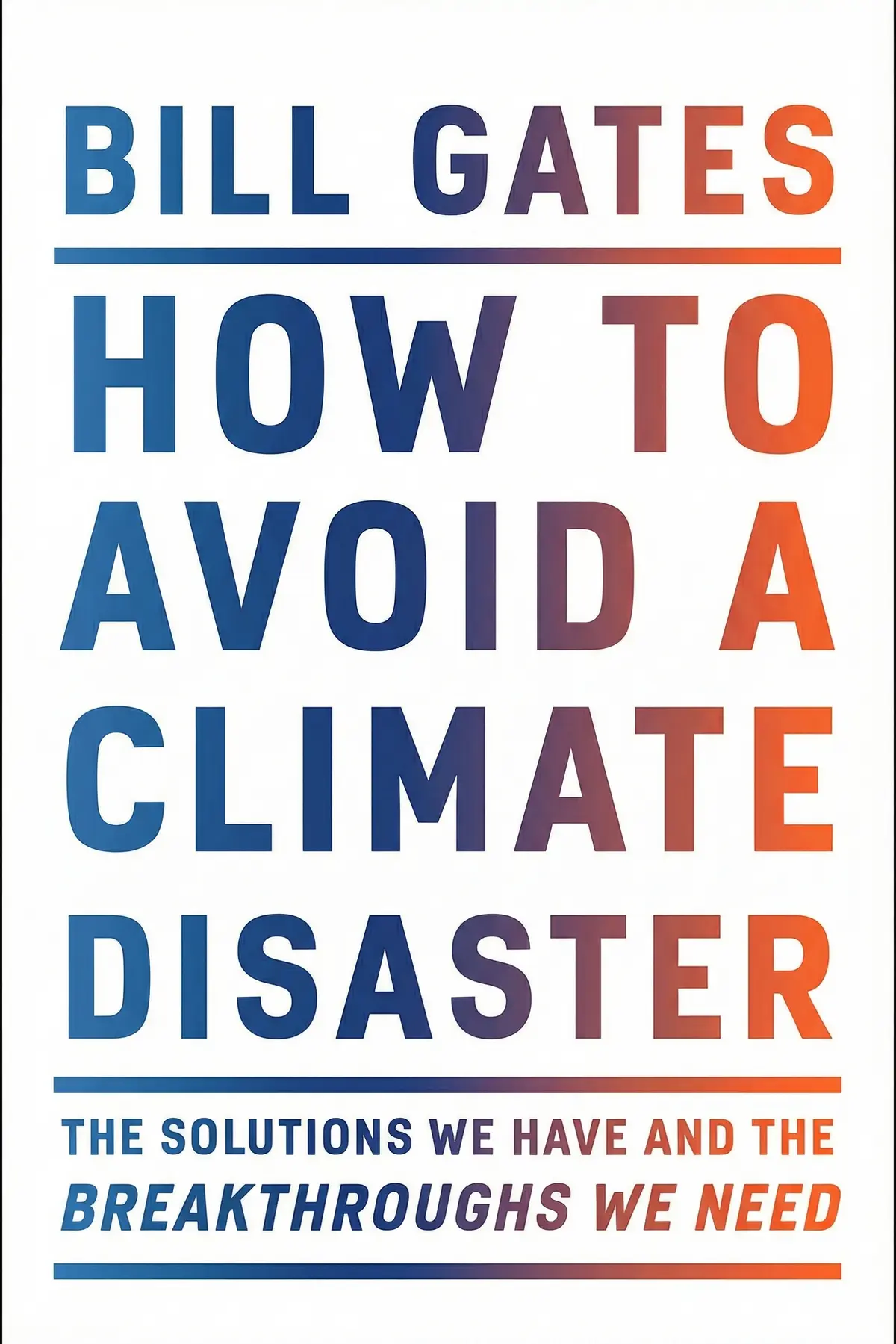
Table of Content
1. Introduction
59 sec
Climate news buries most of us in figures with no way to tell which fixes matter, yet one number sorts them all: humanity adds about 51 billion tons of greenhouse gases to the air each year. In How to Avoid a Climate Disaster, Bill Gates, the Microsoft co-founder who has spent millions backing clean energy ventures, argues that the only safe target for that number is zero, reached by 2050. The gases linger for tens of thousands of years, so any amount still flowing keeps the planet warming.
His case is that the task is hard but solvable once you break it into five parts of daily life. Then you test every proposal with two questions: how much of the 51 billion tons does it remove, and how much extra does the clean version cost? With those tests, a headline becomes something you can check. Your vote, your purchases and your company’s budget become places where you can push.
2. Cutting emissions halfway still lets the bathtub overflow
1 min 40 sec
A desert city where Microsoft was born is heading for twice as many scorching days. Gates explains why slowing emissions, the goal most pledges settle for, cannot stop that trend from getting worse.
3. See every emission in five everyday activities
1 min 32 sec
Most people blame cars and planes first. Gates sorts the world’s emissions into five groups, and the ranking upsets common assumptions about what is heating the planet and why it is so hard to stop.
4. Judge any climate fix by share and price
1 min 34 sec
A pledge to cut millions of tons of emissions sounds like a breakthrough. Gates shows how a little division and one simple cost comparison can reveal whether a promise is big or barely visible.
5. Back the grid upgrades that make clean power work
1 min 45 sec
Wind and solar keep getting cheaper, yet most of the world’s power still comes from burning fuel. The obstacle Gates identifies is not the one most headlines focus on, and it shapes where hope should go.
6. Turn the dirtiest materials into a carbon store
1 min 44 sec
Steel and cement release staggering amounts of carbon, and plastic has the worst reputation of all. Gates argues that one of these three materials could end up working for the climate instead of against it.
7. Shrink your food footprint with three habits
1 min 44 sec
Dinner turns out to warm the planet more than driving does. Gates traces the hidden sources, from the trash can to a farming advance that once cut world hunger, and shows where ordinary people can act.
8. Know which vehicles and homes can go electric now
1 min 51 sec
One Chinese city has already switched its entire bus fleet, yet cargo ships and jets cannot follow. Gates explains where electric options work today, where they fail, and which home upgrade can lower your bills.
9. Push leaders toward zero with real standards
1 min 41 sec
Preparing for a hotter world carries a huge price tag, and Gates does not hide it. He makes the case that the spending pays for itself, and he warns against a popular kind of target.
10. Conclusion
1 min 10 sec
Gates hands his reader a map with prices printed on it. Climate change stops being a fog of guilt and headlines and becomes 51 billion tons divided among five parts of ordinary life, each with a cleaner option and a premium standing in its way. Some premiums have nearly vanished, as with wind and solar in Germany and Denmark. Others, like electrofuels at 237 percent, show where research money and policy still have the most work to do. The deadline is set by the bathtub: while any drip continues, the water keeps rising.
That gives you something to do with the next climate story you meet. Divide the promised cut by 51 billion before you are impressed. Ask what the clean version costs next to the old one, and who could close the gap. At home, the book points to a heat pump, smaller meat portions and less food in the bin. At work and in politics, it points to standards with consequences attached.
Zero by 2050 is a hard number. Gates’s whole argument is that it is also a reachable one.
About this book
What is this book about?
Each year, people put about 51 billion tons of heat-trapping gases up into the atmosphere, and the total continues to climb. Those gases stay there for tens of thousands of years, so Bill Gates argues that cutting back is not enough. The world has to reach net zero by 2050. Gates has spent millions on clean energy ventures, some failed and some promising. He breaks the problem into five parts of ordinary life: making things, electricity, food, transport, and heating and cooling. For each he explains where the emissions come from, from cement kilns and fertilizer to air conditioners, and which clean options exist. His central tool is the Green Premium, the extra cost of doing something the clean way, which shows where research money and policy are needed most. Readers get a clear frame for judging climate claims and a realistic view of what electric vehicles, batteries, nuclear power and carbon capture can and cannot do yet. They also get concrete actions for households, business leaders and voters, from heat pumps and less food waste to internal carbon taxes and letters to elected representatives.
Book Information
Who it's for
Professionals following climate news
Professionals who read climate headlines and want a simple way to tell real progress from noise.
Investors and business leaders
Founders, managers and investors deciding which clean technologies and internal policies deserve their money.
Wanting practical climate steps
Homeowners and citizens who want concrete steps, from heat pumps and diet to pressing their representatives.
About the Author
Bill Gates
Bill Gates grew up in Seattle, Washington, and met Paul Allen at Lakeside School. He entered Harvard in 1973 and left in 1975 to co-found Microsoft with Allen, then served as its CEO for 25 years. He now chairs the Gates Foundation. He also founded Breakthrough Energy, which works to bring clean energy and other climate technologies to market, and TerraPower, which invests in nuclear technology. In 2010 he and Warren Buffett launched the Giving Pledge.
Source Code: My Beginnings
Bill Gates
Ratings & Reviews
Ratings at a glance

What people think
Listeners find this book on climate change to be highly educational and accessible, providing a wealth of crucial data and statistics. The writing is skillfully composed, with one listener pointing out its neutral, non-political tone, and listeners generally value the direct communication and practical mindset. Additionally, the text offers an all-encompassing look at the climate situation alongside viable plans for improvement. Listeners ultimately consider the work to be motivating and a great investment.
Top reviews
Amy
This book provides a roadmap that feels both incredibly ambitious and deeply grounded in reality. Bill Gates isn't interested in selling a fantasy where we all just stop using energy tomorrow; instead, he explores how we can continue to prosper while swapping out the 'dirty' parts of our infrastructure. Personally, I found his breakdown of the five key areas where emissions come from—making things, plugging in, growing things, getting around, and staying warm—to be the most helpful part of the whole text. It makes the massive scale of the climate crisis feel organized and solvable. While some might find his optimism a bit jarring given the current political climate, it’s refreshing to see someone focus on what is possible through innovation. This isn't just another airport shelf-filler. It’s a genuine attempt to provide a blueprint for the next few decades of human history.
Show moreAir
As someone who stays away from partisan debates, I truly appreciated how Bill Gates managed to keep this book relatively nonpolitical. He approaches the climate crisis as a math problem, which is exactly how we should be looking at it if we want to find real answers. The concepts are explained with such simplicity that even someone without a science background can grasp the stakes. In my experience, most environmental books are either too academic or too emotional, but this hits the perfect middle ground. The focus on 'Green Premiums'—the cost difference between a clean technology and one that emits carbon—is a brilliant way to quantify the challenge ahead. It’s an inspiring read that doesn’t shy away from the hard numbers. Gates shows that while the path is difficult, it isn't impossible if we align our global economies.
Show morePraepimon
Wow, I finally feel like I understand the 51 billion number that gets tossed around so much in the news. This book is an essential primer for anyone who wants to participate in the climate conversation without feeling lost in the jargon. Gates breaks down the science into manageable bits, making it feel more like a high school science lesson than a lecture. The truth is, we need more people with his level of influence taking this seriously and offering concrete steps. I loved the emphasis on how innovation in rich countries can bring down prices for the rest of the world. It’s a compassionate and logical approach to a global crisis. It actually inspired me to start looking into which of my local representatives are prioritizing green energy. Highly recommended for the younger generation.
Show moreCharlotte
Bill Gates tackles a massive subject with the precision of a software engineer, and the result is a masterclass in clarity. He doesn’t just focus on the 'glamorous' side of green energy like solar panels and electric cars; he gets into the weeds of how we make concrete and grow crops. Personally, I was most impressed by his discussion on nature’s defenses, like the role of mangroves in protecting coastlines. It’s a comprehensive overview that doesn’t leave any stone unturned. The writing is polished and the logic is hard to fault, even if you aren't a fan of the author himself. It’s rare to find a book that is this packed with essential facts while still being this easy to digest. A must-read for anyone who cares about where we are heading as a planet.
Show moreTod
Finally got around to finishing this, and I have to say the clarity is striking. Gates has a knack for taking complex thermodynamic and economic hurdles and stripping them down to their core essence. Truth is, I went in expecting a lot of self-promotion, but what I found was a fairly humble, data-driven analysis of how we get from 51 billion tons of carbon to zero. He doesn't just harp on the problems; he actually offers a pragmatic framework for the 'green premiums' we need to lower. My only gripe is that he dismisses individual lifestyle changes a bit too quickly, focusing almost entirely on government policy and high-level innovation. It’s a compelling read for anyone who wants to move past the doom-and-gloom headlines and look at actual engineering solutions. The writing is punchy and accessible.
Show moreMingkwan
The chapter on geoengineering was a total eye-opener for me, especially regarding how we might have to manipulate the atmosphere as a last resort. Bill Gates writes with a clarity that makes the 51-billion-ton problem feel less like a looming shadow and more like a puzzle waiting to be solved. I liked that he didn’t sugar-coat the difficulties of decarbonizing heavy industries like steel and cement, which often get ignored in these conversations. Got to say, his focus on technology over lifestyle change is a bit controversial, but it’s a pragmatic take on how global development actually works. He’s right that developing nations need more energy, not less, to pull people out of poverty. It’s a dense read at times, but the value for money is definitely there. A solid, insightful guide for the curious reader.
Show moreJai
Picked this up during a commute and ended up finishing it in two days because the pacing is so efficient. Gates has crafted a very readable, almost conversational guide to the biggest threat facing our species. Unlike many other authors in this space, he doesn’t just scream about the end of the world; he calmly explains the 'Green Premium' and why certain sectors are so hard to fix. Frankly, his admission that his own carbon footprint is massive made the book feel more honest than if he had tried to pretend he was an environmental saint. I did find some of the agriculture sections a bit dry, but the overall message is powerful. It’s a book about the future that actually makes you feel like there might be a future worth having. Definitely worth the time.
Show moreNathan
Look, I’ll be the first to admit I was skeptical of a billionaire's advice on the environment, but this book is surprisingly pragmatic. It’s written without the heavy political bias you usually find in climate literature, focusing instead on economics and scalability. Gates admits that he’s an 'insufferable nerd,' and that passion for technology shines through in every chapter. While I wish he had given more weight to individual agency and the power of small-scale activism, his arguments for large-scale government intervention are well-reasoned. The book is concise and doesn't waste time on fluff, which I appreciated. It’s an informative, realistic look at what it will take to reach net-zero by 2050. Even if you don't agree with every solution, you'll walk away with a much better understanding of the problem. Good value for money.
Show moreClara
Ever wonder why a tech giant thinks he can save the world? This book gives you the answer, though I’m not sure it’s a satisfying one. While I’ll give him credit for his personal integrity and the massive amount of research involved, the tone is often insufferably self-congratulatory. To be fair, the information about geoengineering and the importance of mangroves was fascinating and new to me. However, the book feels detached from the reality of people who can't afford to lobby their representatives or wait for 2050 for a technological miracle. It’s very much a 'top-down' view of the world. It’s informative, sure, but it lacks the soul of other environmental manifestos. Read it for the facts and the statistics, but don't expect it to change how you live your daily life.
Show moreMax
Not what I expected, and frankly, quite frustrating to get through. It’s hard to take advice on carbon footprints from a man who owns multiple private jets and suggests the rest of us switch to synthetic meat. The book feels like it was written for a boardroom rather than for the average citizen who actually wants to know how to live more sustainably. Gates seems to think that if we just throw enough money at tech startups, the planet will be saved without any real change to the economic systems that caused the mess in the first place. He treats climate change like a software bug that just needs a better patch. If you're looking for an inspiring call to action, keep looking. This is a manual for billionaires to maintain their status while pretending to be environmentalists. It completely ignores the power of grassroots movements and individual agency.
Show moreQuestions about this book
What is the main idea of How to Avoid a Climate Disaster?
Bill Gates argues that the world must cut its roughly 51 billion tons of yearly greenhouse gas emissions to net zero by 2050. The gases stay in the atmosphere for tens of thousands of years, so even small ongoing emissions keep warming the planet. He breaks the problem into five sectors and shows which clean solutions exist, which still cost too much, and how innovation and policy can close the gap.
What is a Green Premium?
A Green Premium is the extra cost of doing something the clean way instead of the current way. Gates uses concrete as an example: a ton costs around $125 to make today but between $219 and $300 with carbon capture, a premium of up to 140 percent. Large premiums, like 237 percent for electrofuels, show where research funding and government support are most needed.
What are the five sources of emissions Gates describes?
Gates divides global emissions into five activities. Making things such as steel, cement and plastic produces 31 percent. Electricity adds 27 percent, and growing food comes to 19 percent. Transport by car, plane and cargo ship is 16 percent, and heating and cooling account for 7 percent. The ranking surprises many readers, because food and factories outrank cars and planes.
What can individuals do about climate change according to Bill Gates?
Gates suggests eating less meat, wasting less food and buying from businesses that produce cleanly. When replacing a furnace or air conditioner, an electric heat pump can cut costs, by 22 percent over 15 years in Providence and 27 percent in Houston in his figures. He also urges people to write to elected representatives, and business leaders to adopt clean technology early and set an internal carbon tax.
Why does Gates say batteries are not enough?
Gates explains that batteries are big, heavy, expensive and hard to transport, and none is affordable enough to store power for a whole city. To match gasoline’s energy, a battery must weigh 35 times as much, which rules them out for planes, cargo ships and long-haul trucks. He favors upgraded power grids, nuclear energy and drop-in fuels such as advanced biofuels and electrofuels.
Readers also enjoyed


Beyond Words: What Animals Think and Feel
Carl Safina
Cod: A Biography of the Fish That Changed the World
Mark Kurlansky
Comfortably Unaware: What We Choose to Eat is Killing Us and Our
Richard A. Oppenlander
Cradle to Cradle: Remaking the Way We Make Things
William McDonough
Drinking Water: A History
James Salzman
AUDIO SUMMARY AVAILABLE
Listen to How to Avoid a Climate Disaster in 15 minutes
Get the key ideas from How to Avoid a Climate Disaster by Bill Gates, plus 5,000+ more nonfiction titles.
- 5,000+ titles
- Listen as much as you want
- 7-day free trial
- Cancel anytime









