Principles: Life and Work
Ray Dalio
 English
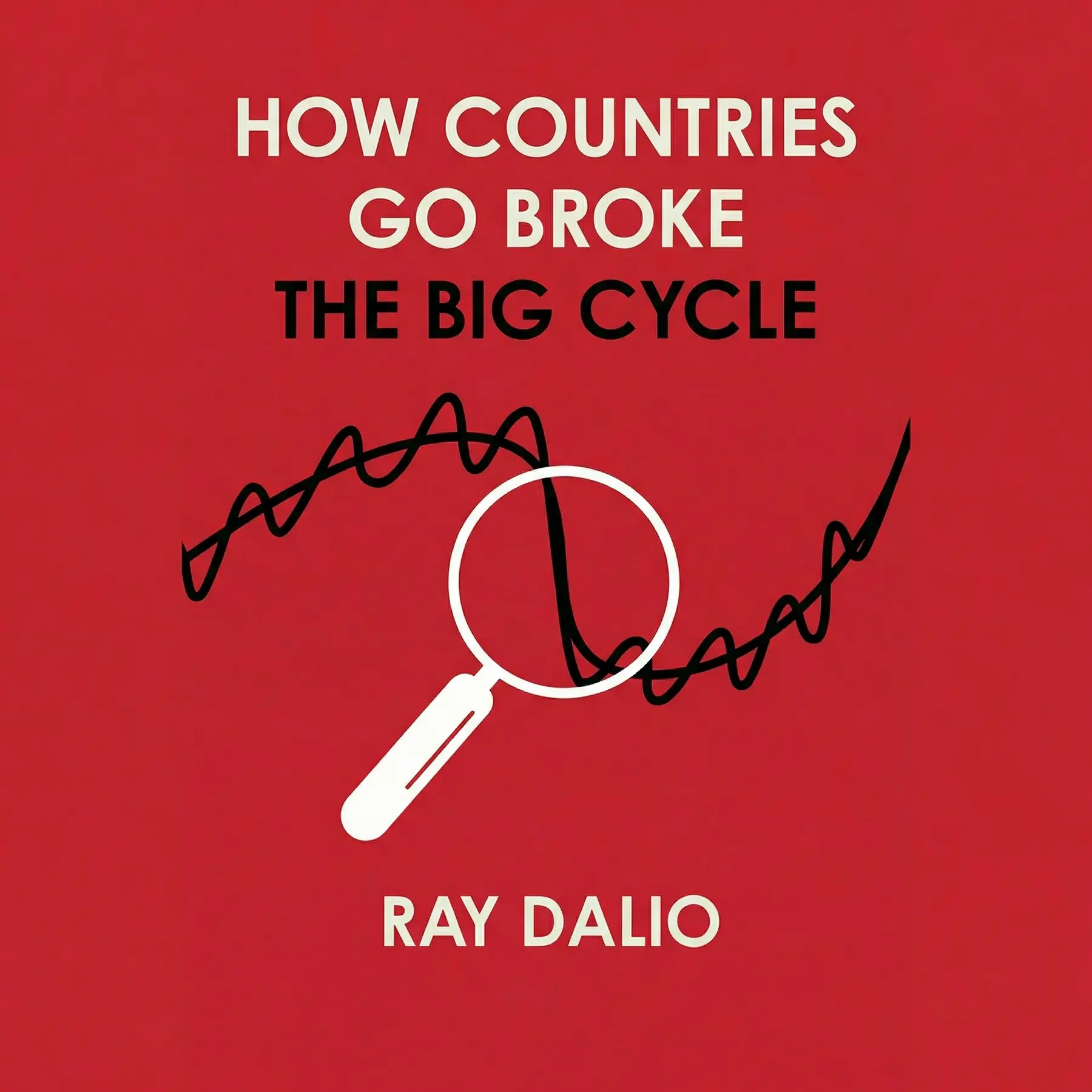
Ray Dalio explains how debt builds over generations until countries default or print money. He shows how to read the nine stages of that slide and what the United States could do to avoid it.
58 sec
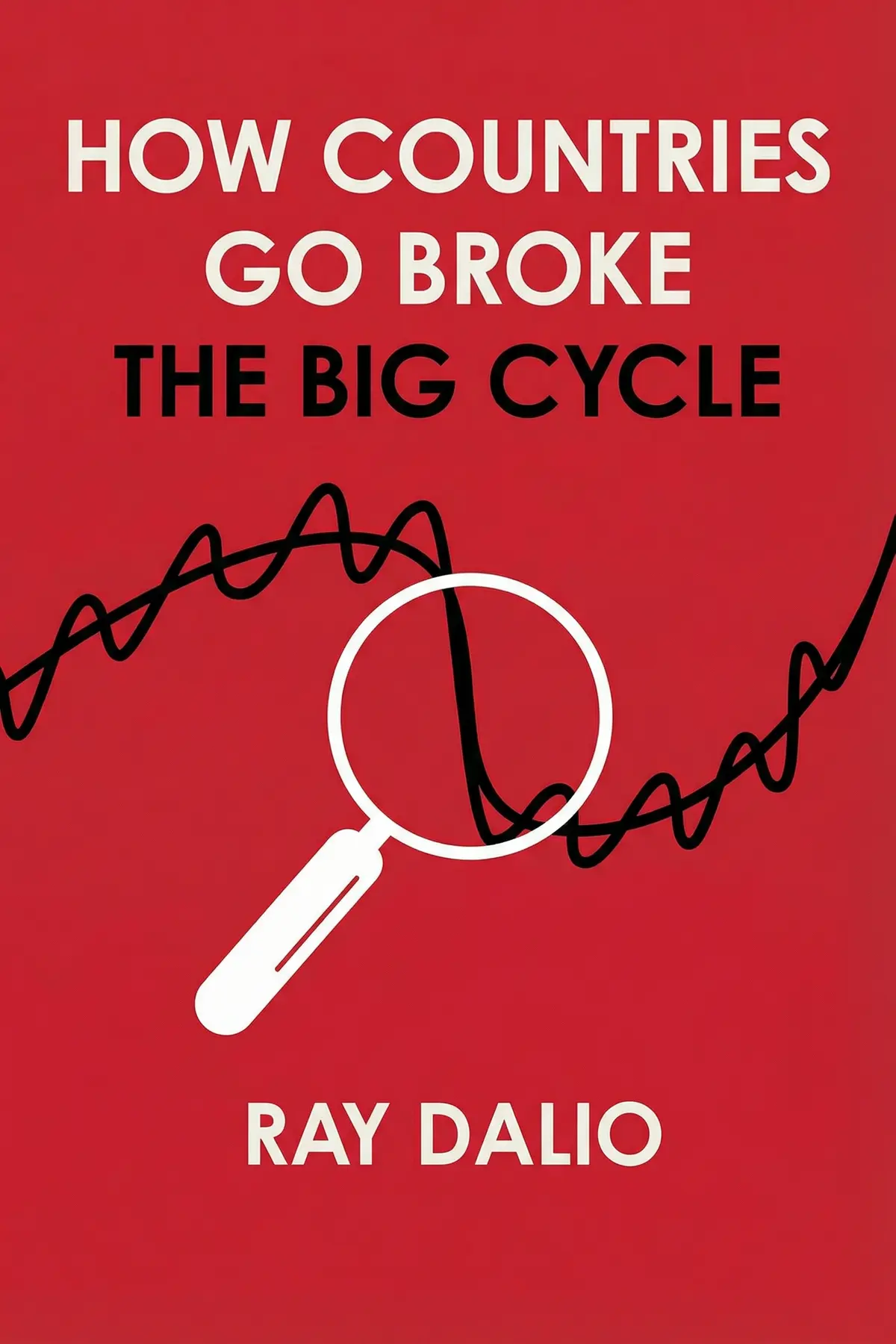
If headlines about national debt, inflation and political anger sound like noise, Ray Dalio offers a way to hear the pattern underneath. In How Countries Go Broke, the founder of Bridgewater Associates, one of the world’s largest hedge funds, argues that nations do not fail at random. They follow a debt cycle lasting roughly 75 to 100 years that nearly always ends in default or money printing. The Dutch and British empires traced that arc, and Dalio believes the United States is close to the end of its own.
In his account, debt grows faster than income until something breaks, while politics, power, nature and technology turn alongside it. Learn his stages and you can tell where a country stands and which signals mark the next step. You will also see why one budget target could still spare America the worst.
2 min 02 sec
Borrowing makes a country feel richer, and governments love it for exactly that reason. Dalio shows why each boom tends to peak a little higher than the last, and who pays when the borrowing finally runs out.
2 min 07 sec
On the news, a debt crisis looks sudden, yet it moves through a sequence that can be read in advance. One stage in particular turns a central bank’s rescue tool into a trap.
2 min 21 sec
A country can carry heavy debt for decades and survive. Whether it does depends on four other forces, from the mood of its voters to the weather, and on how they line up at once.
2 min 18 sec
From a banking panic in 1907 to a pandemic in 2020, America kept rewriting the rules of money. Dalio finds one repeating shape behind every rewrite, and it explains where the country stands today.
1 min 56 sec
On the surface the economy looks steady. Dalio argues the strain sits underneath, and he names two specific moves in Washington that would tell you the danger has become real.
2 min 02 sec
Dalio’s fix fits in one number, and the United States has managed something like it before. The obstacle lies elsewhere, and so does his estimate of how much of the current cycle is left.
1 min 17 sec
Dalio’s book adds up to an uncomfortable idea: nations go broke much the way people do. They borrow against a future they expect to look like the recent past, and each good stretch invites a little more debt than the last. Over generations that habit hardens into a load no income can carry. The only exits, default or printing, fall hardest on whoever saved.
What makes the warning useful is that the road has markers. A central bank losing money on bonds it bought tells you how late it is. So do a fresh wave of printing to hold rates down and a government reaching for control of its central bank. Division at home, a rising rival and a pandemic tell you how rough the ride could get.
So read the news as evidence about the cycle. Notice whether debt is growing faster than income, and notice those two red flags. Notice too whether leaders talk about deficit targets while times are calm, when the fix costs least. Dalio places the United States near the close of a cycle that started when World War II ended. History, as he reads it, repeats, but it also teaches, and a country that learns the pattern still has a say in how the cycle ends.
Powerful nations rarely stay on top. The Dutch and British empires rose, dominated and then came apart, and Ray Dalio argues the United States is following the same arc. In How Countries Go Broke, he explains why. A long debt cycle of roughly 75 to 100 years lets borrowing outrun income until a country has to either default or print money. Dalio breaks that slide into nine stages, from private defaults and government bailouts to central banks losing money on the bonds they bought. He then widens the view to five forces that move together: debt, politics at home, the balance of world power, natural disasters and technology. A century of American history serves as his test case, from the founding of the Federal Reserve to the money printing of the pandemic years. Readers get a map for placing today's news on that cycle and two specific warning signs to watch. They also get Dalio's proposed fix: cut the federal deficit from about 6 percent of GDP to 3 percent while the economy is still calm.
Investors and savers who want to know what a long debt cycle could do to their money.
Professionals who follow economic news and want a framework for deficits, inflation and central bank moves.
Readers of Dalio's earlier work curious how his world order ideas apply to national debt.
Ray Dalio, born in 1949, is an American investor, hedge fund manager and philanthropist. He founded Bridgewater Associates, one of the largest hedge funds in the world. His book Principles reached number one on the New York Times bestseller list, and The Changing World Order examines why nations succeed and fail. He has appeared on the Time 100 list and on Bloomberg Markets' list of the 50 most influential people.
Listeners feel this work offers excellent perspective on today's global economy and consider it a valuable investment. They also appreciate its accessible nature, with one listener remarking it reads like a thriller, and its high-quality writing, noting the inclusion of bold type passages. Additionally, the economic substance is well-received, as one listener highlights the thorough analysis of government debt. However, the more technical sections receive mixed reactions, with several listeners finding them quite complex, though the material is praised for its exceptional synthesis.
Ray Dalio has a gift for taking the abstract, terrifying machinery of global finance and making it feel like a high-stakes drama. While some might find the heavy use of bold passages a bit distracting, I thought it helped emphasize the most critical takeaways. The book covers the "Big Debt Cycle" with a level of granular detail that explains why our current economic trajectory feels so precarious. Truth is, the sections on the five forces—especially the interplay between internal politics and debt—are worth the price of admission alone. It reads almost like a thriller at points, which is a rare feat for a book filled with yield curves and debt-to-GDP ratios. Even if you don't agree with every historical analogy, the overarching framework is impossible to ignore. It’s an essential briefing for anyone trying to navigate the messy transition into a new world order.
Show moreEvery page of this book feels like a wake-up call for anyone holding long-term paper assets in an era of unprecedented fiat expansion. Dalio dives deep into the "uncontrollable unravelling" that happens when debt growth outpaces real income for too long. To be blunt, the outlook is grim, but the clarity he provides is invaluable for wealth preservation. The chapter on the mechanics of money and credit is worth every penny because it strips away the jargon used by central banks. I loved the "bubble indicator" section; it’s a practical tool that most readers can actually apply to the current market. Some might call him a doomer, but the logic is grounded in historical reality and hard numbers. If we are indeed moving back to a world of "direct, brutal strength," this book is the survival manual you didn’t know you needed.
Show moreDalio manages to distill centuries of fiscal history into a readable roadmap that explains exactly why the current world order is shifting. The transition from the post-WW2 era of liberalism to a more fractured, autocracy-prone world is laid out with chilling precision. I was particularly struck by the "archetypical sequence" of how countries go broke—first the debt piles up, then the printing presses start, and finally the currency loses its soul. The visuals and charts are top-notch, providing a necessary anchor for the more abstract concepts. While the text is heavy on data, it never feels overwhelming because of the clear, utilitarian writing style. It is a formidable report on the state of global finance. Even if you only read the first few chapters on the "Big Debt Cycle," you will come away with a much clearer understanding of why our current path is unsustainable.
Show moreTo understand the next decade, you have to understand the mechanics of how currencies lose their value and empires overextend. This book provides that blueprint. Dalio’s focus on the "five big forces" gives a holistic view that most economists miss by focusing only on interest rates. I particularly liked the discussion on how technology and acts of nature act as wildcards in the debt cycle. The book is well-written and the use of bold type allows for a quick skim if you’re already familiar with the basics. Look, hope is not a strategy, and this book hammers that point home with every chart and equation. It's an intellectual tome that manages to stay accessible enough for anyone with a basic interest in macroeconomics. If you're looking for a clear-eyed analysis of why countries fail, this is the most comprehensive guide available today.
Show moreAfter following Dalio’s LinkedIn articles for years, I finally dove into this full text, and the synthesis provided here is truly impressive. The book isn’t just about money; it’s about the underlying mechanics of power and the inevitable decline of overextended empires. Some chapters get incredibly technical, diving deep into fiscal and monetary dynamics that might overwhelm a layperson, but the visuals are outstandingly helpful. I particularly appreciated the detailed analysis of government debt and how it triggers a "painful reversal" once interest burdens become unmanageable. Look, the historical data might be subject to interpretation, but the logic regarding currency devaluation is hard to argue with. It’s a dense economist’s report masquerading as a guide for investors, and it succeeds on both fronts. Highly recommended for those who want to see the world through a more objective, data-driven lens.
Show moreThe way the book utilizes bold typeface to highlight core principles makes it incredibly easy to navigate for a busy professional. Dalio has a unique way of breaking down complex sovereign credit issues into digestible bits, even if the "archetypical sequence" feels a bit rigid at times. I was particularly fascinated by the section on Japan; it challenges the traditional view that high debt must immediately lead to collapse. The book highlights how countries can "kick the can" for decades, though the eventual reckoning remains inevitable. Not gonna lie, some of the math in the middle chapters had me reaching for my old economics textbooks, but it was worth the effort. It’s a well-written, methodical look at the arithmetic of failure. While his solutions for fiscal sanity seem politically impossible, identifying the symptoms of the debt spiral is a vital service for any modern investor.
Show morePicked this up expecting a dry textbook, but I was surprised by how much the "Big Cycle" framework actually clarified current events. The author describes the problem of sovereign debt with the kind of verbal flourishes that make you realize just how high the stakes are. Honestly, I found the discussion on the status of the reserve currency to be the most compelling part. It isn’t just about economics; it’s about how internal conflict and external geopolitics accelerate the decline of a currency’s value. The writing is methodical, yet it manages to capture the morbid appeal of watching an empire overextend itself. My only gripe is that the solutions offered—like cutting spending and raising taxes—feel like a fantasy in today's political climate. Regardless, the book is a must-read for anyone who wants to look past the headlines and see the underlying trends.
Show moreFrankly, the technical depth in the middle chapters might scare off the casual reader, but the insights are too valuable to ignore. After page 100, the book really starts to "cook" as Dalio applies his theories to current world powers. He tackles the excessive accumulation of government borrowing with a rigor that is rare in today’s soundbite-driven media. I found the distinction between debt assets and debt liabilities to be a crucial takeaway for anyone managing a portfolio. The book isn't perfect—the reliance on an 80-year cycle can feel like overfitting historical data to a specific narrative. However, the core premise that we are in a "turbulent stage" is backed by enough data to make even the most optimistic reader pause. It’s a high-level briefing that forces you to confront the reality of our fiscal situation without the rose-tinted glasses of modern monetary theory.
Show moreIs it a masterpiece or just a very expensive briefing document for the Davos crowd? Personally, I found it a bit of both. The text is dry and utilitarian, clearly targeting a financial-world readership that cares more about spreadsheets than prose. Dalio’s track record brings a level of credibility that a typical academic simply cannot match, especially when he discusses the "long-term debt cycle." However, I felt the book occasionally glossed over the human element of these crises in favor of historical patterns. The five big forces are a solid framework, but the 80-year cycle feels a bit arbitrary when you consider how much technology has changed the variables. Still, the synthesis of data is outstanding, and the focus on the "Big Debt Cycle" provides a necessary warning. It’s a dense read, but if you want to understand why things are getting so turbulent, it’s a solid starting point.
Show moreThis feels like a repetitive remix of his previous work rather than a fresh contribution to economic literature. I found the first hundred pages to be almost verbatim from The Changing World Order, which was frustrating given the hype surrounding this release. Dalio makes grand claims about an 80-year cycle, but the evidence often feels cherry-picked to fit a predetermined narrative. To be fair, the graphs are visually appealing, but they often serve to illustrate a point rather than prove it scientifically. The political sections feel a bit naive and were already starting to seem dated by the time I finished the chapter. If you’ve never read his "Principles" or his previous macro-economic deep dives, you might find some value here. However, for those already familiar with his "Big Cycle" theory, there isn't much new material to justify the investment of time.
Show moreRay Dalio argues that countries go broke through a predictable debt cycle. Short cycles of 6 to 10 years stack into a Big Debt Cycle lasting 75 to 100 years. Each peak is higher than the last, until debt outgrows income. At that point a country must default or print money, and savers and bondholders lose either way. He links this cycle to politics, world power, nature and technology.
Dalio’s stages begin with heavy borrowing everywhere. Then come private defaults and government bailouts, nervous bond buyers, rising rates and tight credit. Next the central bank prints money to buy bonds. If rates keep rising, the central bank starts losing money and the currency falls. Finally the debt is restructured or inflated away, emergency taxes and capital controls follow, and debt returns to a level incomes can support.
Dalio places the United States deep in Stage Five of the cycle. He names two red flags: another large round of money printing and bond buying to keep interest rates low, or the government taking control of the Federal Reserve. Either, in his view, would signal serious trouble. He also warns that rising rates would swell the Fed’s losses and could weaken trust in the dollar.
Under his 3 Percent 3-Part Solution, the federal deficit would fall to 3 percent of GDP, down from a projected 6 percent. It combines spending cuts, tax increases and lower interest rates, with lower rates doing the most work. He points out that in the 1990s the United States turned a 4 percent deficit into a surplus. He argues the key is acting while the economy is still calm, before a recession arrives.


William J. Bernstein




Yanis Varoufakis


Andrew Ross Sorkin

Ha-Joon Chang
AUDIO SUMMARY AVAILABLE
Get the key ideas from How Countries Go Broke by Ray Dalio, plus 5,000+ more nonfiction titles.