

15 min
Available in: English
How Asia Works: Success and Failure in the World’s Most Dynamic Region
By Joe Studwell
Explains why Japan, South Korea and Taiwan became rich while much of Southeast Asia stalled. The difference was a strict sequence: land reform for small farms, protected but export-driven industry, and state-directed finance.
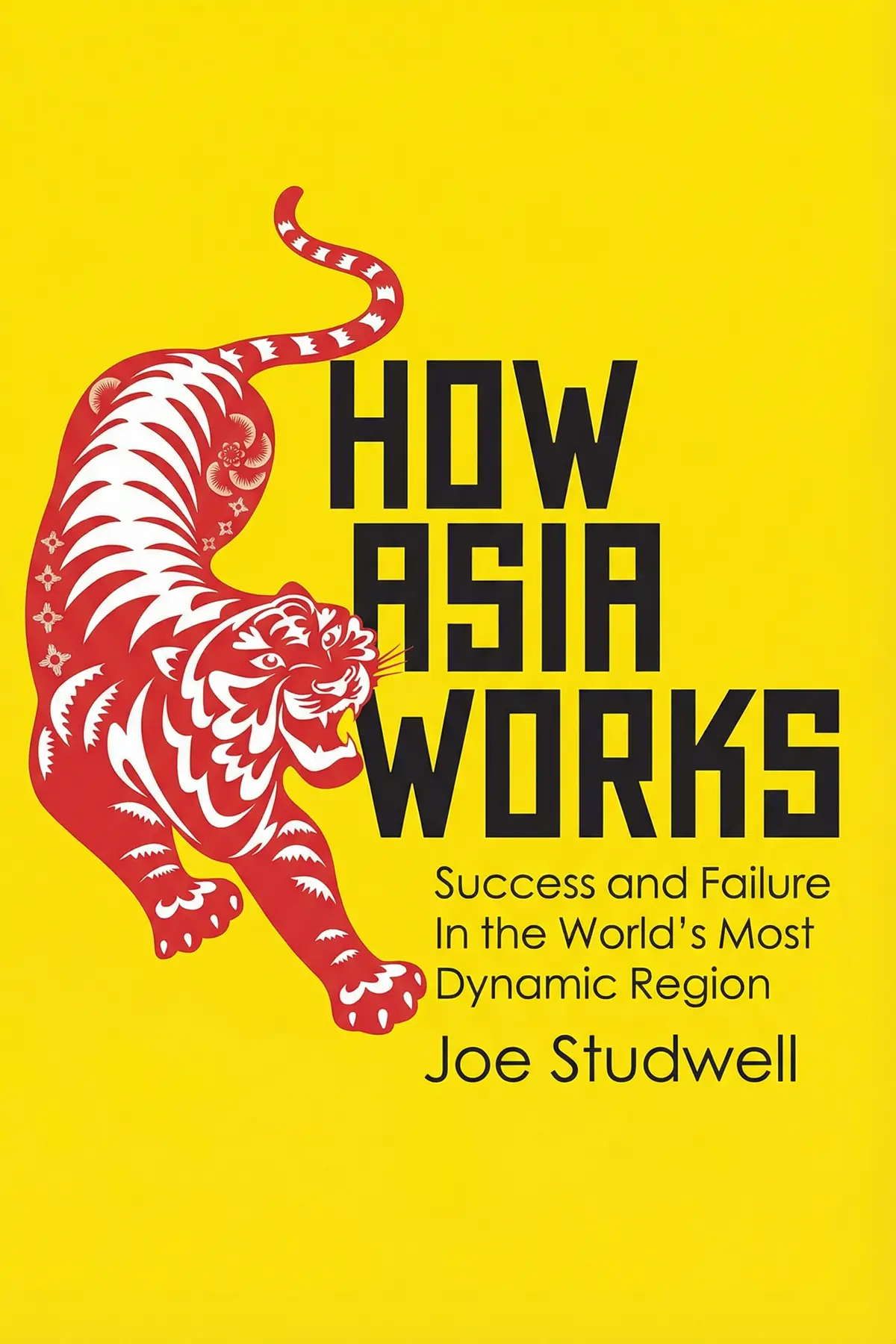
Table of Content
1. Introduction
1 min 05 sec
If Asia’s economic rise looks to you like cheap labor plus luck, the real story is more exact than that. In How Asia Works, journalist Joe Studwell argues that Japan, South Korea and Taiwan grew rich by taking specific steps in a strict order. Malaysia, Thailand and the Philippines also grew, but only for a short time. Studwell’s first step surprises most people: before it builds factories, a poor country needs millions of small family farms.
From there Studwell builds a sequence. Land goes to the people who work it. Young industries are sheltered, then pushed to export and to compete with one another. Banks stay under state direction until industry can stand alone. If a country gets the order right, it can become an industrial power within decades. If it skips a step, the gains can disappear in the next crisis. Follow the argument through and you will have a working checklist for judging any country’s development story, including China’s.
2. Small farms give poor countries bigger harvests
1 min 23 sec
Huge mechanized farms look like the modern choice for a country trying to catch up. Studwell argues that in a poor economy they do the most damage, and he shows what the successful countries planted in their place.
3. Land reform that pays off for decades
1 min 36 sec
Two governments that had lost the trust of their people found an unlikely way to win it back. Their answer remade their countryside, and it laid the base that their later booms were built on.
4. Shelter young industries until they can compete
1 min 28 sec
Free trade is often presented as the path to wealth. Studwell looks at how today’s rich nations actually built their first industries, and the record tells a less comfortable story about open markets.
5. Let the state plant industry, then back builders
1 min 40 sec
Japan’s first government factories turned out poor copies of Western goods. Then one giant cotton mill and a painful choice about who should lose changed the country’s trade position completely.
6. Make companies earn support through exports and rivals
1 min 40 sec
South Korea built a car industry by splitting a tiny market among three rivals, which looked wasteful at the time. Malaysia chose a tidier plan, and a financial crisis later showed which choice was wiser.
7. Point the banks at factories before freeing them
1 min 39 sec
Opening up the financial system sounds like an obvious sign of a modern economy. In one Asian country it drained money away from the very companies the nation needed most, and two small cities show when it works.
8. Learn China's copy of the northeast Asian playbook
1 min 40 sec
For decades, China’s leaders followed two beliefs that kept the country poor, and one of them cost millions of lives. Deng Xiaoping’s turnaround looks bold, but the plan behind it had already been proven nearby.
9. The unfinished steps holding China back
1 min 39 sec
China’s growth has been enormous, yet its own carmakers struggle and its farmers earn a fraction of city wages. Studwell traces both problems to steps that were left half done, and points to an old fix.
10. Conclusion
1 min 10 sec
Studwell’s Asia is a story about order and discipline. Land reform, protected industry, export targets and state-guided banks produced lasting wealth in Japan, South Korea and Taiwan. Elsewhere, similar tools produced short booms. The outcome depended on whether governments used the steps in sequence and kept up the pressure. Malaysia had a larger car market than Korea and handed it to one state company. Korea split a market of 30,000 cars among three rivals and made them compete.
The book gives you a test for any development story in the news. Ask who owns the land and whether small farmers keep what they grow. Ask whether protected companies have to prove themselves abroad and against rivals at home. Ask where bank lending goes, into factories and technology or into speculation. Those questions go a long way toward explaining how countries that started level after World War II ended up four times apart.
In Studwell’s account, growth starts on the small household farm, and the states that later forced exports and built domestic competition bounced back fastest after the 1997 crisis.
About this book
What is this book about?
After World War II, South Korea and Taiwan were about as rich as Thailand and Indonesia. Today they produce four times as much per person. Joe Studwell sets out to explain that gap, and his answer has little to do with culture or luck. It comes down to policy, and above all to the order in which policies are applied. Studwell describes a sequence. First, land reform hands land to the people who farm it, because small, labor-intensive household farms feed more people and employ more of them than big mechanized estates. Next, the state shelters young manufacturers from foreign competition, but only on hard conditions: they must export and they must compete fiercely with one another at home. Throughout, governments keep banks pointed at factories and technology and away from speculation, until industry can stand on its own. Readers get a clear framework built from concrete cases: Japan's three-hectare farm limit, Korea's three carmakers fighting over a tiny market, Malaysia's early stock market deregulation, and Deng Xiaoping's turn back to household farming in China. It also shows what China still has to fix before it can join the rich industrial nations.
Book Information
Who it's for
Following global economics
Professionals and students who follow global economics and want a clear account of why Asia's economies diverged.
Founders and managers
Founders and managers interested in how protection, competition and export pressure shape strong companies.
Judging economic policy debates
Readers who want to judge debates about free trade, deregulation and China with concrete cases.
About the Author
Joe Studwell
Joe Studwell is a journalist who also writes a blog and speaks publicly about his subjects. In the middle of his career he took up a PhD at Cambridge University. In How Asia Works he uses a reporter's eye for concrete cases to tackle a big economic question: why some Asian countries became industrial powers while others that started from a similar place fell behind.
Ratings & Reviews
Ratings at a glance

What people think
Listeners find the work exceptionally well-researched and accessible, with one review noting that it clarifies modern developments across Asia. Furthermore, the narrative approach is praised, as one listener points out the fair treatment of both Asian triumphs and setbacks. The prose is also commended, and listeners value the economic insights, including one review that specifically mentions the thorough examination of economic strategies. On the other hand, the work's structure and clarity get varied responses.
Top reviews
Natchaya
Studwell provides a masterclass in development economics that feels more like a gripping narrative than a dry textbook. His three-pillar framework—land reform, export-oriented manufacturing, and controlled finance—is presented with such clarity that it makes you wonder why more developing nations haven't successfully replicated the blueprint. The book is brilliantly researched, pulling no punches when criticizing the 'Berkeley Mafia' in Indonesia or the failed industrial attempts in Malaysia. I particularly appreciated the distinction between 'picking winners' and Studwell’s concept of 'culling losers' through export discipline. It is a dense read, yes, but the prose is sharp and the historical anecdotes are fascinating. If you want to understand how South Korea went from a war-torn wasteland to a global tech giant while the Philippines remained stagnant, this is the only book you need to read. It's a foundational text for anyone interested in why some regions prosper while others fail.
Show moreMilk
Picked this up after seeing Bill Gates recommend it, and it definitely lived up to the hype by providing a clear, logical explanation for a very complex topic. The central argument is that development is a sequential process: you start by empowering small farmers to create a surplus, then you force manufacturers to compete globally, and finally you keep the banks on a short leash. Studwell’s writing style is refreshingly blunt; he isn't afraid to label certain policies as outright disasters or call out specific leaders for their incompetence. The comparison between the success of Hyundai in Korea and the relative struggle of the Proton in Malaysia was particularly eye-opening for me. It really highlights how crucial 'export discipline' is—it’s not enough to just give subsidies; you have to stop the money if the company doesn't perform. This is essential reading for anyone who wants a realistic, non-ideological look at how countries actually get rich.
Show moreKae
The chapter on land reform was a total revelation for me because I never realized how much of a country's industrial success depends on what happens in the dirt first. Studwell explains that by breaking up big estates into small, labor-intensive family farms, countries like South Korea were able to maximize their yields and create a massive base of consumers. This 'gardening' approach is the secret sauce that many Southeast Asian nations missed. The book is incredibly well-researched, but it doesn't feel like a dry academic paper because the author has such a strong voice. He uses the facts to tell a story of ambition, failure, and ruthless policy-making. I loved how he challenged the IMF's typical advice, proving that sometimes the 'experts' are completely wrong about what a developing nation needs. It’s a thick book with a lot of information to digest, but the clarity of the argument keeps you moving through the pages.
Show moreRuangrat
Not what I expected from a book about Asian finance, but I couldn't put it down once I got into the meat of the industrial policy sections. The idea that a government should actively 'cull' its own failing companies is such a radical departure from how we think about business in the West. Studwell shows that the difference between a winner and a loser isn't just talent; it's the pressure of having to export to survive. The writing is vivid and the author clearly knows these countries inside and out. Frankly, this should be mandatory reading for anyone working in international development or foreign policy. It shatters the myth that these countries just got lucky or that it was all due to 'Confucian values.' Instead, it was about cold, hard, and often brutal economic choices. It's a brilliant piece of work that manages to be both informative and deeply provocative.
Show moreSamart
After hearing so much about the 'Asian Miracle' as some kind of mystical event, it was refreshing to see someone actually explain the institutional flesh between the equations. Studwell demonstrates that the success of Northeast Asia wasn't an accident or a miracle, but the result of very specific, often difficult interventions in land and finance. The comparison of the Hyundai Elantra versus the Proton Waja is a perfect example of his 'export discipline' theory in action. He avoids the typical mathematical gobbledygook of modern econ and instead uses history and storytelling to make his point. The book is an absolute powerhouse of information, beautifully written and deeply challenging to anyone who believes in a hands-off approach to development. It’s easily one of the most enlightening non-fiction books I’ve read in the last decade, providing a framework that is both historically grounded and relevant to today’s global economy.
Show moreWissanu
Ever wonder why the 'Washington Consensus' often fails in practice? This book offers a compelling rebuttal to traditional neoliberal advice by focusing on what actually worked on the ground in Northeast Asia. The author argues that successful development requires a temporary rejection of free-market dogmas in favor of infant industry protection and strict state-level financial control. While the technical details of the 'gardening' style of labor-intensive farming were a bit dry for my taste, they serve as a crucial foundation for his larger argument. The truth is, some chapters are definitely a slog because of the heavy data, and the organization can feel a bit repetitive as he jumps between countries. However, the payoff is immense. You walk away with a nuanced understanding of the 'developmental state' that goes far beyond the typical cultural explanations for Asian success. It’s a challenging but highly rewarding read for the economically curious.
Show moreConnor
As someone who studied economics in college, this book felt like unlearning everything I was taught about the inherent perfection of free trade. Studwell makes a powerful case for the 'infant industry' argument, showing that countries like Japan and Taiwan only succeeded by protecting their domestic markets until they were strong enough to compete. It’s a fascinating look at the 'historical' approach to economics rather than the purely mathematical one. My only real gripe is that he downplays the role of institutional culture and the specific geopolitical advantages these countries had during the Cold War. Still, the analysis of how the Philippines' elite avoided land reform is a masterclass in political economy. The writing is accessible, but be prepared for a lot of talk about fertilizer and interest rates. It’s not exactly a beach read, but it’s probably the most important book on Asia I’ve encountered in years.
Show morePrayoon
In my experience, books on macroeconomics tend to be either overly simplistic or impossibly dense, but Studwell hits a sweet spot that remains highly readable throughout. He breaks down the 'Asian Miracle' into a repeatable formula, which is both impressive and a little terrifying when you realize how hard it is for democratic governments to actually implement. The tension between his 'three-step' model and the realities of modern globalization is palpable. Look, the book isn't perfect—the section on China feels slightly dated given how fast things are moving there now—but the historical framework is rock solid. I appreciated the detailed analysis of economic policies without the usual partisan fluff. It’s a balanced coverage of successes and failures that helps explain a lot of current events in the region. Definitely worth the time if you want to go beyond the headlines and understand the actual mechanics of wealth creation.
Show morePairot
To be fair, the level of detail here is absolutely exhausting and sometimes feels like it's buried in a pile of spreadsheets. I picked this up based on a high-profile recommendation, and while the core thesis about land reform and export discipline is solid, the book's organization made it difficult to stay engaged. Studwell spends an incredible amount of time on 19th-century history and agricultural yields per hectare, which might be a bit much for a casual reader looking for a quick summary of the Asian miracle. I also found his total dismissal of Singapore and Hong Kong as 'parasitic' city-states to be a bit too convenient for his argument; it felt like he was ignoring data that didn't fit his specific three-step model. It is certainly informative and well-documented, but the pacing is uneven. If you aren't already a policy wonk or a history buff, you might find yourself skimming the middle sections just to get to the conclusions.
Show moreFilm
While the central thesis is fascinating, I found the author’s dismissal of city-states like Singapore and Hong Kong a bit too convenient for his narrative. He calls them 'parasitic' because they don't follow his agricultural model, but that feels like a shortcut to avoid addressing their massive success. The book also has a tendency to gloss over the human rights records of the dictators who implemented these 'successful' policies. I appreciate the economic analysis, but I wish there was a bit more balance regarding the social cost of this kind of state-directed growth. On the plus side, the research is exhaustive and the writing is quite clear. It's just that the book's organization can be frustrating as it loops back over similar points across different chapters. It's an important perspective, certainly, but I'd suggest reading it with a healthy dose of skepticism toward his 'one-size-fits-all' development recipe.
Show moreQuestions about this book
What is the main idea of How Asia Works?
Joe Studwell argues that the Asian economies that became rich, Japan, South Korea, Taiwan and more recently China, followed a sequence. They first used land reform to create productive household farms. Next they protected manufacturing while forcing firms to export and compete, and they kept finance under state control so money went to industry. Countries such as Malaysia and Thailand skipped or weakened these steps, and their growth faded.
Why does How Asia Works favor small farms over large ones?
Studwell argues that, unlike factories, farms do not get more productive just by getting bigger. Fertilizer and intensive hand labor raise yields, as when shade-tolerant crops such as celery are grown beneath taller plants. In poor countries labor is plentiful and other jobs are scarce, so mechanized estates destroy work and lower output. Household farms employ millions of people and feed the economy until industry can take over.
Is How Asia Works against free trade?
Not as a final goal. Studwell sees free trade as the right destination, but only after a country’s manufacturing has matured. He notes that the United Kingdom, Germany and the United States all shielded their young industries, and that only offshore financial centers such as Hong Kong and Singapore got ahead through free trade alone. He also insists that protection must come with export targets and strong competition at home.
What does How Asia Works say about China?
Studwell says Deng Xiaoping reversed China’s stagnation by bringing back household farming, opening the country to foreign technology, starting with a 1980 turbine deal with Westinghouse, and directing finance through state banks. He warns that China still relies too much on state companies that depend on foreign car designs, and that urban incomes are three times rural ones because peasants cannot own their land.
Who should read How Asia Works?
It suits readers who want to understand why some poor countries become industrial powers while others stall, including students of economics, policy professionals and business readers who follow Asia. Its cases, from Japan’s three-hectare farm limit to Korea’s three competing carmakers and Malaysia’s 1989 stock exchange deregulation, give a practical framework for judging development policy anywhere.
Readers also enjoyed

A Splendid Exchange: How Trade Shaped the World
William J. Bernstein



Adults in The Room: My Battle With Europe’s Deep Establishment
Yanis Varoufakis

1929: Inside the Greatest Crash in Wall Street History--and How It
Andrew Ross Sorkin

23 Things They Don’t Tell You About Capitalism
Ha-Joon Chang
AUDIO SUMMARY AVAILABLE
Listen to How Asia Works in 15 minutes
Get the key ideas from How Asia Works by Joe Studwell, plus 5,000+ more nonfiction titles.
- 5,000+ titles
- Listen as much as you want
- 7-day free trial
- Cancel anytime









