

13 min 51 sec
Available in: English
 ไทย
EnglishไทยHillbilly Elegy: A Memoir of a Family and Culture in Crisis
By J.D. Vance
A memoir of how one boy from a chaotic, poor family in a fading Ohio steel town reached Yale Law School, and what his escape reveals about the barriers facing working-class children.
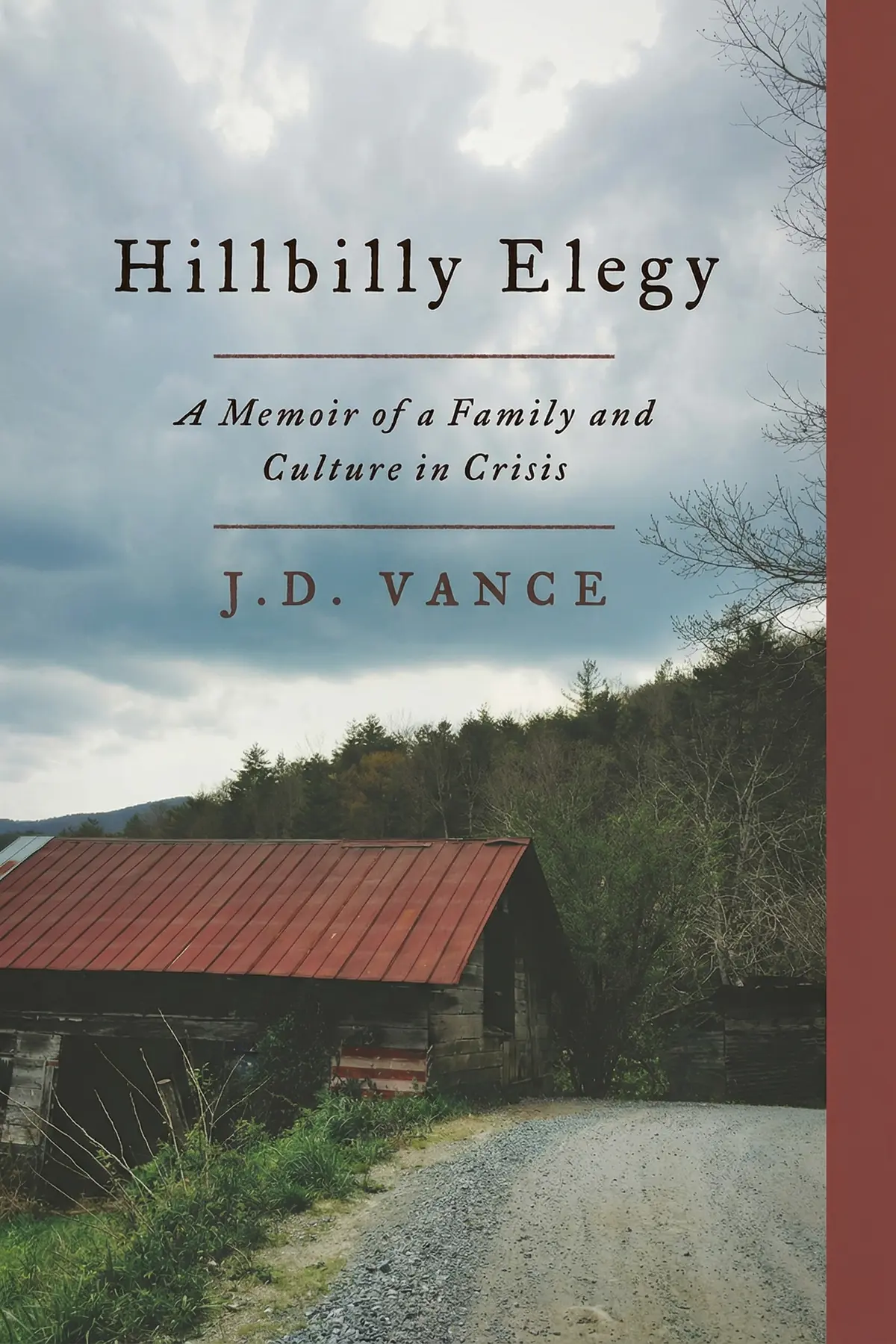
Table of Content
1. Introduction
57 sec
Escaping a hard childhood is usually told as a story of pure grit, but J.D. Vance’s escape turned on something plainer: a grandmother with three strict rules. In Hillbilly Elegy, Vance traces how a boy from a poor, chaotic home in a fading Ohio steel town made it through the Marine Corps, Ohio State and Yale Law School. His family came from the hills of Kentucky, people often called hillbillies, and his memoir follows three generations of them as factory jobs disappeared and trouble at home deepened.
The story makes one case. Children from broken homes and broken towns can beat the odds, but rarely alone. What carried Vance out was a steady home, a structured institution and, at the end, the right connections. Follow his path and you will be able to name the real barriers facing kids like him, and spot the anchors that helped him past them.
2. See how a steel town's collapse still shapes families
1 min 51 sec
One factory job once carried a Kentucky couple into a comfortable retirement. Two generations later, the same route led somewhere very different, and the reasons explain much of what went wrong inside Vance’s own home.
3. Spot the chaos a family hands down
1 min 39 sec
Vance’s uncle remembers a happy childhood home. The events of a single Christmas Eve, and a terrifying act a week after a warning, suggest that warm memories can hide something far more dangerous.
4. Trouble at home shows up on the report card
1 min 42 sec
A house full of books and a mother devoted to learning should have set a boy up well. Then the fights started at night, his grades began to slide, and a trip to the mall ended with police.
5. What a revolving door of homes does to a teenager
1 min 36 sec
One man stayed steady while boyfriends and stepfathers came and went. When he died, the fragile structure around Vance gave way, and the moves that followed left a teenager worn out before he could drive.
6. One steady home can turn a failing teen around
1 min 36 sec
A lonely boy on the edge of dropping out moved in with a grandmother who demanded more of him than anyone had. Her rules were strict, and her biggest lesson cost exactly $180.
7. Build the adult habits a chaotic home skips
1 min 42 sec
College frightened him, so he chose a place with even more rules. What he learned there had little to do with combat and a great deal to do with checkbooks, hygiene and how to lead people.
8. Learn the hidden networks that open doors talent cannot
1 min 46 sec
At Yale, Vance noticed that his classmates rarely sent out résumés, yet jobs still found them. Learning why became the final step out of poverty, and it says something uncomfortable about how success works.
9. Conclusion
1 min 02 sec
Hillbilly Elegy is an elegy in the full sense: a lament for a way of life that once let a Kentucky couple with a factory job retire in comfort, and that has since given way to closed shops and children with painful teeth. Against that loss, Vance’s own life stands as proof that the odds can be beaten, though never by grit alone. Every step out came from something steady: a grandfather who practiced math with him, a grandmother’s three rules, a corps that taught him to balance a checkbook, a professor willing to back his name.
That is the lesson worth keeping. When a young person is failing, look first at what is happening at home, and only then at their effort. Where you can, be the stable adult or the open door they lack, whether that takes a firm rule, a $180 calculator or a single phone call.
A boy who lived in four homes in two years became a Yale graduate because, at the right moments, someone made room for him.
About this book
What is this book about?
J.D. Vance grew up in Middletown, Ohio, a steel town that lost its jobs and much of its hope. His grandparents had left the hills of Kentucky for factory work and retired comfortably middle class. By the time Vance was a boy, that path had all but vanished, and his own home was full of fights, money worries, addiction and a changing cast of father figures. Hillbilly Elegy follows three generations of one Appalachian family: a grandfather's violent drinking, a mother's suicide attempts and stays in rehab, and a teenager moved through four homes in two years. Then comes the turn. A strict, loving grandmother with three rules, four years in the Marine Corps, a fast degree at Ohio State and finally Yale Law School. Readers get a vivid family story and a clear lesson inside it. Children from broken homes can beat the odds, but they rarely do it alone. Vance shows what stability, practical life skills and social connections did for him, and why policy that ignores home life misses the real problem.
Book Information
Who it's for
Curious about factory towns
Readers who want to understand the working-class towns hollowed out by lost factory jobs.
Hoping to reach youth
Teachers, mentors and managers trying to reach young people from unstable homes.
Feeling like outsiders
First-generation students and professionals who feel like outsiders among better-connected peers.
About the Author
J.D. Vance
J.D. Vance was born James Donald Bowman and grew up in an unstable, low-income family in Middletown, Ohio. He joined the US Marine Corps in 2003, working in public affairs as a journalist until 2007, including six months in Iraq. He then earned a bachelor's degree at Ohio State University and a law degree from Yale Law School, and later worked at the venture capital firm Mithril Capital. Hillbilly Elegy, published in 2016, became a bestseller and a 2020 film. Vance won a US Senate seat in Ohio in 2022 and later became vice president of the United States.
Ratings & Reviews
Ratings at a glance
What people think
Listeners find this memoir exceptionally accessible and immersive, featuring a gripping personal story that keeps them hooked right from the start. Furthermore, the work provides deep perspectives on the social fabric of America, with one listener characterizing the book as a great sociological study. Listeners also value the writer's sincere and empathetic tone, resulting in a moving and emotionally powerful experience.
Top reviews
Suthee
Wow. This memoir hit me much harder than I anticipated, especially the chapters detailing the chaotic life of Vance's grandparents. Mamaw is such a vivid, terrifying, yet ultimately redeeming figure who provided the only stability in a world of drug addiction and rotating father figures. Vance writes with a raw honesty that makes the hillbilly culture feel accessible without being purely caricature. While some parts are difficult to read due to the violence and poverty, the narrative remains deeply engaging and readable throughout. It is a poignant look at how one person escaped a cycle of despair through sheer grit and a few key supporters. I found the ending particularly moving as he reconciles his Yale education with his rough beginnings. It’s a great sociological study of a forgotten America that deserves our attention and empathy.
Show moreWitthaya
The chapter on Vance’s transition to Yale Law School was absolutely fascinating to me. He describes the cultural hurdles of the elite world—knowing which fork to use or how to schmooze—with such vivid detail. It highlights a type of class struggle that isn't just about money, but about social capital and knowing the unspoken rules of the game. Personally, I found his account of Mamaw and Papaw’s fierce loyalty to be the emotional core of the entire book. They were tough old biddies who used violence to protect their own, but they gave him the love he needed to survive. This is a highly readable and deeply engaging memoir that doesn't shy away from the ugly parts of the American Dream. It is a poignant reminder that success often depends on having at least one person who truly has your back. I highly recommend it.
Show moreWilliam
Picked this up on a whim and couldn't put it down until I finished the last page. Vance is an excellent writer who knows how to pace a story, mixing humor and tragedy in a way that feels very real. The scenes where Mamaw threatens to set people on fire or brandishes a gun are wild, yet you feel the underlying love she had for J.D. It is a heart-rending account of a young man navigating a world where the odds are stacked against him from birth. You really feel the tension between his hillbilly roots and his eventual success at Yale. I loved how he acknowledged that his path wasn't just about hard work, but also about the luck of having a few stable influences. This is a poignant and honest look at the American Dream that stayed with me long after I finished. This is definitely one of the most engaging memoirs I've read.
Show moreChamnong
Ever wonder what life is actually like in those 'flyover' states we hear so much about? J.D. Vance provides a compelling and personal narrative that bridges the gap between the Rust Belt and the Ivy League. I appreciated how he credited the Marine Corps as a catalyst for his transformation, teaching him the basic life skills that his family couldn't. To be fair, he does lean heavily into the idea of learned helplessness, which might rub some readers the wrong way if they're looking for systemic economic analysis. However, as a memoir, it is remarkably honest about the dysfunction and fierce loyalty of his Appalachian roots. The writing style is straightforward and clear. This makes it a very quick read despite the heavy subject matter. It offers a unique window into the white working class that feels authentic and deeply researched.
Show moreJoe
As someone who grew up in the industrial Midwest, I recognized so many of these themes in my own hometown. The decline of manufacturing jobs and the subsequent rise of the opioid crisis have left a permanent mark on these communities. Vance captures that sense of 'rustexit' despair perfectly, though his family was perhaps more violent than the average household. The truth is, his writing is compassionate even when he is being critical of the choices people make around him. It is a heart-rending look at the cycle of poverty and the learned helplessness that can trap entire generations. I liked that he didn't offer simplistic political solutions, even if his conservative leanings are obvious throughout the text. It is a great sociological study disguised as a family history. Definitely worth the read for the perspective alone, even if you don't agree with every conclusion.
Show moreNitaya
Finally finished this today. I have some thoughts on why it became such a phenomenon. The narrative is deeply engaging because it touches on universal themes of family, struggle, and the search for identity. Vance’s honesty about his mother’s heroin addiction and his own feelings of inadequacy is truly brave and heart-rending. I appreciated the way he explored how childhood trauma follows you even into successful adult life. It is tough. While some of his political takes are a bit simplified, the personal story of his journey from Middletown to Yale is undeniably powerful. It offers a window into a culture that is often mocked but rarely understood by the mainstream media. The prose is lean and effective. It makes the emotional beats land with significant impact. It is a solid four-star read for anyone interested in American culture or just a well-told personal story.
Show moreNoppadol
After hearing so much buzz, I finally got around to reading this one. It is an interesting blend of personal history and social commentary, but it doesn't quite succeed at being either completely. The stories about his mother’s addiction and his grandparents' rough-and-tumble marriage are undeniably gripping and heart-rending. Yet, when he tries to pivot toward explaining the broader cultural decline of Appalachia, the logic feels a bit shaky and anecdotal. Look, he is a talented writer. He certainly knows how to tell a story that keeps you turning pages. I just found myself wishing for more data to back up his claims about culture being the primary driver of poverty. It is a decent enough memoir about a guy who got out, but I am not sure it is the definitive sociological study people claim it is. Mamaw was definitely the highlight.
Show moreNing
Look, this is a very readable book. It is just far from perfect. Vance tries to generalize his very specific, very dysfunctional family experience to an entire region and ethnic group. I am not sure we can take his family’s violence and drug abuse as typical of all Appalachian people. To be fair, he does provide some interesting insights into the cultural differences between the working class and the professional elite. His time in the Marines and at Ohio State served as great catalysts for his growth. That part was inspiring. However, the tone occasionally feels a bit condescending toward those who didn't make it like he did. It is a decent memoir if you take it with a grain of salt and don't expect a rigorous sociological analysis. The writing is clear. The story is compelling. The generalizations are just a bit of a stretch.
Show moreNina
This book left a sour taste in my mouth by the time I reached the final chapter. While I respect the immense struggle Vance overcame, his tone often slips into a why can't you just work harder attitude that ignores massive systemic hurdles. He describes his own people as lazy or culpable for their own misery. That feels like a betrayal of the community he claims to represent. Frankly, it reads more like a conservative manifesto masked as a memoir rather than a compassionate look at poverty. He mentions 'welfare queens' and other derogatory tropes that felt unnecessary and dehumanizing to his former neighbors. I wanted a more profound analysis of the economic shifts in the Midwest. Instead, I got a string of anecdotes about a dysfunctional family. It is readable, sure, but the underlying message is incredibly naive about how mobility actually works.
Show moreThawee
Not what I expected at all. To be fair, it is hard to separate the text from the political figure he has become since publication. Reading this now, the whole narrative feels like a calculated attempt to build a brand rather than a sincere memoir. He talks about his own community with a level of disdain that is uncomfortable, almost as if he is performing for an elite audience. I found the anecdotes about his mother to be exploitative rather than truly compassionate or insightful. He blames the poor for their own plight while ignoring the massive corporate failures that gutted the region. It felt like a pull yourself up by your bootstraps fairytale that doesn't reflect the reality for most people in Appalachia. If you are looking for a profound understanding of American economics, skip this and find something with actual depth. It feels fundamentally like a sham.
Show moreQuestions about this book
What is Hillbilly Elegy about?
It is J.D. Vance’s memoir of growing up in a poor, unstable family in Middletown, Ohio, a steel town that declined as factory jobs moved abroad. He traces his Kentucky grandparents’ move north, his grandfather’s drinking, his mother’s addiction and suicide attempts, and his own constant moves as a teenager. The story then follows his rescue by his grandmother, his years in the Marines and his path through Ohio State and Yale Law School.
Who is Mamaw in Hillbilly Elegy?
Mamaw is Vance’s grandmother, born around 1930 in Jackson, Kentucky. Fierce enough to set her drunk husband on fire after warning him, she later became the stable center of her grandson’s life. During his three years in her home she enforced three rules: good grades, a job and helping her out. Vance credits that time with saving his life, and her support helped him reach college.
What is social capital in Hillbilly Elegy?
Vance uses the economists’ term for the networks of people and institutions that help someone get ahead. At Yale he saw classmates find jobs through a friend’s email or an uncle’s call rather than résumés. He landed an interview with a powerful federal judge only because a professor backed his application, a lesson in how connections, not only talent, decide who gets through the door.
What lessons does Hillbilly Elegy offer?
The book suggests that trouble at home shows up in a child’s grades and health, so struggling students need more than calls for effort. One stable adult with clear rules can turn a teenager around, as Mamaw did. Practical life skills, like those Vance learned in the Marines, fill gaps a chaotic home leaves. And Vance argues policy should address home life and stop poor families being segregated in housing.
Readers also enjoyed

A Promised Land
Barack Obama


A River in Darkness: One Man’s Escape from North Korea
Masaji Ishikawa


A Spy Among Friends: Philby and the Great Betrayal
Ben Macintyre

A Biography of Loneliness: The History of an Emotion
Fay Bound Alberti


A Force for Good: The Dalai Lama's Vision for Our World
Daniel Goleman

A Year in the Life of William Shakespeare: 1599
James Shapiro
AUDIO SUMMARY AVAILABLE
Listen to Hillbilly Elegy in 15 minutes
Get the key ideas from Hillbilly Elegy by J.D. Vance, plus 5,000+ more nonfiction titles.
- 5,000+ titles
- Listen as much as you want
- 7-day free trial
- Cancel anytime









