
13 min 38 sec
Available in: English
Hardwiring Happiness: The New Brain Science of Contentment, Calm, and Confidence
By Rick Hanson
Explains why the brain holds on to criticism and lets praise slip away. It then gives short daily practices for noticing, savoring and creating good experiences until contentment and calm come more easily.
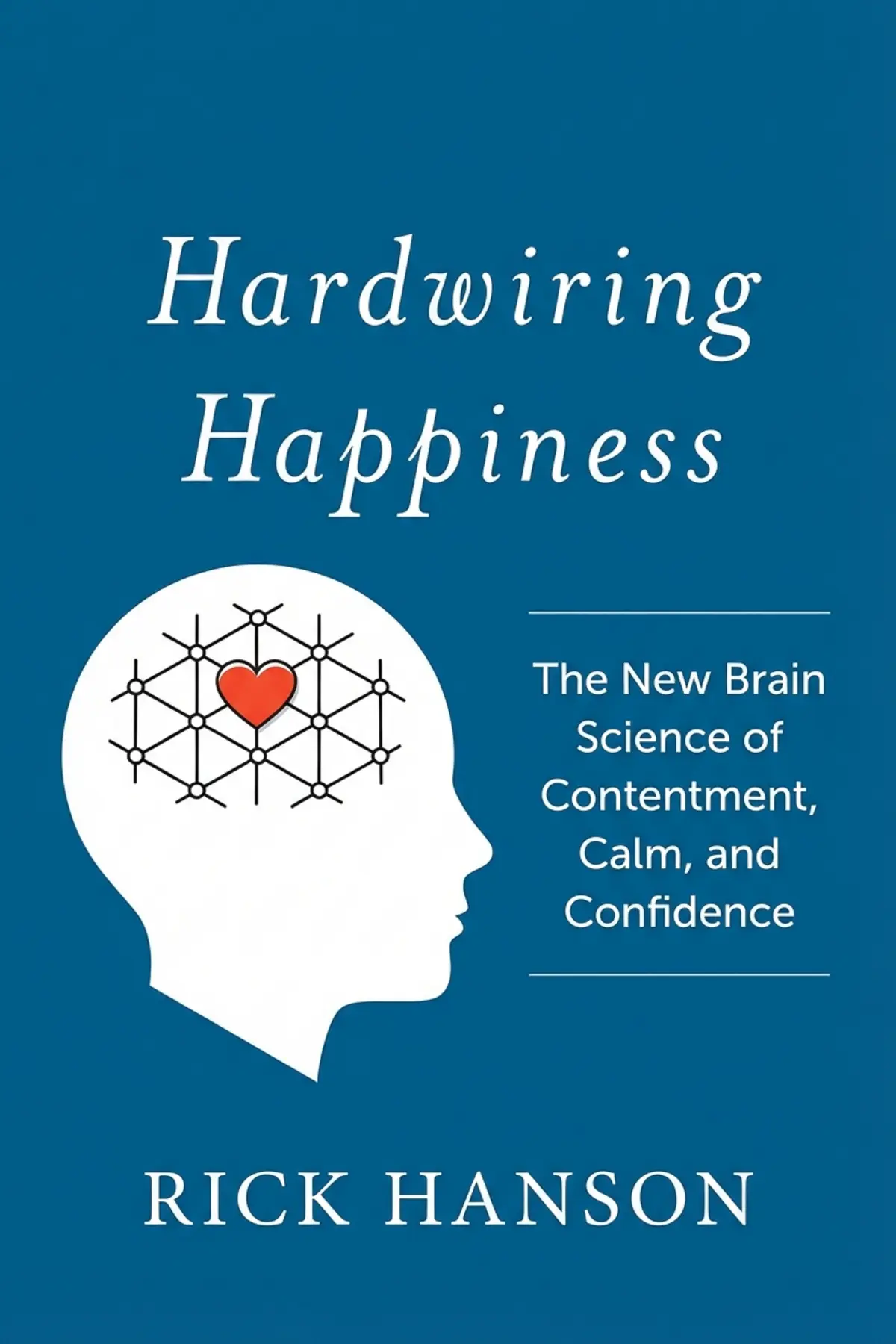
Table of Content
1. Introduction
1 min 01 sec
Most people can recall a single criticism for years, while a dozen compliments fade by the weekend. In Hardwiring Happiness, psychologist Rick Hanson explains why: the human brain still behaves as if a predator is close by, so it grabs bad news and lets good news slide past. That tilt toward the negative is real, but Hanson argues it is not fixed. The brain changes with every experience, so the way you handle ordinary good moments can slowly rebuild it.
His case comes down to one claim. A brain shaped by ancient danger can be retrained for contentment and calm if you deliberately notice good experiences, hold them for longer and create new ones. Along the way come London taxi drivers with enlarged memory centers, a box that fills up with good days, two playful corgis and a brain study of generous people. Most of the practices take seconds, and you can start them today.
2. Stop one criticism from drowning out praise
1 min 42 sec
A review packed with compliments can still ruin your evening because of one small remark. The reason lies in how your brain is built, and most people carry the gloomier version.
3. Calm a brain built for prehistoric danger
1 min 44 sec
Being picked last for a playground game can feel like a matter of life and death. That overreaction made sense once, and it still shapes how you respond to deadlines, traffic and the evening news.
4. Reshape your brain through what you repeat
1 min 47 sec
A group of London drivers turned out to have an unusual bulge inside their heads, and it was not a tumor. What caused it suggests your daily habits of attention are building something too.
5. Spot small wins before they slip away
1 min 33 sec
Pleasant moments happen every day, yet most of them leave no mark at all. A paper slip, a cardboard box and a pause after sending an email can change which moments your brain keeps.
6. Make good moments last long enough to stick
1 min 38 sec
Remembering a bowl of ice cream sounds like a strange mental health exercise. Hanson explains why lingering on pleasure is the move that slowly turns a negativity bias around, and how a figure skater shows it.
7. Let new joys soften old wounds
1 min 35 sec
A frightening childhood memory, a grieving pet owner and a cancer diagnosis all appear in Hanson’s book. Each shows a way that fresh good experiences can change how old pain feels.
8. Create fresh good experiences and share them
1 min 39 sec
Happiness can seem like something that happens to you or doesn’t. Hanson sees it as something you can produce on demand, through novelty, courage and generosity, and multiply by giving it away.
9. Conclusion
59 sec
Hanson’s picture of the mind is an old survival system still on duty. It was built for a world where one person in eight died violently, and it keeps scanning a world of deadlines and news alerts for tigers. Left alone, it records every criticism and lets every kindness drain away. His hopeful claim is that the brain that learned fear can learn contentment too, one repeated experience at a time, the way memorizing streets built up the taxi drivers’ hippocampus.
The practice asks very little. When a task is done or someone says something kind, stop long enough to feel it. Hold the good moment longer than feels natural, the way the grieving cat owner gave each memory half a minute. Drop one slip of paper a day into a box. When an old fear or hurt surfaces, place a fresh good memory beside it. And tell someone about the good things, so you get to feel them twice.
Bad things will still happen. Hanson’s practices just make sure they are not the only things that stay.
About this book
What is this book about?
Most people remember a single harsh remark for years and forget a dozen compliments by the weekend. Psychologist Rick Hanson explains why. The human brain was shaped in a world where violent death was common, so it still scans for threats, reacts to deadlines as if they were predators and keeps bad news longer than good news. He calls this the negativity bias. Hanson's hopeful point is that the brain is never finished. It changes with experience, as a study of London taxi drivers with enlarged memory centers shows. So the way you treat ordinary good moments can slowly reshape it. The book turns that idea into small practices: pausing when a task is done, keeping a box of good days, holding a pleasant memory long enough for it to sink in, pairing new joys with old hurts, and creating fresh experiences through novelty, generosity and sharing. Readers learn why their mood leans gloomy and get simple ways to tilt it back, a few seconds at a time.
Book Information
Who it's for
Professionals who replay criticism
Anxious professionals who replay one criticism and forget all the praise.
Worn down by stress
People worn down by stress, bad news and constant worry who want short daily practices for calm.
Carrying hurt or grief
Anyone carrying old hurts or grief who wants a gentle, practical way to soften them.
About the Author
Rick Hanson
Rick Hanson, Ph.D., is a psychologist and a Senior Fellow of the Greater Good Science Center at the University of California, Berkeley. His seven books, including Buddha's Brain and Neurodharma, have appeared in 33 languages and sold over a million copies in English. He has meditated since 1974, teaches at meditation centers worldwide, founded the Wellspring Institute for Neuroscience and Contemplative Wisdom and the Global Compassion Coalition, co-hosts the Being Well podcast, and has lectured at NASA, Google, Oxford and Harvard.
Ratings & Reviews
Ratings at a glance

What people think
Listeners find the material thoroughly researched and simple to follow, offering practical, actionable advice that yields real results. They value the optimistic outlook on retraining the brain for joy, and one listener remarks that it provides an excellent overview of the neuroscience field. Listeners describe the work as captivating, with one noting the inclusion of narratives to maintain interest, while another observes that it is written for ordinary individuals facing everyday challenges.
Top reviews
Liam
The 'Velcro and Teflon' analogy really stuck with me. For anyone who feels like they are constantly drowning in negative thoughts, this provides a biological explanation rather than a moral judgment. Rick Hanson explains how our Stone Age brains are naturally wired for survival, which unfortunately means we fixate on the bad. By using the HEAL method, I’ve started actually "absorbing" the small moments of joy instead of letting them slide away. It’s a bit repetitive in the middle chapters, but frankly, that repetition might be necessary to hammer the point home for a skeptical mind.
Show moreRania
Finally, a book that explains the 'why' behind our constant worrying without making it feel like a personal failing or a lack of willpower. Hanson’s writing is compassionate and deeply informed by his background as a neuropsychologist. The distinction between the responsive and reactive modes of the brain was a lightbulb moment for me. I’ve started practicing the ten-second "soaking in" technique during my morning coffee, and it actually makes a difference in my stress levels. It’s a must-read for anyone who feels like their brain is permanently stuck in "fight or flight" mode.
Show moreKomsan
This isn't just another 'think positive' book; it's a manual for retraining your evolutionary response to threats in a modern world. Rick Hanson manages to weave together Buddhist practices and modern brain science in a way that feels both spiritual and logical. I especially appreciated the focus on how to "Let In" positive experiences, an area that many mindfulness practices actually overlook. Even though it can feel a bit repetitive, I think that’s intentional to help the reader actually "hardwire" the lessons. It’s changed how I view my own anxiety and given me a path forward.
Show moreLuckana
As someone who has struggled with a 'grumpy amygdala' for years, I found the HEAL process quite practical and grounded. Unlike many self-help gurus who preach "law of attraction" nonsense, Hanson uses neuroscience to show why we need to consciously tilt toward the positive. I appreciated the specific exercises for letting go of past traumas and building inner strength. My only minor gripe is that the tone can get a bit clinical at times, which made it hard to stay engaged during long reading sessions. Still, the core message about "taking in the good" is incredibly valuable.
Show moreSienna
Picked this up on a whim from the library and was pleasantly surprised by the lack of 'toxic positivity' usually found in this genre. The author doesn't suggest that we ignore the bad things in life; instead, he teaches us how to build up our internal resources so we can handle them better. I particularly liked the section on "Let Be, Let Go, Let In," which bridges the gap between traditional mindfulness and active change strategies like CBT. It’s written for real people with real problems, though the narration in the audiobook version can be a bit dry.
Show moreTak
After hearing so much about neuroplasticity, I was looking for concrete steps rather than just vague theories, and this book delivered exactly that. The HEAL method is a tangible way to transform fleeting positive experiences into lasting neural structures. I found the sections on "growing" inner strengths like compassion and grit to be the most helpful. The author does over-simplify some of the neuroscience to make it accessible, which might bother actual scientists, but for a layperson, it’s perfect. It’s definitely more of a manual for mental health than a casual beach read.
Show moreSven
Is happiness really something you can just 'hardwire' into your brain through sheer repetition? Rick Hanson certainly thinks so, and he provides plenty of data to support his claims. The concept of the "negativity bias" is eye-opening and helps explain why we remember one insult but forget ten compliments. However, the four-step technique he proposes—HEAL—is so simple that it didn’t need several hundred pages of explanation. I found myself skimming through the latter half because the examples started to feel redundant. It’s a good book with a great core idea that just lacks brevity.
Show moreConnor
While I appreciate the solid research backing Hanson's claims, the writing style itself is incredibly dry and repetitive to the point of annoyance. The first fifty pages are brilliant, laying out the evolutionary reasons why our brains are like "Velcro for bad experiences." After that, the book descends into endless lists of adjectives and slightly cheesy scenarios that didn't always resonate with me. To be fair, the practical steps are easy to implement in a busy life. I just wish the editor had cut about sixty pages of fluff to keep the momentum going.
Show moreCaleb
I really wanted to love this after hearing Rick Hanson on a podcast, but it felt like a chore to finish. The science in the first few chapters is genuinely fascinating, especially the parts about neuroplasticity and the evolution of the mind. However, the rest of the book is essentially the same few tips repeated over and over again with different adjectives. It feels like a very solid magazine article that was stretched thin to meet a publisher's word count. If you’re looking for a quick fix, just read the synopsis online and save your time.
Show moreRatthapong
Look, the truth is that this whole book could have been a three-page PDF or a short YouTube video. I appreciated the initial explanation of the "Stone Age Brain," but I found myself zoning out for minutes at a time as the author listed off categories of adjectives. It felt like he was trying to wallpaper over my actual problems with forced optimism. If you are in a genuine crisis, I don’t think following a four-step clinical checklist is going to be the miracle cure this book promises. It’s okay as an introductory text, but it’s far too bloated.
Show moreQuestions about this book
What is the main idea of Hardwiring Happiness?
Rick Hanson argues that the brain evolved in a dangerous world, so it pays far more attention to bad experiences than good ones, a tendency called the negativity bias. Because the brain changes with experience, though, people can retrain it. By deliberately noticing good moments, savoring them for longer and creating new ones, Hanson says, we can shift the brain toward contentment and calm.
Why does the brain focus on negative things, according to Rick Hanson?
Hanson traces it to human history. Ten thousand years ago, roughly one person in eight died violently, so paying close attention to threats kept people alive. Today a deadline triggers the same neural connections as an armed robber, and bad news sets off fight-or-flight, releasing adrenaline and cortisol. The result is a mind that treats everyday stress as danger.
Can you really rewire your brain for happiness?
Hanson believes so, pointing to how the brain changes with use. Neuroscientist Eleanor Maguire’s 2000 study found London taxi drivers had an enlarged hippocampus from memorizing the city’s streets. In the same way, Hanson argues, repeatedly practicing positive experiences, such as exercises imagining a loving family, can gradually strengthen the brain’s capacity for happiness.
What practical exercises does Hardwiring Happiness suggest?
Hanson suggests pausing to feel good after finishing even a small task, starting the morning with fresh air or a moment of gratitude, and keeping a Good Year box with one positive note added each evening. He also recommends recalling a favorite food and stretching out the pleasure, holding good memories for around 30 seconds, and sharing happy experiences with friends.
Can positive experiences help with trauma or grief?
Hanson says new good experiences can soften old pain. He linked a happy memory of playing with two corgis to a frightening childhood memory of being locked out by his grandmother, until thinking of her brought up the dogs instead. He also describes a woman who eased her grief over her cat by savoring good memories of it for at least 30 seconds each.

Readers also enjoyed






A Guide to the Good Life: The Ancient Art of Stoic Joy
William B. Irvine




A High-Performing Mind: Strengthen Your Mind and Live Your Best Life
Andrew D. Thompson
AUDIO SUMMARY AVAILABLE
Listen to Hardwiring Happiness in 15 minutes
Get the key ideas from Hardwiring Happiness by Rick Hanson, plus 5,000+ more nonfiction titles.
- 5,000+ titles
- Listen as much as you want
- 7-day free trial
- Cancel anytime









